Map of Netherlands showing where the Heyne arms are recorded
The Heyne arms were recorded in Netherlands, c. 1815.
Arms such as these were typically recorded in Friesland.
Friesland was low, wet country on the northern coast of the Netherlands, farmed by families who had held the same land for centuries. Free landholders were unusually common there, and a free landholder could carry arms.
This is where the arms were entered in the register. Families often moved to other parts of the country, so the same name can turn up in more than one region.
Region
Friesland
First recorded
1815
Granting Authority for the Heyne Arms
Hoge Raad van Adel
Photograph made by me · CC BY-SA 3.0
The body that granted and recorded arms in Netherlands in this period.
William I of the Netherlands
Sovereign of the period
William I of the Netherlands
1815–1840
Reigning in Netherlands when the Heyne arms are first recorded.
How Arms Worked in Netherlands
In the Netherlands, coats of arms were often used by noble families and those who held specific public offices. These arms were passed down through the generations to legitimate descendants. Younger branches of a family usually kept the original design without needing to add special marks. This system ensured that the family identity remained clear and consistent over many years.
Granting authority
The Hoge Raad van Adel is the official body that regulates and manages noble titles and coats of arms in the Netherlands.
How they got arms
Families typically obtained their coats of arms through official royal grants or by proving their long-standing historical use of the symbols.
Where arms were recorded
Coats of arms are officially recorded in the registers held by the Hoge Raad van Adel, which began its work in 1814.
The family's standing
Recorded among the armigerous families of Netherlands.
Origin & History of the Heyne Family in Netherlands
The family name Heyne has deep roots in the northern regions of the Netherlands, particularly within the province of Friesland. By the early nineteenth century, records confirm that members of the family were well-established in this coastal area, living through a period of significant political transition as the Netherlands emerged as a unified kingdom. The name itself is likely a patronymic variation, derived from the Germanic name Heinrich, which was shortened and adapted over generations to reflect the local Frisian dialect. During the early 1800s, families in Friesland often lived in close-knit agricultural communities where they maintained strong ties to the land and local trade. As the Dutch government began to standardize civil registration in 1811, families like the Heynes were formally documented in official ledger books, which helped solidify the spelling of the name as it appears today. These early records provide a window into a time when the family was actively participating in the social and economic life of the Frisian countryside.
Coat of Arms & Family Crest Details
Symbols on this shield
applePeace, plenty and long-standing settlement
lionCourage, strength and royalty
Colours
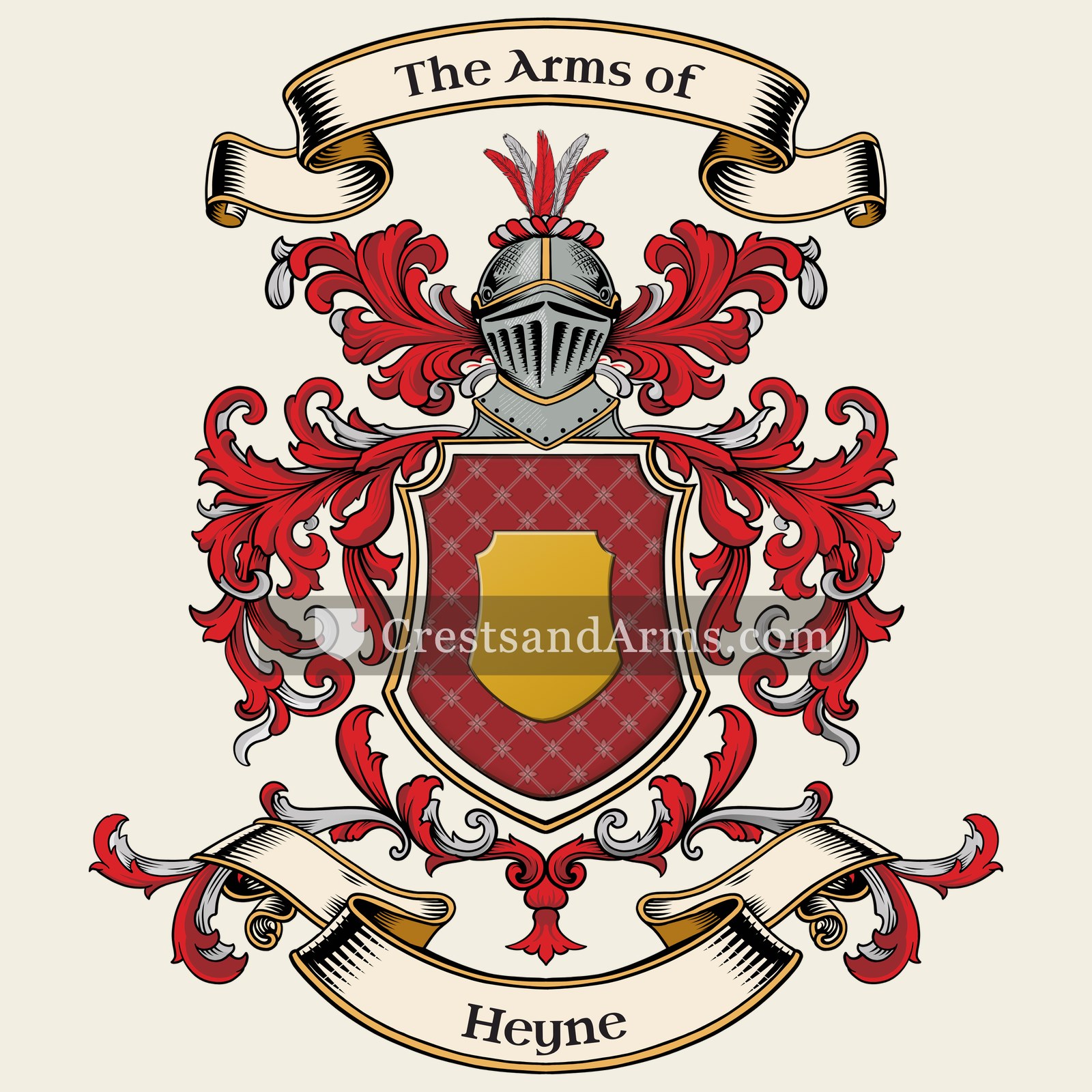
Silver (Argent)Means: Peace and sincerity
Red (Gules)Means: Military strength
Gold (Or)Means: Generosity
Historical info
Source
J. B. Rietstap, Armorial Général, Gouda: G. B. van Goor Zonen, 1884–87
Blazon (the actual original written record)
“Coupé: au 1 d'arg. à trois grenades allumées mal-ordonnées au nat.; au 2 de gu. au lion d'or. L'écu bordé d'or. Cq. cour. C.: une queue de paon au nat., entre un vol de l'aigle de Prusse. L.: à dextre d'arg. et de sa., à sen. d'or et de gu.”
Germanyc. 1746
Digital archive packCoat of arms PNG, gold border print PDF, vector SVG and the certificate of authenticity. Sent to your email in minutes.
Map of Germany showing where the Heyne arms are recorded
The Heyne arms were recorded in Germany, c. 1746.
Arms such as these were typically recorded in Bavaria.
Bavaria was a country of old landed families and walled market towns. Estates passed down the same line for centuries, and both the landowners and the leading townsmen kept arms, which is why so many Bavarian names sit in the registers.
This is where the arms were entered in the register. Families often moved to other parts of the country, so the same name can turn up in more than one region.
The body that granted and recorded arms in Germany in this period.
Francis I, Holy Roman Emperor
Sovereign of the period
Francis I, Holy Roman Emperor
1745–1765
Reigning in Netherlands when the Heyne arms are first recorded.
How Arms Worked in Germany
In the Holy Roman Empire, coats of arms were often granted to individuals by the Emperor or his representatives. These arms were then passed down through the generations to all legitimate descendants of the original holder. Younger branches of a family usually kept the same shield design without needing to change it, as the arms belonged to the entire lineage.
Granting authority
The Holy Roman Emperor held the sole power to grant new coats of arms throughout his vast imperial territories.
How they got arms
Families typically obtained their coats of arms through a formal imperial grant or by proving their noble status to the authorities.
Where arms were recorded
These grants were officially recorded in the Imperial Chancery registers, which began keeping formal records of such honors during the Middle Ages.
The family's standing
Recorded among the armigerous families of Germany.
Origin & History of the Heyne Family in Germany
The surname Heyne is a variation of the name Heinrich, which was a popular choice in German-speaking regions during the Middle Ages. The name evolved as a shortened, affectionate form of the original, eventually becoming a distinct family name as people began to adopt hereditary surnames to distinguish themselves in growing communities. By the mid-eighteenth century, historical records confirm that families bearing the name Heyne were well-established in the region of Bavaria. During this period, Bavaria was a collection of territories undergoing significant social and religious changes, and families like the Heynes were often involved in local agriculture, trade, or craft guilds. Their presence in 1746 suggests that the family was part of the stable, working population that helped define the cultural and economic landscape of southern Germany before the industrial era transformed the country.
Coat of Arms & Family Crest Details
Symbols on this shield
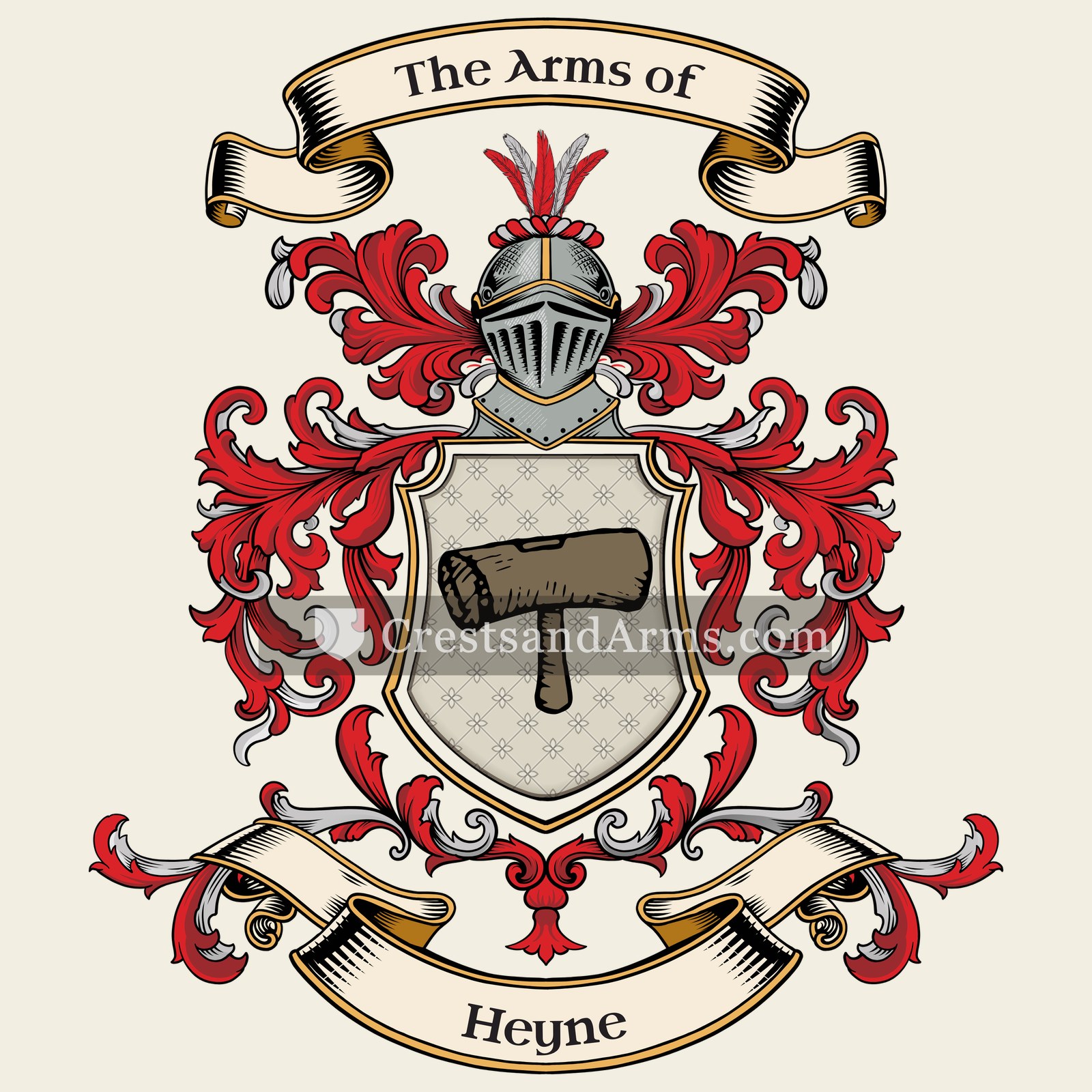
hammerHonest labour, and the smith's craft
Colours
Silver (Argent)Means: Peace and sincerity
Historical info
Source
J. B. Rietstap, Armorial Général, Gouda: G. B. van Goor Zonen, 1884–87
Blazon (the actual original written record)
“D'arg. à un marteau au nat., emm. d'or en pal. C.: le marteau. L. d'or et d'azur.”
SwitzerlandBâle, c. 1745
Digital archive packCoat of arms PNG, gold border print PDF, vector SVG and the certificate of authenticity. Sent to your email in minutes.
Map of Switzerland showing where the Heyne arms are recorded
The Heyne arms were recorded in Bâle, c. 1745.
This is where the arms were entered in the register. Families often moved to other parts of the country, so the same name can turn up in more than one region.
The body that granted and recorded arms in Switzerland in this period.
How Arms Worked in Switzerland
In Switzerland, coats of arms were not restricted to the nobility and were often adopted by common citizens and families. These symbols were passed down through generations to show family identity. When branches of a family grew, they often changed small details of the design to distinguish their own line from the original group.
Granting authority
Cantonal and civic authorities managed the use of coats of arms within their specific regions and local jurisdictions.
How they got arms
Families typically assumed their own coats of arms based on local custom rather than receiving them from a central monarch.
Where arms were recorded
Arms were recorded in various cantonal and civic registers starting from the fourteenth century throughout the Swiss region.
The family's standing
Recorded among the armigerous families of Switzerland.
Origin & History of the Heyne Family in Switzerland
The surname Heyne carries a rich history tied to the German-speaking regions of Europe, with its presence in the Swiss city of Basel documented as early as 1745. The name is generally understood to be a diminutive form of the name Heinrich, which was a very popular choice in the Middle Ages. Families bearing this name often settled in urban centers where trade and craftsmanship flourished. By the mid-18th century, individuals named Heyne in Basel were integrated into the local social fabric, likely participating in the city's vibrant guild system or its growing mercantile economy. Because Basel served as a major crossroads for travelers and merchants moving between Switzerland, France, and Germany, the Heyne family was positioned in a place where cultural and linguistic traditions frequently blended. This location allowed them to contribute to the unique development of the region while maintaining a name that reflects a long-standing heritage of Germanic naming customs.
Related Branches & Arms
Root word
Hagano
Derived from the Germanic word for hedge or enclosure.
This name
HeyneA diminutive form of names beginning with the element hag, signifying one who lives near a hedge.
also spelled
Heine
Haine
Hine
Related arms
Heinevariant spelling
Documented Sources
J. B. Rietstap, Armorial Général, Gouda: G. B. van Goor Zonen, 1884–87
Tresoar (Frisian Historical and Literary Center), Burgerlijke Stand Friesland (Civil Registry of Friesland), 1811–1950
Van der Meer, G., Friese familienamen: Een onderzoek naar de oorsprong en verspreiding van achternamen in Friesland (2005)
Nationaal Archief (National Archives of the Netherlands), Registers van de Burgerlijke Stand, 1811–1842
Digital archive packCoat of arms PNG, gold border print PDF, vector SVG and the certificate of authenticity. Sent to your email in minutes.




 applePeace, plenty and long-standing settlement
 lionCourage, strength and royalty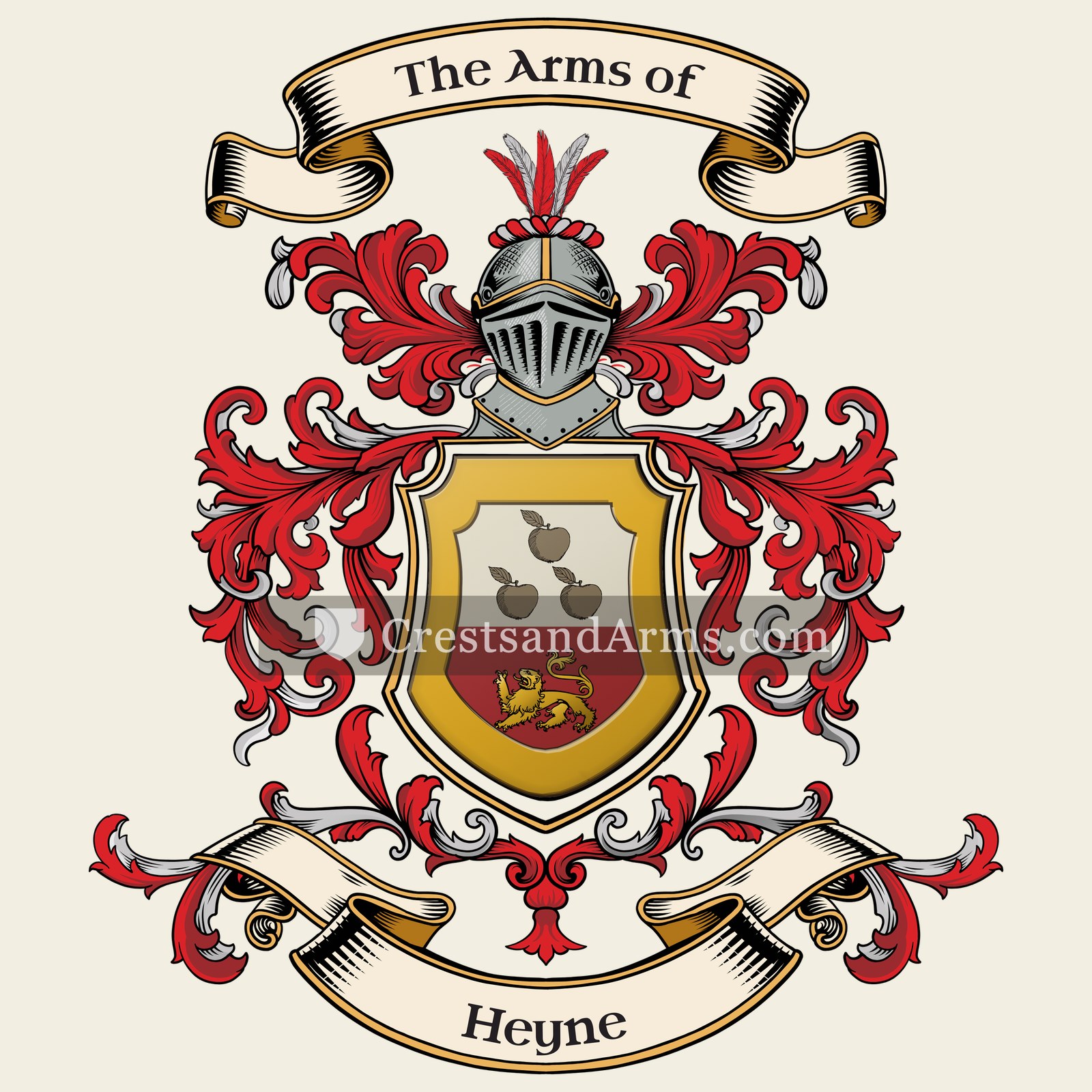


 hammerHonest labour, and the smith's craft