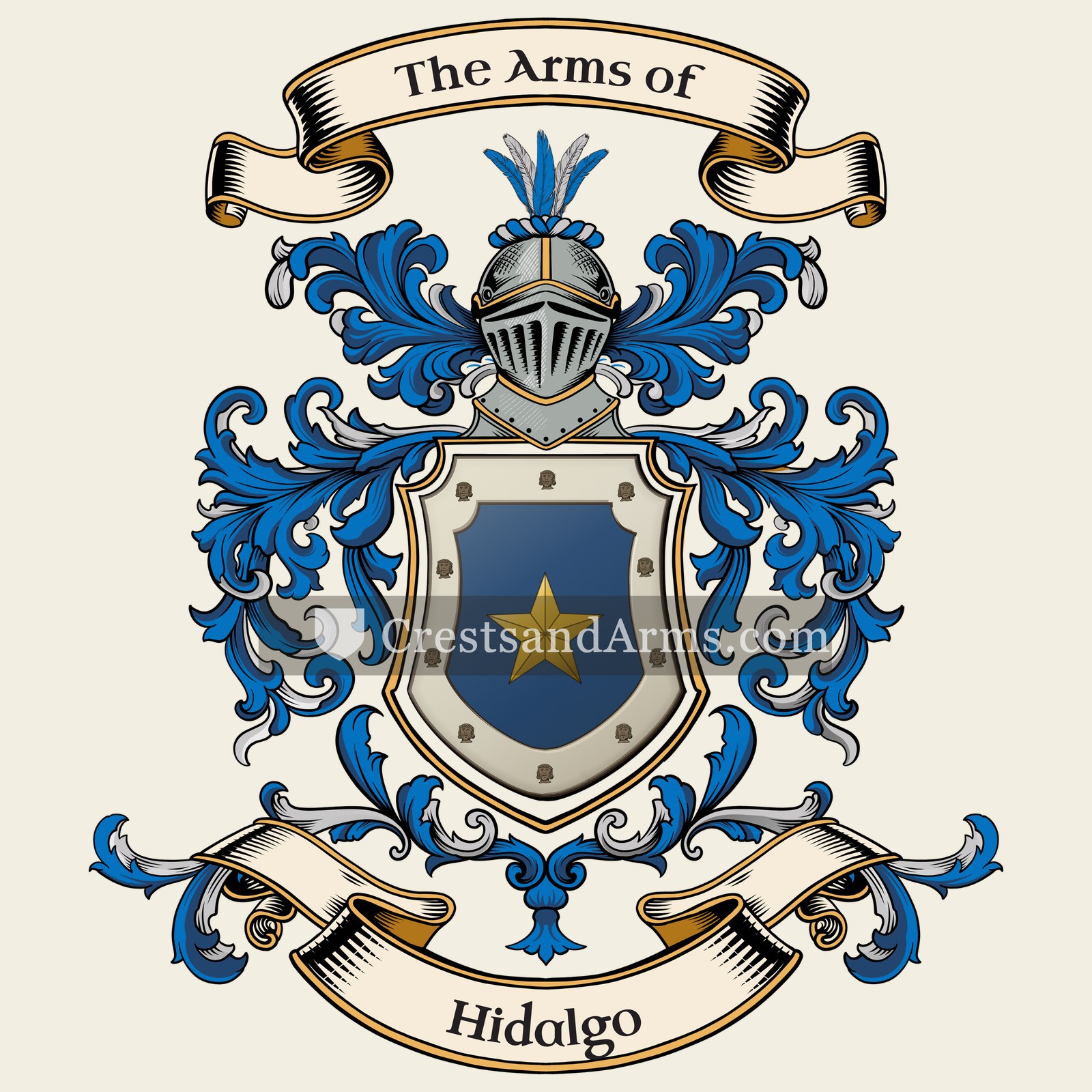
A record of documented arms, meaning and origin, researched for the Hidalgo family of Spain.
Reg. 0437 · Spanish, G–I
Coat of Arms & Family Crest Details
Symbols on this shield
mulletThe third son, and a divine quality from above
saracens head affronty coupedA crusade fought, and an enemy met in the field
Colours
Blue (Azure)Means: Loyalty and truth
Silver (Argent)Means: Peace and sincerity
Gold (Or)Means: Generosity
Historical info
Source
J. B. Rietstap, Armorial Général, Gouda: G. B. van Goor Zonen, 1884–87
Blazon (the actual original written record)
“D'azur à une étoile (8) d'or; à la bord. d'arg., ch. de dix têtes de Sarasin de carn., posées de profil, coiffées de turbans de gu., retr. d'arg., les têtes posées 3 en chef, 2 à chaque flanc, l'une sur l'autre, et 3 en p.”
SpainAsturies, c. 1722
Digital archive packCoat of arms PNG, gold border print PDF, vector SVG and the certificate of authenticity. Sent to your email in minutes.
Map of Spain showing where the Hidalgo arms are recorded
The Hidalgo arms were recorded in Asturies, c. 1722.
This is where the arms were entered in the register. Families often moved to other parts of the country, so the same name can turn up in more than one region.
The body that granted and recorded arms in Spain in this period.
Philip V of Spain
Sovereign of the period
Philip V of Spain
1714–1724
Reigning in Spain when the Hidalgo arms are first recorded.
How Arms Worked in Spain
In Spain, a coat of arms was considered a form of property that belonged to the entire family line. These arms were passed down from a father to all his children equally. Younger branches of the family usually kept the original design without needing to add any special marks to distinguish their specific line.
Granting authority
The Cronista Rey de Armas was the official body that regulated and granted coats of arms throughout Spain.
How they got arms
Families often obtained their arms through royal grants or by proving their noble status to the official heraldic authority.
Where arms were recorded
Coats of arms were officially recorded in the registers of the Cronista Rey de Armas starting in 1496.
The family's standing
Recorded among the armigerous families of Spain.
Origin & History of the Hidalgo Family in Spain
The surname Hidalgo originated in medieval Spain as a social title rather than a traditional family name. The word comes from the phrase "hijo de algo," which translates literally to "son of something." In the context of the Middle Ages, this meant a person was the son of someone of importance, typically a member of the lower nobility. These individuals were often exempt from paying certain taxes and held a respected status in society. By the time your ancestors were documented in Asturias in 1722, the term had evolved from a simple description of social rank into a formal hereditary surname passed down through generations. Families living in the northern regions like Asturias were often deeply connected to the land and the local administrative systems of the Spanish Crown. Over time, the name became a permanent identifier for families who traced their roots back to these early noble lineages.
Related Branches & Arms
Root word
filius
Latin term meaning son or offspring.
This name
HidalgoRefers to a nobleman or a member of the lower nobility.
also spelled
Hidalgos
Hidalgue
Hidal
Documented Sources
J. B. Rietstap, Armorial Général, Gouda: G. B. van Goor Zonen, 1884–87
Douglass, William A., Basque Cultural Studies, 1999
Gerli, E. Michael, Medieval Iberia: An Encyclopedia, 2003
Archivo Histórico de Asturias, Registro de Padrones y Censos, 1722
Digital archive packCoat of arms PNG, gold border print PDF, vector SVG and the certificate of authenticity. Sent to your email in minutes.


 mulletThe third son, and a divine quality from above
 saracens head affronty coupedA crusade fought, and an enemy met in the field
 mulletThe third son, and a divine quality from above
 saracens head affronty coupedA crusade fought, and an enemy met in the field