Map of England showing where the Higgins arms are recorded
The Higgins arms were recorded in Hereford, c. 1620.
Herefordshire lay on the Welsh border, where land was held in return for military service. Families there were expected to arm and to fight, and a fighting household needed a shield it could be known by.
This is where the arms were entered in the register. Families often moved to other parts of the country, so the same name can turn up in more than one region.
The body that granted and recorded arms in England in this period.
James VI and I
Sovereign of the period
James VI and I
1603–1625
Reigning in England when the Higgins arms are first recorded.
How Arms Worked in England
English heraldry allowed arms to be shared by all legitimate descendants of the original owner. These symbols were treated as personal property that moved through the generations to all children. While the eldest son kept the original design, other family members could use the same shield without needing to change it or register their own unique versions.
Granting authority
The College of Arms in London has regulated the use of coats of arms throughout England and Wales since 1484.
How they got arms
Families typically obtained their coats of arms through a formal grant from the Crown or by proving their ancient right to them.
Where arms were recorded
All official coats of arms are recorded in the registers kept at the College of Arms, which date back to the fifteenth century.
The family's standing
Recorded among the armigerous families of Hereford.
Origin & History of the Higgins Family in England
The surname Higgins is a patronymic name, which means it originated as a way to identify a person as the son of someone named Hick. Hick was a common medieval nickname for Richard, a name that became incredibly popular in England after the Norman Conquest. By the time the family was firmly established in the county of Hereford in 1620, the name had already been in use for several centuries across various parts of the country. Families with this name were often found in rural areas where they worked as farmers or tradespeople. Because the name was linked to a popular nickname rather than a specific location, it emerged independently in different regions of England. The presence of the Higgins family in Hereford during the early seventeenth century suggests they were part of a long-standing local community that had likely lived in the West Midlands for generations.
Coat of Arms & Family Crest Details
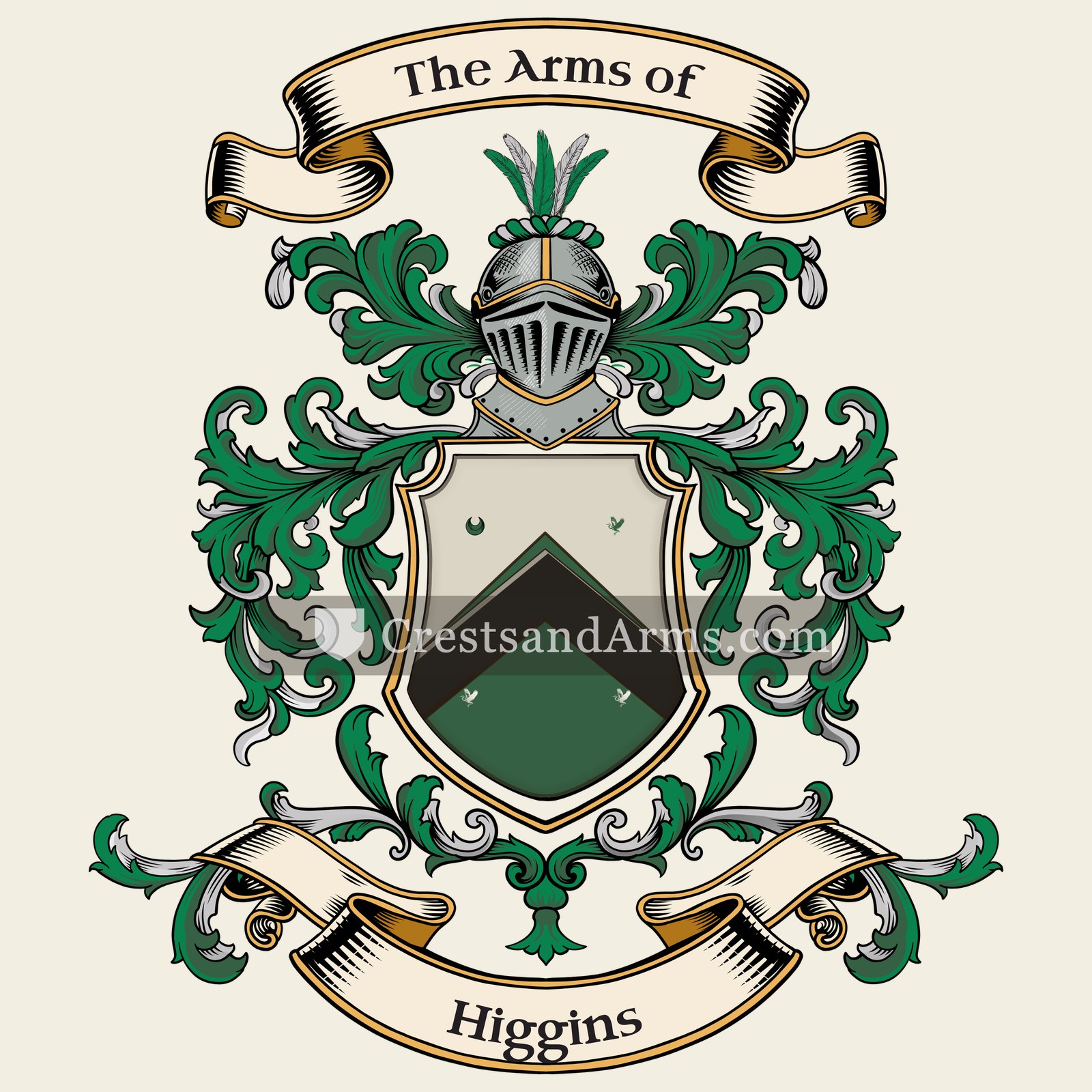
Symbols on this shield
chevronProtection, and faithful service completed
crescentHonour by the sovereign, and the second son
heronPatience and quiet watchfulness
Colours
Silver (Argent)Means: Peace and sincerity
Green (Vert)Means: Hope
Historical info
Source
Sir Bernard Burke, The General Armory of England, Scotland, Ireland and Wales, London: Harrison & Sons, 1884
Blazon (the actual original written record)
“Per chev. ar. and vert, a crescent betw. three cranes' heads erased counterchanged”
WaterfordGlenary · Waterford, c. 1645
Digital archive packCoat of arms PNG, gold border print PDF, vector SVG and the certificate of authenticity. Sent to your email in minutes.
Map of Ireland showing where the Higgins arms are recorded
The Higgins arms were recorded in Waterford, c. 1645.
Waterford was a port with good farming country behind it, settled early by Norman families. Merchants and landowners both prospered, and both sorts of family took arms.
This is where the arms were entered in the register. Families often moved to other parts of the country, so the same name can turn up in more than one region.
The body that granted and recorded arms in Ireland in this period.
Charles I of England
Sovereign of the period
Charles I of England
1625–1649
Reigning in England when the Higgins arms are first recorded.
How Arms Worked in Ireland
The Ulster King of Arms granted coats of arms to individuals who proved their social standing and good character. These symbols were typically inherited by all legitimate descendants of the original holder. If a family branch wanted a unique look, they could apply for a specific change to their design through the office to ensure their identity remained distinct.
Granting authority
The Ulster King of Arms acted as the official body that regulated and issued all coats of arms throughout Ireland.
How they got arms
Families obtained their arms through formal grants issued by the office after proving their eligibility and paying the required fees.
Where arms were recorded
All official grants were recorded in the registers held by the Ulster King of Arms starting from the year 1552.
The family's standing
Recorded among the armigerous families of Waterford.
Origin & History of the Higgins Family in Ireland
The name Higgins is an anglicized version of the Gaelic surname Ó hUiginn, which translates to a descendant of Uiginn, a name derived from the Old Norse word for a Viking. This connection suggests that the family’s roots trace back to the period of Norse settlement in Ireland. By the time the family was firmly established in Waterford in 1645, they were part of a long tradition of Gaelic families who had integrated into the social and political landscape of the region. During the seventeenth century, the Higgins family lived through a time of intense upheaval, including the Cromwellian conquest and the subsequent redistribution of land. Despite these pressures, the family maintained a presence in the area, reflecting the resilience of many Irish lineages that navigated the transition from the traditional Gaelic order to the changing administrative structures of the period.
Higgins Meaning & Related Branches
Root word
Hick
A medieval diminutive form of the personal name Richard.
This name
HigginsA patronymic surname meaning son of little Richard.
also spelled
Higgens
Higgons
Hyggins
Related arms
Fifieldsimilar arms
Higgensvariant spelling
Hygginsvariant spelling
O'Higginvariant spelling
Documented Sources
Sir Bernard Burke, The General Armory of England, Scotland, Ireland and Wales, London: Harrison & Sons, 1884
Reaney, P.H., A Dictionary of English Surnames, 1958
Bardsley, Charles Wareing, A Dictionary of English and Welsh Surnames, 1901
Herefordshire Archives, Parish Registers of the Diocese of Hereford, 1620
Digital archive packCoat of arms PNG, gold border print PDF, vector SVG and the certificate of authenticity. Sent to your email in minutes.


 heronPatience and quiet watchfulness
 heronPatience and quiet watchfulness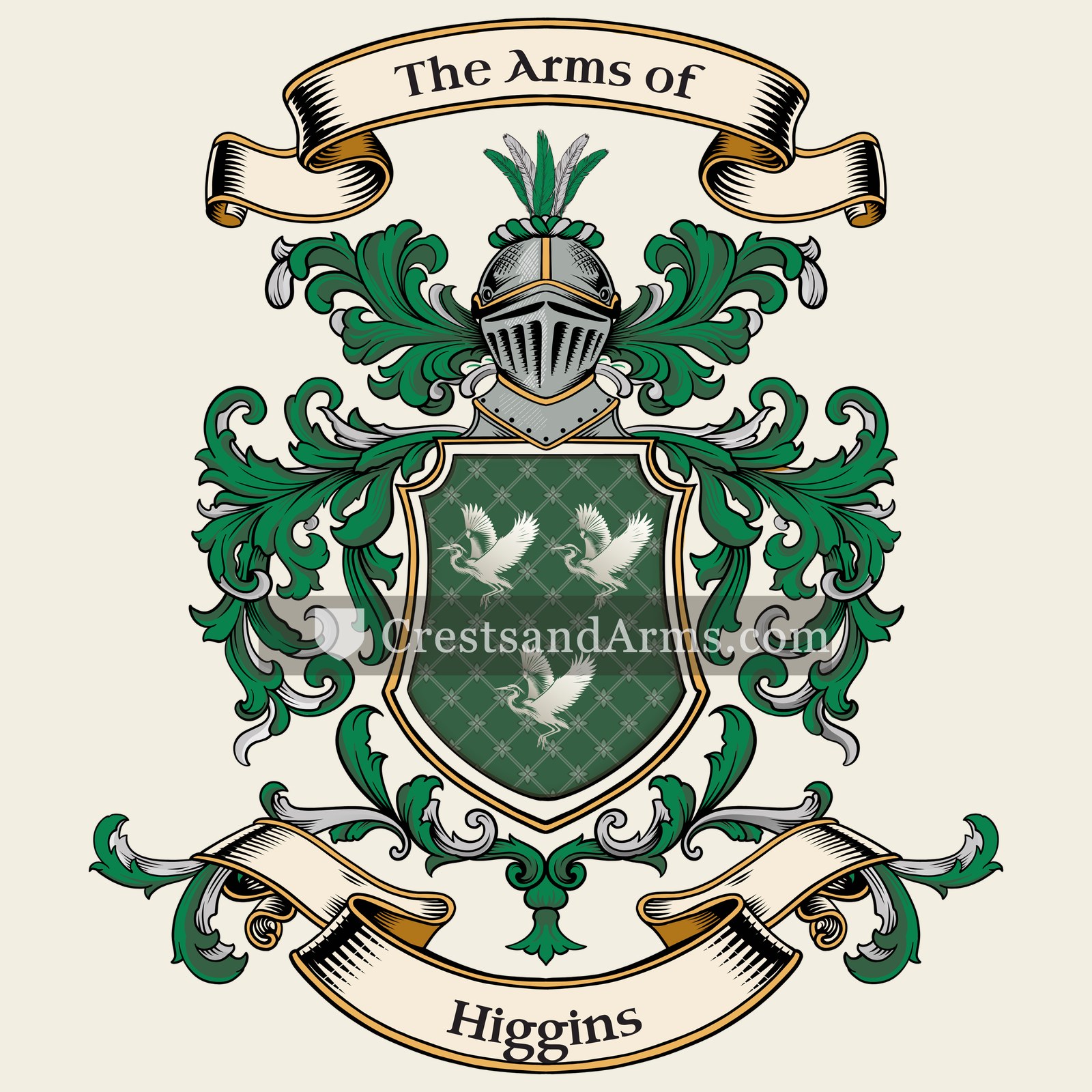


 chevronProtection, and faithful service completed
 crescentHonour by the sovereign, and the second son