Map of England showing where the Higgs arms are recorded
The Higgs arms were recorded in Gloucester, c. 1620.
Gloucestershire had good farmland, a cloth trade in its valleys and a river carrying goods to Bristol. All three made money, and money bought the estates that brought arms with them.
This is where the arms were entered in the register. Families often moved to other parts of the country, so the same name can turn up in more than one region.
The body that granted and recorded arms in England in this period.
James VI and I
Sovereign of the period
James VI and I
1603–1625
Reigning in England when the Higgs arms are first recorded.
How Arms Worked in England
English heraldry allowed arms to be shared by all legitimate descendants of the original owner. These symbols were treated as personal property that moved through the generations to all children. While the eldest son kept the original design, other family members could use the same shield without needing to change it or register their own unique versions.
Granting authority
The College of Arms in London has regulated the use of coats of arms throughout England and Wales since 1484.
How they got arms
Families typically obtained their coats of arms through a formal grant from the Crown or by proving their ancient right to them.
Where arms were recorded
All official coats of arms are recorded in the registers kept at the College of Arms, which date back to the fifteenth century.
The family's standing
Recorded among the armigerous families of Gloucester.
Origin & History of the Higgs Family in England
The surname Higgs is a patronymic name, which means it originated as a way to identify a person as the son of someone named Hick. Hick was a common medieval nickname for Richard, a name that became very popular in England after the Norman Conquest. By the time the family was firmly established in the county of Gloucestershire in the early 1600s, the name had evolved into its current spelling. Families with this name were often involved in local trade and agriculture, helping to build the rural communities of the West Country. Because the name was tied to a common nickname, it appeared in various forms in parish registers and tax records as the family spread across the region. These early ancestors were part of the hardworking population that defined the social fabric of Gloucestershire long before many of them eventually sought new opportunities across the Atlantic.
Higgs Meaning & Related Branches
Root word
Hick
A medieval diminutive form of the Germanic name Richard.
This name
HiggsA patronymic surname meaning son of Richard or son of Hick.
also spelled
Hygge
Higgis
Related arms
Colmorerecorded with Higgs, same area
Documented Sources
Sir Bernard Burke, The General Armory of England, Scotland, Ireland and Wales, London: Harrison & Sons, 1884
Reaney, P.H. and Wilson, R.M., A Dictionary of English Surnames, 1991
The National Archives, Probate Records of the Prerogative Court of Canterbury, 1620


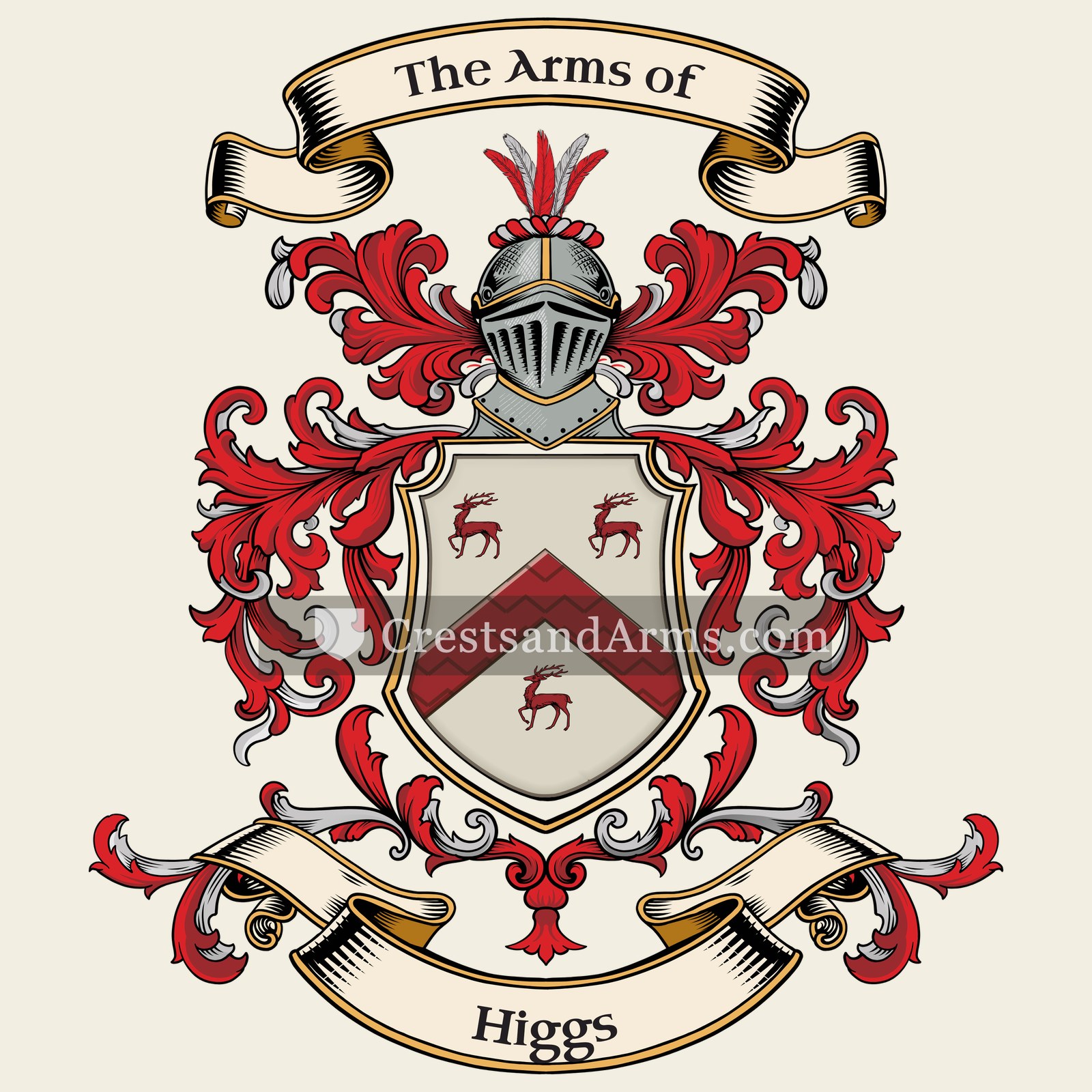
 chevronProtection, and faithful service completed
 stagPeace and harmony, and one who will not fight unprovoked
 chevronProtection, and faithful service completed
 stagPeace and harmony, and one who will not fight unprovoked