Map of Belgium showing where the Hilaire arms are recorded
The Hilaire arms were recorded in Liege, c. 1737.
Liege was a prosperous town and its surrounding country, living on metalworking and trade. Merchant families grew rich, bought land outside the walls, and took arms as landowners rather than tradesmen.
This is where the arms were entered in the register. Families often moved to other parts of the country, so the same name can turn up in more than one region.
The body that granted and recorded arms in Belgium in this period.
Charles VI, Holy Roman Emperor
Sovereign of the period
Charles VI, Holy Roman Emperor
1711–1740
Reigning in Belgium when the Hilaire arms are first recorded.
How Arms Worked in Belgium
In Belgium, a coat of arms is considered personal property that is passed down through the male line to legitimate descendants. Families often use the same shield design across generations to show their shared heritage. If a branch of the family wants to change the design, they must apply for an official update to their specific version of the arms.
Granting authority
The Conseil héraldique is the official body that regulates and approves all coats of arms in Belgium.
How they got arms
Families obtain their coats of arms through formal royal grants or by confirming their historical right to use existing designs.
Where arms were recorded
All approved coats of arms are officially recorded in the public registers of the Conseil héraldique since 1844.
The family's standing
Recorded among the armigerous families of Liege.
Origin & History of the Hilaire Family in Belgium
The family name Hilaire finds its roots in the Latin name Hilarius, which translates to cheerful or joyful. During the Middle Ages, this name became popular across Europe due to the influence of Saint Hilary of Poitiers, a prominent religious figure. By the time the family was documented in Liège in 1737, the region was a bustling center for trade and craftsmanship within the Prince-Bishopric of Liège. Families living in this area during the eighteenth century often held roles tied to the local guilds or the mining industries that defined the Meuse River valley. As the name spread through the French-speaking territories, it evolved from a personal given name into a hereditary surname passed down through generations. This transition reflects the broader historical trend where families began adopting fixed surnames to better manage tax records and legal identities in growing urban centers like Liège.
Related Branches & Arms
Root word
Hilarius
Derived from the Latin word for cheerful or merry.
This name
HilaireA French surname signifying a joyful or happy person.
also spelled
Hilaire
Hilair
de Hilar
Documented Sources
J. B. Rietstap, Armorial Général, Gouda: G. B. van Goor Zonen, 1884–87
Dauzat, Albert, Dictionnaire étymologique des noms de famille et prénoms de France, 1951
Morlet, Marie-Thérèse, Dictionnaire étymologique des noms de famille, 1991
Archives de l'État à Liège, Registres paroissiaux de la ville de Liège, 1737
Digital archive packCoat of arms PNG, gold border print PDF, vector SVG and the certificate of authenticity. Sent to your email in minutes.


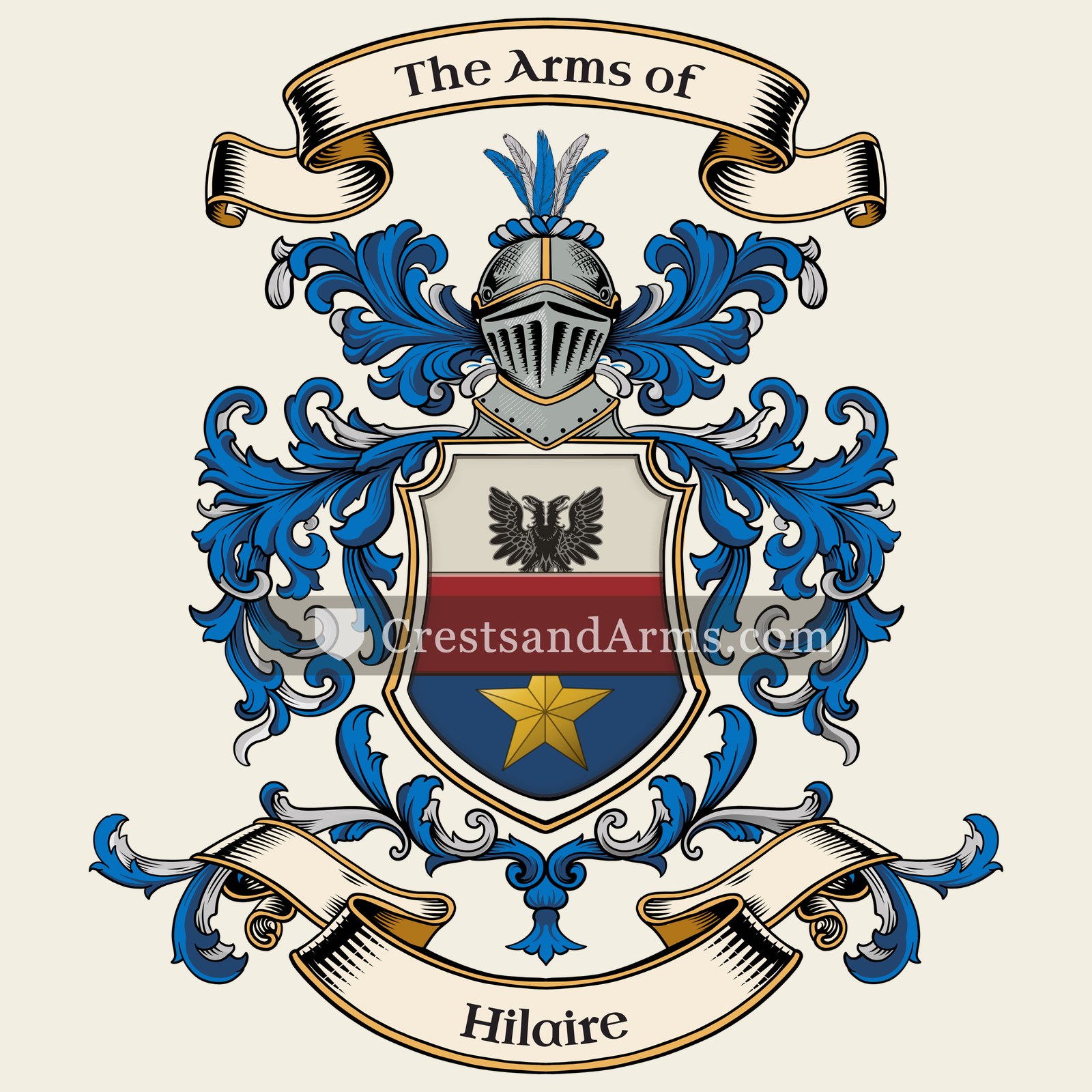
 fessThe military belt, and readiness to serve
 eagleNobility, strength and a keen mind
 mulletThe third son, and a divine quality from above
 fessThe military belt, and readiness to serve
 eagleNobility, strength and a keen mind
 mulletThe third son, and a divine quality from above