Map of Germany showing where the Hildebrandt arms are recorded
The Hildebrandt arms were recorded in Germany, c. 1765.
Arms such as these were typically recorded in Bavaria.
Bavaria was a country of old landed families and walled market towns. Estates passed down the same line for centuries, and both the landowners and the leading townsmen kept arms, which is why so many Bavarian names sit in the registers.
This is where the arms were entered in the register. Families often moved to other parts of the country, so the same name can turn up in more than one region.
The body that granted and recorded arms in Germany in this period.
Francis I, Holy Roman Emperor
Sovereign of the period
Francis I, Holy Roman Emperor
1745–1765
Reigning in Germany when the Hildebrandt arms are first recorded.
How Arms Worked in Germany
In the Holy Roman Empire, coats of arms were often granted to individuals by the Emperor or his representatives. These arms were then passed down through the generations to all legitimate descendants of the original holder. Younger branches of a family usually kept the same shield design without needing to change it, as the arms belonged to the entire lineage.
Granting authority
The Holy Roman Emperor held the sole power to grant new coats of arms throughout his vast imperial territories.
How they got arms
Families typically obtained their coats of arms through a formal imperial grant or by proving their noble status to the authorities.
Where arms were recorded
These grants were officially recorded in the Imperial Chancery registers, which began keeping formal records of such honors during the Middle Ages.
The family's standing
Recorded among the armigerous families of Germany.
Origin & History of the Hildebrandt Family in Germany
The surname Hildebrandt originates from the Old High German name Hildebrand, which combines the words for battle and sword. This name gained legendary status through the medieval epic poem known as the Hildebrandslied, which tells the tragic story of a father and son meeting on the battlefield. By the eighteenth century, the name had become well-established across various German-speaking regions. Records from 1765 confirm that members of the family were living in Bavaria during this period. At that time, families often lived in small agricultural communities where the name was passed down through generations of farmers and craftsmen. These early ancestors likely lived through a time of significant social change as the region transitioned under the influence of the Holy Roman Empire. The presence of the family in Bavaria suggests they were part of the stable population that helped shape the local culture and economy of southern Germany during the late eighteenth century.
Coat of Arms & Family Crest Details
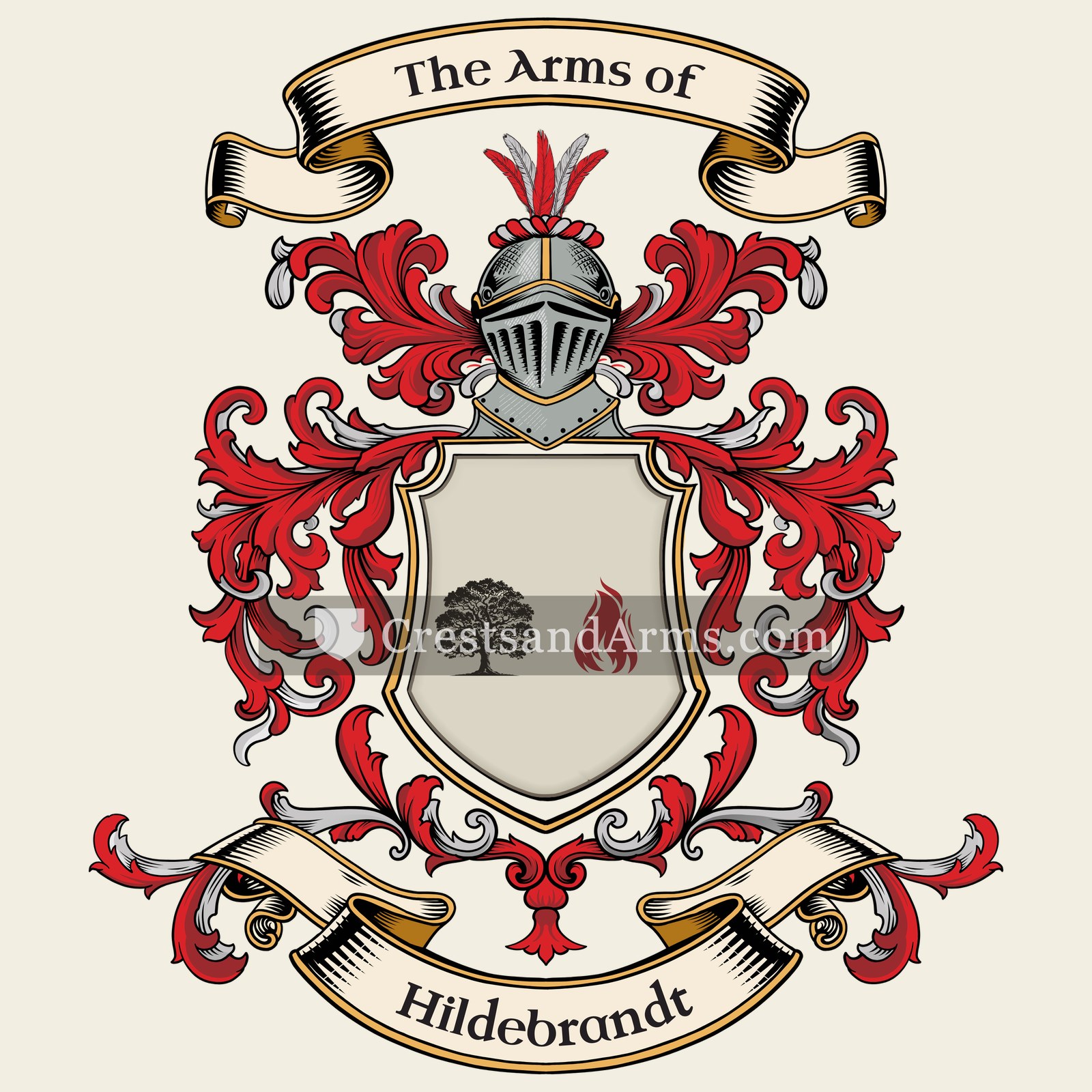
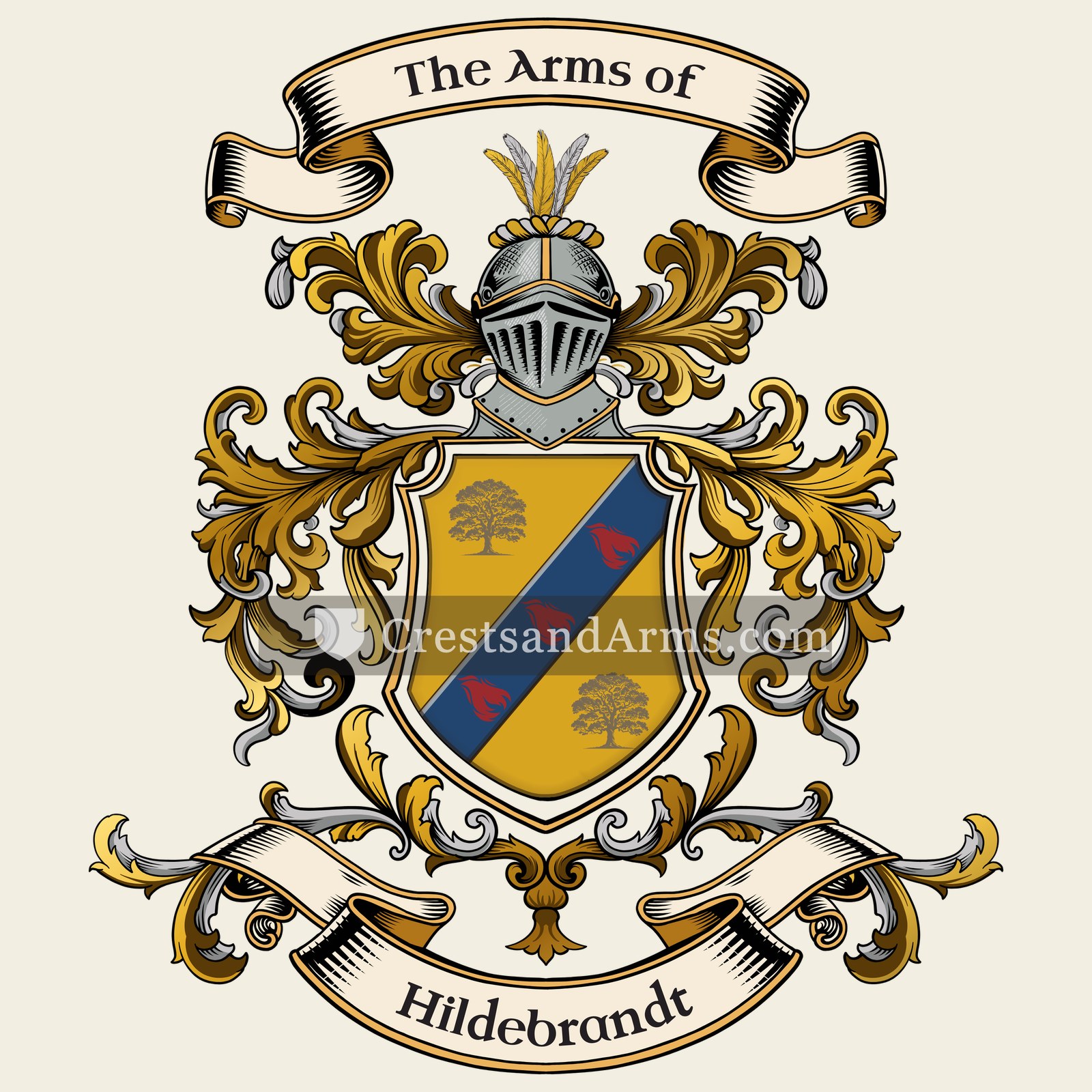
Symbols on this shield
fireZeal and purification
treeLife, endurance and deep roots
Colours
Gold (Or)Means: Generosity
Blue (Azure)Means: Loyalty and truth
Red (Gules)Means: Military strength
Historical info
Source
J. B. Rietstap, Armorial Général, Gouda: G. B. van Goor Zonen, 1884–87
Blazon (the actual original written record)
“D'or à la barre d'azur, ch. de trois flammes de gu., posées dans le sens de la barre, et côtoyée de deux chicots au nat., le côté supérieur de chaque chicot enflammé en trois endroits. Cq. cour. C.: un homme d'armes iss., cuirassé d'arg., coiffé d'un morion du même, embrassant deux prob. d'arg. ayant chacune une flamme de gu. dans son embouchure. L. d'or et d'azur.”
LivoniaEsthonie · Livonia, c. 1772
Digital archive packCoat of arms PNG, gold border print PDF, vector SVG and the certificate of authenticity. Sent to your email in minutes.
Map of Poland showing where the Hildebrandt arms are recorded
The Hildebrandt arms were recorded in Livonia, c. 1772.
Livonia was Baltic country held by a small number of landed families who kept their estates for centuries. Land there passed down whole rather than being divided, and long unbroken tenure is what fills a register.
This is where the arms were entered in the register. Families often moved to other parts of the country, so the same name can turn up in more than one region.
Region
Livonia
Town
Esthonie
First recorded
1772
Granting Authority for the Hildebrandt Arms
Ennoblement by the Sejm
Author: Olek Remesz · CC BY-SA 3.0
The body that granted and recorded arms in Poland in this period.
Stanisław August Poniatowski
Sovereign of the period
Stanisław August Poniatowski
1764–1795
Reigning in Germany when the Hildebrandt arms are first recorded.
How Arms Worked in Poland
Polish noble families shared a single coat of arms across many different surnames, creating large clans rather than individual designs. These symbols were held collectively by all members of the clan regardless of their specific family name. When a new family joined the nobility, they were adopted into an existing clan and began using that group's established shield.
Granting authority
The Sejm, which was the Polish parliament, held the power to grant noble status and the right to bear arms.
How they got arms
Families typically received their coat of arms through a formal act of ennoblement granted by the Sejm for distinguished service.
Where arms were recorded
These grants were officially recorded in the Crown Metrica, which served as the central archive for state documents starting in the sixteenth century.
The family's standing
Recorded among the armigerous families of Livonia.
Origin & History of the Hildebrandt Family in Poland
The surname Hildebrandt carries deep roots in the Baltic and Central European regions, emerging from Germanic origins that spread eastward through trade and migration. By the time of the First Partition of Poland in 1772, members of the family were well-established in the territory of Livonia, a region that had long been a crossroads for German, Polish, and Baltic cultures. During this period, the name was often associated with families who served as administrators, craftsmen, or landowners within the complex social structure of the Polish-Lithuanian Commonwealth. As these individuals moved through the changing political borders of the eighteenth century, they integrated into local communities while maintaining the linguistic heritage of their name. Their presence in Livonia reflects a broader history of families who navigated the shifting loyalties and cultural exchanges that defined the Polish frontier during the late Enlightenment era.
Related Branches & Arms
Root word
Hild-brand
Battle or war combined with a sword or firebrand.
This name
HildebrandtA warrior wielding a sword, or one who is a battle-hardened fighter.
also spelled
Hildebrante
Hildebrand
Related arms
Bouzinsimilar arms
Charnotetsimilar arms
du Hilsimilar arms
Hildebrandvariant spelling
Documented Sources
J. B. Rietstap, Armorial Général, Gouda: G. B. van Goor Zonen, 1884–87
Bahlow, Hans, Deutsches Namenlexikon: Familien- und Vornamen nach Ursprung und Sinn erklärt, 1967


 treeLife, endurance and deep roots
 fireZeal and purification
 treeLife, endurance and deep roots
 fireZeal and purification