Map of Netherlands showing where the Hilgers arms are recorded
The Hilgers arms were recorded in Netherlands, c. 1815.
Arms such as these were typically recorded in Friesland.
Friesland was low, wet country on the northern coast of the Netherlands, farmed by families who had held the same land for centuries. Free landholders were unusually common there, and a free landholder could carry arms.
This is where the arms were entered in the register. Families often moved to other parts of the country, so the same name can turn up in more than one region.
Region
Friesland
First recorded
1815
Granting Authority for the Hilgers Arms
Hoge Raad van Adel
Photograph made by me · CC BY-SA 3.0
The body that granted and recorded arms in Netherlands in this period.
William I of the Netherlands
Sovereign of the period
William I of the Netherlands
1815–1840
Reigning in Netherlands when the Hilgers arms are first recorded.
How Arms Worked in Netherlands
In the Netherlands, coats of arms were often used by noble families and those who held specific public offices. These arms were passed down through the generations to legitimate descendants. Younger branches of a family usually kept the original design without needing to add special marks. This system ensured that the family identity remained clear and consistent over many years.
Granting authority
The Hoge Raad van Adel is the official body that regulates and manages noble titles and coats of arms in the Netherlands.
How they got arms
Families typically obtained their coats of arms through official royal grants or by proving their long-standing historical use of the symbols.
Where arms were recorded
Coats of arms are officially recorded in the registers held by the Hoge Raad van Adel, which began its work in 1814.
The family's standing
Recorded among the armigerous families of Netherlands.
Origin & History of the Hilgers Family in Netherlands
The surname Hilgers is a patronymic name, which means it was originally created to identify a person as the son of someone named Hilger. This name is a shortened form of the Germanic name Hildeger, which combines words meaning battle and spear. While the name has roots across various Germanic regions, the presence of the Hilgers family in the province of Friesland by 1815 reflects the common practice of families settling in northern coastal areas during the early nineteenth century. At this time, the Netherlands was undergoing significant administrative changes, including the formal registration of surnames under the Napoleonic civil code. This period required families to officially document their names for tax, military, and census purposes, which helped solidify the spelling and lineage of the Hilgers name within Dutch records. By settling in Friesland, these early family members became part of a region known for its strong agricultural traditions and distinct cultural identity, helping to anchor the name within the local history of the Dutch northern provinces.
Coat of Arms & Family Crest Details
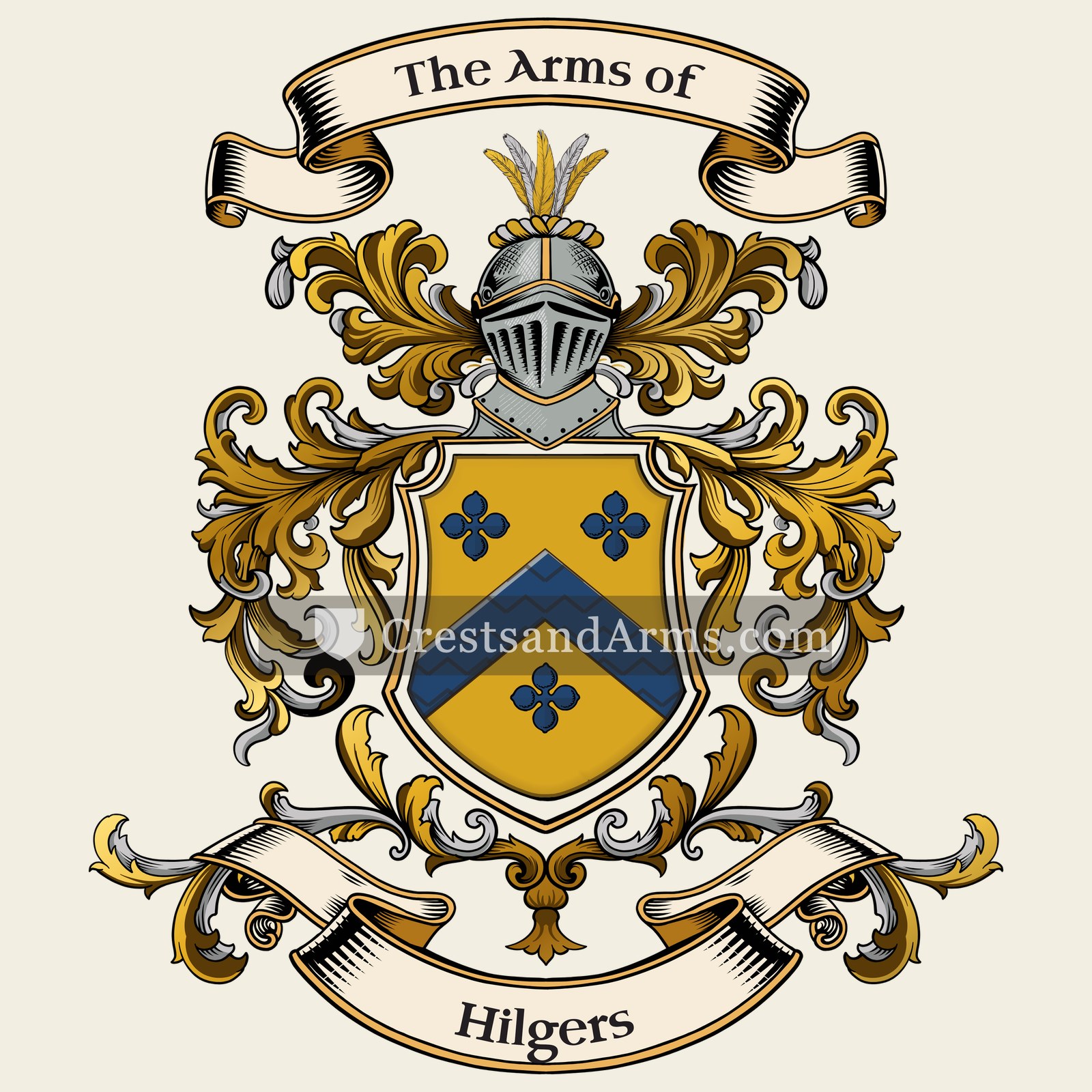
Symbols on this shield
chevronProtection, and faithful service completed
plant quatrefoilGood fortune and the fourfold gospel
Colours
Gold (Or)Means: Generosity
Blue (Azure)Means: Loyalty and truth
Historical info
Source
J. B. Rietstap, Armorial Général, Gouda: G. B. van Goor Zonen, 1884–87
Blazon (the actual original written record)
“D'or au chev. d'azur, acc. de trois quartefeuilles du même, bout. du champ. Deux cq. cour. C.: 1° une quartefeuille de l'écu: entre un vol, coupé alt. d'azur et d'or; 2° une quartefeuille de l'écu, entre deux prob. de gu. L. d'or et d'azur. S.: deux aigles reg. de sa., bq. et m. d'or.”
Francec. 1783
Digital archive packCoat of arms PNG, gold border print PDF, vector SVG and the certificate of authenticity. Sent to your email in minutes.
Map of France showing where the Hilgers arms are recorded
The Hilgers arms were recorded in France, c. 1783.
Arms such as these were typically recorded in Bretagne.
More families held coats of arms in Bretagne than anywhere else in France. The land was divided into many small estates rather than a few large ones, so far more households counted as gentry, and each needed a shield of its own to be told apart.
This is where the arms were entered in the register. Families often moved to other parts of the country, so the same name can turn up in more than one region.
The body that granted and recorded arms in France in this period.
Louis XVI of France
Sovereign of the period
Louis XVI of France
1774–1791
Reigning in Netherlands when the Hilgers arms are first recorded.
How Arms Worked in France
In France, a coat of arms was a mark of honor that passed down through the male line to all legitimate descendants. Families often used the same shield without changes to show their shared heritage. If a branch wanted to stand out, they could add a small mark to their shield to show their specific place in the family tree.
Granting authority
The Juge d'armes de France acted as the official authority that regulated and verified coats of arms across the country.
How they got arms
Families typically inherited their arms from ancestors, though they could also receive them through royal grants or by proving their noble status.
Where arms were recorded
Coats of arms were officially recorded in the Armorial Général de France, which began its main collection in the year 1696.
The family's standing
Recorded among the armigerous families of France.
Origin & History of the Hilgers Family in France
The family name Hilgers carries a distinct history that reflects the movement of people across European borders. While the name is often associated with Germanic roots, its presence in France by the late eighteenth century suggests a family that adapted to new cultural environments. Records confirm that members of the Hilgers family were established in the region of Bretagne by 1783. During this era, Bretagne was a hub for trade and maritime activity, which likely drew families from various backgrounds to settle in its coastal towns. The family members living there at the time were part of a broader trend of migration where individuals moved across regions to seek new opportunities in agriculture or local commerce. By integrating into the social fabric of Bretagne, the Hilgers family became part of the local history of western France during the final years of the French monarchy.
Related Branches & Arms
Root word
Hildeger
Derived from Germanic elements meaning battle and spear.
This name
HilgersA patronymic surname meaning son of Hildeger, signifying a descendant of a warrior.
also spelled
Hilgerse
Documented Sources
J. B. Rietstap, Armorial Général, Gouda: G. B. van Goor Zonen, 1884–87
Meertens, P.J., Voornamen in Nederland, 1951
Van der Schaar, J., Woordenboek van voornamen, 1964
Nationaal Archief, Burgerlijke Stand in Nederland, 1811–1912
Tresoar (Fries Historisch en Letterkundig Centrum), Bevolkingsregisters van Friesland, 1811–1850
Digital archive packCoat of arms PNG, gold border print PDF, vector SVG and the certificate of authenticity. Sent to your email in minutes.


 chevronProtection, and faithful service completed
 chevronProtection, and faithful service completed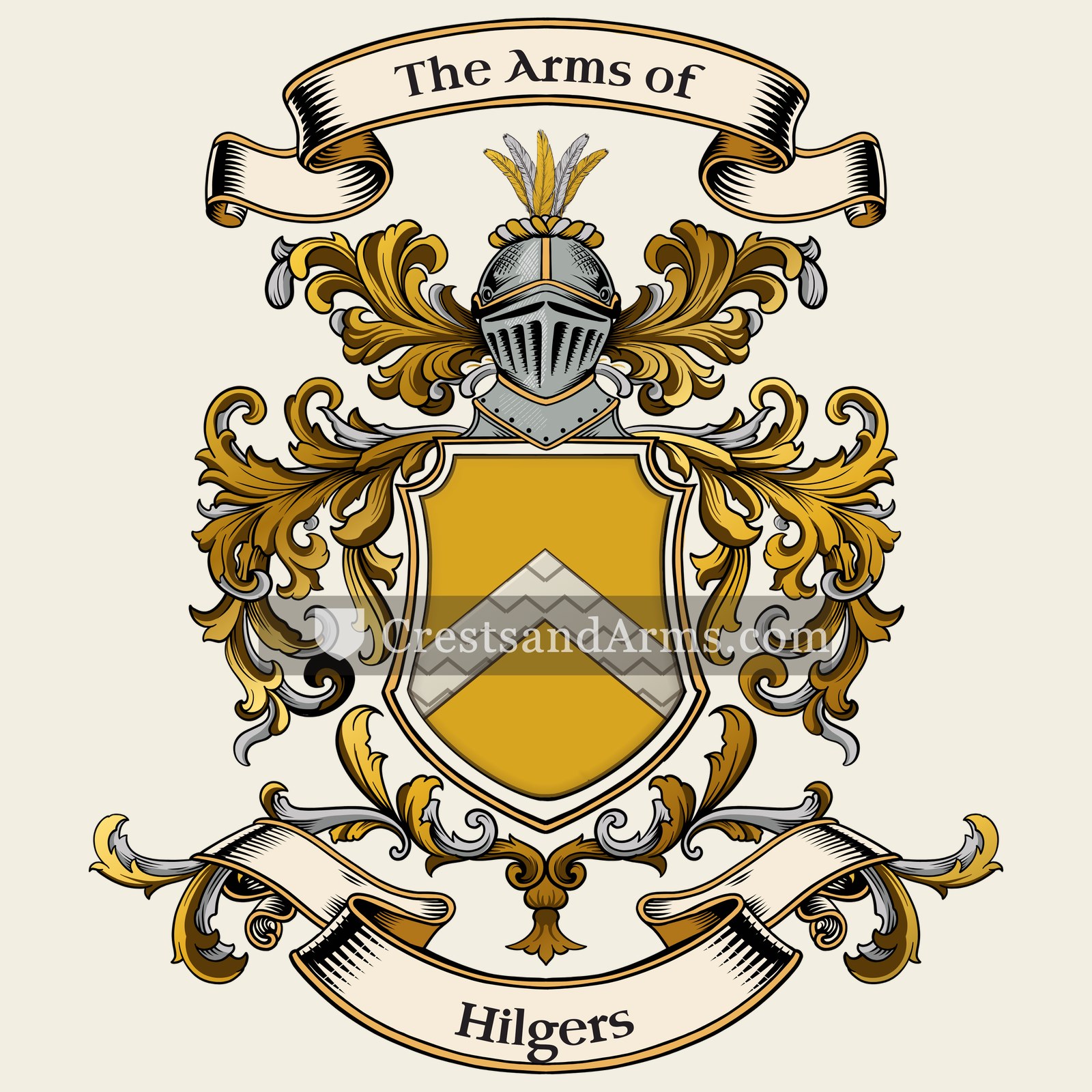


 plant quatrefoilGood fortune and the fourfold gospel