A record of documented arms, meaning and origin, researched for the Himenez family lines. Documented in 2 countries.
Reg. 4513 · Spanish, G–I
Coat of Arms & Family Crest Details
Symbols on this shield
bendDefence, and the scarf of a commander
dragonA most valiant defender of treasure
columnFortitude and constancy
Colours
Blue (Azure)Means: Loyalty and truth
Gold (Or)Means: Generosity
Green (Vert)Means: Hope
Historical info
Source
J. B. Rietstap, Armorial Général, Gouda: G. B. van Goor Zonen, 1884–87
Blazon (the actual original written record)
“D'azur à la bande d'or, engouée de deux têtes de dragon de sin. et acc. de deux colonnes d'or, couronnées du même, chaque colonne entourée d'un listel d'arg. inscrit des mots: REGIA FORTITUDO.”
AndalusiaAndalusia, c. 1722
Digital archive packCoat of arms PNG, gold border print PDF, vector SVG and the certificate of authenticity. Sent to your email in minutes.
Map of Spain showing where the Himenez arms are recorded
The Himenez arms were recorded in Andalusia, c. 1722.
Andalusia was the last part of Spain taken back from the Moors, and the land was shared out among the men who took it. A grant of land came with a grant of arms, so the region produced a great many.
This is where the arms were entered in the register. Families often moved to other parts of the country, so the same name can turn up in more than one region.
The body that granted and recorded arms in Spain in this period.
Philip V of Spain
Sovereign of the period
Philip V of Spain
1714–1724
Reigning in Spain when the Himenez arms are first recorded.
How Arms Worked in Spain
In Spain, a coat of arms was considered a form of property that belonged to the entire family line. These arms were passed down from a father to all his children equally. Younger branches of the family usually kept the original design without needing to add any special marks to distinguish their specific line.
Granting authority
The Cronista Rey de Armas was the official body that regulated and granted coats of arms throughout Spain.
How they got arms
Families often obtained their arms through royal grants or by proving their noble status to the official heraldic authority.
Where arms were recorded
Coats of arms were officially recorded in the registers of the Cronista Rey de Armas starting in 1496.
The family's standing
Recorded among the armigerous families of Andalusia.
Origin & History of the Himenez Family in Spain
The surname Himenez is a variant of the more common Jimenez, rooted in the ancient naming traditions of the Iberian Peninsula. It originated as a patronymic, meaning it was formed by adding a suffix to the father's given name, which in this case was Jimeno. By the early 18th century, families bearing this name were well-established in the Andalusia region of southern Spain. During this period, Andalusia was a vibrant center of agricultural production and trade, shaped by centuries of cultural exchange. Families like those documented in 1722 often lived in close-knit rural communities or growing towns, where they contributed to the local economy through farming, craftsmanship, or trade. The presence of the name in regional records from this time highlights how families maintained their identity and lineage while adapting to the social and economic shifts occurring across the Spanish countryside.
Coat of Arms & Family Crest Details
Symbols on this shield
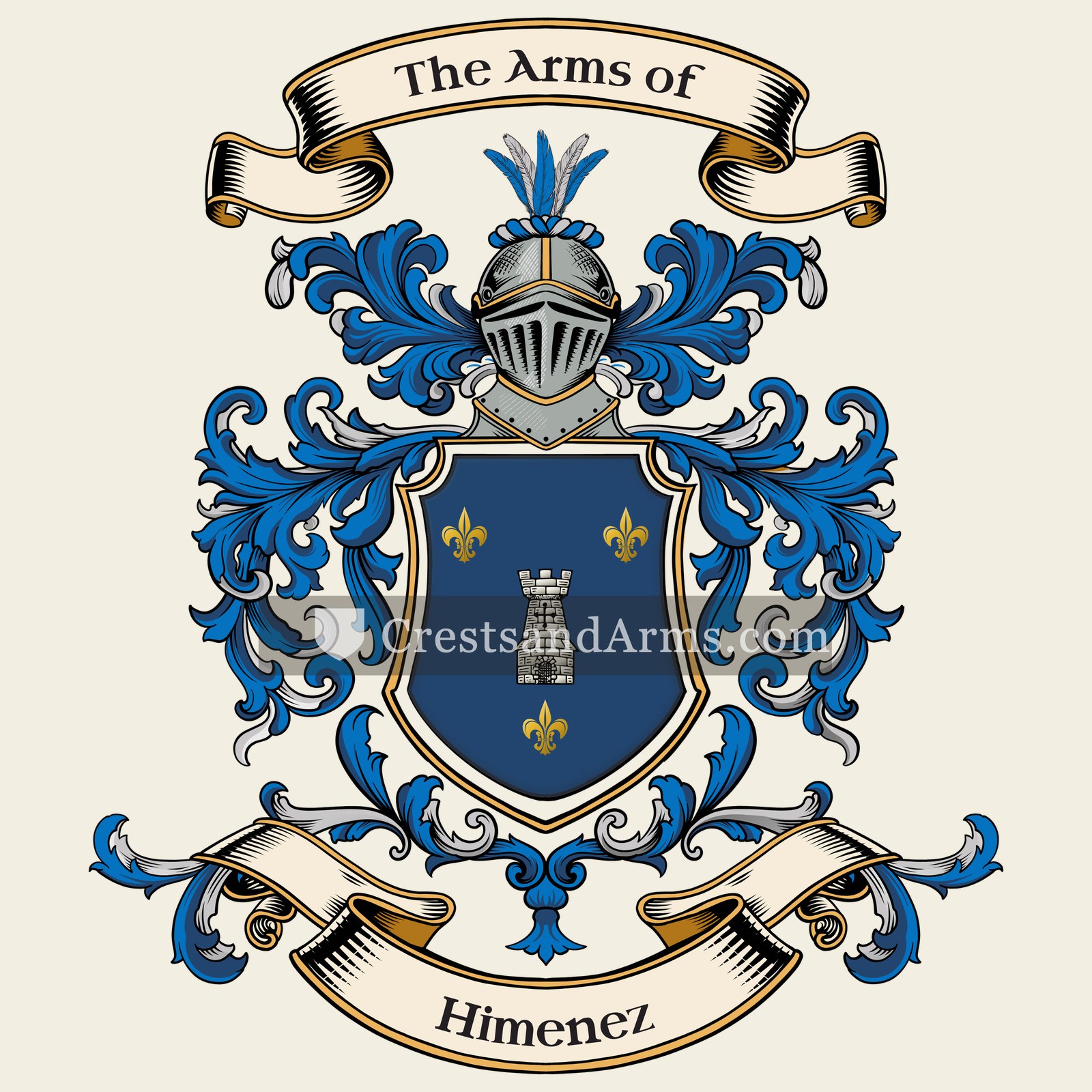
cross symbolChristian faith and service
towerGrandeur and solidity, and a stronghold defended
fleur de lisPurity, light, and the sixth son
Colours
Blue (Azure)Means: Loyalty and truth
Silver (Argent)Means: Peace and sincerity
Gold (Or)Means: Generosity
Historical info
Source
J. B. Rietstap, Armorial Général, Gouda: G. B. van Goor Zonen, 1884–87
Blazon (the actual original written record)
“D'azur à une tour d'arg., sommée d'une croix de Lorraine du même, et acc. de trois fleurs-de-lis d'or, 2 à dextre, l'une sur l'autre, et 1 à sen., celle-ci plus grande que les deux autres.”
NavarreNavarre, c. 1663
Digital archive packCoat of arms PNG, gold border print PDF, vector SVG and the certificate of authenticity. Sent to your email in minutes.
Map of France showing where the Himenez arms are recorded
The Himenez arms were recorded in Navarre, c. 1663.
Navarre was mountain country straddling the Pyrenees, with a strong class of small independent landholders. A great many households counted as gentry there, and each needed a shield to be told apart.
This is where the arms were entered in the register. Families often moved to other parts of the country, so the same name can turn up in more than one region.
The body that granted and recorded arms in France in this period.
Louis XIV of France
Sovereign of the period
Louis XIV of France
1643–1715
Reigning in Spain when the Himenez arms are first recorded.
How Arms Worked in France
In France, a coat of arms was a mark of honor that passed down through the male line to all legitimate descendants. Families often used the same shield without changes to show their shared heritage. If a branch wanted to stand out, they could add a small mark to their shield to show their specific place in the family tree.
Granting authority
The Juge d'armes de France acted as the official authority that regulated and verified coats of arms across the country.
How they got arms
Families typically inherited their arms from ancestors, though they could also receive them through royal grants or by proving their noble status.
Where arms were recorded
Coats of arms were officially recorded in the Armorial Général de France, which began its main collection in the year 1696.
The family's standing
Recorded among the armigerous families of Navarre.
Origin & History of the Himenez Family in France
The surname Himenez, a variant of the more common Jimenez, finds its roots in the medieval regions bordering the Pyrenees mountains. By the year 1663, records confirm that families bearing this name were well-established in the Kingdom of Navarre, a territory that historically straddled the border between modern-day France and Spain. During this period, the region was a complex cultural crossroads where families frequently moved between the northern Basque provinces and the French side of the mountains. The name itself is a patronymic, meaning it was originally derived from the given name Jimeno, which was popular among the nobility and commoners alike in the Basque country. As families migrated across the shifting political boundaries of the seventeenth century, the spelling of the name often adapted to fit local French phonetic customs. These early ancestors were likely involved in the agricultural and pastoral life of the Pyrenean foothills, contributing to the distinct social fabric of the borderlands during a time of significant regional transition.
Related Branches & Arms
Root word
Jimeno
Derived from the Hebrew name Shimon meaning he has heard.
This name
HimenezA patronymic surname signifying son of Jimeno, originating from medieval Spanish naming traditions.
also spelled
Jimenez
Himenez
Documented Sources
J. B. Rietstap, Armorial Général, Gouda: G. B. van Goor Zonen, 1884–87
Pérez Bustamante, Rogelio. El sistema de gobierno en la España de los Borbones. 1990
Archivo Histórico Nacional. Sección de Consejos, Libro de registro de hidalguías
Digital archive packCoat of arms PNG, gold border print PDF, vector SVG and the certificate of authenticity. Sent to your email in minutes.


 bendDefence, and the scarf of a commander
 dragonA most valiant defender of treasure
 columnFortitude and constancy
 bendDefence, and the scarf of a commander
 dragonA most valiant defender of treasure
 columnFortitude and constancy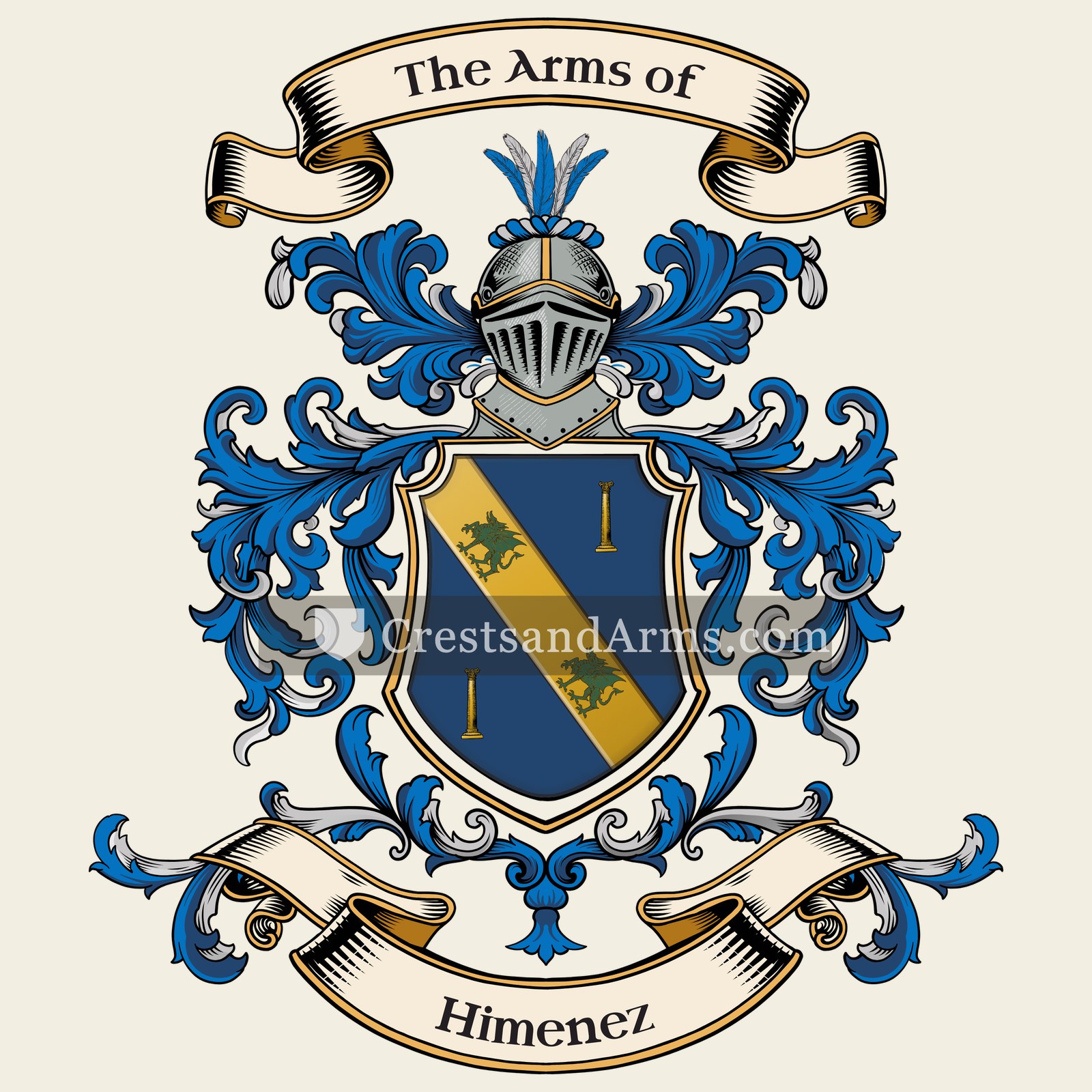


 cross symbolChristian faith and service
 towerGrandeur and solidity, and a stronghold defended
 fleur de lisPurity, light, and the sixth son