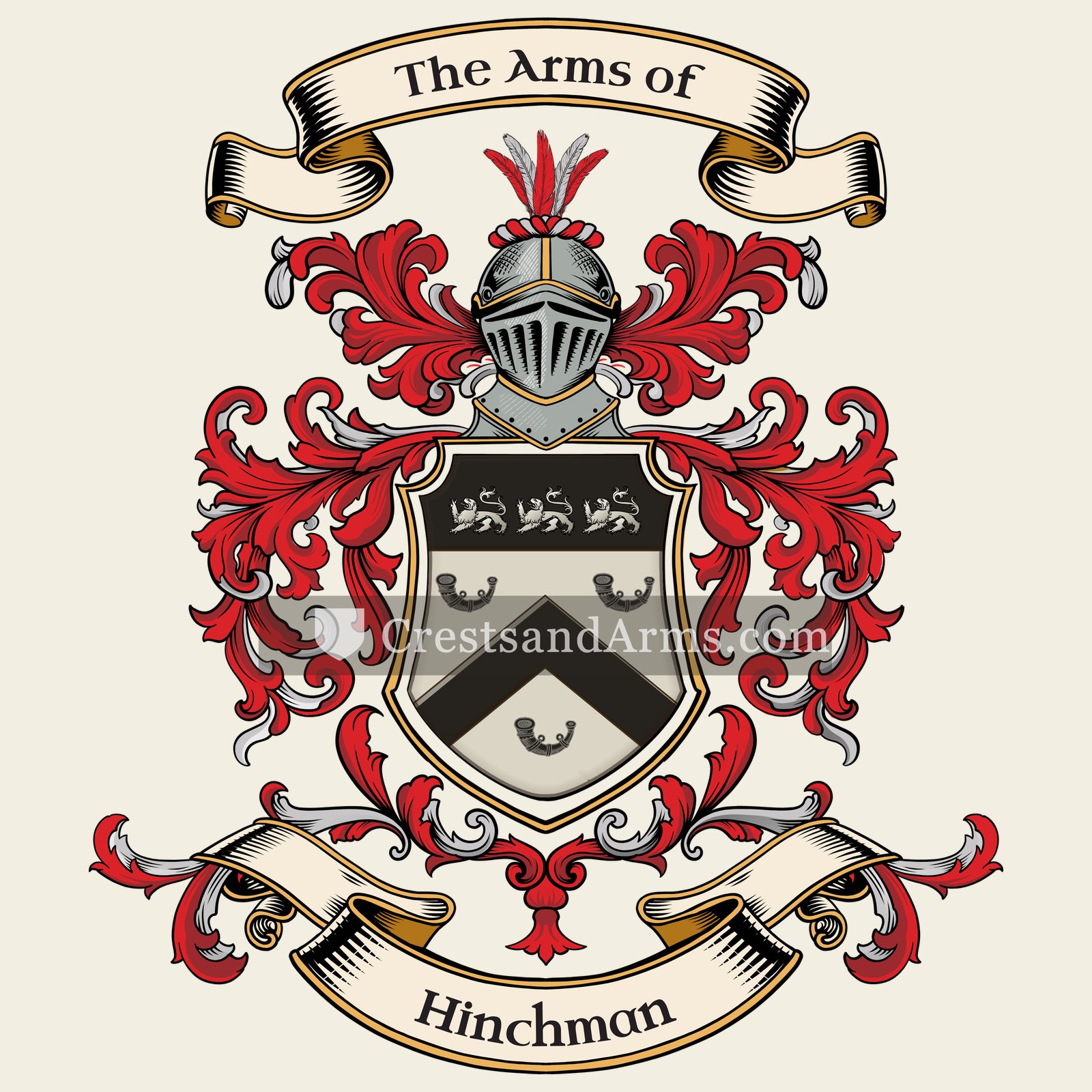
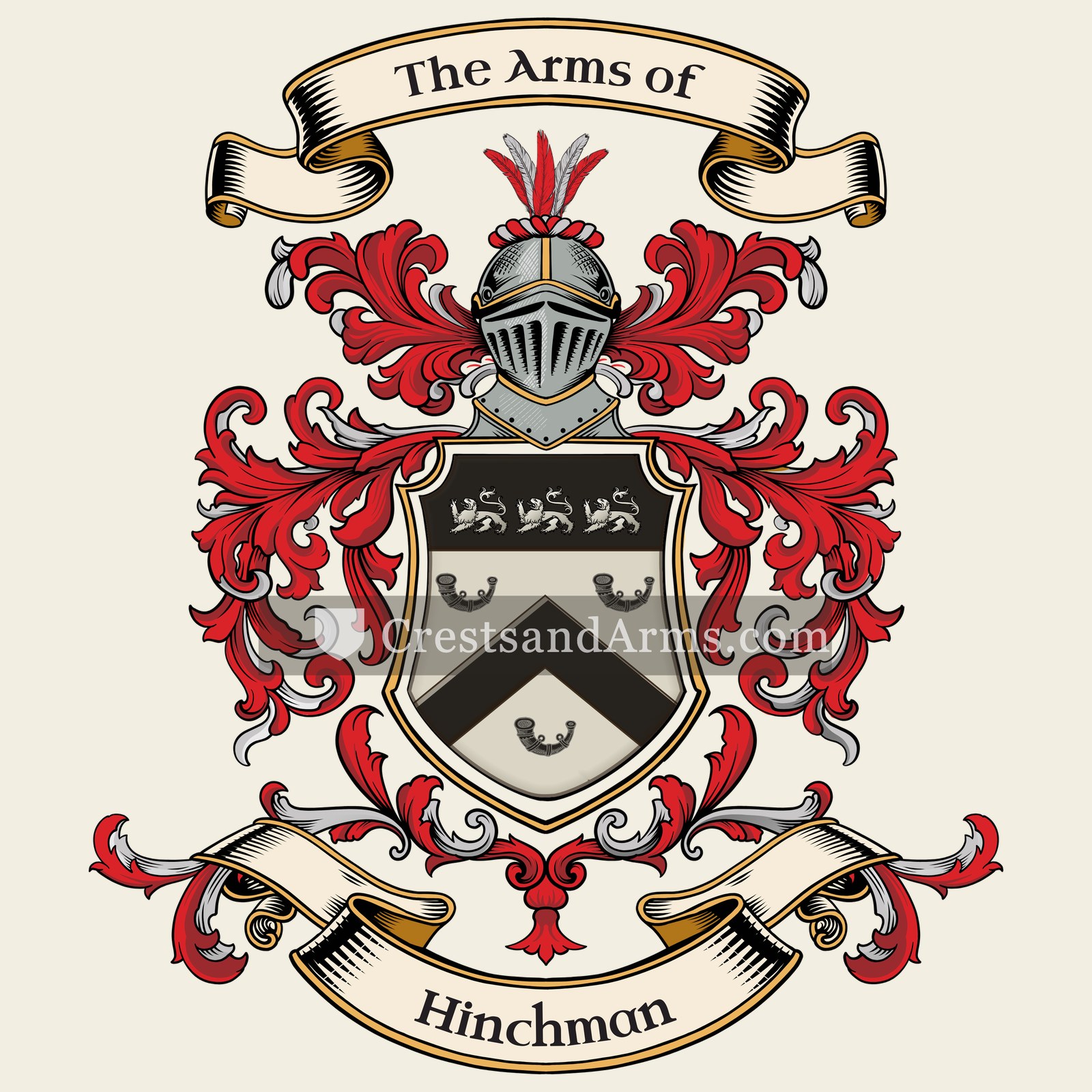
A record of documented arms, meaning and origin, researched for the Hinchman family lines. Documented in 2 countries.
Reg. 0198 · Britain, G–I
Coat of Arms & Family Crest Details
Symbols on this shield
chevronProtection, and faithful service completed
chiefAuthority, wisdom and dominion
hunting horn stringedOne who delights in the chase
lionCourage, strength and royalty
Colours
Silver (Argent)Means: Peace and sincerity
Black (Sable)Means: Constancy
Historical info
Source
J. B. Rietstap, Armorial Général, Gouda: G. B. van Goor Zonen, 1884–87
Blazon (the actual original written record)
“D'arg. au chev. de sa. bordé d'or et acc. de trois cors-de-chasse de sa. liés de gu.; au chef de sa. ch. de trois lions d'arg. C.: un lion iss. d'arg. soufflant dans un des cors de l'écu. D.: SEMPER FIDELES.”
BritainEtats-Unis, c. 1700
Digital archive packCoat of arms PNG, gold border print PDF, vector SVG and the certificate of authenticity. Sent to your email in minutes.
Map of Britain showing where the Hinchman arms are recorded
The Hinchman arms were recorded in Etats-Unis, c. 1700.
Arms such as these were typically recorded in Kent.
Kent sits between London and the short crossing to Europe, and the trade passing through made it wealthy. Merchant families bought land with that money, and it was landowners who took coats of arms.
This is where the arms were entered in the register. Families often moved to other parts of the country, so the same name can turn up in more than one region.
The body that granted and recorded arms in Britain in this period.
William III of England
Sovereign of the period
William III of England
1694–1702
Reigning in Britain when the Hinchman arms are first recorded.
How Arms Worked in Britain
English heraldry allowed arms to be shared by all legitimate descendants of the original owner. These symbols were treated as personal property that moved through the generations to all children. While the eldest son kept the original design, other family members could use the same shield without needing to change it or register their own unique versions.
Granting authority
The College of Arms in London has regulated the use of coats of arms throughout England and Wales since 1484.
How they got arms
Families typically obtained their coats of arms through a formal grant from the Crown or by proving their ancient right to them.
Where arms were recorded
All official coats of arms are recorded in the registers kept at the College of Arms, which date back to the fifteenth century.
The family's standing
Recorded among the armigerous families of Britain.
Origin & History of the Hinchman Family in Britain
The surname Hinchman is rooted in the social and professional structures of medieval England, originating as an occupational name for a henchman or a trusted attendant to a person of high rank. The term itself evolved from the Middle English word *henchmand*, which described a squire or a page who walked beside a horse to provide assistance to a nobleman. By the time the name became established in the county of Kent during the early 1700s, it had transitioned from a job title into a hereditary family name passed down through generations. Families bearing this name in Kent were often part of the local agricultural or trade communities, living in a region known for its deep historical ties to the English monarchy and its proximity to the coast. As the name spread throughout the British Isles, it retained its connection to the idea of loyal service and personal duty, reflecting the roles that early ancestors held within their local society.
Coat of Arms & Family Crest Details
Symbols on this shield
chevronProtection, and faithful service completed
chiefAuthority, wisdom and dominion
hunting horn stringedOne who delights in the chase
lionCourage, strength and royalty
Colours
Silver (Argent)Means: Peace and sincerity
Black (Sable)Means: Constancy
Historical info
Source
Sir Bernard Burke, The General Armory of England, Scotland, Ireland and Wales, London: Harrison & Sons, 1884
Blazon (the actual original written record)
“Ar. a chev. betw. three buglehorns sa. stringed gu. on a chief of the second as many lions ramp. of the first”
Englandc. 1620
Digital archive packCoat of arms PNG, gold border print PDF, vector SVG and the certificate of authenticity. Sent to your email in minutes.
Map of England showing where the Hinchman arms are recorded
The Hinchman arms were recorded in England, c. 1620.
Arms such as these were typically recorded in York.
Yorkshire is the largest of the English counties, and it held more gentry families than any other. Land there was split among a great many households rather than a few, so a great many of them carried arms.
This is where the arms were entered in the register. Families often moved to other parts of the country, so the same name can turn up in more than one region.
The body that granted and recorded arms in England in this period.
James VI and I
Sovereign of the period
James VI and I
1603–1625
Reigning in Britain when the Hinchman arms are first recorded.
How Arms Worked in England
English heraldry allowed arms to be shared by all legitimate descendants of the original owner. These symbols were treated as personal property that moved through the generations to all children. While the eldest son kept the original design, other family members could use the same shield without needing to change it or register their own unique versions.
Granting authority
The College of Arms in London has regulated the use of coats of arms throughout England and Wales since 1484.
How they got arms
Families typically obtained their coats of arms through a formal grant from the Crown or by proving their ancient right to them.
Where arms were recorded
All official coats of arms are recorded in the registers kept at the College of Arms, which date back to the fifteenth century.
The family's standing
Recorded among the armigerous families of England.
Origin & History of the Hinchman Family in England
The Hinchman family name is rooted in the northern regions of England, with historical records placing members of the family in the city of York by the early seventeenth century. The name itself is thought to be an occupational surname, likely derived from the Middle English term "hench-man," which referred to a trusted attendant or a squire who served a person of high rank. During the medieval and early modern periods, such titles were often passed down to describe a person’s role in a household or their relationship to a local lord. By 1620, the presence of the Hinchman family in York suggests they were well-established members of the local community during a time of significant social and religious change in England. As the family grew, their history became intertwined with the regional development of Yorkshire, reflecting the broader patterns of migration and professional life in northern English cities during the Stuart era.
Hinchman Meaning & Related Branches
Root word
Hengest
Old English word for a stallion or male horse.
This name
HinchmanA servant or attendant associated with a person named Hengest.
also spelled
Hinchmann
Hinchmen
Hynchman
Hincheman
Hinchmon
Related arms
Henchman, or Hinchmansimilar arms
Farmerrecorded with Hinchman, same area
Green Mac Larrenrecorded with Hinchman, same area
Hollingworthrecorded with Hinchman, same area
Documented Sources
J. B. Rietstap, Armorial Général, Gouda: G. B. van Goor Zonen, 1884–87
Bardsley, Charles Wareing, A Dictionary of English and Welsh Surnames, 1901
Reaney, Percy Hide, A Dictionary of British Surnames, 1958
The National Archives, Prerogative Court of Canterbury and related Probate Jurisdictions: Will Registers, 1700–1750
Kent History and Library Centre, Parish Registers of Kent, 1700–1750
Digital archive packCoat of arms PNG, gold border print PDF, vector SVG and the certificate of authenticity. Sent to your email in minutes.


 chevronProtection, and faithful service completed
 chiefAuthority, wisdom and dominion
 hunting horn stringedOne who delights in the chase
 lionCourage, strength and royalty
 chevronProtection, and faithful service completed
 chiefAuthority, wisdom and dominion
 hunting horn stringedOne who delights in the chase
 lionCourage, strength and royalty