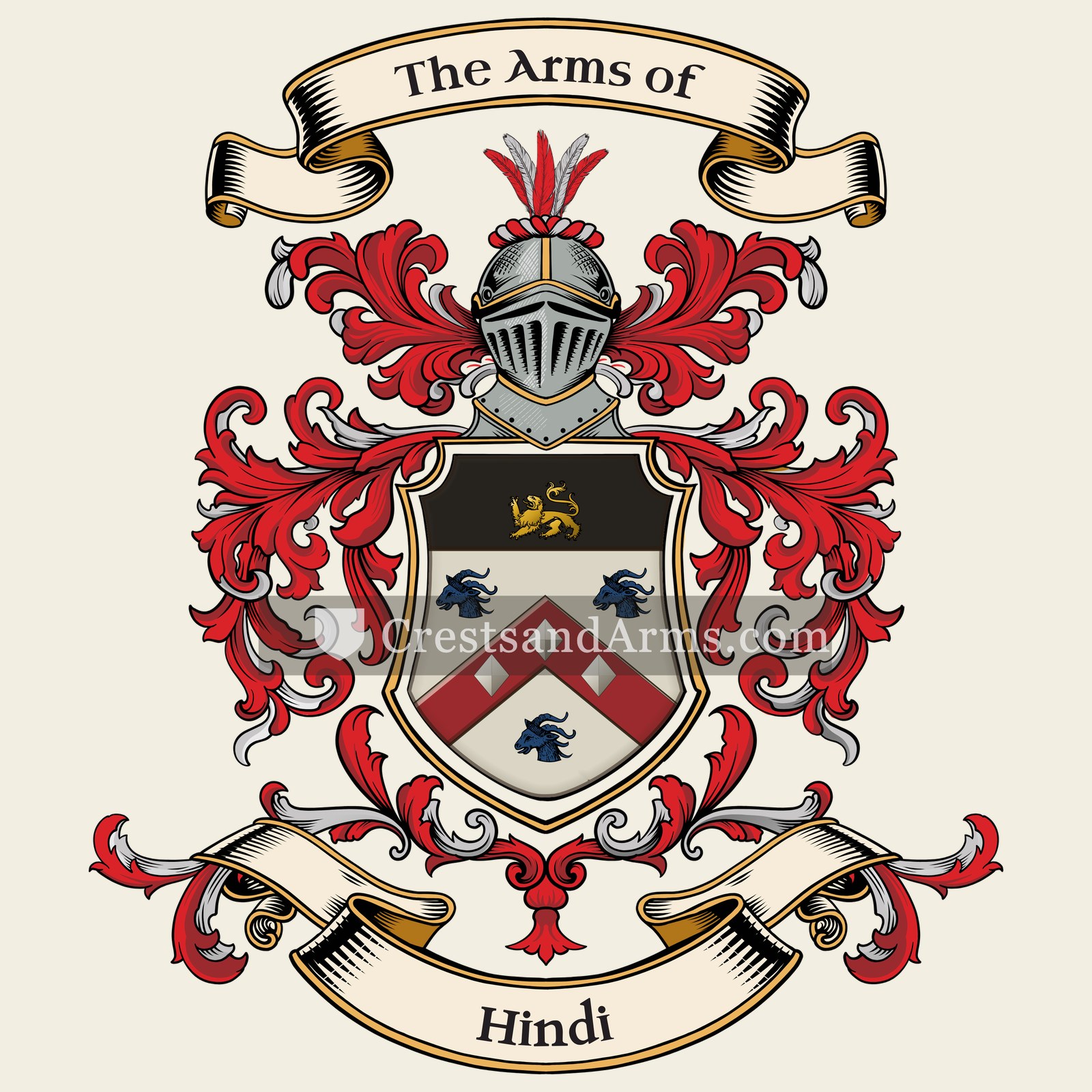
A record of documented arms, meaning and origin, researched for the Hindi family of England.
Reg. 5759 · English, G–I
Coat of Arms & Family Crest Details
Symbols on this shield
chevronProtection, and faithful service completed
chiefAuthority, wisdom and dominion
goats headWisdom, and one who wins by policy rather than force
lozengeHonour and nobility, and the arms of a woman
lionCourage, strength and royalty
Colours
Silver (Argent)Means: Peace and sincerity
Red (Gules)Means: Military strength
Black (Sable)Means: Constancy
Blue (Azure)Means: Loyalty and truth
Gold (Or)Means: Generosity
Historical info
Source
Sir Bernard Burke, The General Armory of England, Scotland, Ireland and Wales, London: Harrison & Sons, 1884
Blazon (the actual original written record)
“Ar. on a chev. gu. betw. three goats' heads az. collared and attired or, as many lozenges of the first, on a chief sa. a lion pass. guard. of the fourth”
KentKent, c. 1620
Digital archive packCoat of arms PNG, gold border print PDF, vector SVG and the certificate of authenticity. Sent to your email in minutes.
Map of England showing where the Hindi arms are recorded
The Hindi arms were recorded in Kent, c. 1620.
Kent sits between London and the short crossing to Europe, and the trade passing through made it wealthy. Merchant families bought land with that money, and it was landowners who took coats of arms.
This is where the arms were entered in the register. Families often moved to other parts of the country, so the same name can turn up in more than one region.
The body that granted and recorded arms in England in this period.
James VI and I
Sovereign of the period
James VI and I
1603–1625
Reigning in England when the Hindi arms are first recorded.
How Arms Worked in England
English heraldry allowed arms to be shared by all legitimate descendants of the original owner. These symbols were treated as personal property that moved through the generations to all children. While the eldest son kept the original design, other family members could use the same shield without needing to change it or register their own unique versions.
Granting authority
The College of Arms in London has regulated the use of coats of arms throughout England and Wales since 1484.
How they got arms
Families typically obtained their coats of arms through a formal grant from the Crown or by proving their ancient right to them.
Where arms were recorded
All official coats of arms are recorded in the registers kept at the College of Arms, which date back to the fifteenth century.
The family's standing
Recorded among the armigerous families of Kent.
Origin & History of the Hindi Family in England
The family name Hindi has deep roots that connect to the movement of people and trade across the English Channel. By the year 1620, records confirm that members of the family were already established in the county of Kent. During this era, Kent served as a vital gateway for travelers and merchants arriving from the European continent. The name itself often functioned as a descriptive label, likely identifying individuals who had traveled from or conducted business with regions associated with the East. As these early ancestors settled into the local communities of Kent, they integrated into the agricultural and maritime life of the region. Over time, the family name became a permanent part of the local landscape, reflecting the diverse origins of the people who helped shape the history of southeastern England.
Related Branches & Arms
Root word
Indus
Derived from the Sanskrit word for the river Indus.
This name
HindiRefers to a person originating from the region of the Indus River.
also spelled
Hynd
Hynde
Documented Sources
Sir Bernard Burke, The General Armory of England, Scotland, Ireland and Wales, London: Harrison & Sons, 1884
Everitt, Alan, Continuity and Colonization: The Evolution of Kentish Settlement, 1986
The National Archives, State Papers Domestic, James I, 1603–1625
Hasted, Edward, The History and Topographical Survey of the County of Kent, 1797
Digital archive packCoat of arms PNG, gold border print PDF, vector SVG and the certificate of authenticity. Sent to your email in minutes.


 chevronProtection, and faithful service completed
 chiefAuthority, wisdom and dominion
 goats headWisdom, and one who wins by policy rather than force
 lozengeHonour and nobility, and the arms of a woman
 lionCourage, strength and royalty
 chevronProtection, and faithful service completed
 chiefAuthority, wisdom and dominion
 goats headWisdom, and one who wins by policy rather than force
 lozengeHonour and nobility, and the arms of a woman
 lionCourage, strength and royalty