Map of Russia showing where the Hinn arms are recorded
The Hinn arms were recorded in Russia, c. 1784.
Arms such as these were typically recorded in Moscow.
Moscow held the Russian court, and rank there came from service rather than land. Families who served the Tsar were entered in the registers of nobility, and that entry is where their arms are recorded.
This is where the arms were entered in the register. Families often moved to other parts of the country, so the same name can turn up in more than one region.
The body that granted and recorded arms in Russia in this period.
Catherine II of Russia
Sovereign of the period
Catherine II of Russia
1762–1796
Reigning in Russia when the Hinn arms are first recorded.
How Arms Worked in Russia
Russian heraldry was strictly tied to the nobility and the state service system. Families proved their ancient status or earned new rank to receive an official grant from the Tsar. These symbols were then inherited by all legitimate children of the noble line. If a family lacked proof of their status, they were often excluded from the official records entirely.
Granting authority
The Herald Master's Office acted as the central state body that strictly regulated and verified all noble heraldic symbols.
How they got arms
Families typically received their arms through a formal state grant or by proving their noble status to the government authorities.
Where arms were recorded
All approved coats of arms were officially recorded in the General Armorial of the Noble Families of the Russian Empire starting in 1797.
The family's standing
Recorded among the armigerous families of Russia.
Origin & History of the Hinn Family in Russia
The family name Hinn carries a history that stretches back to the late eighteenth century, with documented roots established in Moscow by 1784. During this period, the city was a vibrant center of trade and cultural exchange, serving as a hub for families who often moved across borders for professional or economic opportunities. The name itself likely evolved from regional linguistic roots, reflecting the diverse ethnic landscape of the Russian Empire at the time. Families with this surname were often integrated into the urban fabric of Moscow, participating in the city’s growth as it transitioned into a modern administrative and commercial capital. While the specific origins of the name remain a subject of ongoing historical research, its presence in official records from the 1780s suggests that the family was well-established within the social and bureaucratic structures of the era.
Related Branches & Arms
Root word
Henn
A diminutive form of the Germanic name Heinrich meaning home ruler.
This name
HinnA patronymic surname derived from a short form of the name Henry.
also spelled
Hinn
Hyn
Hinne
Documented Sources
J. B. Rietstap, Armorial Général, Gouda: G. B. van Goor Zonen, 1884–87
Russian State Historical Archive (Rossiyskiy gosudarstvennyy istoricheskiy arkhiv), Fond 1343, Opis 33 (Records of the Governing Senate regarding noble and merchant families)
Moscow City Archives (Tsentral'nyy gosudarstvennyy arkhiv goroda Moskvy), Fond 203 (Records of the Moscow Consistory regarding census and parish registers)
Petrov, A. A., Istoriya moskovskogo kupechestva (History of the Moscow Merchantry), 1995
Digital archive packCoat of arms PNG, gold border print PDF, vector SVG and the certificate of authenticity. Sent to your email in minutes.


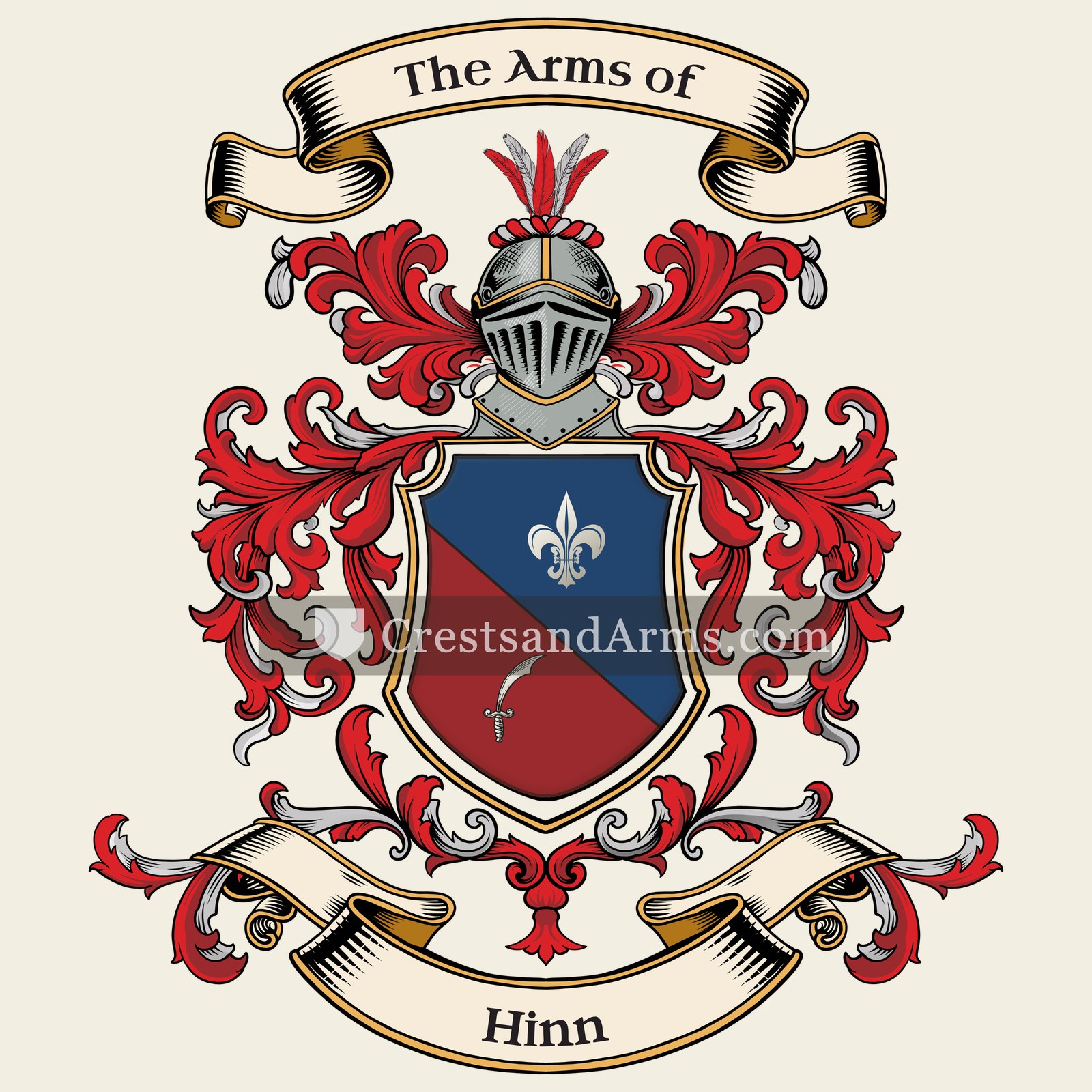
 swordJustice, and military honour
 fleur de lisPurity, light, and the sixth son
 swordJustice, and military honour
 fleur de lisPurity, light, and the sixth son