Map of France showing where the Hirsch arms are recorded
The Hirsch arms were recorded in France, c. 1663.
Arms such as these were typically recorded in Bretagne.
More families held coats of arms in Bretagne than anywhere else in France. The land was divided into many small estates rather than a few large ones, so far more households counted as gentry, and each needed a shield of its own to be told apart.
This is where the arms were entered in the register. Families often moved to other parts of the country, so the same name can turn up in more than one region.
The body that granted and recorded arms in France in this period.
Louis XIV of France
Sovereign of the period
Louis XIV of France
1643–1715
Reigning in France when the Hirsch arms are first recorded.
How Arms Worked in France
In France, a coat of arms was a mark of honor that passed down through the male line to all legitimate descendants. Families often used the same shield without changes to show their shared heritage. If a branch wanted to stand out, they could add a small mark to their shield to show their specific place in the family tree.
Granting authority
The Juge d'armes de France acted as the official authority that regulated and verified coats of arms across the country.
How they got arms
Families typically inherited their arms from ancestors, though they could also receive them through royal grants or by proving their noble status.
Where arms were recorded
Coats of arms were officially recorded in the Armorial Général de France, which began its main collection in the year 1696.
The family's standing
Recorded among the armigerous families of France.
Origin & History of the Hirsch Family in France
The family name Hirsch carries a deep history that traces back to the Germanic linguistic roots of the word for deer, yet its presence in France reveals a unique story of migration and integration. By the mid-seventeenth century, members of the family had established themselves in the region of Bretagne, a coastal area known for its distinct cultural identity and maritime traditions. Settling in this part of France during the year 1663 suggests that the family was part of the broader movement of people crossing borders for trade, craftsmanship, or religious refuge during a time of significant European upheaval. As they integrated into the local Breton society, they likely adapted their linguistic habits and social customs to fit the regional landscape. This early presence in Bretagne highlights how a family name can travel far from its origins to become a permanent part of a new community’s historical fabric.
Coat of Arms & Family Crest Details
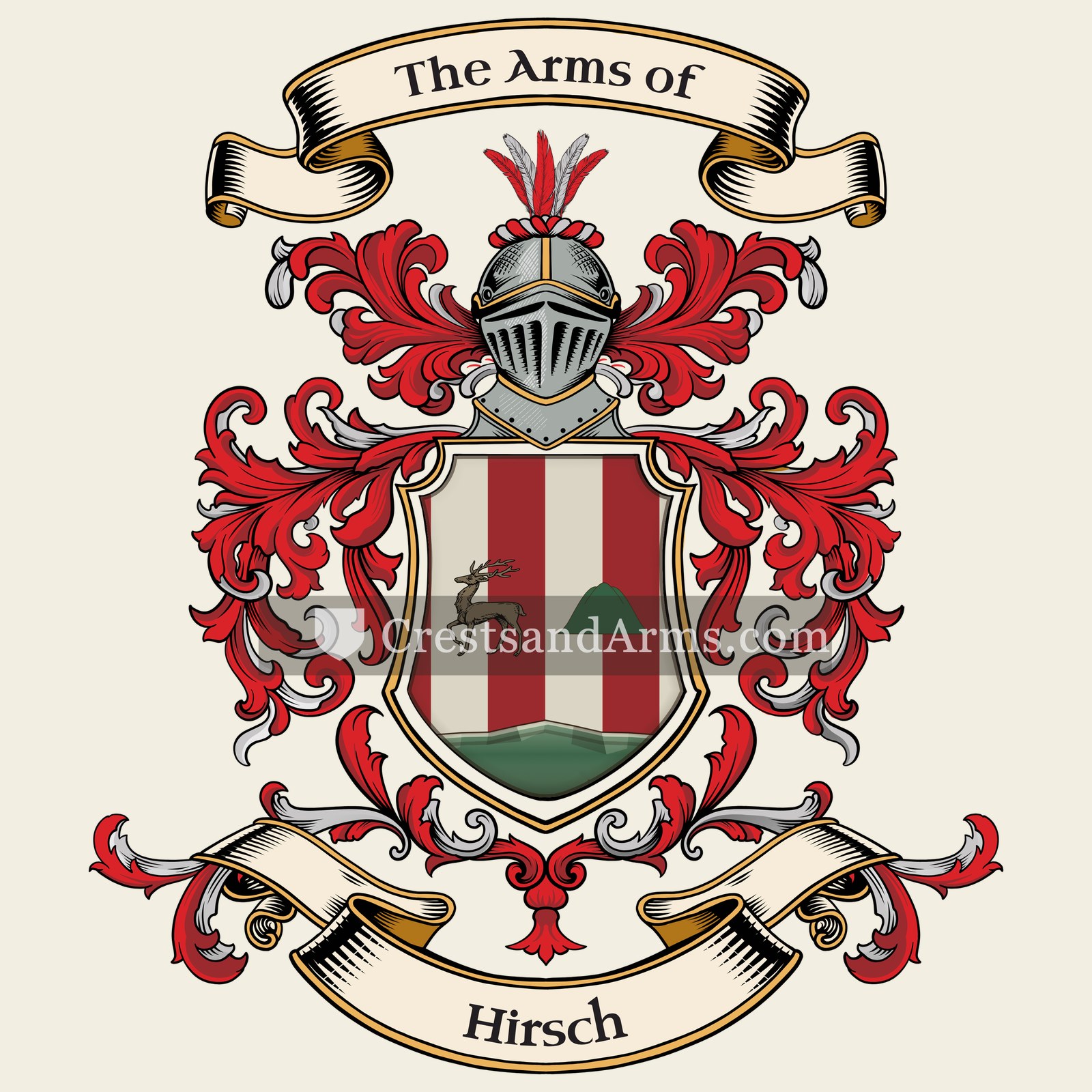
Symbols on this shield
paleMilitary strength, and a fortified defence
mountThe ground held, and steadfastness upon it
stagPeace and harmony, and one who will not fight unprovoked
Colours
Silver (Argent)Means: Peace and sincerity
Green (Vert)Means: Hope
Red (Gules)Means: Military strength
Historical info
Source
J. B. Rietstap, Armorial Général, Gouda: G. B. van Goor Zonen, 1884–87
Blazon (the actual original written record)
“Palé de quatre pièces: d'arg., de gu., d'or et de sa.; à un cerf ramp. au nat., br. sur le palé, soutenu d'un tertre de sin. et tenant entre ses dents une navette au nat. C.: le cerf iss. (moins la navette). L.: à dextre d'or et de sa., à sen. d'arg. et de gu.”
BavariaBavaria, c. 1686
Digital archive packCoat of arms PNG, gold border print PDF, vector SVG and the certificate of authenticity. Sent to your email in minutes.
Map of Germany showing where the Hirsch arms are recorded
The Hirsch arms were recorded in Bavaria, c. 1686.
Bavaria was a country of old landed families and walled market towns. Estates passed down the same line for centuries, and both the landowners and the leading townsmen kept arms, which is why so many Bavarian names sit in the registers.
This is where the arms were entered in the register. Families often moved to other parts of the country, so the same name can turn up in more than one region.
The body that granted and recorded arms in Germany in this period.
Leopold I, Holy Roman Emperor
Sovereign of the period
Leopold I, Holy Roman Emperor
1658–1705
Reigning in France when the Hirsch arms are first recorded.
How Arms Worked in Germany
In the Holy Roman Empire, coats of arms were often granted to individuals by the Emperor or his representatives. These arms were then passed down through the generations to all legitimate descendants of the original holder. Younger branches of a family usually kept the same shield design without needing to change it, as the arms belonged to the entire lineage.
Granting authority
The Holy Roman Emperor held the sole power to grant new coats of arms throughout his vast imperial territories.
How they got arms
Families typically obtained their coats of arms through a formal imperial grant or by proving their noble status to the authorities.
Where arms were recorded
These grants were officially recorded in the Imperial Chancery registers, which began keeping formal records of such honors during the Middle Ages.
The family's standing
Recorded among the armigerous families of Bavaria.
Origin & History of the Hirsch Family in Germany
The surname Hirsch originates from the German word for deer, a name that likely began as a descriptive nickname or a house sign in medieval times. By the late 17th century, the family was firmly established in the region of Bavaria, where records confirm their presence as early as 1686. During this period, surnames were becoming increasingly standardized to help local governments track residents for tax and census purposes. Families often adopted names based on their trade, their physical appearance, or the specific location where they lived. Because the deer was a common symbol in the forests of Southern Germany, the name Hirsch became a popular choice for families living near wooded areas or those who worked in forestry and hunting. Over generations, the name transitioned from a simple identifier into a permanent family legacy that reflected the deep connection between the people and the Bavarian landscape.
Related Branches & Arms
Root word
Hirz
A Middle High German term for a male deer or stag.
This name
HirschAn occupational or habitational surname derived from the German word for deer, often associated with Jewish families.
also spelled
Hirscher
Hirsche
Hyrsch
Hirsh
Documented Sources
J. B. Rietstap, Armorial Général, Gouda: G. B. van Goor Zonen, 1884–87
Archives départementales d'Ille-et-Vilaine, Registres paroissiaux et d'état civil, 1663
Gauvard, Claude, La France au Moyen Âge du Ve au XVe siècle, 1996
Le Goff, Jacques, Bretagne: Histoire et civilisation, 1988
Digital archive packCoat of arms PNG, gold border print PDF, vector SVG and the certificate of authenticity. Sent to your email in minutes.


 fessThe military belt, and readiness to serve
 fessThe military belt, and readiness to serve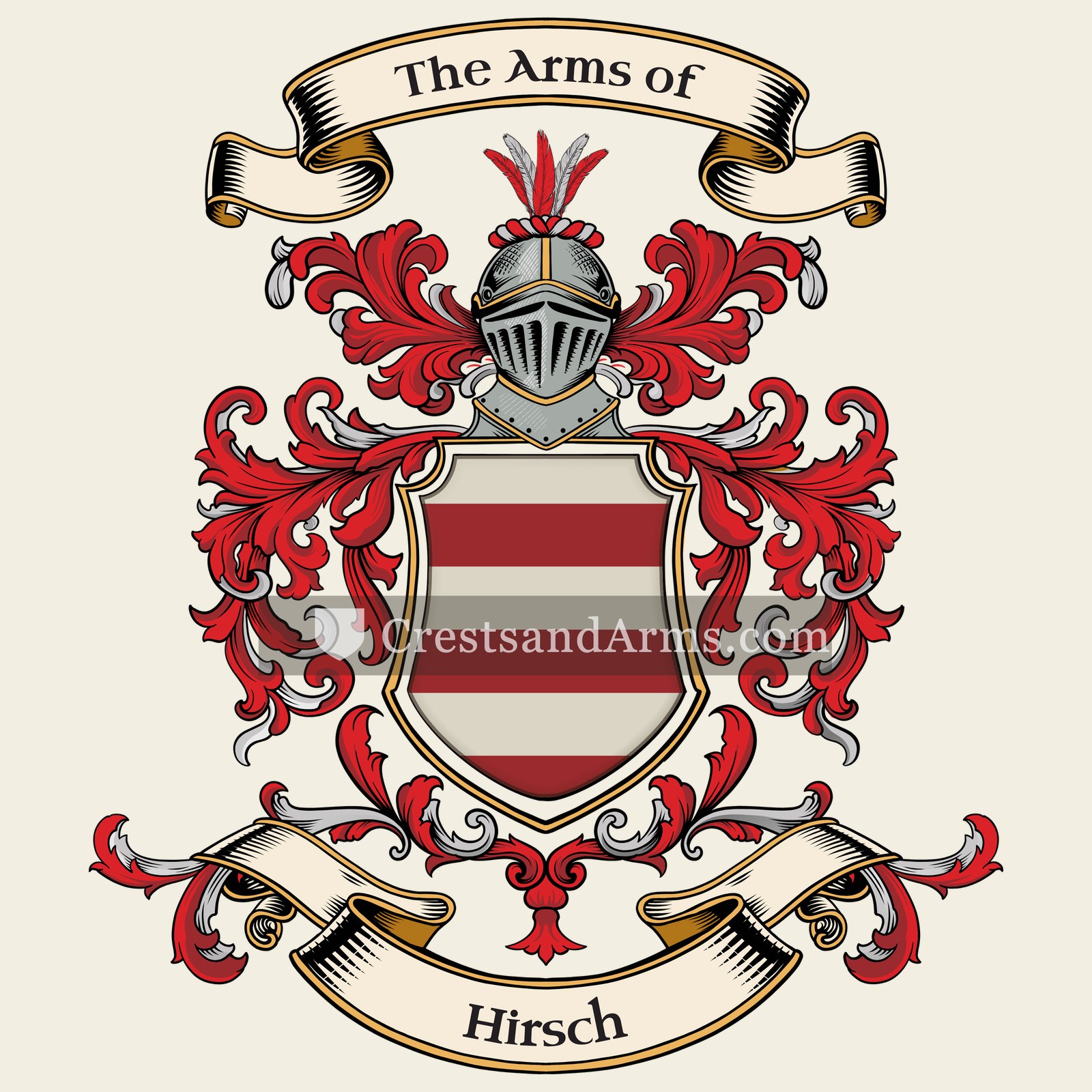


 paleMilitary strength, and a fortified defence
 mountThe ground held, and steadfastness upon it
 stagPeace and harmony, and one who will not fight unprovoked