A record of documented arms, meaning and origin, researched for the Hirschman family lines. Documented in 2 countries.
Reg. 9368 · Dutch, G–I
Coat of Arms & Family Crest Details
Symbols on this shield
cross symbolChristian faith and service
lanceKnightly service and the tilt
Colours
Gold (Or)Means: Generosity
Silver (Argent)Means: Peace and sincerity
Blue (Azure)Means: Loyalty and truth
Red (Gules)Means: Military strength
Historical info
Source
J. B. Rietstap, Armorial Général, Gouda: G. B. van Goor Zonen, 1884–87
Blazon (the actual original written record)
“Coupé: au 1 d'or à deux croisettes pattées de ...., accostées; au 2 d'arg. à un trident au nat., posé en barre. A trois trangles ondées d'azur, alternant avec deux trangles ondées d'arg., br. sur le coupé. C.: un bras arm., brandissant une massue. S.: deux cerfs, au nat.”
Netherlandsc. 1815
Digital archive packCoat of arms PNG, gold border print PDF, vector SVG and the certificate of authenticity. Sent to your email in minutes.
Map of Netherlands showing where the Hirschman arms are recorded
The Hirschman arms were recorded in Netherlands, c. 1815.
Arms such as these were typically recorded in Friesland.
Friesland was low, wet country on the northern coast of the Netherlands, farmed by families who had held the same land for centuries. Free landholders were unusually common there, and a free landholder could carry arms.
This is where the arms were entered in the register. Families often moved to other parts of the country, so the same name can turn up in more than one region.
Region
Friesland
First recorded
1815
Granting Authority for the Hirschman Arms
Hoge Raad van Adel
Photograph made by me · CC BY-SA 3.0
The body that granted and recorded arms in Netherlands in this period.
William I of the Netherlands
Sovereign of the period
William I of the Netherlands
1815–1840
Reigning in Netherlands when the Hirschman arms are first recorded.
How Arms Worked in Netherlands
In the Netherlands, coats of arms were often used by noble families and those who held specific public offices. These arms were passed down through the generations to legitimate descendants. Younger branches of a family usually kept the original design without needing to add special marks. This system ensured that the family identity remained clear and consistent over many years.
Granting authority
The Hoge Raad van Adel is the official body that regulates and manages noble titles and coats of arms in the Netherlands.
How they got arms
Families typically obtained their coats of arms through official royal grants or by proving their long-standing historical use of the symbols.
Where arms were recorded
Coats of arms are officially recorded in the registers held by the Hoge Raad van Adel, which began its work in 1814.
The family's standing
Recorded among the armigerous families of Netherlands.
Origin & History of the Hirschman Family in Netherlands
The history of the Hirschman name in the Netherlands is deeply connected to the social shifts of the early nineteenth century. When the Dutch government mandated the formal registration of surnames in 1811, many families of Germanic or Jewish descent adopted names that reflected their heritage or personal traits. The name Hirschman, which translates from German as deer man, likely arrived in the northern province of Friesland through migration patterns common among merchants and craftsmen moving across European borders. By 1815, records confirm that members of the family were already established within the Frisian community. This period was a time of significant transition as the region moved from French administrative control to the newly formed Kingdom of the Netherlands. The family likely integrated into local life by participating in the regional economy, which relied heavily on agriculture and trade. Their presence in Friesland during this era highlights the broader movement of families seeking stability and new opportunities in the northern provinces during the post-Napoleonic reconstruction of Dutch society.
Coat of Arms & Family Crest Details
Symbols on this shield
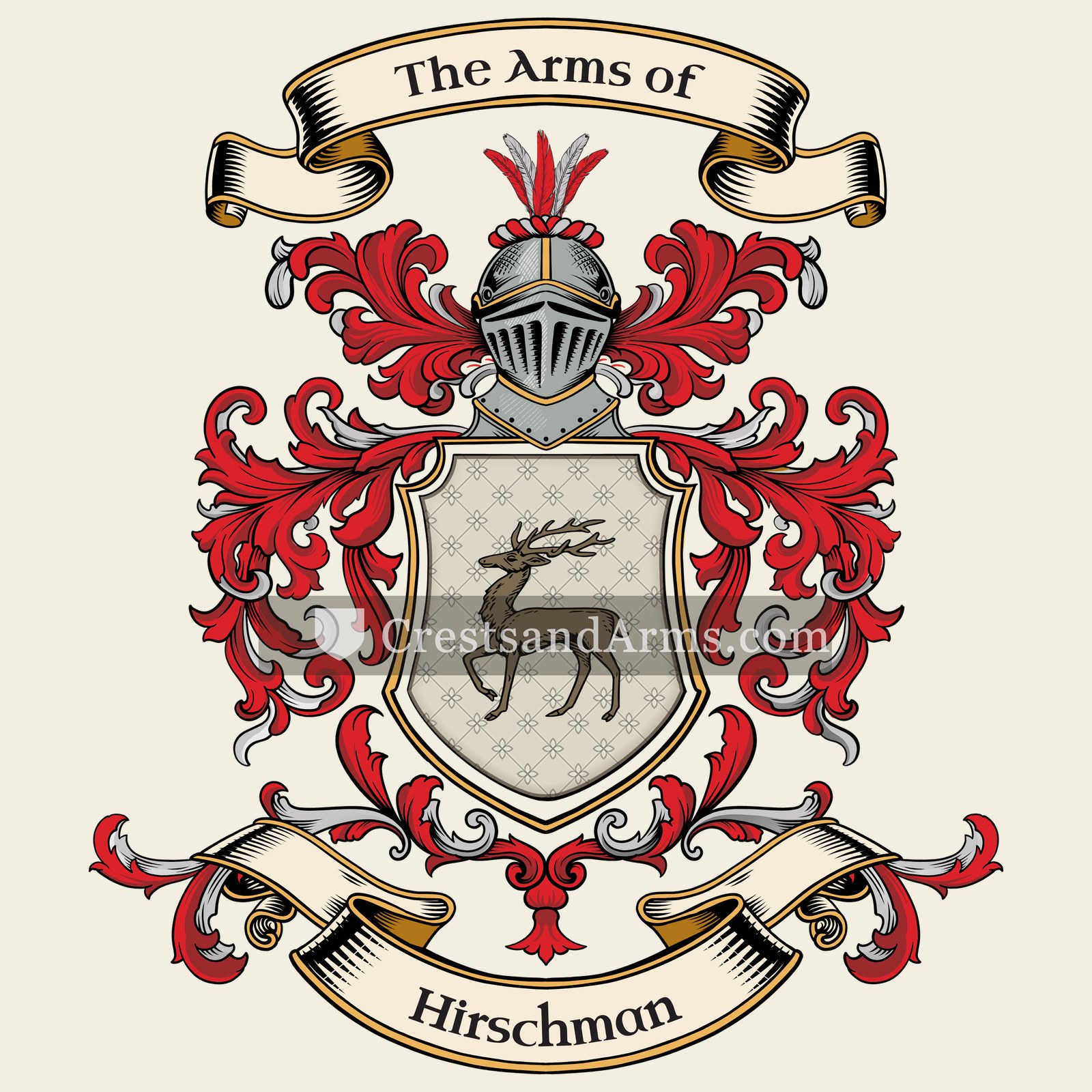
stagPeace and harmony, and one who will not fight unprovoked
Colours
Silver (Argent)Means: Peace and sincerity
Historical info
Source
J. B. Rietstap, Armorial Général, Gouda: G. B. van Goor Zonen, 1884–87
Blazon (the actual original written record)
“D'arg. à une renne naiss. au nat. C.: un buste d'homme, hab. et tort. d'azur, ceint d'arg., les bras remplacés par deux demi-ramures de renne au nat. L. d'arg. et d'azur.”
FranconiaFranconia, c. 1765
Digital archive packCoat of arms PNG, gold border print PDF, vector SVG and the certificate of authenticity. Sent to your email in minutes.
Map of Germany showing where the Hirschman arms are recorded
The Hirschman arms were recorded in Franconia, c. 1765.
Franconia was a patchwork of small territories in central Germany, full of minor landowners and prosperous market towns. So many separate households held land there that the region produced a great many coats of arms.
This is where the arms were entered in the register. Families often moved to other parts of the country, so the same name can turn up in more than one region.
The body that granted and recorded arms in Germany in this period.
Francis I, Holy Roman Emperor
Sovereign of the period
Francis I, Holy Roman Emperor
1745–1765
Reigning in Netherlands when the Hirschman arms are first recorded.
How Arms Worked in Germany
In the Holy Roman Empire, coats of arms were often granted to individuals by the Emperor or his representatives. These arms were then passed down through the generations to all legitimate descendants of the original holder. Younger branches of a family usually kept the same shield design without needing to change it, as the arms belonged to the entire lineage.
Granting authority
The Holy Roman Emperor held the sole power to grant new coats of arms throughout his vast imperial territories.
How they got arms
Families typically obtained their coats of arms through a formal imperial grant or by proving their noble status to the authorities.
Where arms were recorded
These grants were officially recorded in the Imperial Chancery registers, which began keeping formal records of such honors during the Middle Ages.
The family's standing
Recorded among the armigerous families of Franconia.
Origin & History of the Hirschman Family in Germany
The surname Hirschman belongs to a group of German names derived from the Middle High German word *hirz*, meaning stag or deer. In the context of eighteenth-century Franconia, this name likely functioned as a descriptive identifier for individuals living near a house marked with a deer sign or for those who worked in forestry and game management. By 1765, families bearing this name were well-established within the social and economic fabric of the Franconian region, which was then a patchwork of small territories under the influence of the Holy Roman Empire. During this era, the family would have navigated the strict local regulations regarding residency and trade that governed daily life in German towns. As the name spread through the region, it became a marker of a family’s long-standing connection to the rural and semi-urban landscapes of southern Germany, reflecting a time when surnames were increasingly used by officials to track taxpayers and community members.
Related Branches & Arms
Root word
Hirsch
A German word meaning deer or stag.
This name
HirschmanA topographic or occupational name for someone living near a deer forest or a hunter.
also spelled
Hirschman
Hirshman
Documented Sources
J. B. Rietstap, Armorial Général, Gouda: G. B. van Goor Zonen, 1884–87
AlleFriezen, Burgerlijke Stand Friesland (Civil Registry of Friesland)
Nationaal Archief, Registers van de Burgerlijke Stand (National Archives, Civil Registry Registers)
Meertens, P.J., De betekenis van de Nederlandse familienamen, 1959
Van Driel, L., Naamgeving in Nederland: Een geschiedenis van achternamen, 2005
Digital archive packCoat of arms PNG, gold border print PDF, vector SVG and the certificate of authenticity. Sent to your email in minutes.


 cross symbolChristian faith and service
 lanceKnightly service and the tilt
 cross symbolChristian faith and service
 lanceKnightly service and the tilt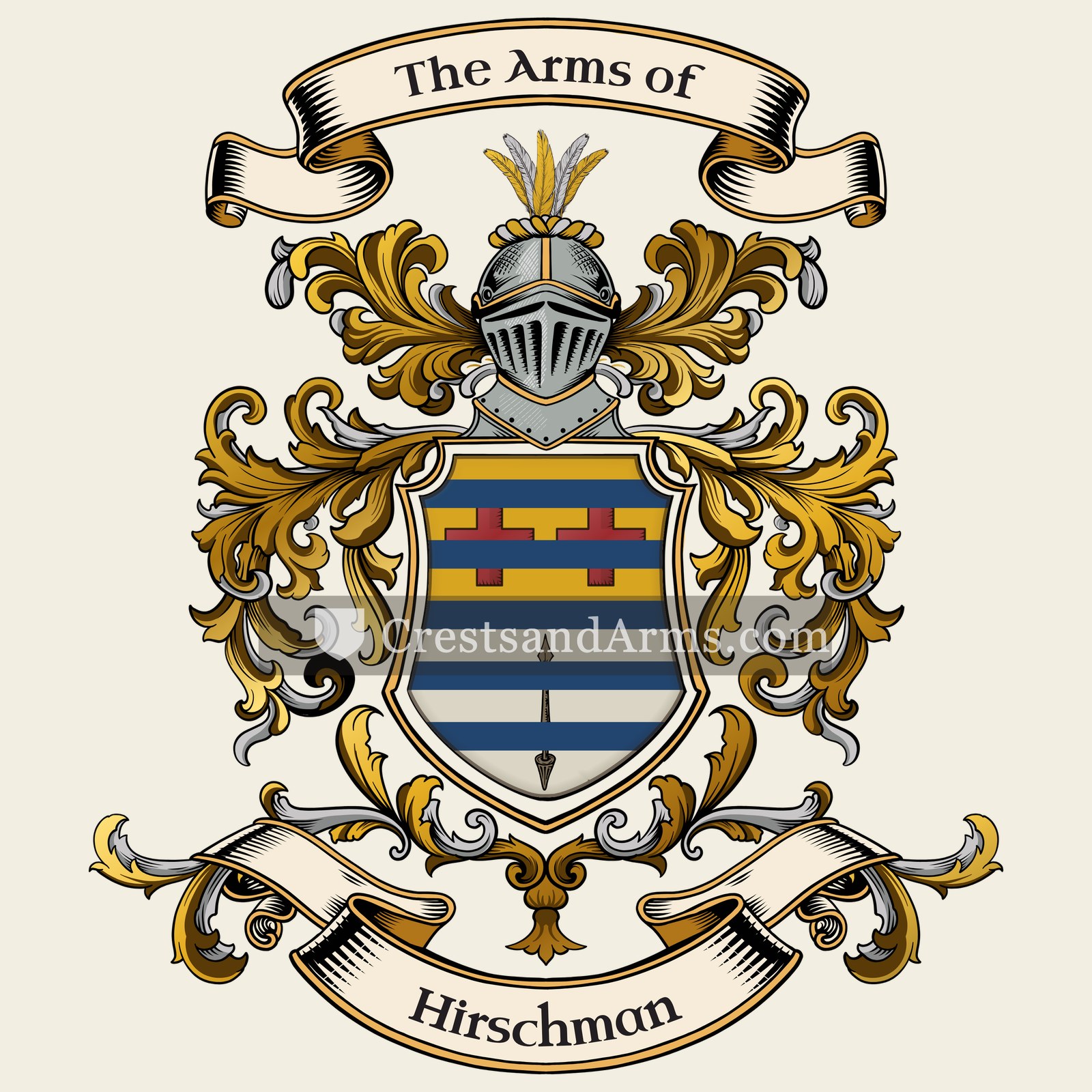


 stagPeace and harmony, and one who will not fight unprovoked