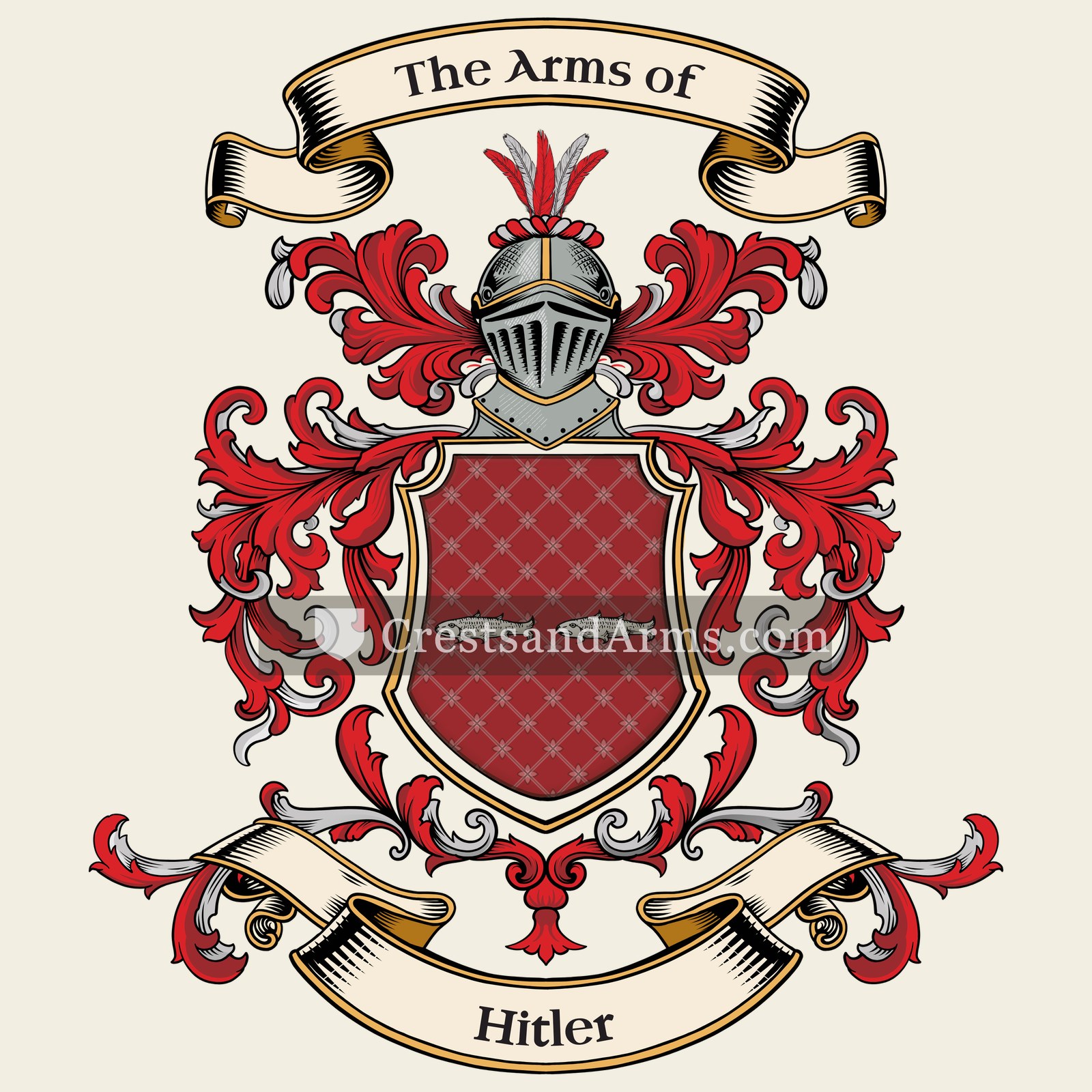
A record of documented arms, meaning and origin, researched for the Hitler family of Austria.
Reg. 1219 · Austrian, G–I
Coat of Arms & Family Crest Details
Symbols on this shield
saltireResolution, and St Andrew's cross
fishA true and generous mind, and Christian faith
Colours
Red (Gules)Means: Military strength
Historical info
Source
J. B. Rietstap, Armorial Général, Gouda: G. B. van Goor Zonen, 1884–87
Blazon (the actual original written record)
“De gu. à deux barbeaux au nat., passés en saut. C.: un jeune homme iss., aux cheveux blonds, tort. de gu. et d'arg., hab. d'un parti d'arg. et de gu., tenant de chaque main un barbeau au nat., en pal. L. d'arg. et de gu.”
Austriac. 1499
Digital archive packCoat of arms PNG, gold border print PDF, vector SVG and the certificate of authenticity. Sent to your email in minutes.
Map of Austria showing where the Hitler arms are recorded
The Hitler arms were recorded in Austria, c. 1499.
Arms such as these were typically recorded in Tyrol.
Tyrol was mountain country in western Austria, where the valleys were held by families who had been there a very long time. Old tenure counted for more than money, and old families carried arms.
This is where the arms were entered in the register. Families often moved to other parts of the country, so the same name can turn up in more than one region.
Region
Tyrol
First recorded
1499
Granting Authority for the Hitler Arms
Imperial and Royal chancery
Sodacan · CC BY-SA 3.0
The body that granted and recorded arms in Austria in this period.
How Arms Worked in Austria
Austrian coats of arms were often linked directly to noble titles granted by the Emperor. These symbols belonged to the entire family line rather than just one individual. When a family grew, new branches kept the original design without needing to change it. This system allowed all members of a noble house to share the same identity across many generations.
Granting authority
The Imperial and Royal chancery managed all heraldic matters and controlled the official granting of arms throughout the Austrian lands.
How they got arms
Families typically received their arms through a formal imperial decree that often accompanied the elevation of a person to noble status.
Where arms were recorded
Official records of these grants were kept in the Imperial Register of Nobility which began its formal documentation process in 1453.
The family's standing
Recorded among the armigerous families of Austria.
Origin & History of the Hitler Family in Austria
The history of the surname Hitler traces back to the mountainous region of Tyrol, where records confirm the family was present as early as 1499. The name itself is thought to be a variation of older terms like Hiedler or Hüttler, which were common in the southern German and Austrian regions. Linguists believe these names often described a person who lived in a small hut or worked on a plot of land near a river. Because spelling was not standardized in the fifteenth century, the name appeared in many different forms across church registers and tax documents. Over several generations, the family moved through various parts of Lower Austria, maintaining a lifestyle primarily rooted in farming and rural labor. These early ancestors lived quiet lives as peasants and tradespeople long before the name became associated with modern history.
Related Branches & Arms
Root word
Hütte
A small hut or cottage used by a forest dweller.
This name
HitlerOne who lives in or works at a small hut or cabin.
also spelled
Hitzlere
Documented Sources
J. B. Rietstap, Armorial Général, Gouda: G. B. van Goor Zonen, 1884–87
Hamann, Brigitte. Hitlers Wien: Lehrjahre eines Diktators. 1996
Kershaw, Ian. Hitler: 1889–1936 Hubris. 1998
Lower Austrian State Archives (Niederösterreichisches Landesarchiv), Tauf- und Heiratsbücher der Pfarreien des Waldviertels
Digital archive packCoat of arms PNG, gold border print PDF, vector SVG and the certificate of authenticity. Sent to your email in minutes.


 saltireResolution, and St Andrew's cross
 fishA true and generous mind, and Christian faith
 saltireResolution, and St Andrew's cross
 fishA true and generous mind, and Christian faith