Map of Belgium showing where the Hnin arms are recorded
The Hnin arms were recorded in Flandre, c. 1663.
Flandre grew rich on cloth, and its towns were among the busiest in Europe. Merchant families bought land with their profits and took arms to go with it, so trade put as many names in the registers here as land did.
This is where the arms were entered in the register. Families often moved to other parts of the country, so the same name can turn up in more than one region.
The body that granted and recorded arms in Belgium in this period.
Philip IV of Spain
Sovereign of the period
Philip IV of Spain
1621–1665
Reigning in Belgium when the Hnin arms are first recorded.
How Arms Worked in Belgium
In Belgium, a coat of arms is considered personal property that is passed down through the male line to legitimate descendants. Families often use the same shield design across generations to show their shared heritage. If a branch of the family wants to change the design, they must apply for an official update to their specific version of the arms.
Granting authority
The Conseil héraldique is the official body that regulates and approves all coats of arms in Belgium.
How they got arms
Families obtain their coats of arms through formal royal grants or by confirming their historical right to use existing designs.
Where arms were recorded
All approved coats of arms are officially recorded in the public registers of the Conseil héraldique since 1844.
The family's standing
Recorded among the armigerous families of Flandre.
Origin & History of the Hnin Family in Belgium
The history of the Hnin family name finds its earliest documented roots in the region of Flandre during the year 1663. At this time, the area was a complex landscape of shifting borders and agricultural communities where families were often tied closely to the land and local parish life. The name likely emerged as a localized identifier within these Flemish-speaking territories, reflecting the linguistic patterns and naming customs common to the seventeenth-century Low Countries. As the family established itself in this region, they were part of a society transitioning through significant political changes, which influenced how records were kept and how names were recorded in official registers. By tracing these early appearances in Flandre, we see a family that was integrated into the social and economic fabric of a region known for its trade, craftsmanship, and resilient local traditions.
Related Branches & Arms
Root word
Hnin
Derived from the Burmese word for snow or delicate frost.
This name
HninA name symbolizing purity, elegance, and a gentle, cool nature.
also spelled
Honinn
Honine
Documented Sources
J. B. Rietstap, Armorial Général, Gouda: G. B. van Goor Zonen, 1884–87
Algemeen Rijksarchief (General State Archives of Belgium), Parochieregisters van de Zuidelijke Nederlanden (Parish registers of the Southern Netherlands)
De Smet, J., Geschiedenis van de Vlaamse familienamen (History of Flemish family names), 1954
Vandenbosch, M., Demografie en sociale structuren in de 17e eeuwse Nederlanden (Demography and social structures in the 17th-century Netherlands), 1982
Digital archive packCoat of arms PNG, gold border print PDF, vector SVG and the certificate of authenticity. Sent to your email in minutes.


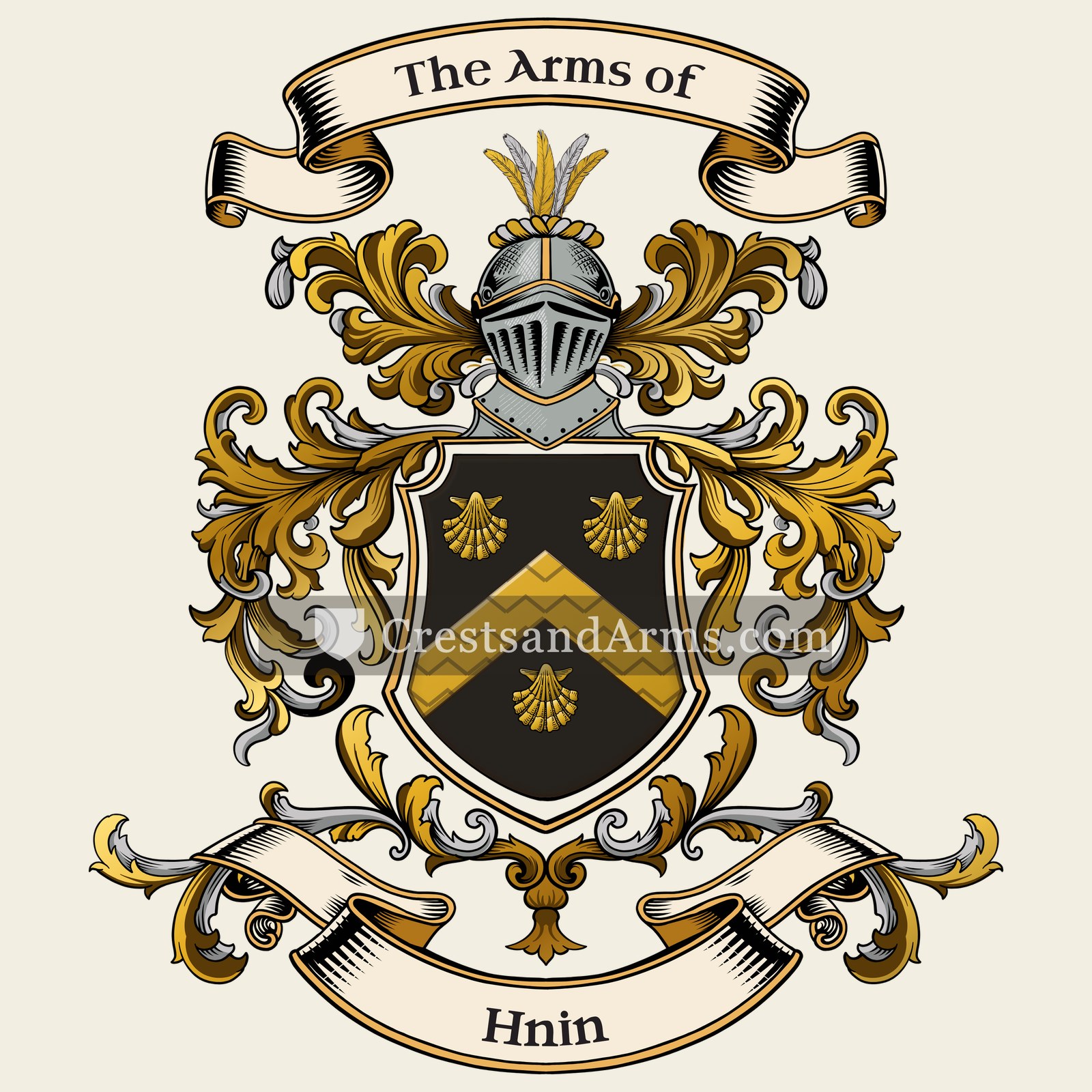
 chevronProtection, and faithful service completed
 escallopThe pilgrim's shell, and a long journey made
 chevronProtection, and faithful service completed
 escallopThe pilgrim's shell, and a long journey made