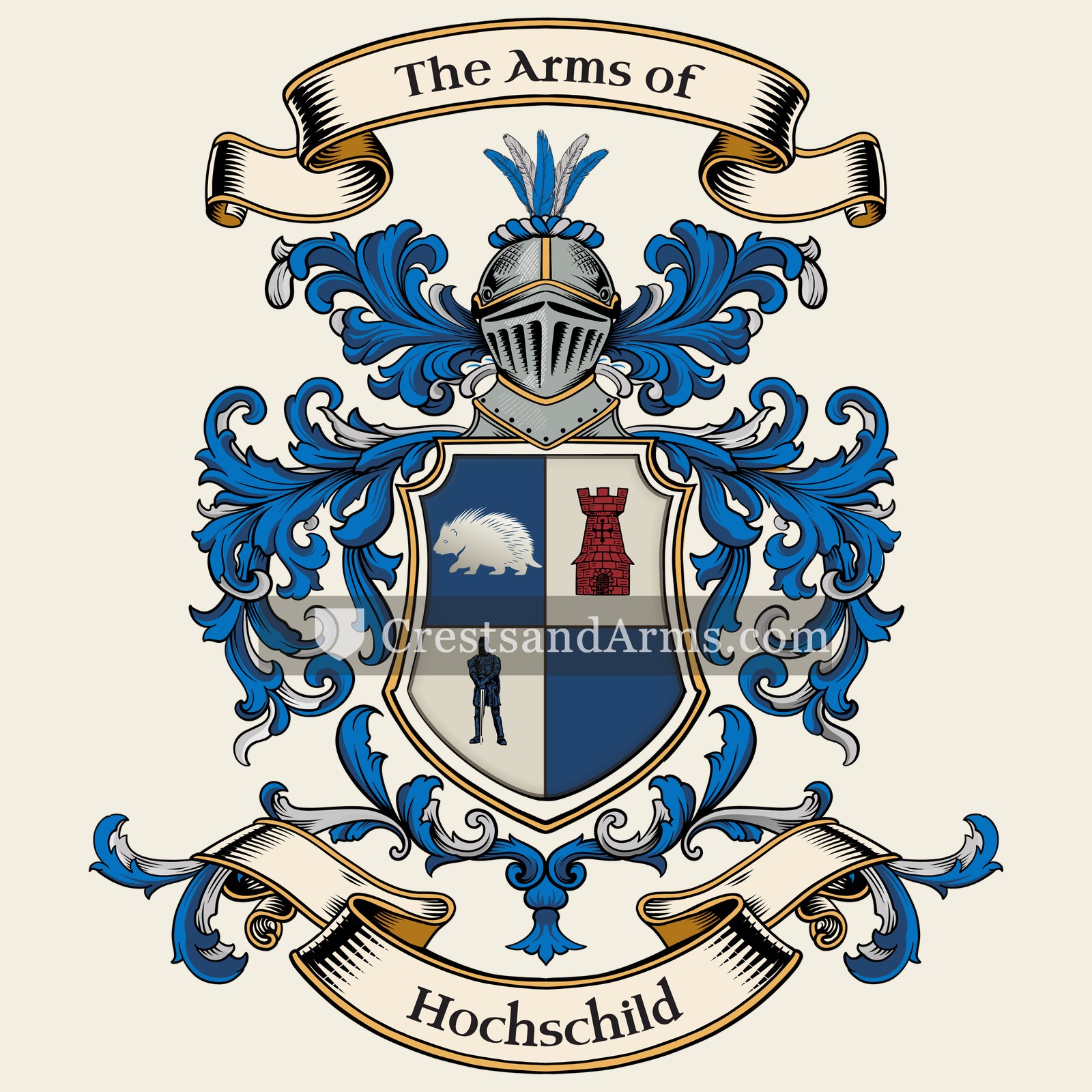
A record of documented arms, meaning and origin, researched for the Hochschild family of Sweden.
Reg. 4925 · Swedish, G–I
Coat of Arms & Family Crest Details
Symbols on this shield
hedgehogA provident provider
towerGrandeur and solidity, and a stronghold defended
knightChivalry and service in arms
Colours
Blue (Azure)Means: Loyalty and truth
Silver (Argent)Means: Peace and sincerity
Red (Gules)Means: Military strength
Historical info
Source
J. B. Rietstap, Armorial Général, Gouda: G. B. van Goor Zonen, 1884–87
Blazon (the actual original written record)
“Ec.: au 1 d'azur à une tortue d'arg., posée en bande; au 2 d'arg. à une tour de gu.; au 3 d'or à un buste de roi cour., posé de front, le tout d'azur; au 4 de gu. à une lettre d'arg., cachetée en cire rouge, posée en fasce. Deux cq. cour. C.: 1° un vol d'arg.; 2° un lion iss. d'or, tenant de ses pattes un faisceau de trois flèches d'or, les pointes en bas. L. d'azur et d'or.”
Swedenc. 1839
Digital archive packCoat of arms PNG, gold border print PDF, vector SVG and the certificate of authenticity. Sent to your email in minutes.
Map of Sweden showing where the Hochschild arms are recorded
The Hochschild arms were recorded in Sweden, c. 1839.
Arms such as these were typically recorded in Stockholm.
Stockholm held the Swedish court and the House of Nobility, where every noble family's arms were entered and kept. Families ennobled for service registered there, which is why so many are recorded around the city.
This is where the arms were entered in the register. Families often moved to other parts of the country, so the same name can turn up in more than one region.
The body that granted and recorded arms in Sweden in this period.
Charles XIV John of Sweden
Sovereign of the period
Charles XIV John of Sweden
1818–1844
Reigning in Sweden when the Hochschild arms are first recorded.
How Arms Worked in Sweden
In Sweden, a coat of arms belonged to a noble family as a whole rather than just one individual. These arms were passed down through the generations to all legitimate descendants. Younger branches of the family used the same shield without needing to change it. This system ensured that the entire lineage shared the same identity and status under the law.
Granting authority
The Riddarhuset, or House of Nobility, regulated all noble coats of arms in Sweden under royal authority.
How they got arms
Families received their coats of arms through royal grants of nobility which were then officially registered with the House.
Where arms were recorded
Coats of arms were officially recorded in the Swedish House of Nobility register starting in the year 1626.
The family's standing
Recorded among the armigerous families of Sweden.
Origin & History of the Hochschild Family in Sweden
The Hochschild family name originates from German-speaking regions and carries a literal meaning related to high or noble shields, though the family rose to prominence through trade and diplomacy rather than ancient battlefield titles. By the time the family established a notable presence in Stockholm in 1839, they were already deeply integrated into the professional and social circles of European high society. Members of the family were known for their roles as diplomats and influential figures who navigated the complex political landscape of the nineteenth century. Their move to Sweden marked a significant chapter in their history, as they helped bridge connections between Swedish interests and the broader European continent. This transition into Swedish life allowed the family to maintain a reputation for intellectual and political service that continued for several generations.
Related Branches & Arms
Root word
Hoch-Schild
High or tall combined with a shield or protective covering.
This name
HochschildA topographic or habitational name referring to someone living near a high shield-shaped landmark or fortification.
also spelled
Hockschild
Hochshild
Hochschilde
Hokshild
Documented Sources
J. B. Rietstap, Armorial Général, Gouda: G. B. van Goor Zonen, 1884–87
Elgenstierna, Gustaf. Den introducerade svenska adelns ättartavlor. 1925


 hedgehogA provident provider
 towerGrandeur and solidity, and a stronghold defended
 knightChivalry and service in arms
 hedgehogA provident provider
 towerGrandeur and solidity, and a stronghold defended
 knightChivalry and service in arms