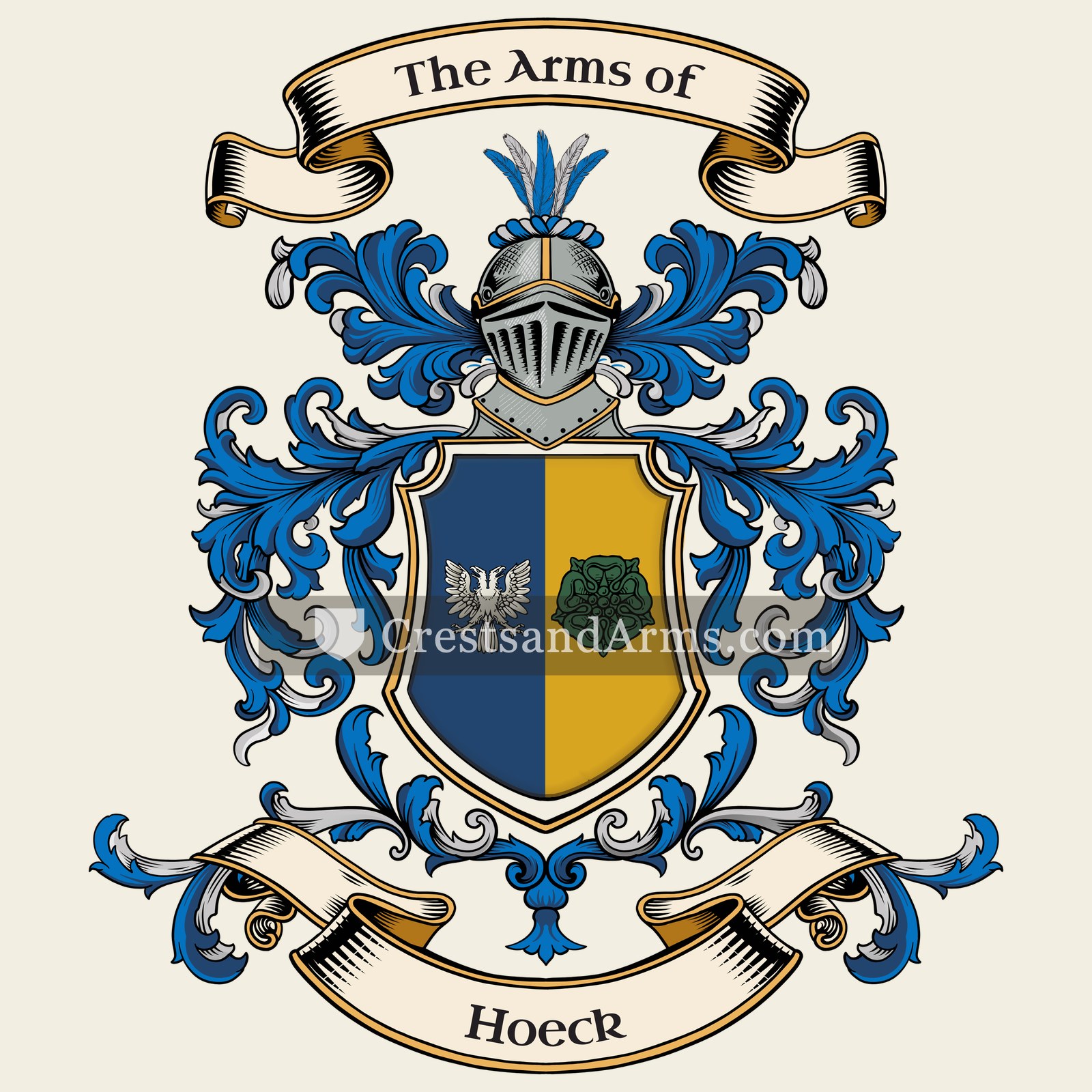
A record of documented arms, meaning and origin, researched for the Hoeck family of Poland.
Reg. 1774 · Polish, G–I
Coat of Arms & Family Crest Details
Symbols on this shield
eagleNobility, strength and a keen mind
roseThe seventh son, and beauty with grace
Colours
Blue (Azure)Means: Loyalty and truth
Gold (Or)Means: Generosity
Silver (Argent)Means: Peace and sincerity
Green (Vert)Means: Hope
Historical info
Source
J. B. Rietstap, Armorial Général, Gouda: G. B. van Goor Zonen, 1884–87
Blazon (the actual original written record)
“Parti: au 1 d'azur à la demi-aigle d'arg., mouv. du parti; au 2 d'or à un rosier de sin., fleuri à dextre de trois roses de gu., bout. d'or, l'une sur l'autre. Cq. cour. C.: le rosier du 2, entre deux pl. d'aut. d'azur. L.: à dextre d'arg. et d'azur, à sen. d'or et de gu.”
CourlandCourland, c. 1772
Digital archive packCoat of arms PNG, gold border print PDF, vector SVG and the certificate of authenticity. Sent to your email in minutes.
Map of Poland showing where the Hoeck arms are recorded
The Hoeck arms were recorded in Courland, c. 1772.
Courland was Baltic coast country held in large estates by a small number of families. They kept their land for generations and served as officers abroad, and both landholding and service brought arms with them.
This is where the arms were entered in the register. Families often moved to other parts of the country, so the same name can turn up in more than one region.
Region
Courland
First recorded
1772
Granting Authority for the Hoeck Arms
Ennoblement by the Sejm
Author: Olek Remesz · CC BY-SA 3.0
The body that granted and recorded arms in Poland in this period.
Stanisław August Poniatowski
Sovereign of the period
Stanisław August Poniatowski
1764–1795
Reigning in Poland when the Hoeck arms are first recorded.
How Arms Worked in Poland
Polish noble families shared a single coat of arms across many different surnames, creating large clans rather than individual designs. These symbols were held collectively by all members of the clan regardless of their specific family name. When a new family joined the nobility, they were adopted into an existing clan and began using that group's established shield.
Granting authority
The Sejm, which was the Polish parliament, held the power to grant noble status and the right to bear arms.
How they got arms
Families typically received their coat of arms through a formal act of ennoblement granted by the Sejm for distinguished service.
Where arms were recorded
These grants were officially recorded in the Crown Metrica, which served as the central archive for state documents starting in the sixteenth century.
The family's standing
Recorded among the armigerous families of Courland.
Origin & History of the Hoeck Family in Poland
The surname Hoeck is rooted in the Low German language, where it originally functioned as a topographic name for someone who lived near a corner, a bend in a road, or a small piece of land. By the late 18th century, the family had established a notable presence in the Baltic region of Courland. Records from 1772 confirm that members of the Hoeck family were living in this area, which was then a duchy under the influence of the Russian Empire. During this period, families in Courland often moved between urban centers and rural estates, participating in the complex social and economic life of the Baltic Germans. As the family settled into this region, the name became a permanent marker of their heritage, connecting their Germanic linguistic origins to the unique cultural landscape of the eastern Baltic coast.
Related Branches & Arms
Root word
Hok
A Middle Low German term referring to a hook or corner.
This name
HoeckA topographic name for someone who lived near a sharp bend or corner of a road.
also spelled
Hoeck
von Hook
Documented Sources
J. B. Rietstap, Armorial Général, Gouda: G. B. van Goor Zonen, 1884–87
Latvian State Historical Archives (Latvijas Valsts vēstures arhīvs), Fond 235 (Evangelical Lutheran Church Records of Courland)
Bahlow, Hans, Deutsches Namenlexikon: Familien- und Vornamen nach Ursprung und Sinn erklärt, 1967
Mettig, Constantin, Geschichte der Stadt Riga, 1897
Digital archive packCoat of arms PNG, gold border print PDF, vector SVG and the certificate of authenticity. Sent to your email in minutes.


 eagleNobility, strength and a keen mind
 roseThe seventh son, and beauty with grace
 eagleNobility, strength and a keen mind
 roseThe seventh son, and beauty with grace