Map of Germany showing where the Hoeg arms are recorded
The Hoeg arms were recorded in Holstein, c. 1765.
Holstein was farming country between the North Sea and the Baltic, held in large estates. The same families kept the same land for generations, and generations of holding is what fills a register.
This is where the arms were entered in the register. Families often moved to other parts of the country, so the same name can turn up in more than one region.
The body that granted and recorded arms in Germany in this period.
Francis I, Holy Roman Emperor
Sovereign of the period
Francis I, Holy Roman Emperor
1745–1765
Reigning in Germany when the Hoeg arms are first recorded.
How Arms Worked in Germany
In the Holy Roman Empire, coats of arms were often granted to individuals by the Emperor or his representatives. These arms were then passed down through the generations to all legitimate descendants of the original holder. Younger branches of a family usually kept the same shield design without needing to change it, as the arms belonged to the entire lineage.
Granting authority
The Holy Roman Emperor held the sole power to grant new coats of arms throughout his vast imperial territories.
How they got arms
Families typically obtained their coats of arms through a formal imperial grant or by proving their noble status to the authorities.
Where arms were recorded
These grants were officially recorded in the Imperial Chancery registers, which began keeping formal records of such honors during the Middle Ages.
The family's standing
Recorded among the armigerous families of Holstein.
Origin & History of the Hoeg Family in Germany
The family name Hoeg has deep roots in the northern German region of Holstein, where records confirm members of the family were established by 1765. The name likely originated as a topographic descriptor, derived from the Low German word "Hoge" or "Hoog," which translates to high or elevated. This suggests that the earliest ancestors bearing this name probably lived near a prominent hill, a raised piece of land, or a high embankment in the local landscape. During the eighteenth century, the people of Holstein were primarily engaged in agriculture and trade, and families often identified themselves by the specific features of the land they occupied. As the family grew and moved throughout the region, the name served as a permanent link to their ancestral home and their connection to the geography of northern Germany.
Coat of Arms & Family Crest Details
Colours
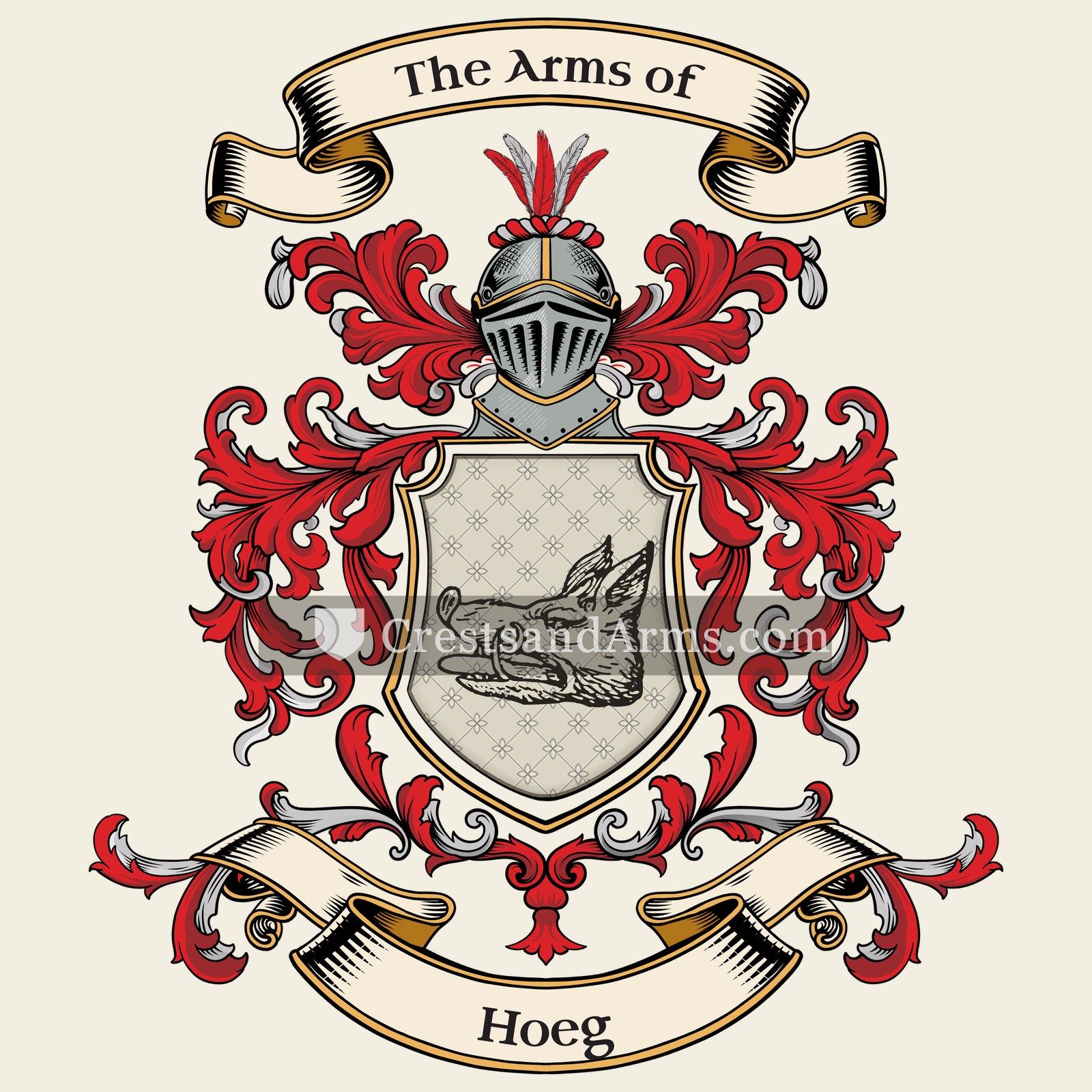
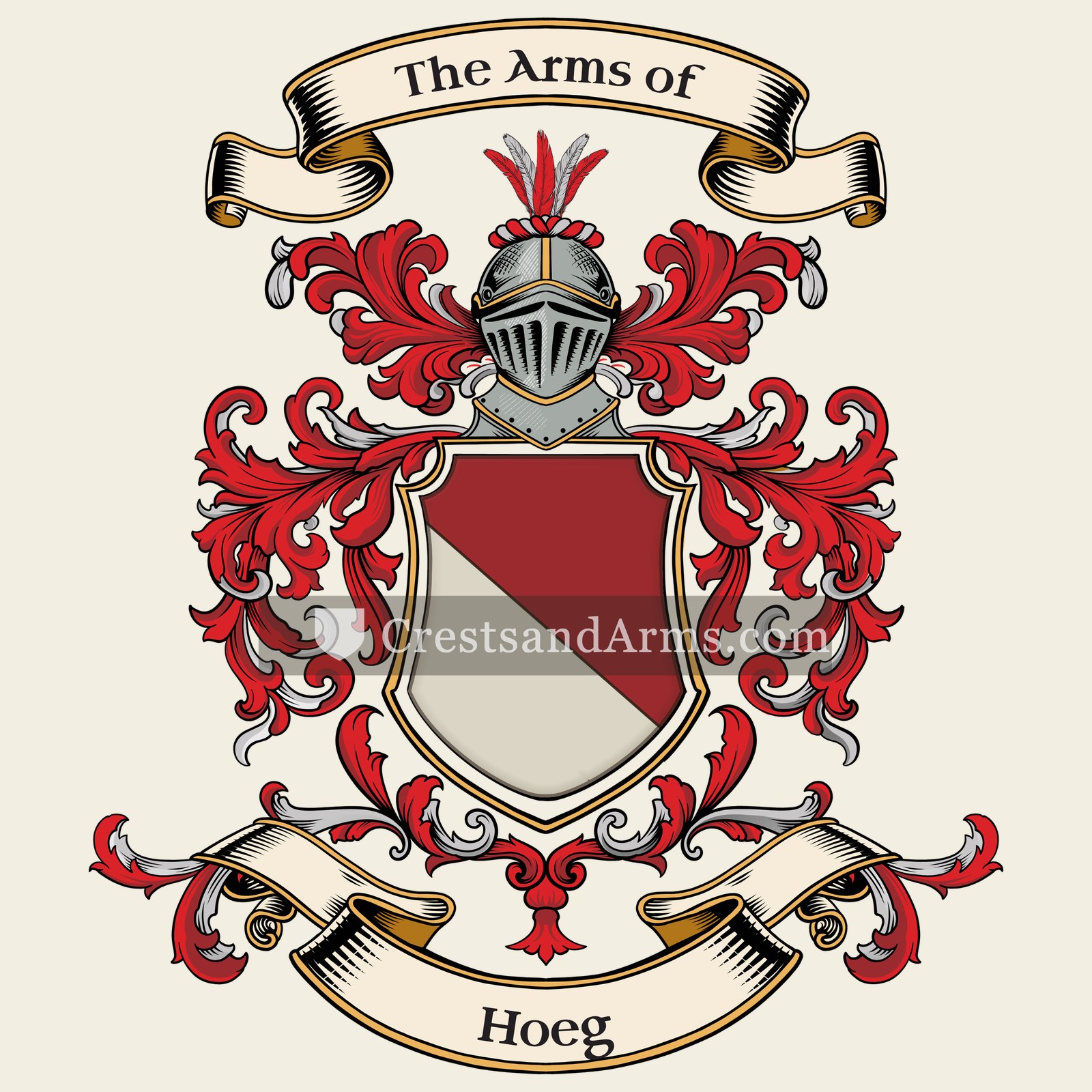
Silver (Argent)Means: Peace and sincerity
Red (Gules)Means: Military strength
Historical info
Source
J. B. Rietstap, Armorial Général, Gouda: G. B. van Goor Zonen, 1884–87
Blazon (the actual original written record)
“tranché d'arg. sur gu. C.: un rang de palissades d'arg., sommé d'un drapeau de gu., enroulé autour de sa trabe, et accosté de dix guidons, alt. d'arg. et de gu.”
Denmarkc. 1722
Digital archive packCoat of arms PNG, gold border print PDF, vector SVG and the certificate of authenticity. Sent to your email in minutes.
Map of Denmark showing where the Hoeg arms are recorded
The Hoeg arms were recorded in Denmark, c. 1722.
Arms such as these were typically recorded in Sjaælland.
Zealand held the Danish court, the crown's offices and Copenhagen itself. Families who served the king kept estates within reach of it, and royal service was the ordinary route to a coat of arms.
This is where the arms were entered in the register. Families often moved to other parts of the country, so the same name can turn up in more than one region.
The body that granted and recorded arms in Denmark in this period.
Frederik IV of Denmark
Sovereign of the period
Frederik IV of Denmark
1699–1730
Reigning in Germany when the Hoeg arms are first recorded.
How Arms Worked in Denmark
Danish heraldry during this period was closely tied to noble status and royal favor rather than being open to all citizens. Arms were typically granted by the monarch to individuals, and these symbols were then shared by all members of the noble house. If a family line died out, the right to use those specific arms ended with them.
Granting authority
The Danish royal chancery held the power to issue and regulate official coats of arms for the kingdom.
How they got arms
Families usually received their arms through a formal royal grant that confirmed their noble status and rights.
Where arms were recorded
These grants were officially recorded in the Danish Royal Chancery records starting in the sixteenth century.
The family's standing
Recorded among the armigerous families of Denmark.
Origin & History of the Hoeg Family in Denmark
The family name Hoeg has deep roots in the Danish landscape, particularly within the region of Sjælland. Historical records confirm that members of the family were established in this area by 1722, living during a time when Denmark was transitioning through significant social and agricultural changes. During the early 18th century, families in Sjælland often lived in tight-knit rural communities where their identity was closely tied to the local parish and the land they worked. The name itself reflects the linguistic traditions of the region, as it is linked to the Old Danish word for a hill or a burial mound. This suggests that the earliest ancestors to carry the name likely lived near a prominent natural landmark or a historic earthwork. By settling in Sjælland, the family became part of the backbone of Danish society, contributing to the local economy and the cultural development of the island for generations.
Hoeg Meaning & Related Branches
Root word
Hoge
Middle Low German term for a high place or hill.
This name
HoegA topographic name for someone who lived on or near a hill or elevated ground.
also spelled
Hoeg
Hoege
Hog
Hoog
Hough
Documented Sources
J. B. Rietstap, Armorial Général, Gouda: G. B. van Goor Zonen, 1884–87
Schütze, Johann Friedrich. Holsteinisches Idiotikon: Ein Beitrag zur Volkssittengeschichte. 1800
Landesarchiv Schleswig-Holstein. Kirchenbücher der evangelisch-lutherischen Kirchengemeinden in Holstein. (Record series: Baptismal, marriage, and burial registers)
Digital archive packCoat of arms PNG, gold border print PDF, vector SVG and the certificate of authenticity. Sent to your email in minutes.


 boars headA fierce fighter who battles to the end
 boars headA fierce fighter who battles to the end