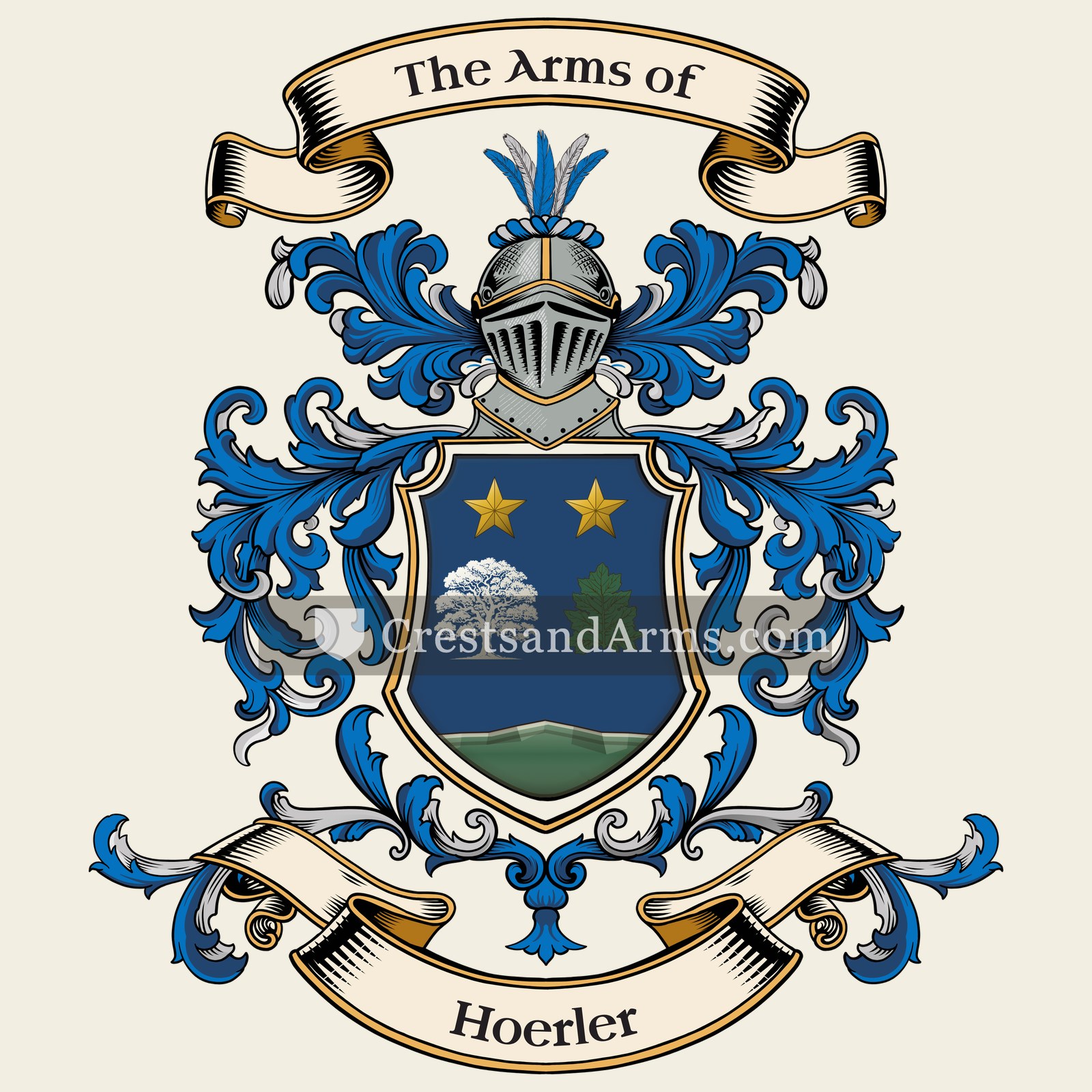
A record of documented arms, meaning and origin, researched for the Hoerler family of Switzerland.
Reg. 3709 · Swiss, G–I
Coat of Arms & Family Crest Details
Symbols on this shield
chiefAuthority, wisdom and dominion
mountThe ground held, and steadfastness upon it
treeLife, endurance and deep roots
leafHappiness and abundance
mulletThe third son, and a divine quality from above
Colours
Blue (Azure)Means: Loyalty and truth
Green (Vert)Means: Hope
Gold (Or)Means: Generosity
Historical info
Source
J. B. Rietstap, Armorial Général, Gouda: G. B. van Goor Zonen, 1884–87
Blazon (the actual original written record)
“D'azur à un chicot au nat., posé en fasce, poussant vers le chef une feuille de tilleul de sin. et soutenu d'un tertre du même; le tout acc. en chef de deux étoiles (5) d'or. C.: un bras, paré d'azur, rebr. d'or, tenant une feuille de tilleul de sin. par la tige. L. d'or et d'azur.”
SwitzerlandBâle, c. 1745
Digital archive packCoat of arms PNG, gold border print PDF, vector SVG and the certificate of authenticity. Sent to your email in minutes.
Map of Switzerland showing where the Hoerler arms are recorded
The Hoerler arms were recorded in Bâle, c. 1745.
This is where the arms were entered in the register. Families often moved to other parts of the country, so the same name can turn up in more than one region.
The body that granted and recorded arms in Switzerland in this period.
How Arms Worked in Switzerland
In Switzerland, coats of arms were not restricted to the nobility and were often adopted by common citizens and families. These symbols were passed down through generations to show family identity. When branches of a family grew, they often changed small details of the design to distinguish their own line from the original group.
Granting authority
Cantonal and civic authorities managed the use of coats of arms within their specific regions and local jurisdictions.
How they got arms
Families typically assumed their own coats of arms based on local custom rather than receiving them from a central monarch.
Where arms were recorded
Arms were recorded in various cantonal and civic registers starting from the fourteenth century throughout the Swiss region.
The family's standing
Recorded among the armigerous families of Switzerland.
Origin & History of the Hoerler Family in Switzerland
The Hoerler family name is deeply rooted in the history of the Swiss region, with documented evidence placing members of the family in the city of Basel by 1745. The name likely originated as a descriptive term for a person’s occupation or their place of residence in the German-speaking territories. In the eighteenth century, Basel was a bustling center for trade and craftsmanship, which suggests that early Hoerlers were likely integrated into the city’s professional guilds or merchant classes. Families during this period often moved between nearby towns and rural areas to find work, meaning the ancestors of the Basel branch may have traveled from smaller villages in the surrounding cantons. By establishing themselves in a major urban hub like Basel, these early family members gained access to better economic opportunities and contributed to the social fabric of a city known for its intellectual and commercial growth.
Related Branches & Arms
Root word
Hor
A Middle High German term referring to a muddy or swampy area.
This name
HoerlerA topographic name for someone who lived near a marsh or muddy ground.
also spelled
Hoerler
Herler
Documented Sources
J. B. Rietstap, Armorial Général, Gouda: G. B. van Goor Zonen, 1884–87
Staatsarchiv Basel-Stadt, Bürgerverzeichnisse der Stadt Basel
Historisches Lexikon der Schweiz, Die Geschichte der Stadt Basel, 2014
Digital archive packCoat of arms PNG, gold border print PDF, vector SVG and the certificate of authenticity. Sent to your email in minutes.


 chiefAuthority, wisdom and dominion
 mountThe ground held, and steadfastness upon it
 treeLife, endurance and deep roots
 leafHappiness and abundance
 mulletThe third son, and a divine quality from above
 chiefAuthority, wisdom and dominion
 mountThe ground held, and steadfastness upon it
 treeLife, endurance and deep roots
 leafHappiness and abundance
 mulletThe third son, and a divine quality from above