Map of Britain showing where the Hoey arms are recorded
The Hoey arms were recorded in Britain, c. 1700.
Arms such as these were typically recorded in Kent.
Kent sits between London and the short crossing to Europe, and the trade passing through made it wealthy. Merchant families bought land with that money, and it was landowners who took coats of arms.
This is where the arms were entered in the register. Families often moved to other parts of the country, so the same name can turn up in more than one region.
The body that granted and recorded arms in Britain in this period.
William III of England
Sovereign of the period
William III of England
1694–1702
Reigning in Britain when the Hoey arms are first recorded.
How Arms Worked in Britain
English heraldry allowed arms to be shared by all legitimate descendants of the original owner. These symbols were treated as personal property that moved through the generations to all children. While the eldest son kept the original design, other family members could use the same shield without needing to change it or register their own unique versions.
Granting authority
The College of Arms in London has regulated the use of coats of arms throughout England and Wales since 1484.
How they got arms
Families typically obtained their coats of arms through a formal grant from the Crown or by proving their ancient right to them.
Where arms were recorded
All official coats of arms are recorded in the registers kept at the College of Arms, which date back to the fifteenth century.
The family's standing
Recorded among the armigerous families of Britain.
Origin & History of the Hoey Family in Britain
The name Hoey has deep roots in the British Isles, with historical records placing members of the family in the county of Kent by the year 1700. During this period, Kent served as a vital hub for trade and agriculture, placing the family in a region that was rapidly modernizing. While the name is often associated with Irish origins, its presence in southeastern England suggests that the family was part of the internal migrations that defined the British landscape during the eighteenth century. Families like the Hoeys often settled in these coastal areas to take advantage of the proximity to London and the bustling maritime economy. As they established themselves in Kent, they became part of the local parish systems, which recorded their births, marriages, and deaths in official registers. This transition into the English countryside reflects a broader pattern of families moving across the United Kingdom to seek new opportunities in farming, craftsmanship, and local commerce.
Coat of Arms & Family Crest Details
Symbols on this shield
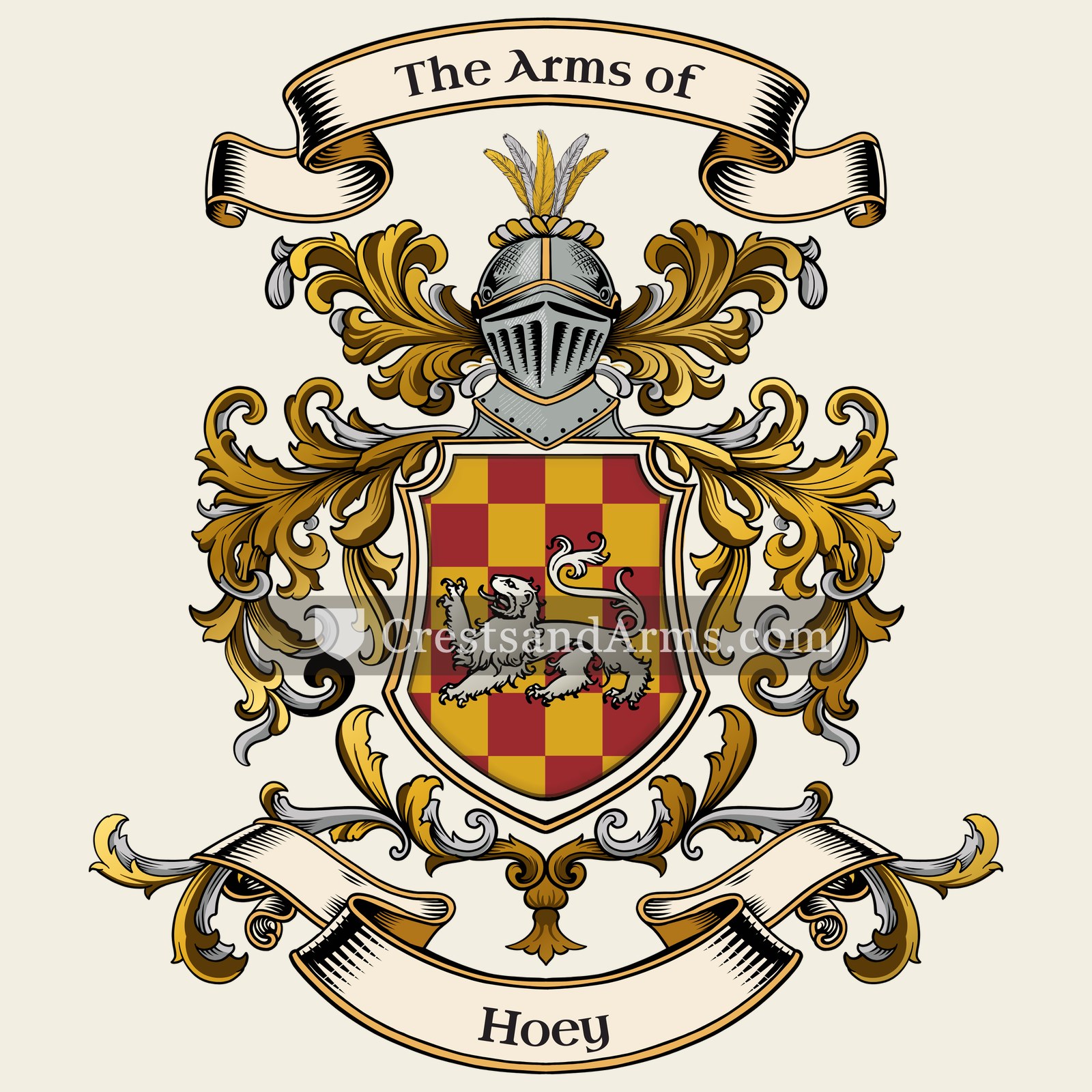
chequyConstancy, and the counting-board
lionCourage, strength and royalty
Colours
Gold (Or)Means: Generosity
Silver (Argent)Means: Peace and sincerity
Red (Gules)Means: Military strength
Historical info
Source
Sir Bernard Burke, The General Armory of England, Scotland, Ireland and Wales, London: Harrison & Sons, 1884
Blazon (the actual original written record)
“Chequy or and gu. a lion ramp. ar. armed and langued az”
WicklowDunganstown · Wicklow, c. 1612
Digital archive packCoat of arms PNG, gold border print PDF, vector SVG and the certificate of authenticity. Sent to your email in minutes.
Map of Ireland showing where the Hoey arms are recorded
The Hoey arms were recorded in Wicklow, c. 1612.
Wicklow was mountain country immediately south of Dublin, the last part of the east coast brought under control. Families granted land there held it under arms, and those grants were recorded.
This is where the arms were entered in the register. Families often moved to other parts of the country, so the same name can turn up in more than one region.
The body that granted and recorded arms in Ireland in this period.
James VI and I
Sovereign of the period
James VI and I
1603–1625
Reigning in Britain when the Hoey arms are first recorded.
How Arms Worked in Ireland
The Ulster King of Arms granted coats of arms to individuals who proved their social standing and good character. These symbols were typically inherited by all legitimate descendants of the original holder. If a family branch wanted a unique look, they could apply for a specific change to their design through the office to ensure their identity remained distinct.
Granting authority
The Ulster King of Arms acted as the official body that regulated and issued all coats of arms throughout Ireland.
How they got arms
Families obtained their arms through formal grants issued by the office after proving their eligibility and paying the required fees.
Where arms were recorded
All official grants were recorded in the registers held by the Ulster King of Arms starting from the year 1552.
The family's standing
Recorded among the armigerous families of Wicklow.
Origin & History of the Hoey Family in Ireland
The family name Hoey has deep roots in Ireland, particularly within the rugged landscape of County Wicklow. By the year 1612, records confirm that members of the Hoey family were already established residents in this region. The name is widely considered to be an anglicized version of the Gaelic surname Ó hEochaidh, which translates to a descendant of Eochaidh, a traditional Irish personal name meaning horseman or knight. During the early seventeenth century, families like the Hoeys were often caught in the middle of significant political shifts as the English administration expanded its control over the Irish countryside. Despite these changing times, the family maintained a strong presence in Wicklow, where they became part of the local social fabric. Their history reflects the broader experience of many Irish families who navigated the transition from the old Gaelic order to the structured society of the early modern period.
Hoey Meaning & Related Branches
Root word
Ó hEochaidh
A Gaelic patronymic meaning descendant of the horseman or knight.
This name
HoeyAn Anglicized form of a Gaelic surname derived from the word for horse.
also spelled
Hoeyy
Hoeye
Hoy
Hoie
Hoye
Related arms
Hoyvariant spelling
Hoyevariant spelling
Griffinrecorded with Hoey, same area
Priorrecorded with Hoey, same area
Documented Sources
J. B. Rietstap, Armorial Général, Gouda: G. B. van Goor Zonen, 1884–87
Bardsley, Charles Wareing, A Dictionary of English and Welsh Surnames, 1901
Kent History and Library Centre, Parish Registers of the Diocese of Canterbury, 1700–1750
Reaney, P.H., A Dictionary of British Surnames, 1958
Digital archive packCoat of arms PNG, gold border print PDF, vector SVG and the certificate of authenticity. Sent to your email in minutes.


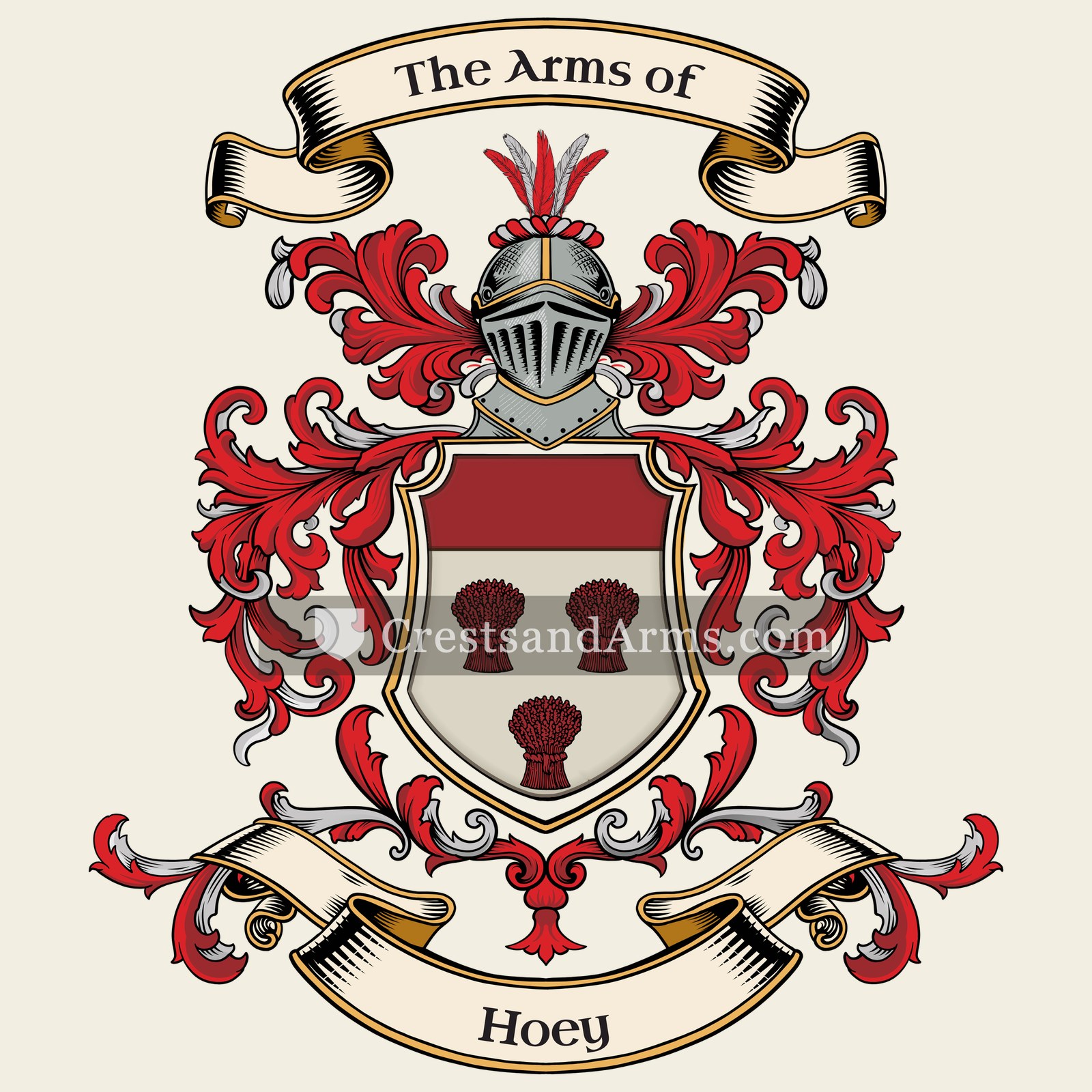
 chiefAuthority, wisdom and dominion
 wheatsheafPlenty, and the harvest of one's own labour
 chiefAuthority, wisdom and dominion
 wheatsheafPlenty, and the harvest of one's own labour


 chequyConstancy, and the counting-board
 lionCourage, strength and royalty