A record of documented arms, meaning and origin, researched for the Hoff family lines. Documented in 3 countries.
Reg. 8178 · Swiss, G–I
Meaning of the Hoff family crest colors & symbols
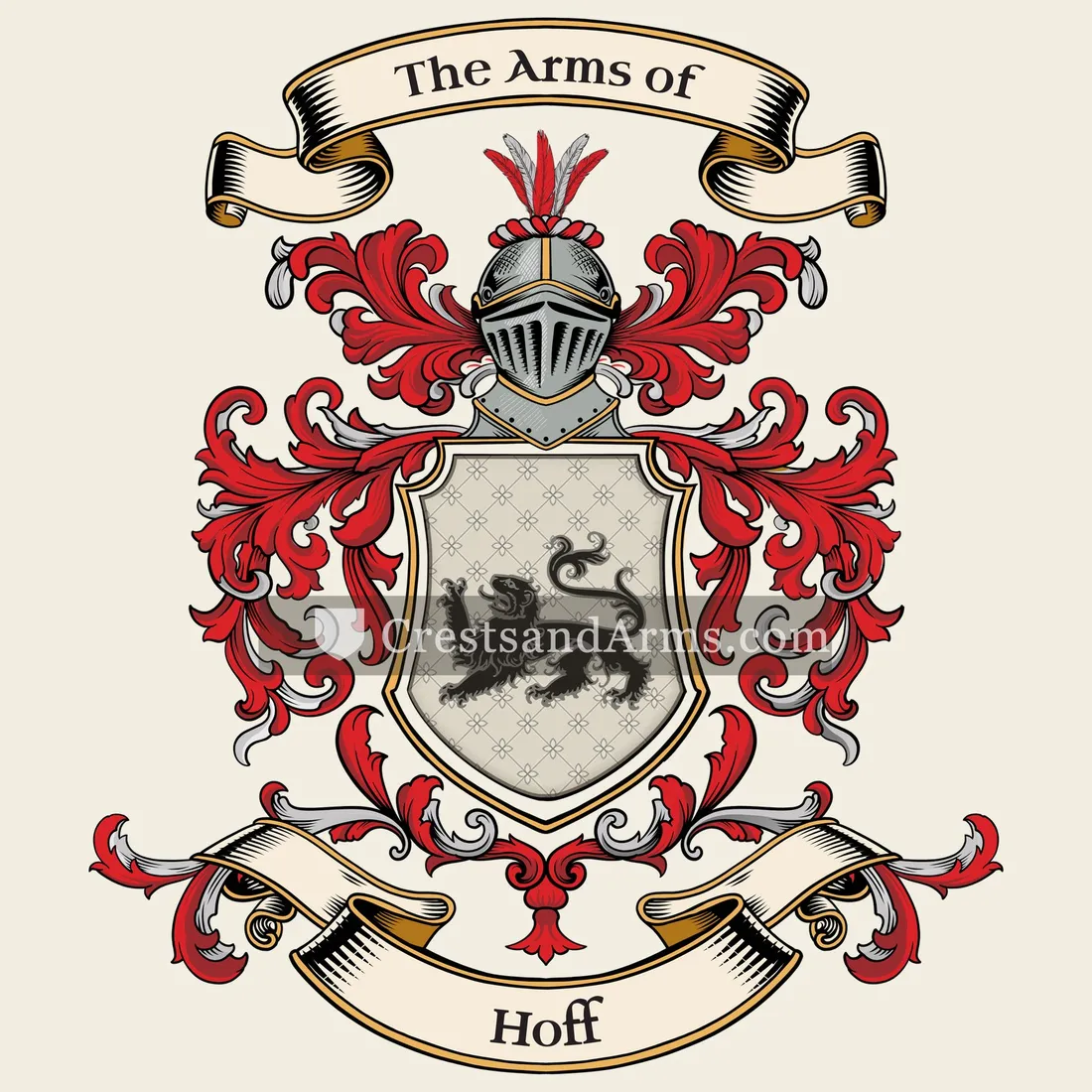
Symbols on this shield
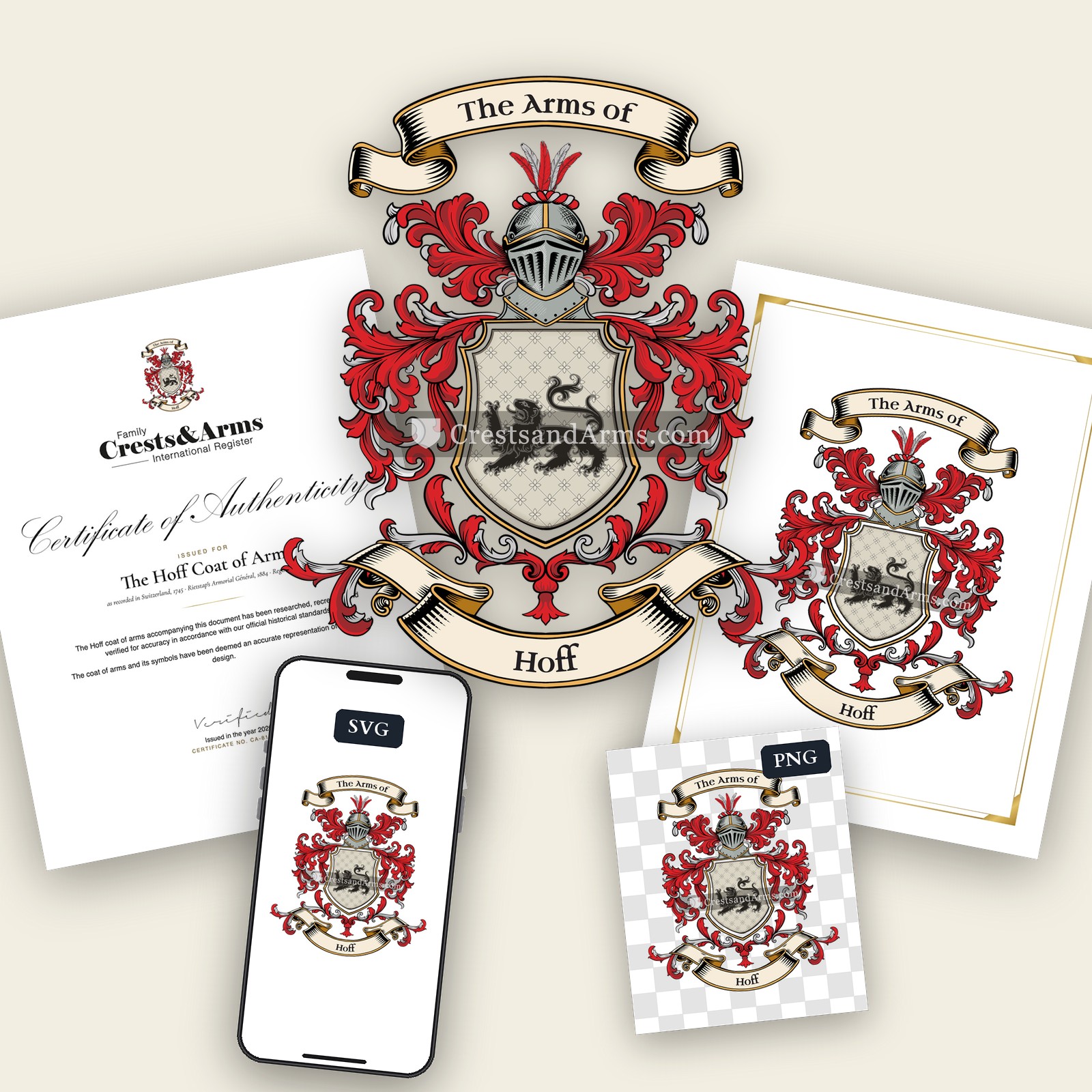
lionCourage, strength and royalty
Colours
Silver (Argent)Means: Peace and sincerity
Black (Sable)Means: Constancy
Historical info
Source
J. B. Rietstap, Armorial Général, Gouda: G. B. van Goor Zonen, 1884–87
Blazon (the actual original written record)
“D'arg. à une tête de léopard de sa., lamp. de gu., cour. d'or, sommée de deux cornes de boeuf de gu. C.: une tête de léopard d'arg., lamp. de gu., cour. d'or, accornée de gu.”
Switzerlandc. 1745
Digital archive packCoat of arms PNG, gold border print PDF, vector SVG and the certificate of authenticity. Sent to your email in minutes.
Map of Switzerland showing where the Hoff arms are recorded
The Hoff arms were recorded in Switzerland, c. 1745.
Arms such as these were typically recorded in Bern.
Bern was the largest of the Swiss cantons and ran itself, with its own council and its own courts. Its governing families held office for generations, and office of that kind carried a shield with it.
This is where the arms were entered in the register. Families often moved to other parts of the country, so the same name can turn up in more than one region.
The body that granted and recorded arms in Switzerland in this period.
How Arms Worked in Switzerland
In Switzerland, coats of arms were not restricted to the nobility and were often adopted by common citizens and families. These symbols were passed down through generations to show family identity. When branches of a family grew, they often changed small details of the design to distinguish their own line from the original group.
Granting authority
Cantonal and civic authorities managed the use of coats of arms within their specific regions and local jurisdictions.
How they got arms
Families typically assumed their own coats of arms based on local custom rather than receiving them from a central monarch.
Where arms were recorded
Arms were recorded in various cantonal and civic registers starting from the fourteenth century throughout the Swiss region.
The family's standing
Recorded among the armigerous families of Switzerland.
Origin & History of the Hoff Family in Switzerland
The surname Hoff finds its roots in the Germanic language, where it originally served as a descriptive term for a person who lived on or managed a farmstead or a courtyard. In the context of Switzerland, the name became established as families moved into urban centers like Bern during the eighteenth century. By 1745, records confirm that members of the Hoff family were already integrated into the social and economic fabric of the city. During this period, Bern was a powerful city-state governed by a strict patrician class, and families like the Hoffs often worked as skilled tradespeople, merchants, or farmers on the outskirts of the city walls. As they settled into the region, these individuals contributed to the local community by participating in the guild systems that regulated labor and commerce. Their presence in Bern reflects a broader trend of families seeking stability and opportunity within the expanding administrative hubs of the Swiss Confederation.
Meaning of the Hoff family crest colors & symbols
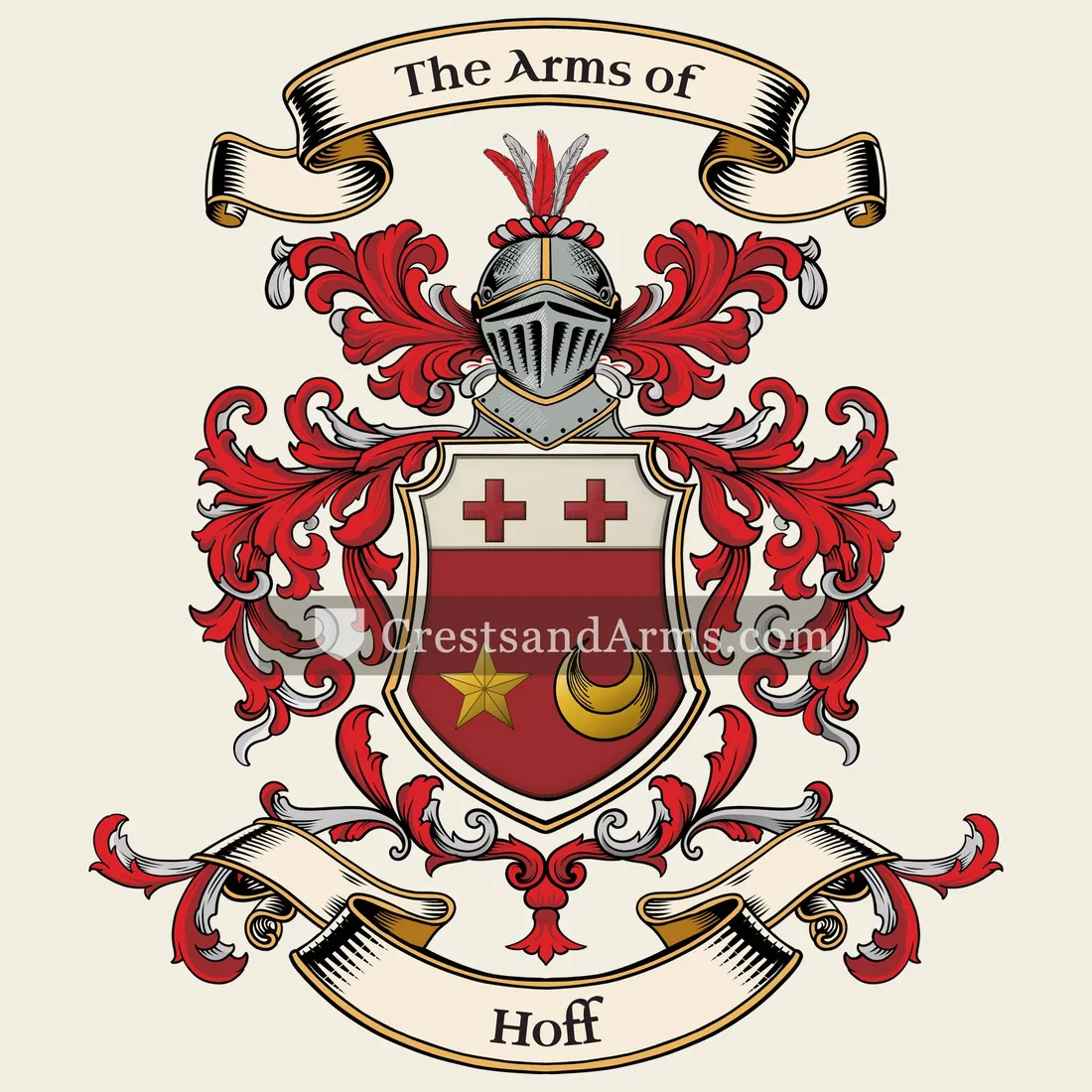
Symbols on this shield
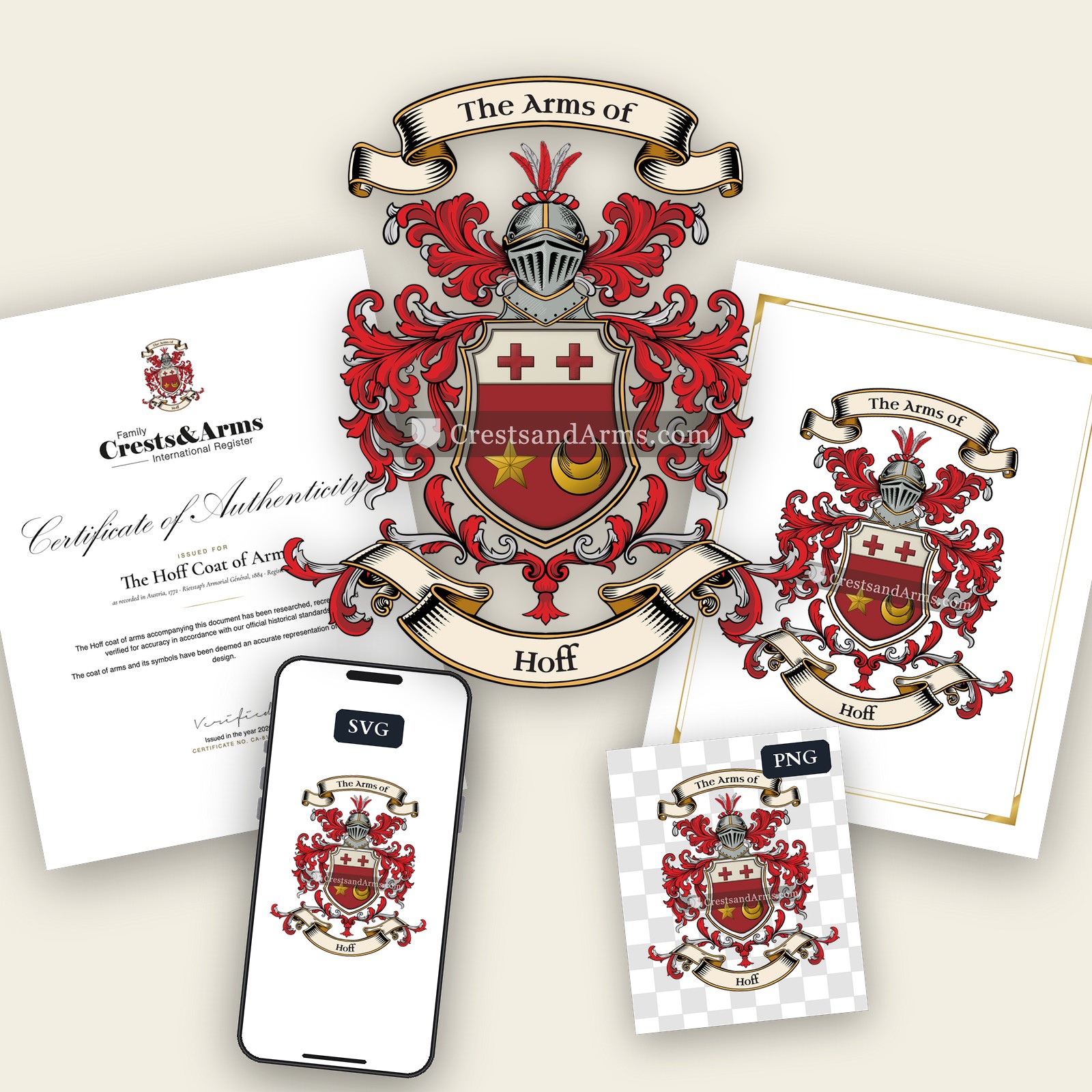
chiefAuthority, wisdom and dominion
cross symbolChristian faith and service
mulletThe third son, and a divine quality from above
crescentHonour by the sovereign, and the second son
Colours
Red (Gules)Means: Military strength
Silver (Argent)Means: Peace and sincerity
Gold (Or)Means: Generosity
Historical info
Source
J. B. Rietstap, Armorial Général, Gouda: G. B. van Goor Zonen, 1884–87
Blazon (the actual original written record)
“De gu. à une étoile d'or à dextre et un croiss. tourné du même à sen.; au chef d'arg. ch. de deux croisettes pattées de gu. C.: une croix latine pattée de gu., les trois bras supérieurs recr. L. d'arg. et de gu. [Une branche de cette famille a porté la croix du cimier entre un vol au nat. T.: à dextre un homme hab. en costume bohème, le sabre à la hanche, tenant un drapeau aux armes de l'écu; à sen. une femme nue, les reins enveloppés d'une toile, supp. de sa main dextre une chouette au nat.]”
Austriac. 1772
Digital archive packCoat of arms PNG, gold border print PDF, vector SVG and the certificate of authenticity. Sent to your email in minutes.
Map of Austria showing where the Hoff arms are recorded
The Hoff arms were recorded in Austria, c. 1772.
Arms such as these were typically recorded in Tyrol.
Tyrol was mountain country in western Austria, where the valleys were held by families who had been there a very long time. Old tenure counted for more than money, and old families carried arms.
This is where the arms were entered in the register. Families often moved to other parts of the country, so the same name can turn up in more than one region.
Region
Tyrol
First recorded
1772
Granting Authority for the Hoff Arms
Imperial and Royal chancery
Sodacan · CC BY-SA 3.0
The body that granted and recorded arms in Austria in this period.
Joseph II, Holy Roman Emperor
Sovereign of the period
Joseph II, Holy Roman Emperor
1765–1790
Reigning in Switzerland when the Hoff arms are first recorded.
How Arms Worked in Austria
Austrian coats of arms were often linked directly to noble titles granted by the Emperor. These symbols belonged to the entire family line rather than just one individual. When a family grew, new branches kept the original design without needing to change it. This system allowed all members of a noble house to share the same identity across many generations.
Granting authority
The Imperial and Royal chancery managed all heraldic matters and controlled the official granting of arms throughout the Austrian lands.
How they got arms
Families typically received their arms through a formal imperial decree that often accompanied the elevation of a person to noble status.
Where arms were recorded
Official records of these grants were kept in the Imperial Register of Nobility which began its formal documentation process in 1453.
The family's standing
Recorded among the armigerous families of Austria.
Origin & History of the Hoff Family in Austria
The surname Hoff is a topographic name that originated from the Middle High German word "hof," which refers to a farm, a courtyard, or a manor. In the mountainous region of Tyrol during the late 18th century, families carrying this name were often tied to the land as independent farmers or stewards of agricultural estates. By 1772, records indicate that the Hoff family was well-established within the local Tyrolean social structure, likely serving as essential members of their rural communities. Because the name describes a specific type of dwelling, it suggests that the earliest ancestors were individuals who managed or resided on significant homesteads. This connection to the land defined their daily lives, as they navigated the challenging climate and terrain of the Austrian Alps while maintaining their family legacy through generations of farming and trade.
Meaning of the Hoff family crest colors & symbols
Symbols on this shield
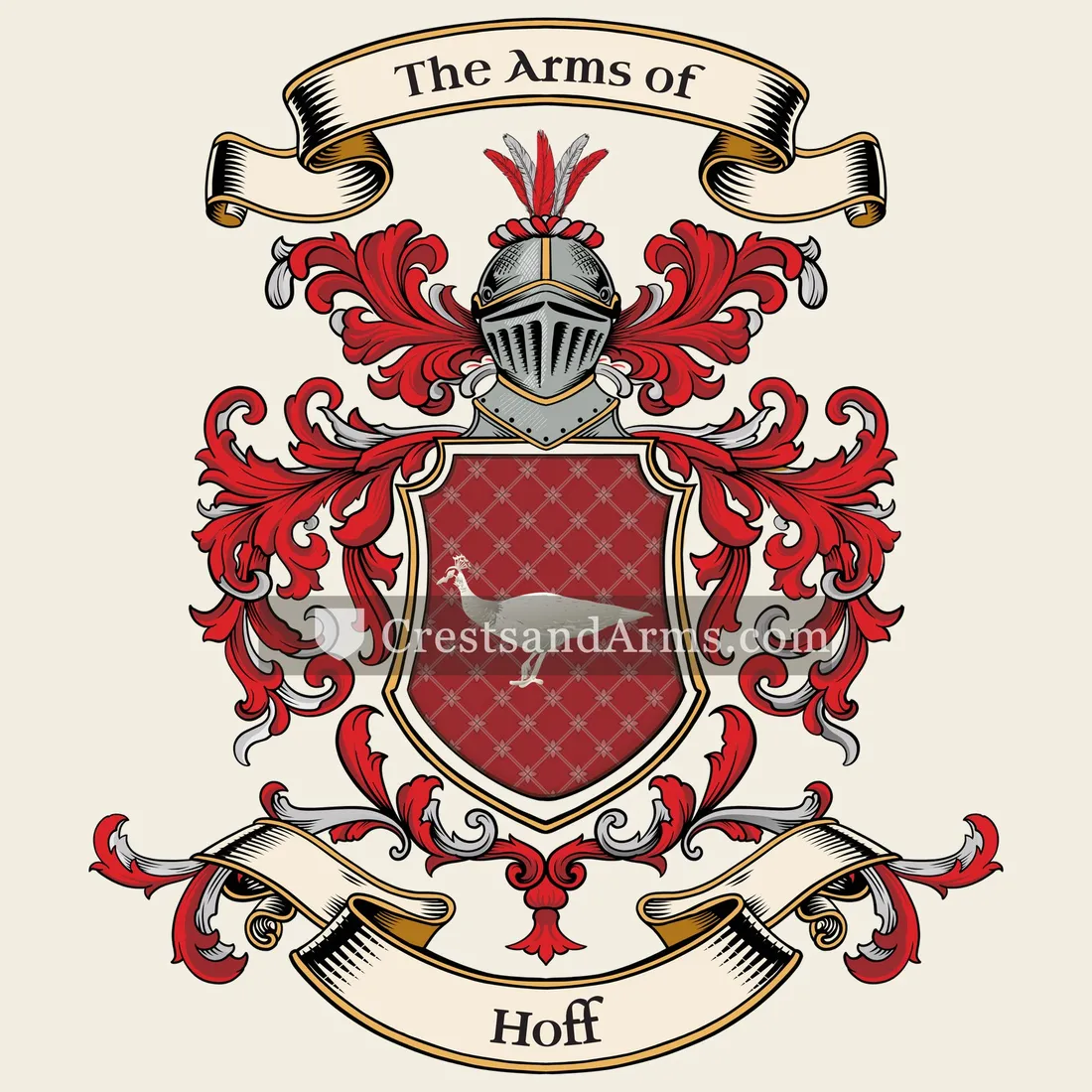
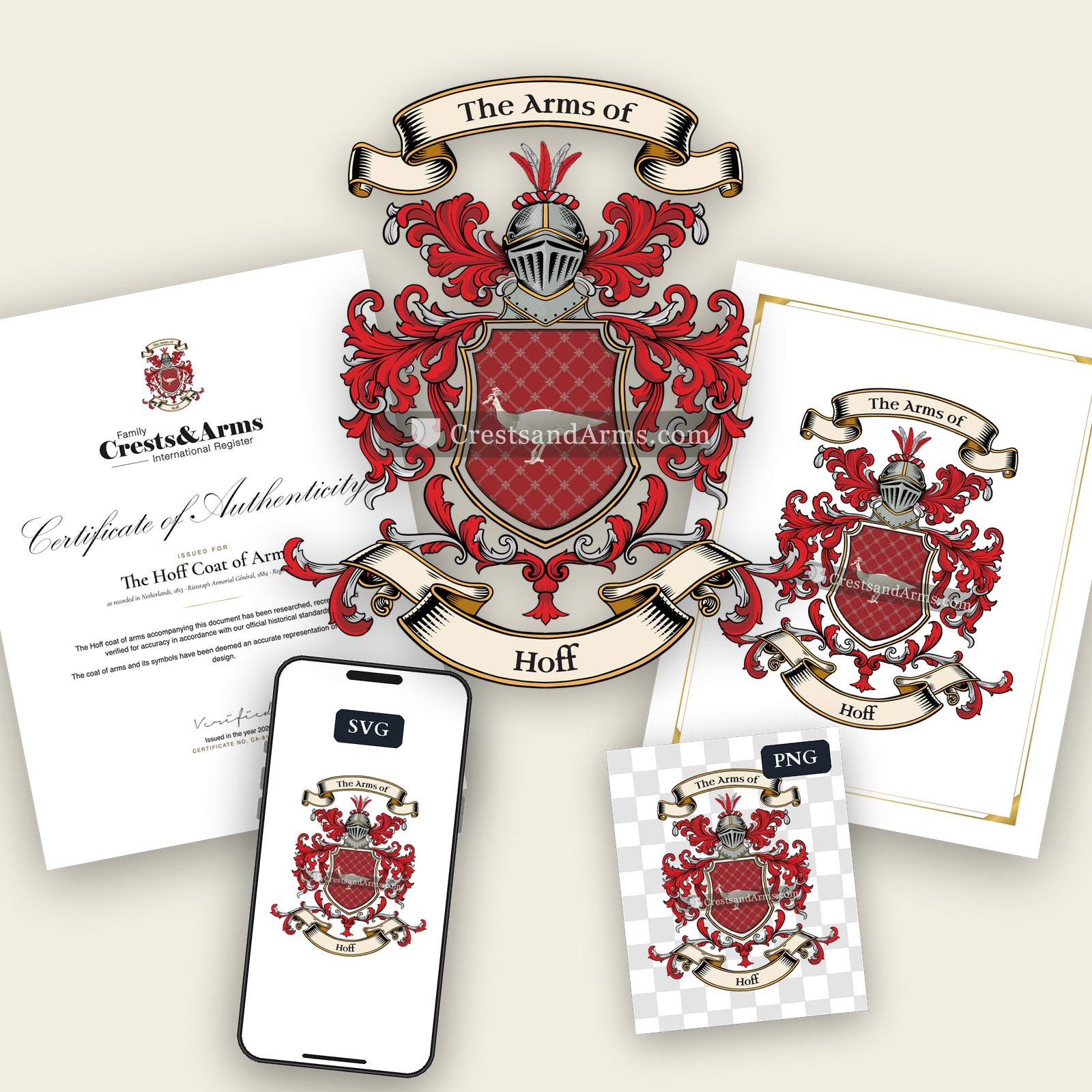
peacockBeauty, power and knowledge
Colours
Red (Gules)Means: Military strength
Silver (Argent)Means: Peace and sincerity
Historical info
Source
J. B. Rietstap, Armorial Général, Gouda: G. B. van Goor Zonen, 1884–87
Blazon (the actual original written record)
“De gu à un paon rouant d'arg., portant au bec un écusson d'arg. suspendu à un lien du même, l'écusson ch. de sept merlettes de gu., 3, 1 et 3.”
Netherlandsc. 1815
Digital archive packCoat of arms PNG, gold border print PDF, vector SVG and the certificate of authenticity. Sent to your email in minutes.
Map of Netherlands showing where the Hoff arms are recorded
The Hoff arms were recorded in Netherlands, c. 1815.
Arms such as these were typically recorded in Friesland.
Friesland was low, wet country on the northern coast of the Netherlands, farmed by families who had held the same land for centuries. Free landholders were unusually common there, and a free landholder could carry arms.
This is where the arms were entered in the register. Families often moved to other parts of the country, so the same name can turn up in more than one region.
Region
Friesland
First recorded
1815
Granting Authority for the Hoff Arms
Hoge Raad van Adel
Photograph made by me · CC BY-SA 3.0
The body that granted and recorded arms in Netherlands in this period.
William I of the Netherlands
Sovereign of the period
William I of the Netherlands
1815–1840
Reigning in Switzerland when the Hoff arms are first recorded.
How Arms Worked in Netherlands
In the Netherlands, coats of arms were often used by noble families and those who held specific public offices. These arms were passed down through the generations to legitimate descendants. Younger branches of a family usually kept the original design without needing to add special marks. This system ensured that the family identity remained clear and consistent over many years.
Granting authority
The Hoge Raad van Adel is the official body that regulates and manages noble titles and coats of arms in the Netherlands.
How they got arms
Families typically obtained their coats of arms through official royal grants or by proving their long-standing historical use of the symbols.
Where arms were recorded
Coats of arms are officially recorded in the registers held by the Hoge Raad van Adel, which began its work in 1814.
The family's standing
Recorded among the armigerous families of Netherlands.
Origin & History of the Hoff Family in Netherlands
The surname Hoff is deeply rooted in the Germanic and Dutch languages, where it originally functioned as a descriptive term for a person who lived near a farmstead, a courtyard, or a manor. In the Netherlands, the name often evolved as families settled in specific rural areas, with the word "hof" referring to a garden or an enclosed piece of land. By the early 19th century, records confirm that members of the Hoff family were established in the northern province of Friesland. This region is known for its unique cultural history and distinct language, which set it apart from the rest of the country. Families in this area often adopted surnames during the Napoleonic era, when civil registration laws required citizens to formally record their family names for the first time. The presence of the Hoff name in Friesland by 1815 suggests that these ancestors were likely part of the local agrarian community, living and working on the fertile lands that define the Frisian landscape.
Hoff Meaning & Related Branches
Root word
Hof
An enclosed area, courtyard, farmstead, or manor.
This name
HoffA topographic name for someone who lived or worked on a farm or manor.
also spelled
Hof
Related arms
Hofvariant spelling
Gössel zum Thurnrecorded with Hoff, same area
Kurtzrock-Wellingsbüttelrecorded with Hoff, same area
Sixtelrecorded with Hoff, same area
Documented Sources
J. B. Rietstap, Armorial Général, Gouda: G. B. van Goor Zonen, 1884–87
Staatsarchiv des Kantons Bern, Kirchenbücher der Stadt Bern (Church records of the city of Bern)
Staatsarchiv des Kantons Bern, Bürgerrodel der Stadt Bern (Citizen registers of the city of Bern)
Bahlow, Hans, Deutsches Namenlexikon (1967)
Feller, Richard, Geschichte Berns (1946)
Digital archive packCoat of arms PNG, gold border print PDF, vector SVG and the certificate of authenticity. Sent to your email in minutes.


 lionCourage, strength and royalty
 lionCourage, strength and royalty

 chiefAuthority, wisdom and dominion
 cross symbolChristian faith and service
 mulletThe third son, and a divine quality from above
 crescentHonour by the sovereign, and the second son


 peacockBeauty, power and knowledge