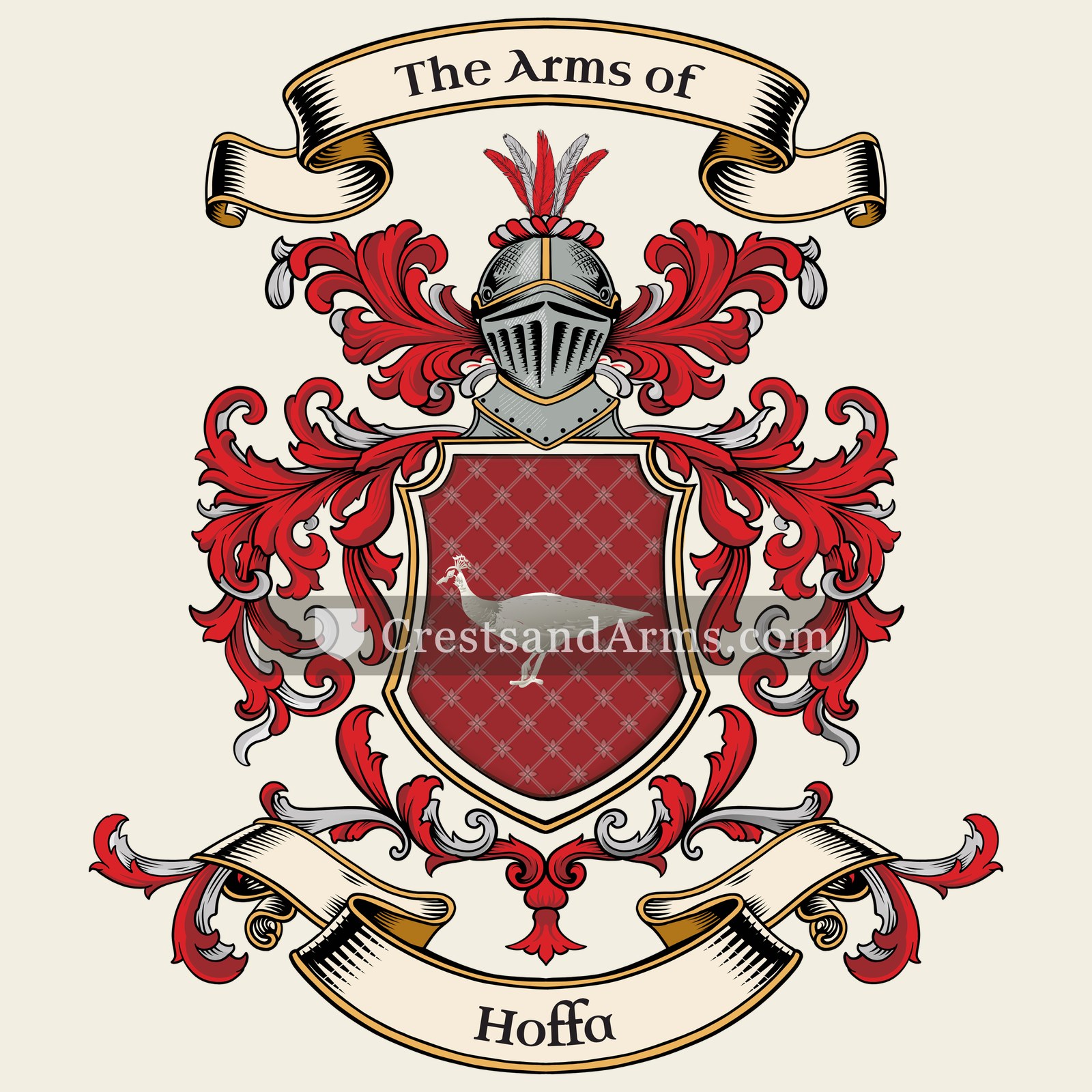
A record of documented arms, meaning and origin, researched for the Hoffa family lines. Documented in 3 countries.
Reg. 8821 · Swiss, G–I
Coat of Arms & Family Crest Details
Symbols on this shield
lionCourage, strength and royalty
Colours
Silver (Argent)Means: Peace and sincerity
Black (Sable)Means: Constancy
Historical info
Source
J. B. Rietstap, Armorial Général, Gouda: G. B. van Goor Zonen, 1884–87
Blazon (the actual original written record)
“D'arg. à une tête de léopard de sa., lamp. de gu., cour. d'or, sommée de deux cornes de boeuf de gu. C.: une tête de léopard d'arg., lamp. de gu., cour. d'or, accornée de gu.”
Switzerlandc. 1745
Digital archive packCoat of arms PNG, gold border print PDF, vector SVG and the certificate of authenticity. Sent to your email in minutes.
Map of Switzerland showing where the Hoffa arms are recorded
The Hoffa arms were recorded in Switzerland, c. 1745.
Arms such as these were typically recorded in Bern.
Bern was the largest of the Swiss cantons and ran itself, with its own council and its own courts. Its governing families held office for generations, and office of that kind carried a shield with it.
This is where the arms were entered in the register. Families often moved to other parts of the country, so the same name can turn up in more than one region.
The body that granted and recorded arms in Switzerland in this period.
How Arms Worked in Switzerland
In Switzerland, coats of arms were not restricted to the nobility and were often adopted by common citizens and families. These symbols were passed down through generations to show family identity. When branches of a family grew, they often changed small details of the design to distinguish their own line from the original group.
Granting authority
Cantonal and civic authorities managed the use of coats of arms within their specific regions and local jurisdictions.
How they got arms
Families typically assumed their own coats of arms based on local custom rather than receiving them from a central monarch.
Where arms were recorded
Arms were recorded in various cantonal and civic registers starting from the fourteenth century throughout the Swiss region.
The family's standing
Recorded among the armigerous families of Switzerland.
Origin & History of the Hoffa Family in Switzerland
The surname Hoffa traces its roots to the German-speaking regions of Switzerland, where the name is closely tied to the history of the canton of Bern. By the year 1745, records confirm that members of the family were established residents within the city, participating in the local social and economic life of the Swiss Confederation. The name itself is derived from the Middle High German word "hof," which refers to a farm, a courtyard, or an estate. This suggests that the earliest ancestors were likely farmers or landowners who held a specific plot of land under the authority of a local lord or the city government. As these individuals moved from rural areas into the urban center of Bern, the name served as a way to identify them by their ancestral home or their status as property holders. Over time, the family became integrated into the fabric of Swiss society, maintaining their presence in the region through generations of agricultural and civic contributions.
Coat of Arms & Family Crest Details
Symbols on this shield
chiefAuthority, wisdom and dominion
cross symbolChristian faith and service
mulletThe third son, and a divine quality from above
crescentHonour by the sovereign, and the second son
Colours
Red (Gules)Means: Military strength
Silver (Argent)Means: Peace and sincerity
Gold (Or)Means: Generosity
Historical info
Source
J. B. Rietstap, Armorial Général, Gouda: G. B. van Goor Zonen, 1884–87
Blazon (the actual original written record)
“De gu. à une étoile d'or à dextre et un croiss. tourné du même à sen.; au chef d'arg. ch. de deux croisettes pattées de gu. C.: une croix latine pattée de gu., les trois bras supérieurs recr. L. d'arg. et de gu. [Une branche de cette famille a porté la croix du cimier entre un vol au nat. T.: à dextre un homme hab. en costume bohème, le sabre à la hanche, tenant un drapeau aux armes de l'écu; à sen. une femme nue, les reins enveloppés d'une toile, supp. de sa main dextre une chouette au nat.]”
Austriac. 1772
Digital archive packCoat of arms PNG, gold border print PDF, vector SVG and the certificate of authenticity. Sent to your email in minutes.
Map of Austria showing where the Hoffa arms are recorded
The Hoffa arms were recorded in Austria, c. 1772.
Arms such as these were typically recorded in Tyrol.
Tyrol was mountain country in western Austria, where the valleys were held by families who had been there a very long time. Old tenure counted for more than money, and old families carried arms.
This is where the arms were entered in the register. Families often moved to other parts of the country, so the same name can turn up in more than one region.
Region
Tyrol
First recorded
1772
Granting Authority for the Hoffa Arms
Imperial and Royal chancery
Sodacan · CC BY-SA 3.0
The body that granted and recorded arms in Austria in this period.
Joseph II, Holy Roman Emperor
Sovereign of the period
Joseph II, Holy Roman Emperor
1765–1790
Reigning in Switzerland when the Hoffa arms are first recorded.
How Arms Worked in Austria
Austrian coats of arms were often linked directly to noble titles granted by the Emperor. These symbols belonged to the entire family line rather than just one individual. When a family grew, new branches kept the original design without needing to change it. This system allowed all members of a noble house to share the same identity across many generations.
Granting authority
The Imperial and Royal chancery managed all heraldic matters and controlled the official granting of arms throughout the Austrian lands.
How they got arms
Families typically received their arms through a formal imperial decree that often accompanied the elevation of a person to noble status.
Where arms were recorded
Official records of these grants were kept in the Imperial Register of Nobility which began its formal documentation process in 1453.
The family's standing
Recorded among the armigerous families of Austria.
Origin & History of the Hoffa Family in Austria
The surname Hoffa traces its roots to the rugged landscape of the Austrian Tyrol, where early family members were documented as residents by 1772. The name is derived from the Middle High German word "hof," which refers to a farmstead, a court, or a manor. In the mountainous terrain of the Tyrol, families often adopted names based on the specific land they worked or the location of their homestead. This suggests that the early Hoffa ancestors were likely independent farmers or landholders who played a vital role in the rural economy of the Alpine region. Living in such a secluded area required the family to be self-sufficient and resilient against the harsh mountain winters. Over time, the name became a permanent marker of their identity, linking the family to the specific agricultural traditions and the unique social structure of the Austrian countryside during the late eighteenth century.
Coat of Arms & Family Crest Details
Symbols on this shield
peacockBeauty, power and knowledge
Colours
Red (Gules)Means: Military strength
Silver (Argent)Means: Peace and sincerity
Historical info
Source
J. B. Rietstap, Armorial Général, Gouda: G. B. van Goor Zonen, 1884–87
Blazon (the actual original written record)
“De gu à un paon rouant d'arg., portant au bec un écusson d'arg. suspendu à un lien du même, l'écusson ch. de sept merlettes de gu., 3, 1 et 3.”
Netherlandsc. 1815
Digital archive packCoat of arms PNG, gold border print PDF, vector SVG and the certificate of authenticity. Sent to your email in minutes.
Map of Netherlands showing where the Hoffa arms are recorded
The Hoffa arms were recorded in Netherlands, c. 1815.
Arms such as these were typically recorded in Friesland.
Friesland was low, wet country on the northern coast of the Netherlands, farmed by families who had held the same land for centuries. Free landholders were unusually common there, and a free landholder could carry arms.
This is where the arms were entered in the register. Families often moved to other parts of the country, so the same name can turn up in more than one region.
Region
Friesland
First recorded
1815
Granting Authority for the Hoffa Arms
Hoge Raad van Adel
Photograph made by me · CC BY-SA 3.0
The body that granted and recorded arms in Netherlands in this period.
William I of the Netherlands
Sovereign of the period
William I of the Netherlands
1815–1840
Reigning in Switzerland when the Hoffa arms are first recorded.
How Arms Worked in Netherlands
In the Netherlands, coats of arms were often used by noble families and those who held specific public offices. These arms were passed down through the generations to legitimate descendants. Younger branches of a family usually kept the original design without needing to add special marks. This system ensured that the family identity remained clear and consistent over many years.
Granting authority
The Hoge Raad van Adel is the official body that regulates and manages noble titles and coats of arms in the Netherlands.
How they got arms
Families typically obtained their coats of arms through official royal grants or by proving their long-standing historical use of the symbols.
Where arms were recorded
Coats of arms are officially recorded in the registers held by the Hoge Raad van Adel, which began its work in 1814.
The family's standing
Recorded among the armigerous families of Netherlands.
Origin & History of the Hoffa Family in Netherlands
The family name Hoffa has deep roots in the northern province of Friesland, where records confirm the family was established by the early nineteenth century. In the Dutch naming tradition, the name likely evolved from a combination of the Germanic word "hof," meaning a farm or courtyard, and the Frisian suffix "-a," which often denotes belonging to a specific place or family line. This suggests that the earliest ancestors were likely independent farmers or landholders who identified themselves by the specific plot of land they cultivated. By 1815, when the Netherlands began formalizing civil registration under the Napoleonic system, the Hoffa name was already well-integrated into the local Frisian community. This transition to official record-keeping helped solidify the spelling and lineage of the family as they moved through the social and economic changes of the nineteenth-century Netherlands.
Related Branches & Arms
Root word
Hof
A farm, courtyard, or enclosed piece of land.
This name
HoffaA topographic surname for someone who lived or worked on a farmstead.
also spelled
Hof
Documented Sources
J. B. Rietstap, Armorial Général, Gouda: G. B. van Goor Zonen, 1884–87
Familiennamenbuch der Schweiz, Familiennamenbuch der Schweiz, 1989
Brechenmacher, Josef Karlmann, Etymologisches Wörterbuch der deutschen Familiennamen, 1957
Staatsarchiv des Kantons Bern, Bürgerrodel der Stadt Bern
Digital archive packCoat of arms PNG, gold border print PDF, vector SVG and the certificate of authenticity. Sent to your email in minutes.


 lionCourage, strength and royalty
 lionCourage, strength and royalty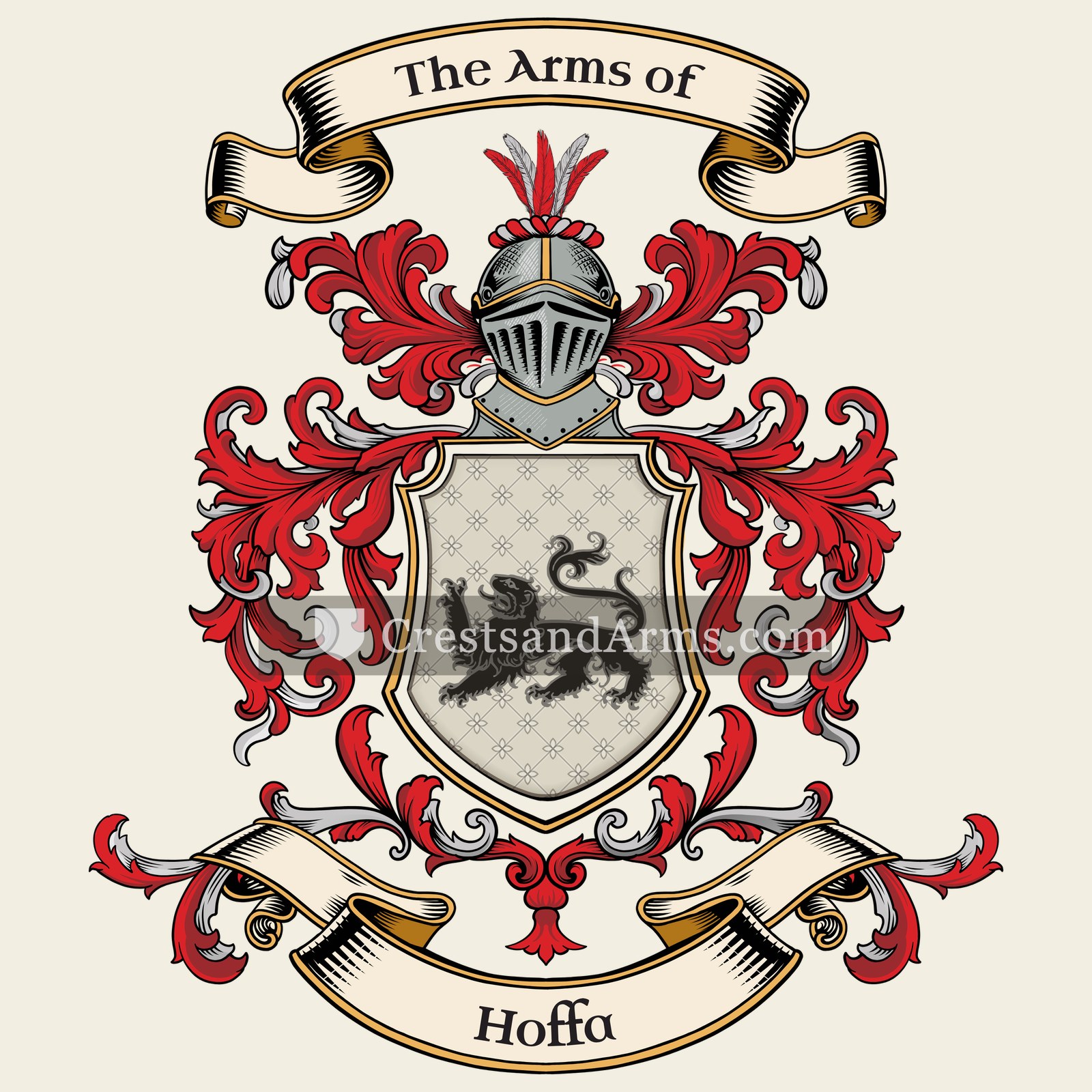

 chiefAuthority, wisdom and dominion
 cross symbolChristian faith and service
 mulletThe third son, and a divine quality from above
 crescentHonour by the sovereign, and the second son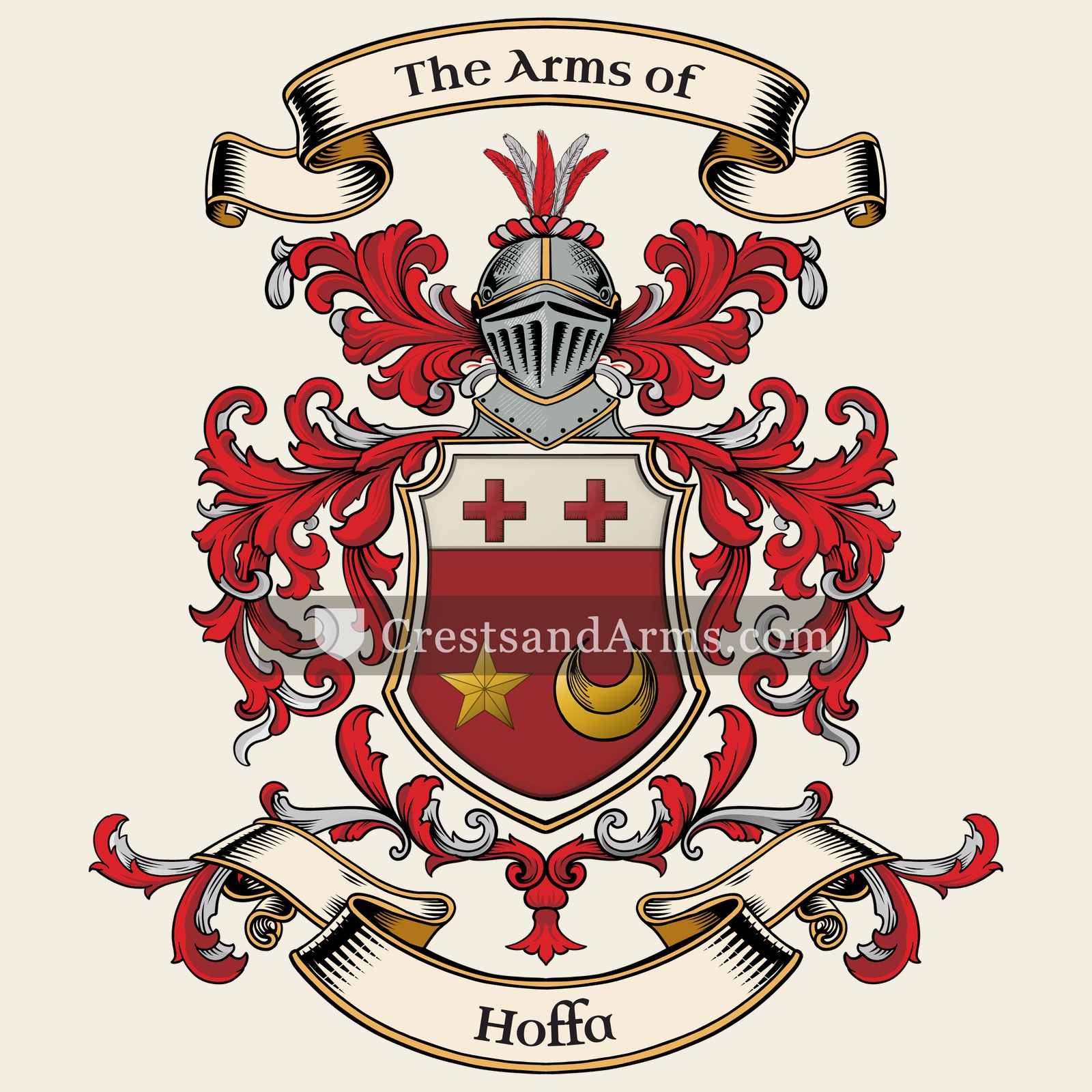


 peacockBeauty, power and knowledge