Map of Netherlands showing where the Hoffman arms are recorded
The Hoffman arms were recorded in Amsterdam, c. 1815.
This is where the arms were entered in the register. Families often moved to other parts of the country, so the same name can turn up in more than one region.
Region
Amsterdam
Town
Amsterdam
First recorded
1815
Granting Authority for the Hoffman Arms
Hoge Raad van Adel
Photograph made by me · CC BY-SA 3.0
The body that granted and recorded arms in Netherlands in this period.
William I of the Netherlands
Sovereign of the period
William I of the Netherlands
1815–1840
Reigning in Netherlands when the Hoffman arms are first recorded.
How Arms Worked in Netherlands
In the Netherlands, coats of arms were often used by noble families and those who held specific public offices. These arms were passed down through the generations to legitimate descendants. Younger branches of a family usually kept the original design without needing to add special marks. This system ensured that the family identity remained clear and consistent over many years.
Granting authority
The Hoge Raad van Adel is the official body that regulates and manages noble titles and coats of arms in the Netherlands.
How they got arms
Families typically obtained their coats of arms through official royal grants or by proving their long-standing historical use of the symbols.
Where arms were recorded
Coats of arms are officially recorded in the registers held by the Hoge Raad van Adel, which began its work in 1814.
The family's standing
Recorded among the armigerous families of Netherlands.
Origin & History of the Hoffman Family in Netherlands
The surname Hoffman carries a long history rooted in the Germanic linguistic tradition, where it originally functioned as an occupational title for a steward or a manager of a farmstead. By the time the name appeared in the official records of Amsterdam in 1815, it had already transitioned from a descriptive label into a stable family identifier. During the early nineteenth century, Amsterdam was a bustling center of trade and social reorganization following the end of the Napoleonic era. Families like the Hoffmans were often part of the growing urban middle class that helped rebuild the city’s economy. As the family settled into life in the Netherlands, they navigated a period of significant administrative change, including the introduction of standardized civil registration laws that required citizens to formally document their surnames. This era marked a shift where the name Hoffman became firmly established within the local population, reflecting the broader movement of families across Northern Europe during the transition into the modern age.
Coat of Arms & Family Crest Details
Symbols on this shield
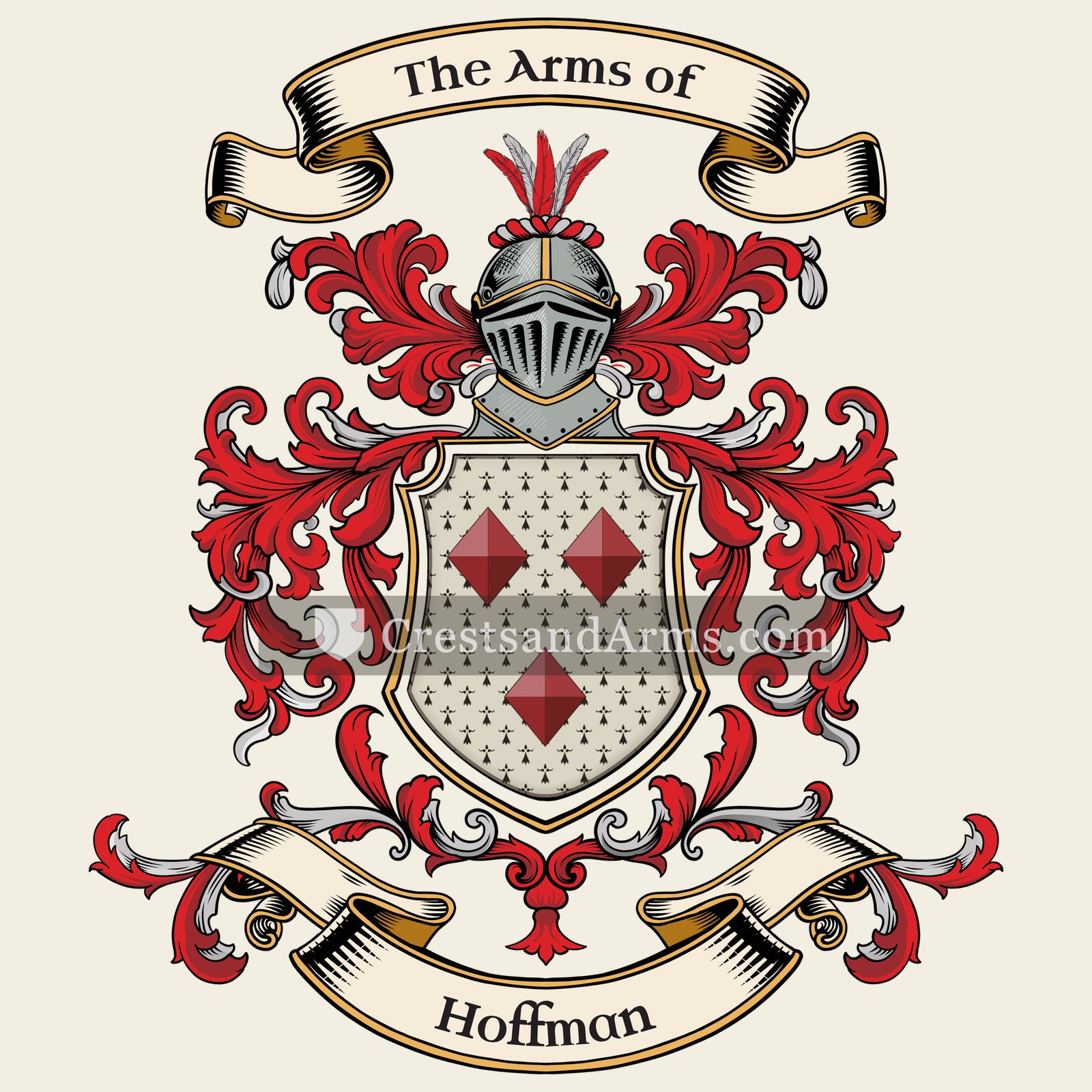
lozengeHonour and nobility, and the arms of a woman
Colours
ErmineMeans: Dignity
Red (Gules)Means: Military strength
Historical info
Source
J. B. Rietstap, Armorial Général, Gouda: G. B. van Goor Zonen, 1884–87
Blazon (the actual original written record)
“D'herm. à trois los. de gu. C.: une tour au nat., et un femme, iss. de la tour, hab. d'azur, tenant de sa main dextre une couronne de laurier de sin.”
Britainc. 1700
Digital archive packCoat of arms PNG, gold border print PDF, vector SVG and the certificate of authenticity. Sent to your email in minutes.
Map of Britain showing where the Hoffman arms are recorded
The Hoffman arms were recorded in Britain, c. 1700.
Arms such as these were typically recorded in Kent.
Kent sits between London and the short crossing to Europe, and the trade passing through made it wealthy. Merchant families bought land with that money, and it was landowners who took coats of arms.
This is where the arms were entered in the register. Families often moved to other parts of the country, so the same name can turn up in more than one region.
The body that granted and recorded arms in Britain in this period.
William III of England
Sovereign of the period
William III of England
1694–1702
Reigning in Netherlands when the Hoffman arms are first recorded.
How Arms Worked in Britain
English heraldry allowed arms to be shared by all legitimate descendants of the original owner. These symbols were treated as personal property that moved through the generations to all children. While the eldest son kept the original design, other family members could use the same shield without needing to change it or register their own unique versions.
Granting authority
The College of Arms in London has regulated the use of coats of arms throughout England and Wales since 1484.
How they got arms
Families typically obtained their coats of arms through a formal grant from the Crown or by proving their ancient right to them.
Where arms were recorded
All official coats of arms are recorded in the registers kept at the College of Arms, which date back to the fifteenth century.
The family's standing
Recorded among the armigerous families of Britain.
Origin & History of the Hoffman Family in Britain
The name Hoffman originates from the Germanic words for a steward or a manager of a farmstead, and it eventually traveled across the North Sea to settle in Britain. By the year 1700, records confirm that members of the family had established themselves in the county of Kent. During this period, Kent served as a vital gateway for trade and migration between mainland Europe and England. Families with this name often worked in agriculture or skilled trades, integrating into the local economy as they adapted to life in a new country. Over time, the name became a permanent fixture in the region, reflecting the steady movement of people who sought new opportunities in the English countryside.
Coat of Arms & Family Crest Details
Symbols on this shield
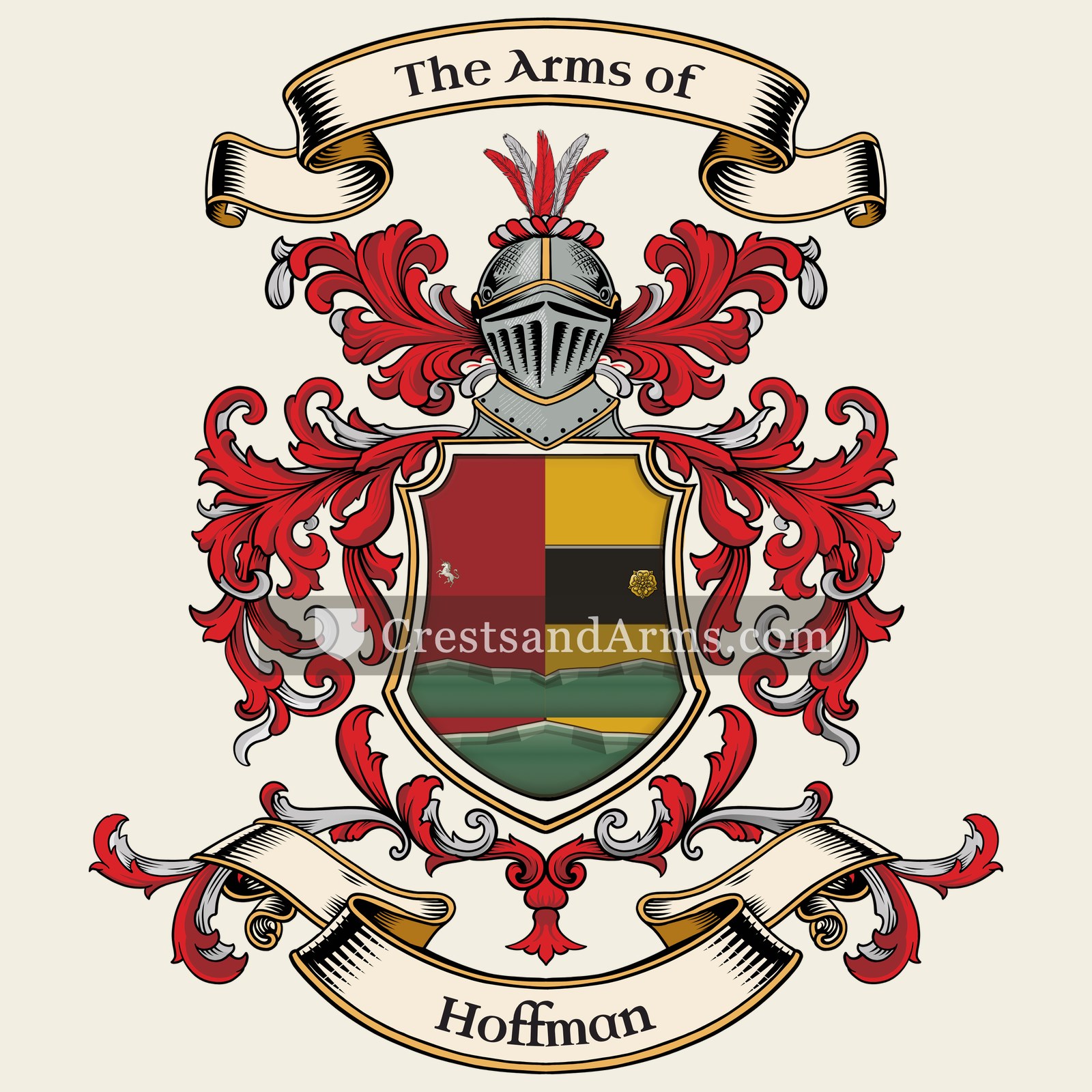
mountThe ground held, and steadfastness upon it
fessThe military belt, and readiness to serve
unicornPurity, and extreme courage in defence of honour
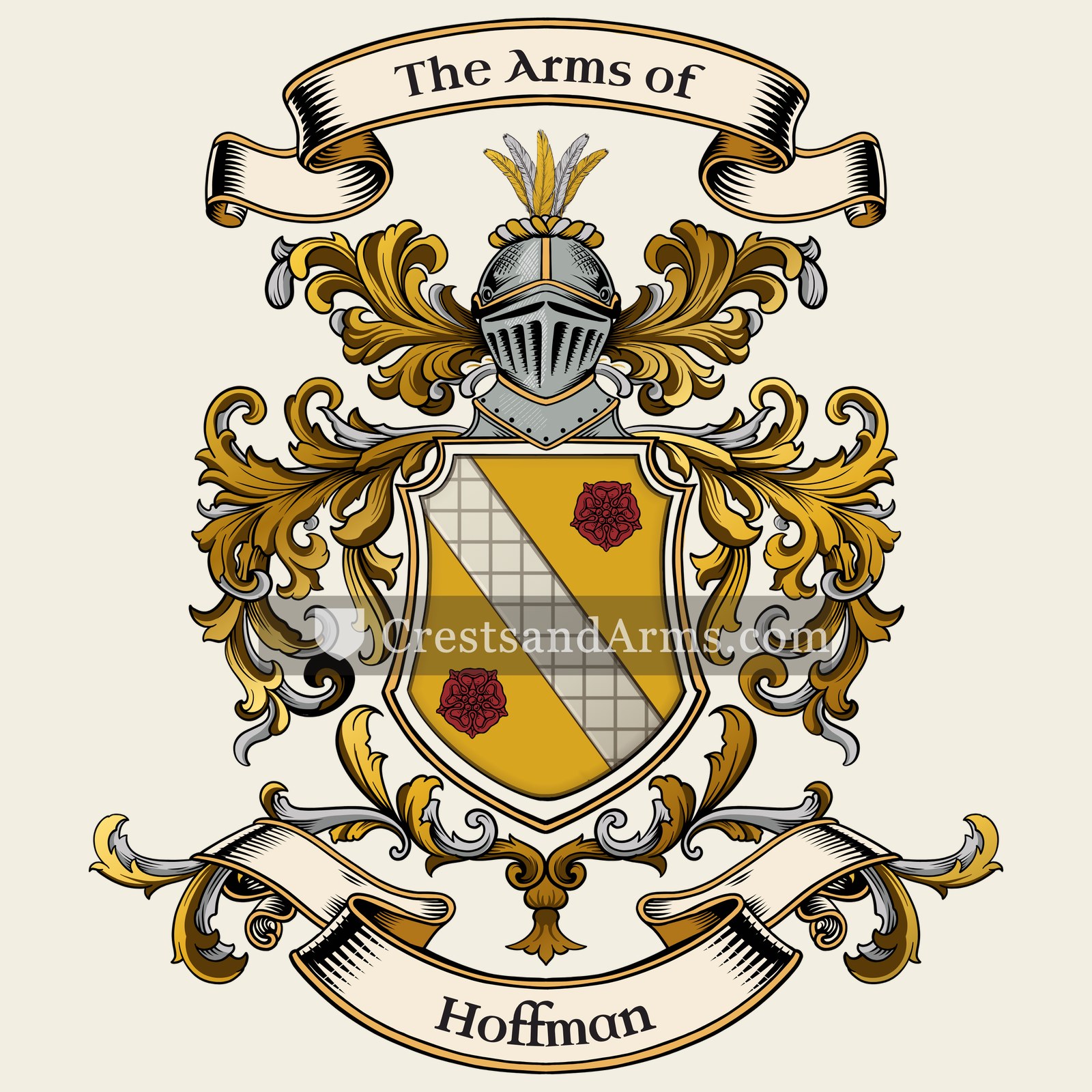
roseThe seventh son, and beauty with grace
Colours
Red (Gules)Means: Military strength
Gold (Or)Means: Generosity
Green (Vert)Means: Hope
Black (Sable)Means: Constancy
Silver (Argent)Means: Peace and sincerity
Historical info
Source
J. B. Rietstap, Armorial Général, Gouda: G. B. van Goor Zonen, 1884–87
Blazon (the actual original written record)
“Parti: au 1 de gu. à une licorne ramp. d'arg., soutenue d'une terrasse de sin.; au 2 d'or à la fasce de sa., ch. d'une rose d'or. Cq. cour. C.: un chevalier iss., arm. d'arg., au baudrier de gu., le casque panaché, tenant une épée. L.: à dextre d'or et de sa., à sen. d'arg. et de gu.”
Germanyc. 1765
Digital archive packCoat of arms PNG, gold border print PDF, vector SVG and the certificate of authenticity. Sent to your email in minutes.
Map of Germany showing where the Hoffman arms are recorded
The Hoffman arms were recorded in Germany, c. 1765.
Arms such as these were typically recorded in Bavaria.
Bavaria was a country of old landed families and walled market towns. Estates passed down the same line for centuries, and both the landowners and the leading townsmen kept arms, which is why so many Bavarian names sit in the registers.
This is where the arms were entered in the register. Families often moved to other parts of the country, so the same name can turn up in more than one region.
The body that granted and recorded arms in Germany in this period.
Francis I, Holy Roman Emperor
Sovereign of the period
Francis I, Holy Roman Emperor
1745–1765
Reigning in Netherlands when the Hoffman arms are first recorded.
How Arms Worked in Germany
In the Holy Roman Empire, coats of arms were often granted to individuals by the Emperor or his representatives. These arms were then passed down through the generations to all legitimate descendants of the original holder. Younger branches of a family usually kept the same shield design without needing to change it, as the arms belonged to the entire lineage.
Granting authority
The Holy Roman Emperor held the sole power to grant new coats of arms throughout his vast imperial territories.
How they got arms
Families typically obtained their coats of arms through a formal imperial grant or by proving their noble status to the authorities.
Where arms were recorded
These grants were officially recorded in the Imperial Chancery registers, which began keeping formal records of such honors during the Middle Ages.
The family's standing
Recorded among the armigerous families of Germany.
Origin & History of the Hoffman Family in Germany
The surname Hoffman originated in Germany as a descriptive title for a person who managed a farm or held a specific position of authority on a landed estate. The name is derived from the German words "Hof," meaning a farm or courtyard, and "Mann," meaning man. During the Middle Ages, this title was often given to a steward or a tenant farmer who oversaw the daily operations of a manor. By the time ancestors of the family were documented in Bavaria in 1765, the name had become a common hereditary surname used to identify families who had long served as skilled agricultural managers or local property administrators. These individuals were essential to the rural economy of the German states, as they were responsible for maintaining the land and ensuring that the harvest was properly managed for the local nobility. Over many generations, the name transitioned from a professional description of a worker's role into a permanent family name that was passed down to children throughout the Bavarian region.
Hoffman Meaning & Related Branches
Root word
hof
A courtyard, farmstead, or enclosed piece of land.
This name
HoffmanA person who manages or lives on a farmstead or manor.
also spelled
Hofman
Related arms
Hofmanvariant spelling
Documented Sources
J. B. Rietstap, Armorial Général, Gouda: G. B. van Goor Zonen, 1884–87
Stadsarchief Amsterdam, Bevolkingsregister 1815
Nationaal Archief, Burgerlijke Stand en Bevolking
Van der Schaar, J., Woordenboek van voornamen, 1964
Huizinga, A., Encyclopedie van namen, 1955
Digital archive packCoat of arms PNG, gold border print PDF, vector SVG and the certificate of authenticity. Sent to your email in minutes.


 bendDefence, and the scarf of a commander
 roseThe seventh son, and beauty with grace
 bendDefence, and the scarf of a commander
 roseThe seventh son, and beauty with grace


 lozengeHonour and nobility, and the arms of a woman


 mountThe ground held, and steadfastness upon it
 fessThe military belt, and readiness to serve
 unicornPurity, and extreme courage in defence of honour