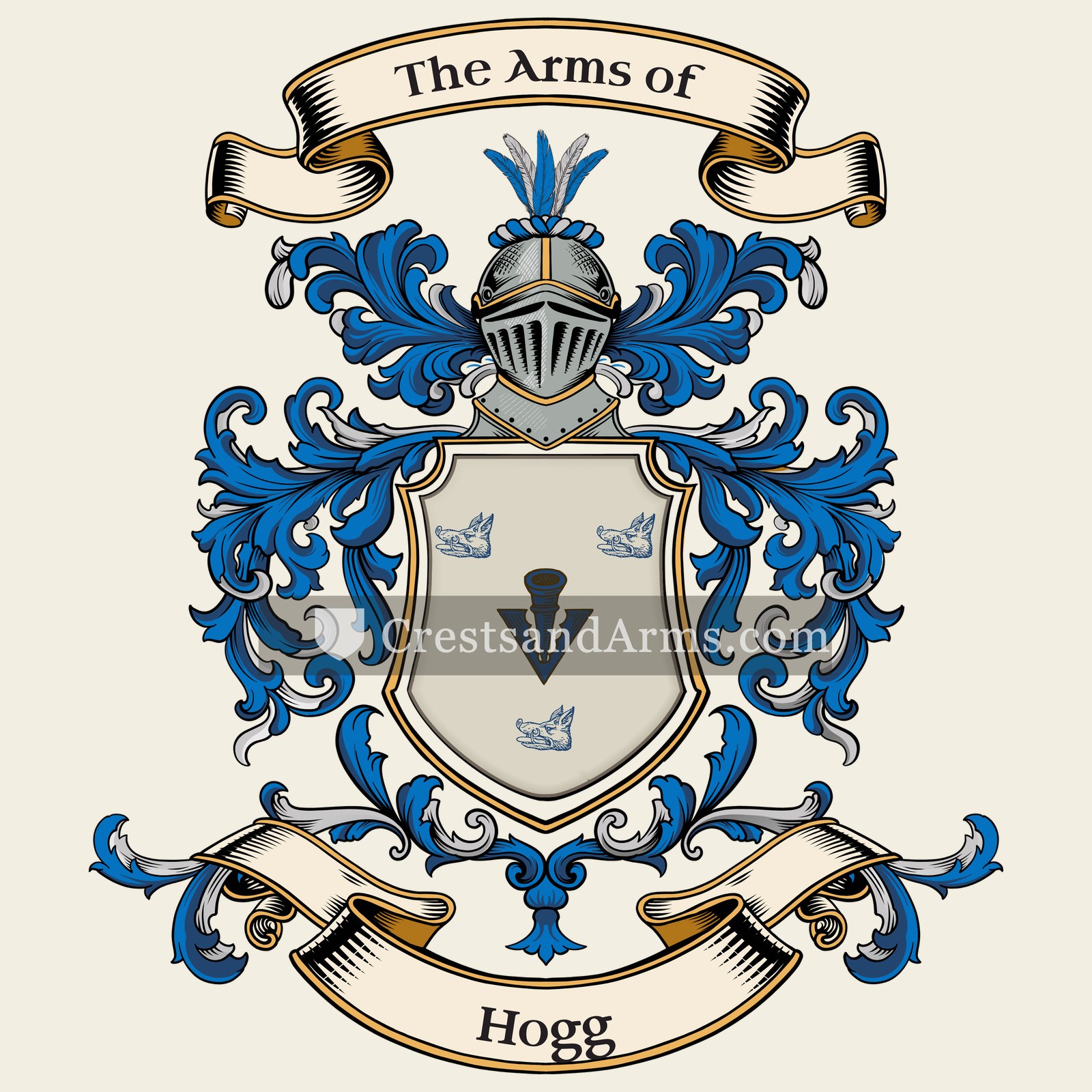
A record of documented arms, meaning and origin, researched for the Hogg family lines. Documented in 3 countries.
Reg. 9541 · Britain, G–I
Coat of Arms & Family Crest Details
Symbols on this shield
boars headA fierce fighter who battles to the end
crescentHonour by the sovereign, and the second son
Colours
Silver (Argent)Means: Peace and sincerity
Blue (Azure)Means: Loyalty and truth
Historical info
Source
J. B. Rietstap, Armorial Général, Gouda: G. B. van Goor Zonen, 1884–87
Blazon (the actual original written record)
“D'arg. à trois hures de sanglier d'azur, languées de gu., 2 et 1; flanqué en rond d'azur, chaque flanc ch. d'un croiss. du champ. Cq. cour. C.: un chêne au nat., auquel est suspendu un écusson d'azur, ch. d'un senestrochère, la main empoignant une flèche en barre, la pointe en bas, le tout au nat. D.: DAT GLORIA VIRES.”
BritainLondres, c. 1700
Digital archive packCoat of arms PNG, gold border print PDF, vector SVG and the certificate of authenticity. Sent to your email in minutes.
Map of Britain showing where the Hogg arms are recorded
The Hogg arms were recorded in Londres, c. 1700.
Arms such as these were typically recorded in Kent.
Kent sits between London and the short crossing to Europe, and the trade passing through made it wealthy. Merchant families bought land with that money, and it was landowners who took coats of arms.
This is where the arms were entered in the register. Families often moved to other parts of the country, so the same name can turn up in more than one region.
The body that granted and recorded arms in Britain in this period.
William III of England
Sovereign of the period
William III of England
1694–1702
Reigning in Britain when the Hogg arms are first recorded.
How Arms Worked in Britain
English heraldry allowed arms to be shared by all legitimate descendants of the original owner. These symbols were treated as personal property that moved through the generations to all children. While the eldest son kept the original design, other family members could use the same shield without needing to change it or register their own unique versions.
Granting authority
The College of Arms in London has regulated the use of coats of arms throughout England and Wales since 1484.
How they got arms
Families typically obtained their coats of arms through a formal grant from the Crown or by proving their ancient right to them.
Where arms were recorded
All official coats of arms are recorded in the registers kept at the College of Arms, which date back to the fifteenth century.
The family's standing
Recorded among the armigerous families of Britain.
Origin & History of the Hogg Family in Britain
The surname Hogg has deep roots in the British Isles, emerging as a descriptive name during the Middle Ages. In early English society, names were often chosen based on a person’s occupation or a notable physical trait. The name Hogg is widely believed to have originated as a nickname for someone who worked as a swineherd or for a person whose personality or appearance reminded others of a pig. By the time the family established a documented presence in Kent around 1700, the name had already been in use for centuries across various regions of Britain. Families bearing this name were typically part of the rural working class, often living in small villages where they contributed to the local agricultural economy. Over time, the name spread from its northern origins into the southern counties, becoming a permanent part of the local history in places like Kent through generations of farming and trade.
Coat of Arms & Family Crest Details
Symbols on this shield
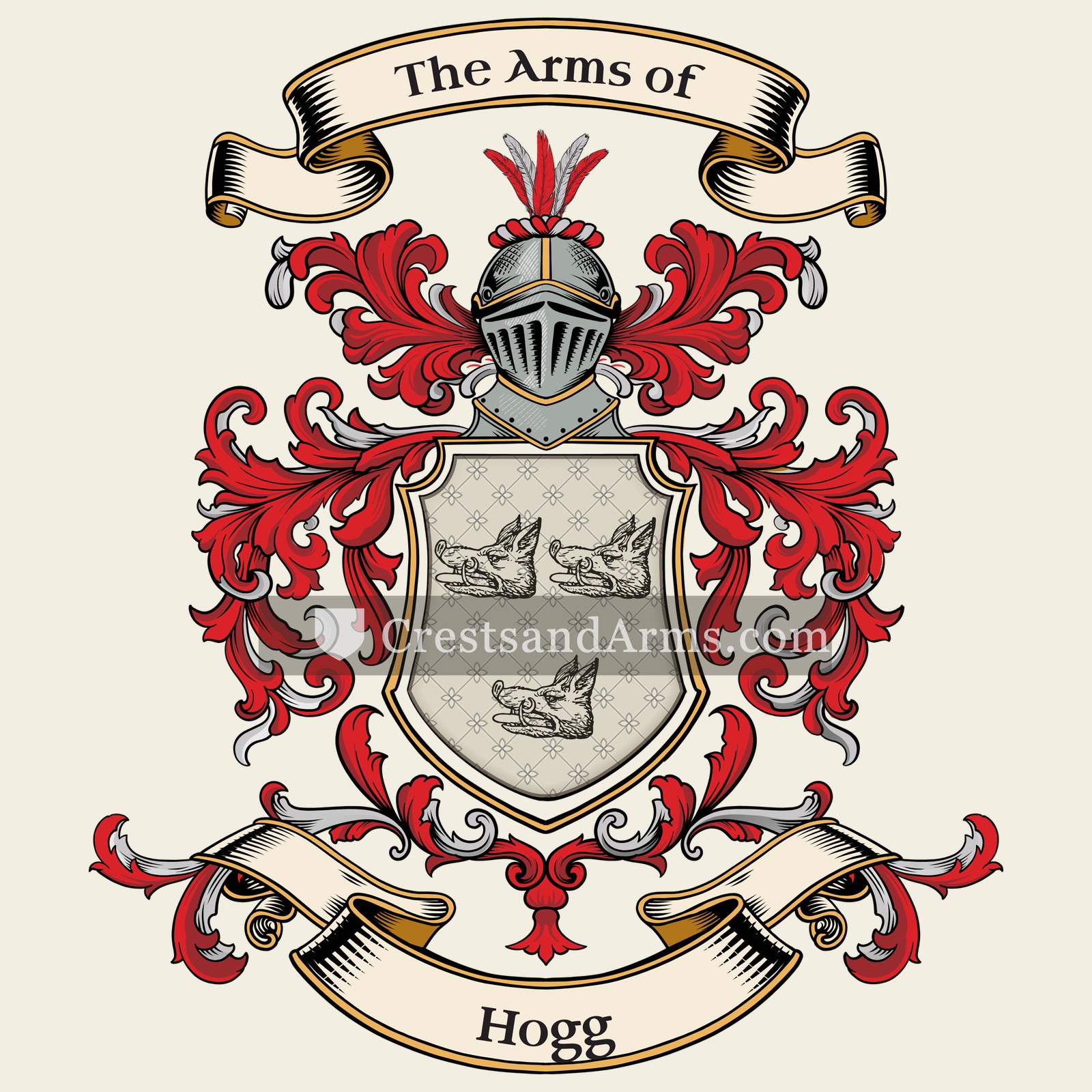
boars headA fierce fighter who battles to the end
Colours
Silver (Argent)Means: Peace and sincerity
Black (Sable)Means: Constancy
Historical info
Source
Sir Bernard Burke, The General Armory of England, Scotland, Ireland and Wales, London: Harrison & Sons, 1884
Blazon (the actual original written record)
“Ar. three boars' heads erased sa”
DurhamBishopwearmouth · Durham, c. 1620
Digital archive packCoat of arms PNG, gold border print PDF, vector SVG and the certificate of authenticity. Sent to your email in minutes.
Map of England showing where the Hogg arms are recorded
The Hogg arms were recorded in Durham, c. 1620.
Durham was governed by its bishop rather than the crown for most of its history, with its own courts and its own landed class. That separate world produced a tight group of families, nearly all of whom held arms.
This is where the arms were entered in the register. Families often moved to other parts of the country, so the same name can turn up in more than one region.
The body that granted and recorded arms in England in this period.
James VI and I
Sovereign of the period
James VI and I
1603–1625
Reigning in Britain when the Hogg arms are first recorded.
How Arms Worked in England
English heraldry allowed arms to be shared by all legitimate descendants of the original owner. These symbols were treated as personal property that moved through the generations to all children. While the eldest son kept the original design, other family members could use the same shield without needing to change it or register their own unique versions.
Granting authority
The College of Arms in London has regulated the use of coats of arms throughout England and Wales since 1484.
How they got arms
Families typically obtained their coats of arms through a formal grant from the Crown or by proving their ancient right to them.
Where arms were recorded
All official coats of arms are recorded in the registers kept at the College of Arms, which date back to the fifteenth century.
The family's standing
Recorded among the armigerous families of Durham.
Origin & History of the Hogg Family in England
The surname Hogg is a classic example of an English occupational or descriptive name that emerged during the Middle Ages. It likely began as a nickname for someone who worked as a swineherd or perhaps for a person whose personality was compared to a young pig. By the time the name appears in historical records in Durham in 1620, it had become a well-established family identifier in the northern counties of England. During this period, families in the Durham region were often deeply connected to the local agricultural economy or the growing coal mining industry. The name reflects a time when surnames were transitioning from simple descriptors used by neighbors into permanent family markers passed down through generations. These early ancestors in Durham were part of a regional identity that helped shape the social fabric of Northern England long before the modern era.
Coat of Arms & Family Crest Details
Symbols on this shield
arms pheon arrowheadReadiness for battle, and the broad arrow of the sovereign
boars headA fierce fighter who battles to the end
Colours
Silver (Argent)Means: Peace and sincerity
Blue (Azure)Means: Loyalty and truth
Historical info
Source
Sir Bernard Burke, The General Armory of England, Scotland, Ireland and Wales, London: Harrison & Sons, 1884
Blazon (the actual original written record)
“Ar. a pheon betw. three boars' heads erased az. langued gu. armed or”
EdinburghEdinburgh, c. 1761
Digital archive packCoat of arms PNG, gold border print PDF, vector SVG and the certificate of authenticity. Sent to your email in minutes.
Map of Scotland showing where the Hogg arms are recorded
The Hogg arms were recorded in Edinburgh, c. 1761.
Edinburgh was the seat of Scotland's government, its courts and its heralds. Families with business there settled nearby, and being close to where arms were recorded is exactly why so many of them appear.
This is where the arms were entered in the register. Families often moved to other parts of the country, so the same name can turn up in more than one region.
The body that granted and recorded arms in Scotland in this period.
George III of Great Britain
Sovereign of the period
George III of Great Britain
1760–1801
Reigning in Britain when the Hogg arms are first recorded.
How Arms Worked in Scotland
Scottish heraldry is unique because it treats a coat of arms as a piece of personal property protected by law. Only one person can own a specific design at any given time. When a family grows, the head keeps the original shield while other relatives must apply for their own distinct version with slight changes to prove their specific identity.
Granting authority
The Court of the Lord Lyon acts as the official body that regulates and controls all heraldic matters throughout Scotland.
How they got arms
Individuals obtain a legal right to their arms through a formal petition process that confirms their identity and family connection.
Where arms were recorded
All valid coats of arms are officially entered into the Public Register of All Arms and Bearings starting from 1672.
The family's standing
Recorded among the armigerous families of Edinburgh.
Origin & History of the Hogg Family in Scotland
The surname Hogg has deep roots in the Scottish Lowlands, where it likely originated as a descriptive nickname for a person who herded or traded sheep. In the Middle Ages, the name appeared frequently in the border regions between Scotland and England, suggesting that many early families were involved in the pastoral life of the countryside. By the time the family established a clear presence in Edinburgh in 1761, the name had transitioned from a simple occupational label into a recognized local identity. During this period, Edinburgh was a growing center of trade and intellectual life, and families like the Hoggs often integrated into the city’s expanding merchant and professional classes. This shift from rural agricultural work to urban life reflected the broader social changes happening across Scotland during the eighteenth century. As the family settled into the capital, they became part of the vibrant history of a city that was rapidly modernizing while keeping its ancient traditions alive.
Related Branches & Arms
Root word
Hogg
Old English word for a young sheep or swine.
This name
HoggAn occupational surname for a swineherd or a nickname for someone resembling a pig.
also spelled
Hogge
Hog
Hoge
Related arms
Hoguevariant spelling
Bucklerecorded with Hogg, same area
Quantockrecorded with Hogg, same area
Documented Sources
J. B. Rietstap, Armorial Général, Gouda: G. B. van Goor Zonen, 1884–87
Reaney, P.H. and Wilson, R.M., A Dictionary of English Surnames, 1991
Cottle, Basil, The Penguin Dictionary of Surnames, 1967
The National Archives, Probate Records of the Prerogative Court of Canterbury, 1700
Kent History and Library Centre, Parish Registers of Kent, 1700
Digital archive packCoat of arms PNG, gold border print PDF, vector SVG and the certificate of authenticity. Sent to your email in minutes.


 boars headA fierce fighter who battles to the end
 crescentHonour by the sovereign, and the second son
 boars headA fierce fighter who battles to the end
 crescentHonour by the sovereign, and the second son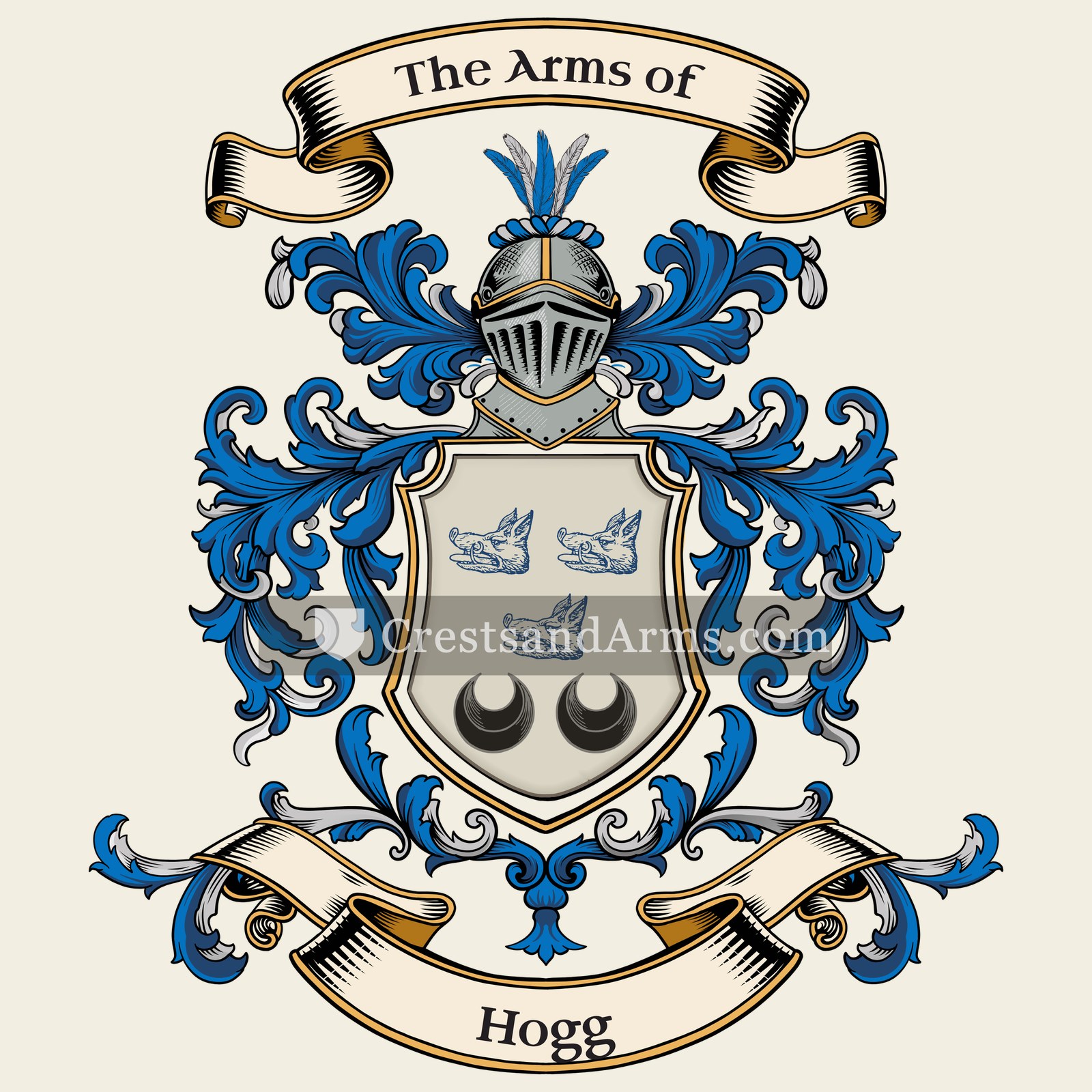



 arms pheon arrowheadReadiness for battle, and the broad arrow of the sovereign