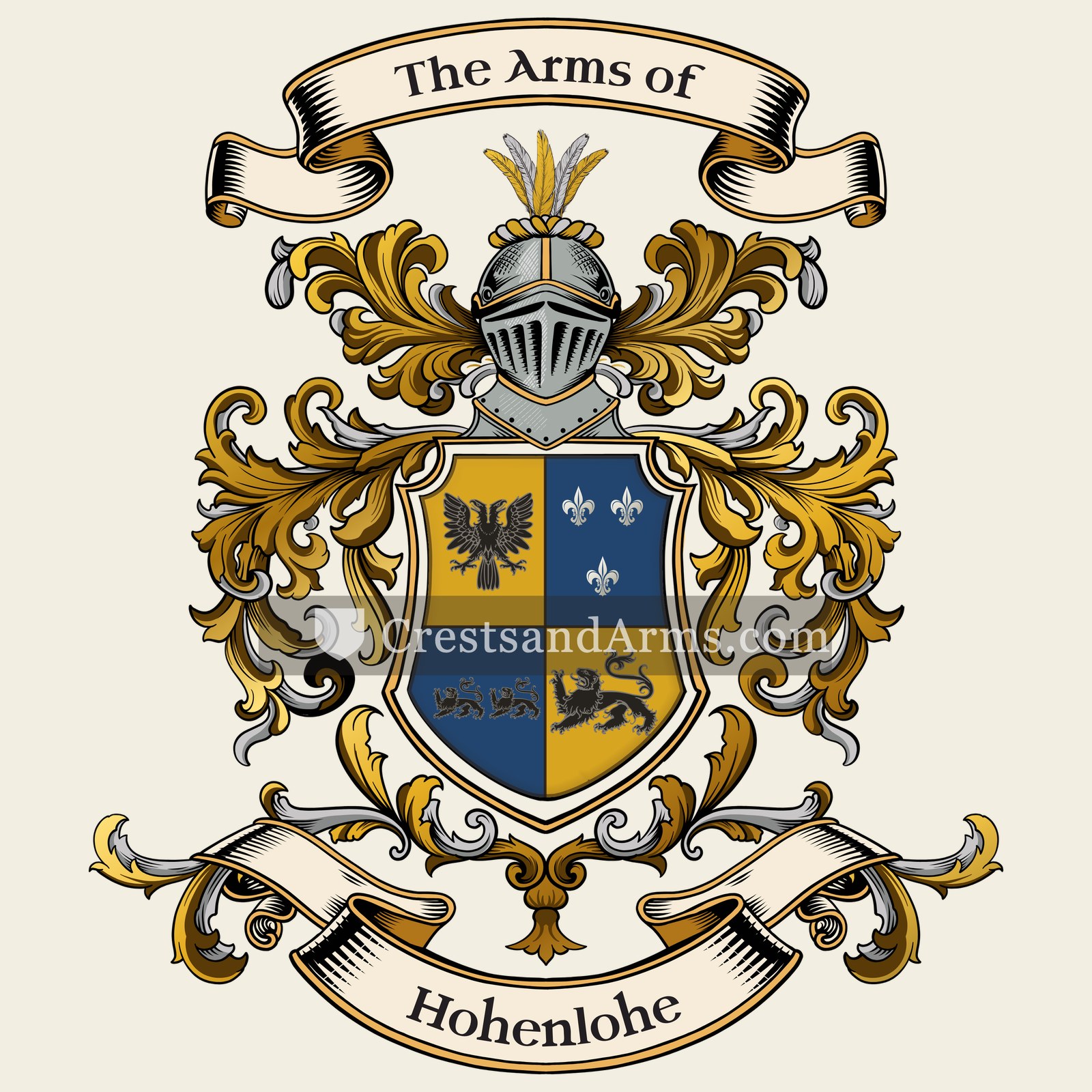
A record of documented arms, meaning and origin, researched for the Hohenlohe family of Germany.
Reg. 2375 · German, G–I
Coat of Arms & Family Crest Details
Symbols on this shield
eagleNobility, strength and a keen mind
fleur de lisPurity, light, and the sixth son
lionCourage, strength and royalty
Colours
Gold (Or)Means: Generosity
Blue (Azure)Means: Loyalty and truth
Black (Sable)Means: Constancy
Silver (Argent)Means: Peace and sincerity
Historical info
Source
J. B. Rietstap, Armorial Général, Gouda: G. B. van Goor Zonen, 1884–87
Blazon (the actual original written record)
“Parti d'un trait, coupé de deux autres, qui font six quartiers: au 1 d'or à l'aigle ép. de sa.; au 2 d'azur à trois fleurs-de-lis d'arg.; au 3 d'arg. à deux léopards de sa., l'un sur l'autre; au 4 coupé: a. de sa. au lion léopardé d'or, cour. du même; b. losangé de sa. et d'or; au 5 d'azur à cinq têtes de massue d'arg., 3 et 2; au 6 coupé-émanché de gu. sur arg. A la champagne de gu., br. sur le tout. Sur le tout un écusson de gu. à la champagne d'arg., timbré d'un bonnet de gu., retr. d'herm. Cinq cq., les 1 et 5 cour. C.: 1° deux prob. coupées de gu. sur arg., ornées chacune dans son embouchure d'une bannière aux armes du 6; 2° une aigle iss. et cont. d'arg., bq. d'or, les plumes ext. des ailes de gu.; 3° un bonnet d'azur, ch. de trois barres d'or, retr. d'herm.; le bonnet sommé d'un panache de trois pl. d'aut. de gu., ch. d'une fleur-de-lis d'arg.; 4° deux cornes de buffle d'arg., ornées chacune à l'ext. de six tiges feuillées d'or; 5° un lion iss. d'or, entre deux prob. de sa. L.: à dextre d'arg. et de gu., à sen. d'or et de sa. S.: à dextre un léopard lionné d'or, lamp. de gu., coiffé d'un bonnet d'azur, ch. de trois barres d'or, retr. d'herm.; le léopard tenant une banderole d'arg., ch. de trois flammes d'or; à sen. un léopard lionné de sa., lamp. de gu., cour. d'or, tenant une banderole de sa., ch. de deux lions léopardés d'or, cour. du même, l'un sur l'autre. D.: EX FLAMMIS ORIOR. Manteau de pourpre, doublé d'herm., frangé et houppé d'or, sommé d'une couronne princière.”
Germanyc. 1725
Digital archive packCoat of arms PNG, gold border print PDF, vector SVG and the certificate of authenticity. Sent to your email in minutes.
Map of Germany showing where the Hohenlohe arms are recorded
The Hohenlohe arms were recorded in Germany, c. 1725.
Arms such as these were typically recorded in Bavaria.
Bavaria was a country of old landed families and walled market towns. Estates passed down the same line for centuries, and both the landowners and the leading townsmen kept arms, which is why so many Bavarian names sit in the registers.
This is where the arms were entered in the register. Families often moved to other parts of the country, so the same name can turn up in more than one region.
The body that granted and recorded arms in Germany in this period.
Charles VI, Holy Roman Emperor
Sovereign of the period
Charles VI, Holy Roman Emperor
1711–1740
Reigning in Germany when the Hohenlohe arms are first recorded.
How Arms Worked in Germany
In the Holy Roman Empire, coats of arms were often granted to individuals by the Emperor or his representatives. These arms were then passed down through the generations to all legitimate descendants of the original holder. Younger branches of a family usually kept the same shield design without needing to change it, as the arms belonged to the entire lineage.
Granting authority
The Holy Roman Emperor held the sole power to grant new coats of arms throughout his vast imperial territories.
How they got arms
Families typically obtained their coats of arms through a formal imperial grant or by proving their noble status to the authorities.
Where arms were recorded
These grants were officially recorded in the Imperial Chancery registers, which began keeping formal records of such honors during the Middle Ages.
The family's standing
Recorded among the armigerous families of Germany.
Origin & History of the Hohenlohe Family in Germany
The Hohenlohe family traces its roots to the medieval nobility of the Franconian region in Germany. The name itself is derived from a specific geographic location, specifically the territory surrounding the Hohenlohe castle near the village of Hollenbach. By the early 12th century, the family had established itself as a powerful force in the region, gaining influence through strategic marriages and loyal service to the Holy Roman Empire. Over several centuries, the family expanded their holdings significantly, eventually gaining the status of imperial counts. By the time members of the family were documented in Bavaria in 1725, they had already spent hundreds of years building a reputation as prominent landowners and political leaders. Their history is deeply tied to the shifting borders and complex feudal systems of Central Europe, where they maintained their status as one of the most respected noble houses for generations.
Related Branches & Arms
Root word
Hohinloh
High or elevated woodland clearing or meadow.
This name
HohenloheRefers to a noble family originating from a high-lying forest clearing or meadow.
also spelled
Hohenlohe-Bartenstein
Hohenlohe-Jaxtberg
Hohenlohe
Documented Sources
J. B. Rietstap, Armorial Général, Gouda: G. B. van Goor Zonen, 1884–87
Biedermann, Johann Gottfried, Geschlechts-Register der Reichs-Frey unmittelbaren Ritterschafft Landes zu Francken, welches aus denen bewährtesten Urkunden, Kauf-Lehen- und Heyrathsbriefen gesammelt worden, 1748


 eagleNobility, strength and a keen mind
 fleur de lisPurity, light, and the sixth son
 lionCourage, strength and royalty