Map of France showing where the Hohenstein arms are recorded
The Hohenstein arms were recorded in Alsace, c. 1663.
Alsace lay between France and the German lands and belonged to both at different times. Its families held small estates and served whichever side ruled, and men who served in arms carried arms of their own.
This is where the arms were entered in the register. Families often moved to other parts of the country, so the same name can turn up in more than one region.
The body that granted and recorded arms in France in this period.
Louis XIV of France
Sovereign of the period
Louis XIV of France
1643–1715
Reigning in France when the Hohenstein arms are first recorded.
How Arms Worked in France
In France, a coat of arms was a mark of honor that passed down through the male line to all legitimate descendants. Families often used the same shield without changes to show their shared heritage. If a branch wanted to stand out, they could add a small mark to their shield to show their specific place in the family tree.
Granting authority
The Juge d'armes de France acted as the official authority that regulated and verified coats of arms across the country.
How they got arms
Families typically inherited their arms from ancestors, though they could also receive them through royal grants or by proving their noble status.
Where arms were recorded
Coats of arms were officially recorded in the Armorial Général de France, which began its main collection in the year 1696.
The family's standing
Recorded among the armigerous families of Alsace.
Origin & History of the Hohenstein Family in France
The family name Hohenstein holds deep roots in the Alsace region, a territory that has shifted between French and German cultural influences for centuries. By 1663, records confirm that members of the family were established in this area, which was a time of significant transition following the Thirty Years' War. The name itself is descriptive, derived from the German words for high and stone, suggesting that the family likely originated from a location near a prominent mountain or a fortified stone structure. During the seventeenth century, families in Alsace often navigated a complex social landscape where they had to adapt to changing administrative rules and shifting borders. Living in this crossroads of Europe allowed the Hohenstein family to participate in the unique blend of traditions that defined the Alsatian identity. Their presence in the region during this era highlights a history of resilience and integration within a borderland that was constantly evolving under the French monarchy.
Coat of Arms & Family Crest Details
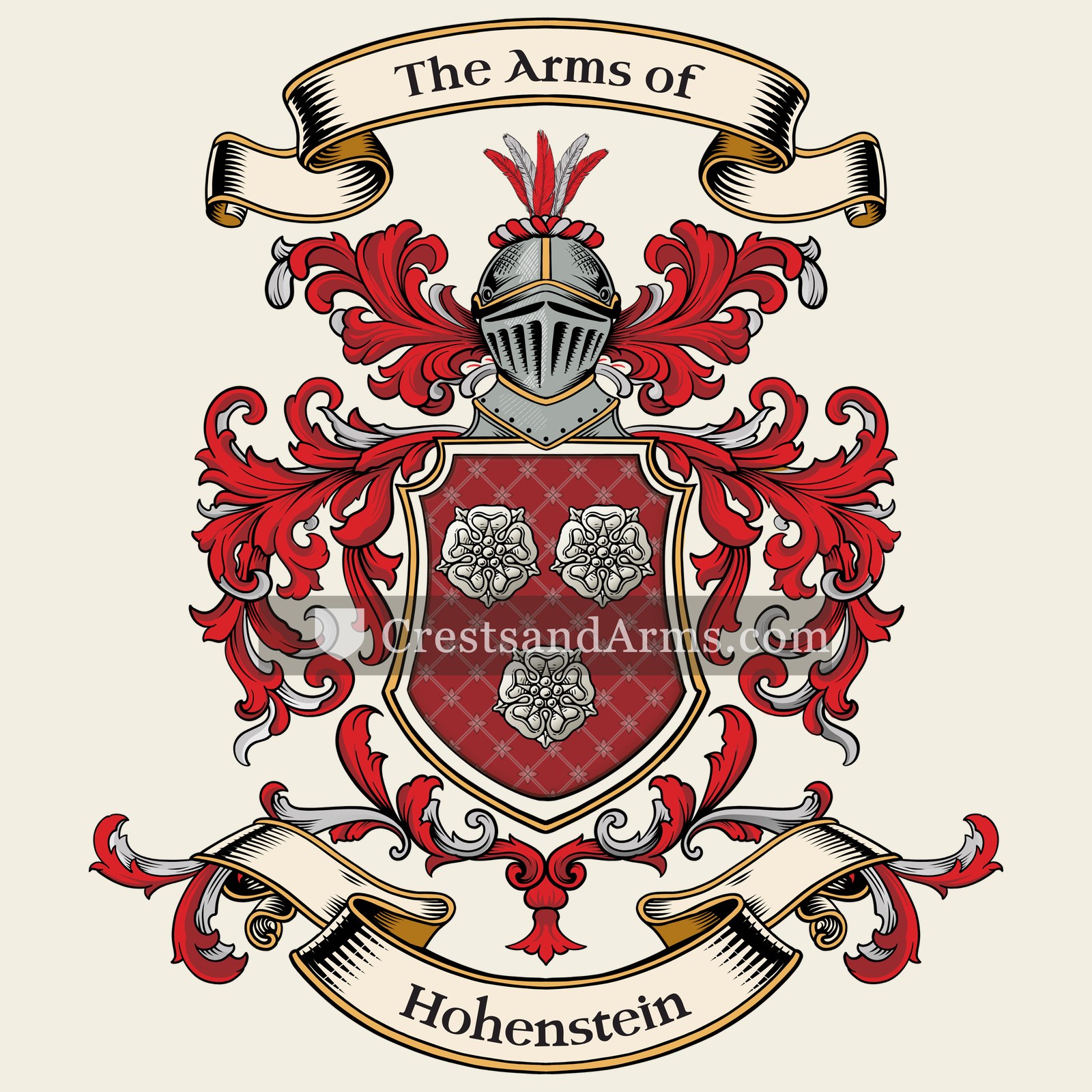
Symbols on this shield
roseThe seventh son, and beauty with grace
Colours
Red (Gules)Means: Military strength
Silver (Argent)Means: Peace and sincerity
Historical info
Source
J. B. Rietstap, Armorial Général, Gouda: G. B. van Goor Zonen, 1884–87
Blazon (the actual original written record)
“De gu. à trois roses tigées, d'arg., sortant d'un même tronc, mises en fasce. C.: les meubles de l'écu.”
HesseHesse, c. 1765
Digital archive packCoat of arms PNG, gold border print PDF, vector SVG and the certificate of authenticity. Sent to your email in minutes.
Map of Germany showing where the Hohenstein arms are recorded
The Hohenstein arms were recorded in Hesse, c. 1765.
Hesse was central German country, divided among a large number of small landowners and prosperous towns. So many separate households held ground there that the region produced an unusual number of coats of arms.
This is where the arms were entered in the register. Families often moved to other parts of the country, so the same name can turn up in more than one region.
The body that granted and recorded arms in Germany in this period.
Francis I, Holy Roman Emperor
Sovereign of the period
Francis I, Holy Roman Emperor
1745–1765
Reigning in France when the Hohenstein arms are first recorded.
How Arms Worked in Germany
In the Holy Roman Empire, coats of arms were often granted to individuals by the Emperor or his representatives. These arms were then passed down through the generations to all legitimate descendants of the original holder. Younger branches of a family usually kept the same shield design without needing to change it, as the arms belonged to the entire lineage.
Granting authority
The Holy Roman Emperor held the sole power to grant new coats of arms throughout his vast imperial territories.
How they got arms
Families typically obtained their coats of arms through a formal imperial grant or by proving their noble status to the authorities.
Where arms were recorded
These grants were officially recorded in the Imperial Chancery registers, which began keeping formal records of such honors during the Middle Ages.
The family's standing
Recorded among the armigerous families of Hesse.
Origin & History of the Hohenstein Family in Germany
The family name Hohenstein is a topographical surname, meaning it was originally derived from the physical landscape of the German regions where the family resided. In German, the name translates to high stone or high rock, likely referencing a family that lived near a prominent cliff, a rocky hill, or a fortified stone structure. By the mid-eighteenth century, records confirm that members of the family were established in the region of Hesse. During this era, Hesse was a collection of territories defined by dense forests and rugged terrain, which provided the ideal setting for a name rooted in geography. Families in this part of Germany were often identified by their proximity to specific natural landmarks, and the Hohenstein name suggests that these early ancestors were deeply connected to the distinct geological features of their home. This connection to the land helped define their identity long before they appeared in the official parish and tax records of 1765.
Related Branches & Arms
Root word
Hoh-Stein
High or elevated stone or rock formation.
This name
HohensteinRefers to a person living near a prominent or high rocky outcrop.
also spelled
Hohensteyn
Hohenstain
Hohenstine
Related arms
Allendorfsimilar arms
Documented Sources
J. B. Rietstap, Armorial Général, Gouda: G. B. van Goor Zonen, 1884–87
Archives Départementales du Bas-Rhin, Registres paroissiaux de l'état civil, Series E
Kintz, Jean-Pierre, La société alsacienne au XVIIe siècle, 1984
Livet, Georges, L'Intendance d'Alsace sous Louis XIV, 1956
Digital archive packCoat of arms PNG, gold border print PDF, vector SVG and the certificate of authenticity. Sent to your email in minutes.


 fretPersuasion, and the net that holds
 fretPersuasion, and the net that holds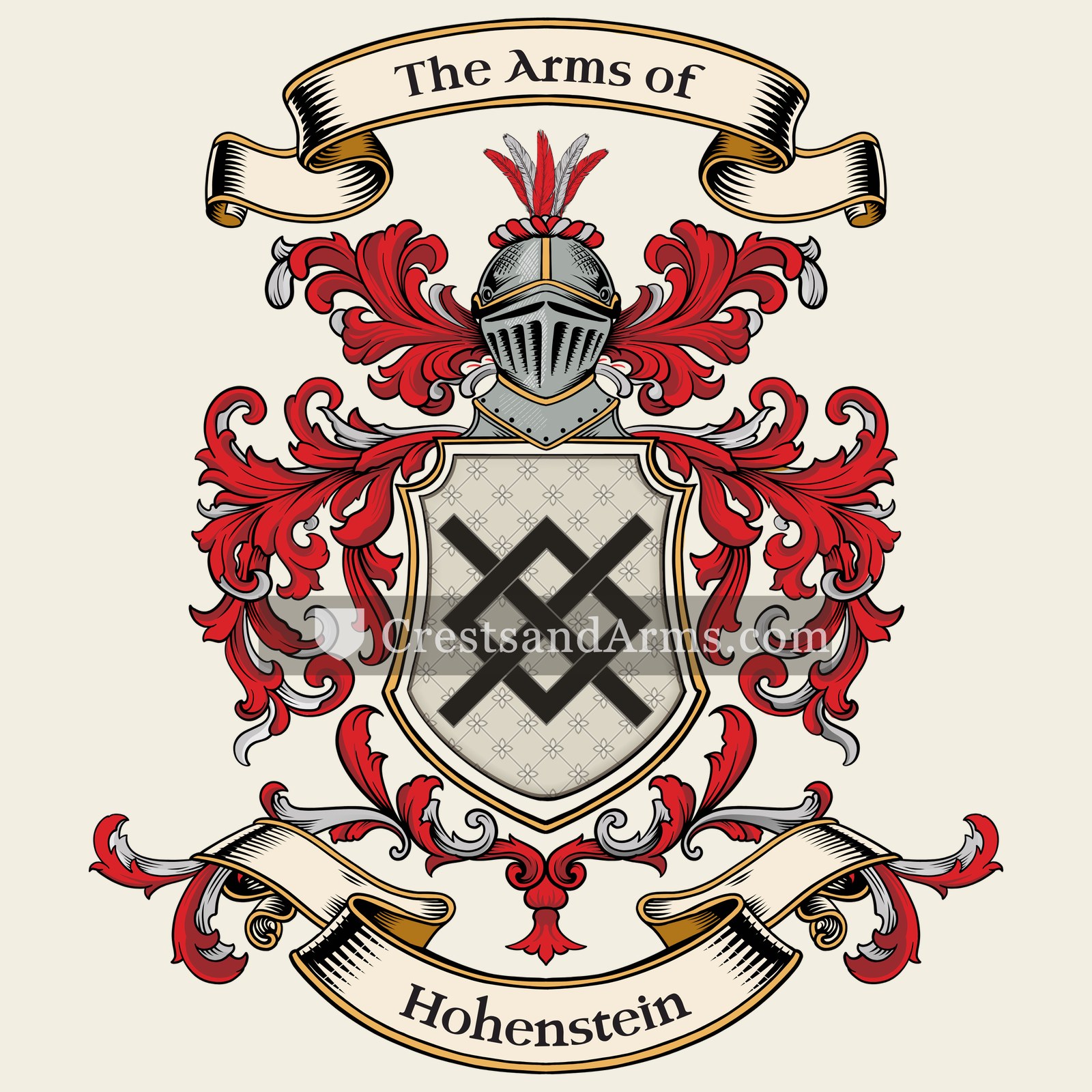


 roseThe seventh son, and beauty with grace