Map of Germany showing where the Holck arms are recorded
The Holck arms were recorded in Hesse, c. 1818.
Hesse was central German country, divided among a large number of small landowners and prosperous towns. So many separate households held ground there that the region produced an unusual number of coats of arms.
This is where the arms were entered in the register. Families often moved to other parts of the country, so the same name can turn up in more than one region.
The body that granted and recorded arms in Germany in this period.
Frederick William III of Prussia
Sovereign of the period
Frederick William III of Prussia
1797–1840
Reigning in Germany when the Holck arms are first recorded.
How Arms Worked in Germany
Prussian heraldry was strictly tied to social rank and noble status rather than being a free choice for every citizen. These symbols were treated as permanent family property that moved through the generations to all legitimate heirs. If a family branch wanted to change their design to stand out, they had to apply for official permission to alter their specific version of the shield.
Granting authority
The Prussian Heroldsamt acted as the central state office that managed and strictly controlled all noble titles and coats of arms.
How they got arms
Families usually obtained their arms through formal royal grants or by proving their long-standing noble status to the state authorities.
Where arms were recorded
All official coats of arms were kept in the rolls of the Prussian Heroldsamt, which functioned from 1706 until 1918.
The family's standing
Recorded among the armigerous families of Hesse.
Origin & History of the Holck Family in Germany
The family name Holck has deep roots in the region of Hesse, where records confirm members of the family were living as early as 1818. The name itself is thought to be topographic in origin, which means it likely described the specific landscape where the family first settled. In many Germanic dialects, the term refers to a hollow, a valley, or a low-lying area of land. Families during this period often adopted surnames based on their immediate surroundings or the physical features of their ancestral farms. By the early 19th century, the Holck family was well-established within the local community, participating in the agricultural and social life of the Hessian countryside. This transition from a descriptive nickname to a formal family name reflects the broader movement toward standardized record-keeping in German states during the Napoleonic era.
Holck Meaning & Related Branches
Root word
Holk
A Middle Low German term referring to a hollow or cavity.
This name
HolckA topographic name for someone who lived in a hollow or valley.
also spelled
Holck
Holke dit fon Sturmfeder
Documented Sources
J. B. Rietstap, Armorial Général, Gouda: G. B. van Goor Zonen, 1884–87
Hessisches Staatsarchiv Marburg, Bestand 310 (Kirchenbücher der evangelischen Pfarreien)
Bahlow, Hans, Deutsches Namenlexikon: Familien- und Vornamen nach Ursprung und Sinn erklärt, 1967
Gottschald, Max, Deutsche Namenkunde: Unsere Familiennamen nach ihrer Entstehung und Bedeutung, 1971
Digital archive packCoat of arms PNG, gold border print PDF, vector SVG and the certificate of authenticity. Sent to your email in minutes.


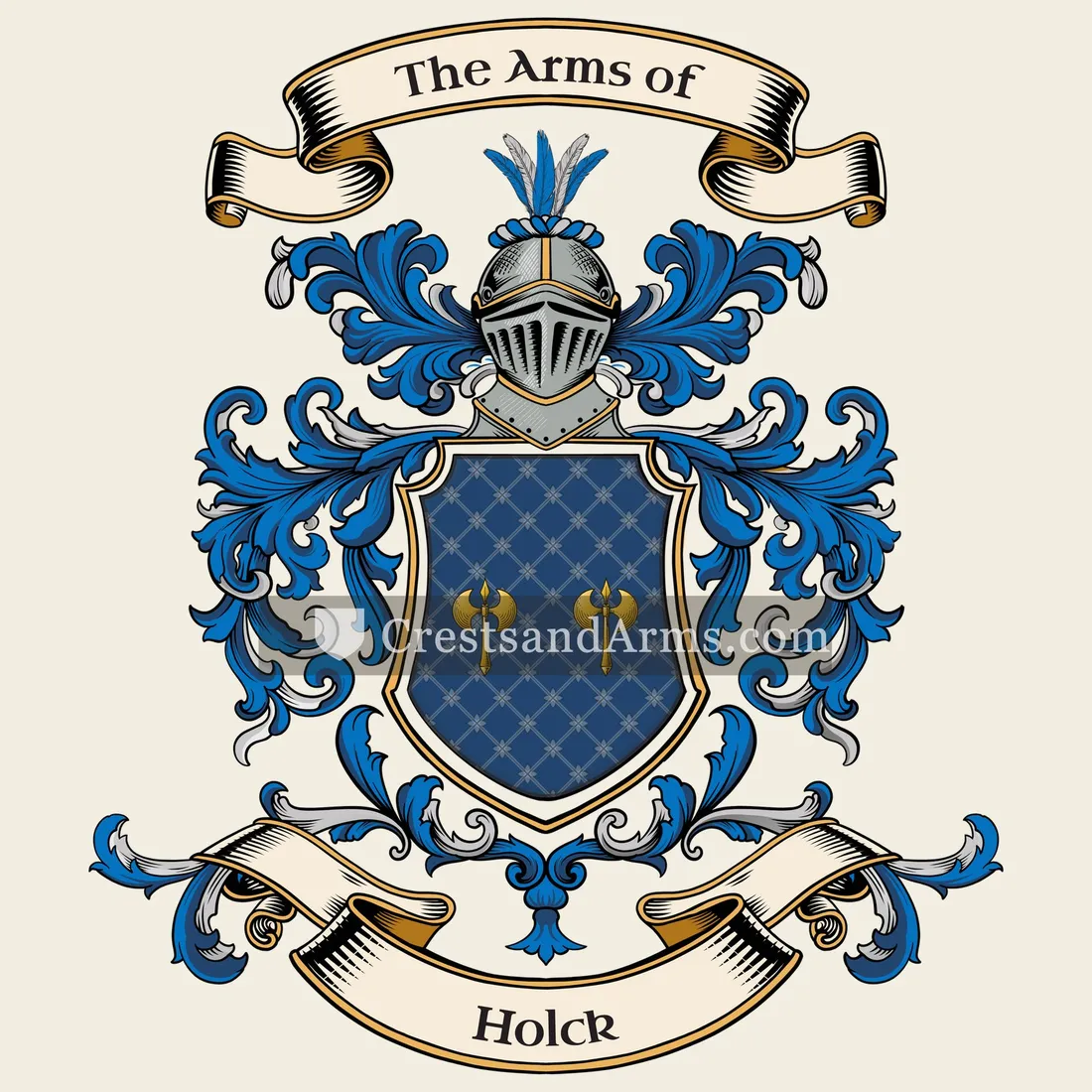
 axeThe execution of military duty
 axeThe execution of military duty