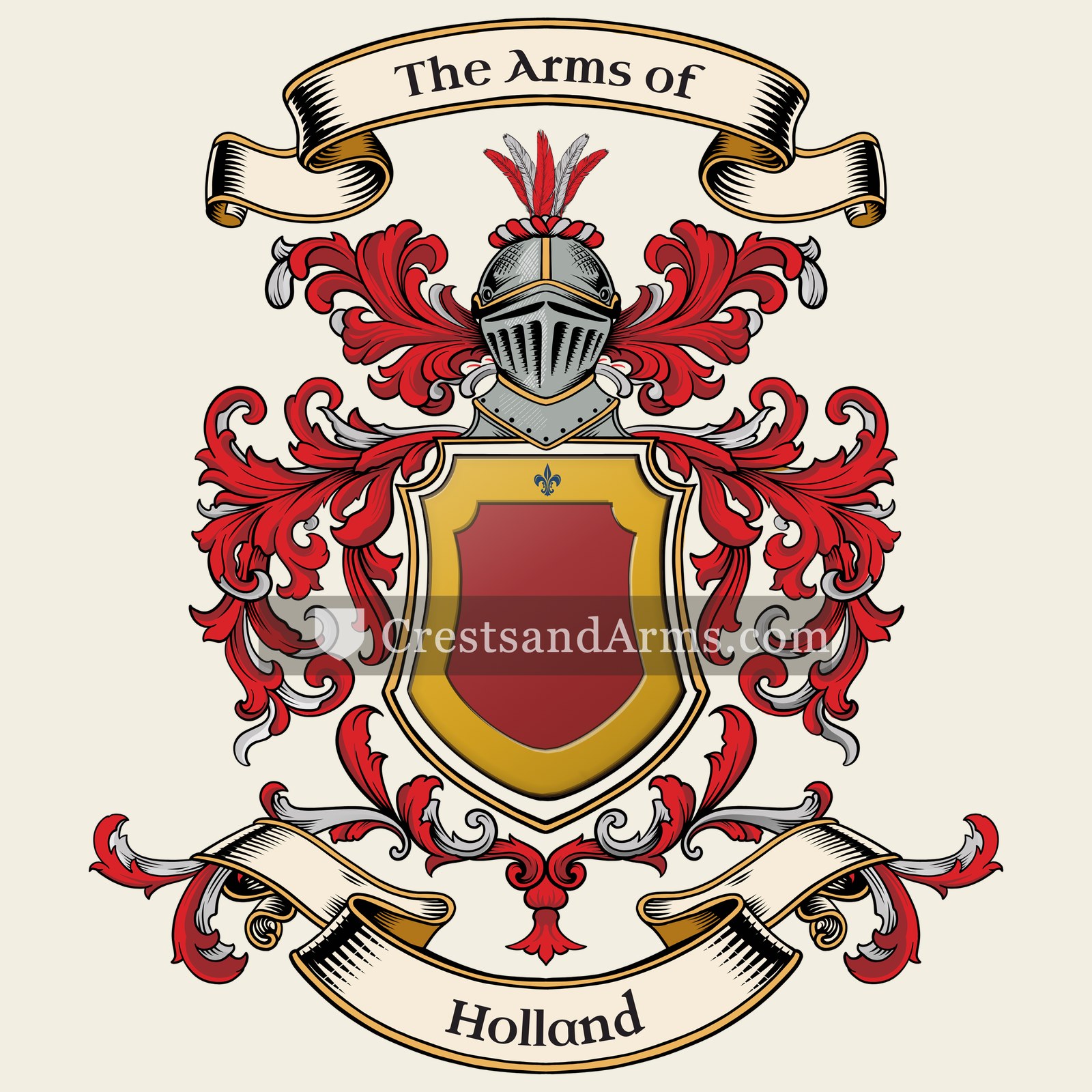
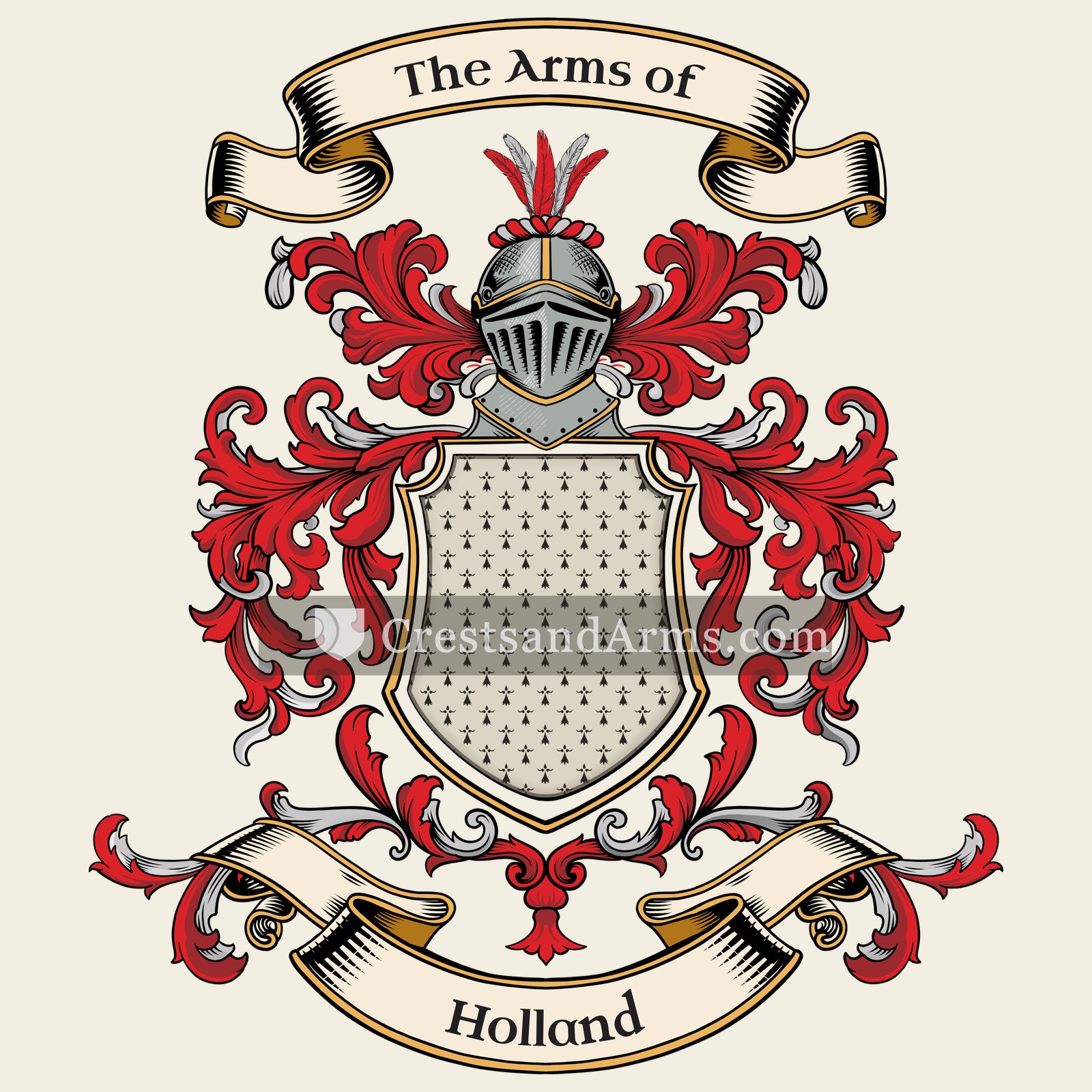
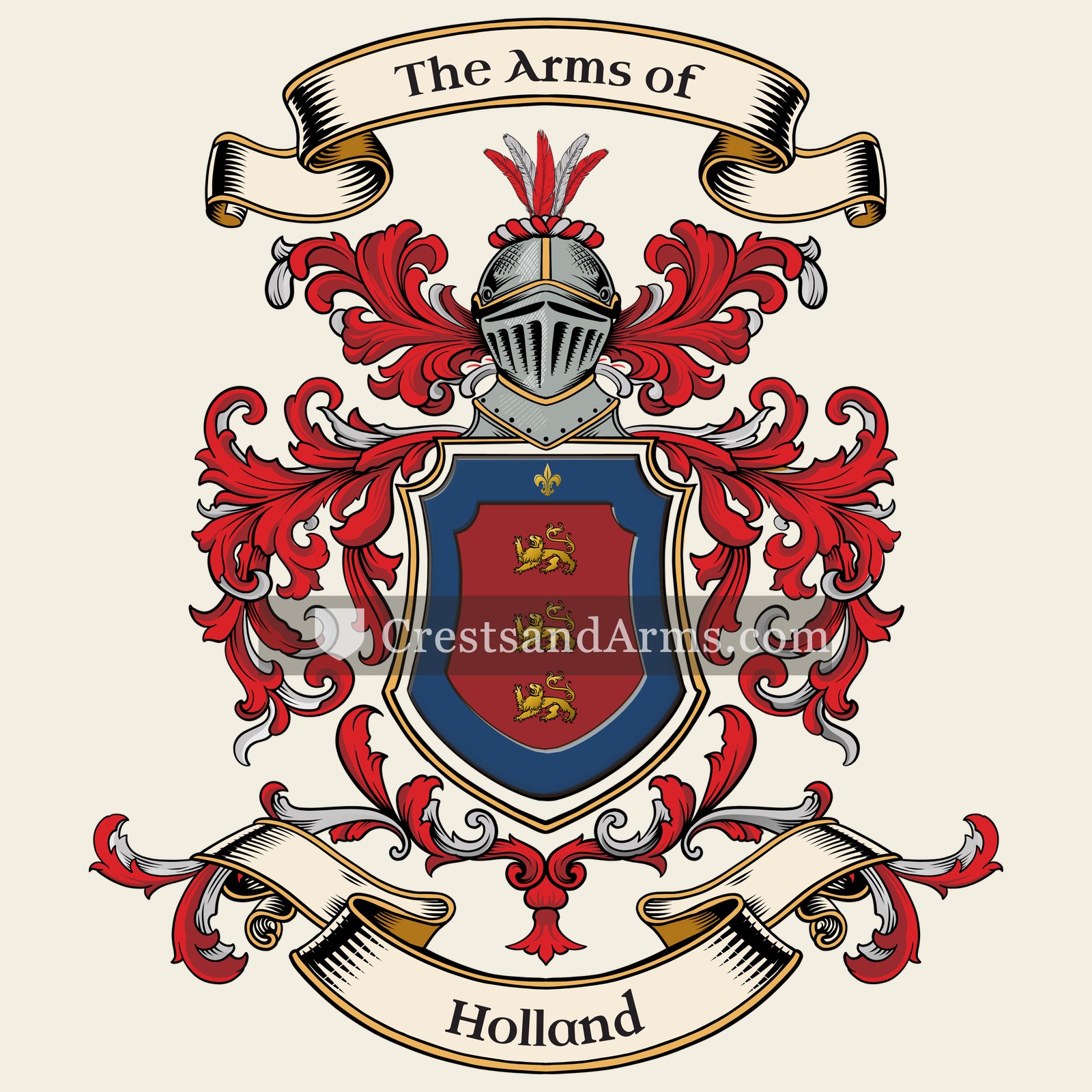
A record of documented arms, meaning and origin, researched for the Holland family lines. Documented in 3 countries.
Reg. 0225 · French, G–I
Coat of Arms & Family Crest Details
Symbols on this shield
lionCourage, strength and royalty
fleur de lisPurity, light, and the sixth son
Colours
Red (Gules)Means: Military strength
Blue (Azure)Means: Loyalty and truth
Gold (Or)Means: Generosity
Historical info
Source
J. B. Rietstap, Armorial Général, Gouda: G. B. van Goor Zonen, 1884–87
Blazon (the actual original written record)
“De gu. à trois léopards d'or, l'un sur l'autre; à la bord. d'azur, semée de fleurs-de-lis d'or. C.: un léopard d'or, cour. du même, au collier d'azur ch. d'une fleur-de-lis d'or, posé sur un chapeau de tournoi de gu., retr. d'herm.”
Francec. 1397
Digital archive packCoat of arms PNG, gold border print PDF, vector SVG and the certificate of authenticity. Sent to your email in minutes.
Map of France showing where the Holland arms are recorded
The Holland arms were recorded in France, c. 1397.
Arms such as these were typically recorded in Bretagne.
More families held coats of arms in Bretagne than anywhere else in France. The land was divided into many small estates rather than a few large ones, so far more households counted as gentry, and each needed a shield of its own to be told apart.
This is where the arms were entered in the register. Families often moved to other parts of the country, so the same name can turn up in more than one region.
The body that granted and recorded arms in France in this period.
Charles VI of France
Sovereign of the period
Charles VI of France
1380–1422
Reigning in France when the Holland arms are first recorded.
How Arms Worked in France
In France, a coat of arms was a mark of honor that passed down through the male line to all legitimate descendants. Families often used the same shield without changes to show their shared heritage. If a branch wanted to stand out, they could add a small mark to their shield to show their specific place in the family tree.
Granting authority
The Juge d'armes de France acted as the official authority that regulated and verified coats of arms across the country.
How they got arms
Families typically inherited their arms from ancestors, though they could also receive them through royal grants or by proving their noble status.
Where arms were recorded
Coats of arms were officially recorded in the Armorial Général de France, which began its main collection in the year 1696.
The family's standing
Recorded among the armigerous families of France.
Origin & History of the Holland Family in France
The history of the Holland family in France is deeply tied to the region of Brittany, where records confirm their presence as early as 1397. During the late Middle Ages, families with this name often held positions of local influence and served within the complex social structures of the Breton nobility. The name itself likely originated as a geographical descriptor, identifying individuals who had traveled from or maintained trade connections with the Low Countries. As these families settled in French territories, they integrated into the local culture by participating in regional administration and land management. Their documented existence in 1397 suggests that they were already well-established members of the community by the end of the fourteenth century. Over time, these early ancestors helped shape the historical landscape of the region through their involvement in the political and economic life of medieval Brittany.
Coat of Arms & Family Crest Details
Symbols on this shield
bordureA difference between branches of one family
fleur de lisPurity, light, and the sixth son
Colours
Red (Gules)Means: Military strength
Gold (Or)Means: Generosity
Blue (Azure)Means: Loyalty and truth
Historical info
Source
Sir Bernard Burke, The General Armory of England, Scotland, Ireland and Wales, London: Harrison & Sons, 1884
Blazon (the actual original written record)
“England, within a bordure or, semée-de-lis az”
NetherlandsExeter, c. 1381
Digital archive packCoat of arms PNG, gold border print PDF, vector SVG and the certificate of authenticity. Sent to your email in minutes.
Map of Netherlands showing where the Holland arms are recorded
The Holland arms were recorded in Exeter, c. 1381.
Arms such as these were typically recorded in Friesland.
Friesland was low, wet country on the northern coast of the Netherlands, farmed by families who had held the same land for centuries. Free landholders were unusually common there, and a free landholder could carry arms.
This is where the arms were entered in the register. Families often moved to other parts of the country, so the same name can turn up in more than one region.
Region
Friesland
Town
Exeter
First recorded
1381
Granting Authority for the Holland Arms
Hoge Raad van Adel
Photograph made by me · CC BY-SA 3.0
The body that granted and recorded arms in Netherlands in this period.
How Arms Worked in Netherlands
In the Netherlands, coats of arms were often used by noble families and those who held specific public offices. These arms were passed down through the generations to legitimate descendants. Younger branches of a family usually kept the original design without needing to add special marks. This system ensured that the family identity remained clear and consistent over many years.
Granting authority
The Hoge Raad van Adel is the official body that regulates and manages noble titles and coats of arms in the Netherlands.
How they got arms
Families typically obtained their coats of arms through official royal grants or by proving their long-standing historical use of the symbols.
Where arms were recorded
Coats of arms are officially recorded in the registers held by the Hoge Raad van Adel, which began its work in 1814.
The family's standing
Recorded among the armigerous families of Netherlands.
Origin & History of the Holland Family in Netherlands
The history of the Holland surname is deeply connected to the northern regions of the Netherlands, particularly the province of Friesland. By the year 1381, records indicate that families bearing this name were already established members of the local community. During this period, the name likely served as a topographical identifier, used to distinguish individuals who had migrated from the county of Holland to other parts of the Low Countries. As people began to move more frequently for trade and agriculture, using a place name as a surname became a common way to track one’s origins. These early ancestors were part of a society defined by independent farming and maritime trade, which helped the name spread across the Frisian landscape. Over time, the name transitioned from a simple description of where a person came from into a permanent family identity that was passed down through generations.
Coat of Arms & Family Crest Details
Colours
ErmineMeans: Dignity
Historical info
Source
Sir Bernard Burke, The General Armory of England, Scotland, Ireland and Wales, London: Harrison & Sons, 1884
Blazon (the actual original written record)
“Holles, or Hollis (Grimsby, co. Lincoln, and Haughton, co. Nottingham; descended from the marriage of WILLIAM HOLLES, of Haughton (second son of Sir WILLIAM HOLLES, Lord Mayor of London in 1540) with ANNE, dau. and heiress of JOHN DENZELL, Esq., of Denzell, co. Cornwall; the grandson of this alliance, JOHN HOLLES, of Haughton, was created Baron Haughton in 1616, and Earl of Clare in 1624; the last inheritor of which honours, JOHN HOLLES, fourth Earl of Clare, was created Duke of Newcastle; his Grace left an only child, HENRIETTA, wife of EDWARD, Lord Harley, and mother of MARGARET, Duchess of Portland). Erm. two piles in point sa. Crest—A boar pass. az. bristled or.”
Englandc. 1540
Digital archive packCoat of arms PNG, gold border print PDF, vector SVG and the certificate of authenticity. Sent to your email in minutes.
Map of England showing where the Holland arms are recorded
The Holland arms were recorded in England, c. 1540.
Arms such as these were typically recorded in York.
Yorkshire is the largest of the English counties, and it held more gentry families than any other. Land there was split among a great many households rather than a few, so a great many of them carried arms.
This is where the arms were entered in the register. Families often moved to other parts of the country, so the same name can turn up in more than one region.
The body that granted and recorded arms in England in this period.
Henry VIII of England
Sovereign of the period
Henry VIII of England
1509–1547
Reigning in France when the Holland arms are first recorded.
How Arms Worked in England
English heraldry allowed arms to be shared by all legitimate descendants of the original owner. These symbols were treated as personal property that moved through the generations to all children. While the eldest son kept the original design, other family members could use the same shield without needing to change it or register their own unique versions.
Granting authority
The College of Arms in London has regulated the use of coats of arms throughout England and Wales since 1484.
How they got arms
Families typically obtained their coats of arms through a formal grant from the Crown or by proving their ancient right to them.
Where arms were recorded
All official coats of arms are recorded in the registers kept at the College of Arms, which date back to the fifteenth century.
The family's standing
Recorded among the armigerous families of England.
Origin & History of the Holland Family in England
The family name Holland is a locative surname, meaning it was originally adopted by people to describe the specific place where they lived. In the context of medieval England, the name typically identified individuals who hailed from regions known as "hollow land" or low-lying areas, which were often found near marshes or river valleys. By the time members of the family were firmly established in York in 1540, the name had already transitioned from a simple geographic descriptor into a permanent hereditary surname. During the sixteenth century, families in northern England often moved toward urban centers like York to participate in the growing trade and craft guilds of the era. As these early ancestors settled into city life, the name Holland became a fixed identifier that linked them to their ancestral roots while they built new lives as residents of a major regional hub.
Holland Meaning & Related Branches
Root word
Holt
Old English word for a wood or a small forest.
This name
HollandRefers to someone who lived near a wood or a hollow land.
also spelled
Hollander
Hollond
Hollant
Related arms
Guéguen d'Estuelsimilar arms
Reeve de la Polesimilar arms
Andrewsrecorded with Holland, same area
Batherecorded with Holland, same area
Documented Sources
J. B. Rietstap, Armorial Général, Gouda: G. B. van Goor Zonen, 1884–87
Archives départementales d'Ille-et-Vilaine, Fonds de la famille de Holland
Poterie, Michel, Histoire de la Bretagne et des Bretons, 1982
Touchard, Henri, Le commerce maritime breton à la fin du Moyen Âge, 1967
Digital archive packCoat of arms PNG, gold border print PDF, vector SVG and the certificate of authenticity. Sent to your email in minutes.


 lionCourage, strength and royalty
 fleur de lisPurity, light, and the sixth son
 lionCourage, strength and royalty
 fleur de lisPurity, light, and the sixth son


 bordureA difference between branches of one family