A record of documented arms, meaning and origin, researched for the Holmer family lines. Documented in 2 countries.
Reg. 2329 · German, G–I
Meaning of the Holmer family crest colors & symbols
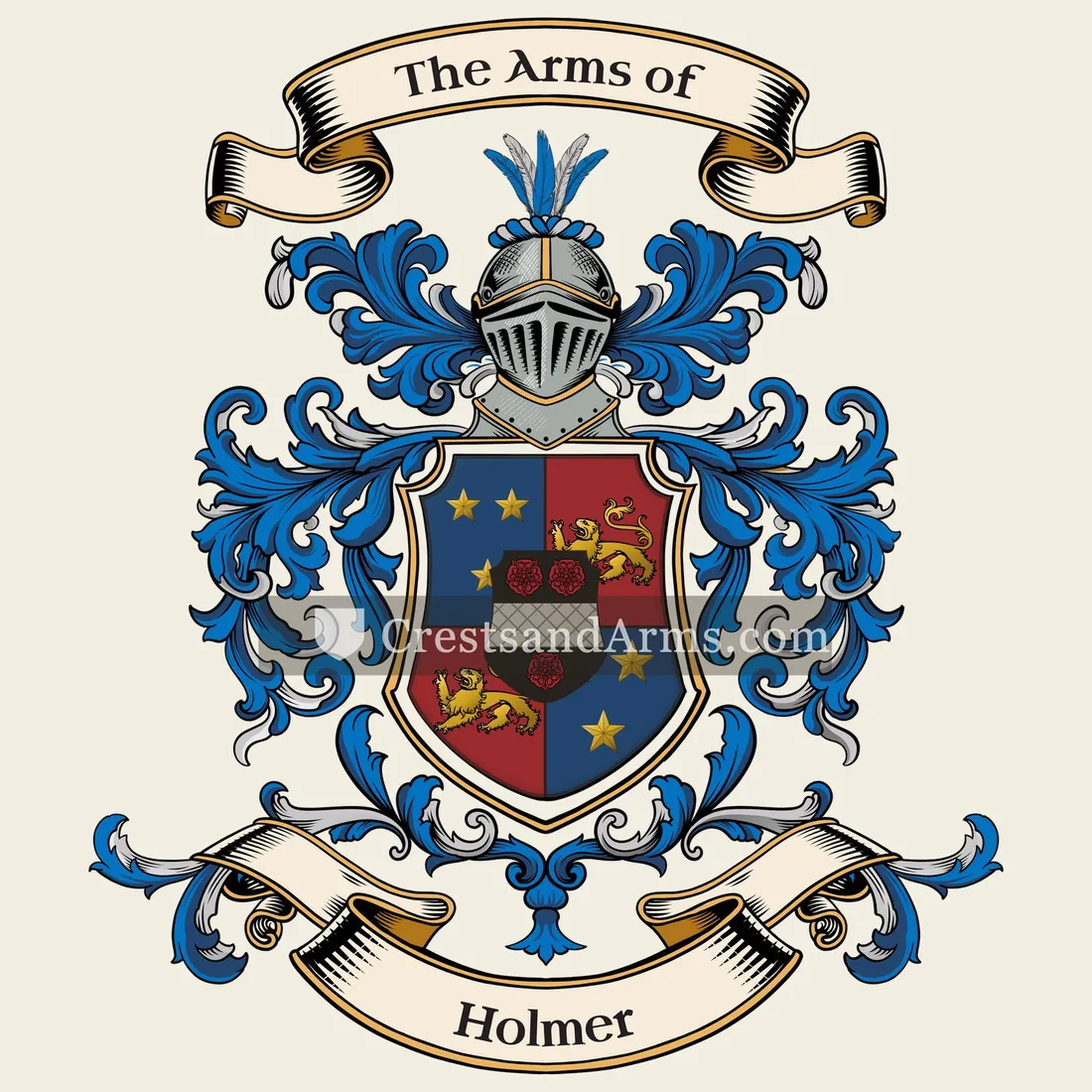
Symbols on this shield
fessThe military belt, and readiness to serve
mulletThe third son, and a divine quality from above
lionCourage, strength and royalty
roseThe seventh son, and beauty with grace
Colours
Blue (Azure)Means: Loyalty and truth
Red (Gules)Means: Military strength
Black (Sable)Means: Constancy
Silver (Argent)Means: Peace and sincerity
Gold (Or)Means: Generosity
Historical info
Source
J. B. Rietstap, Armorial Général, Gouda: G. B. van Goor Zonen, 1884–87
Blazon (the actual original written record)
“Ec.: aux 1 et 4 d'azur à trois étoiles d'or; aux 2 et 3 de gu. au lion d'or, celui du 3 cont. Sur le tout de sa. à la fasce d'arg., ch. de trois roses de gu. Trois cq. cour. C.: 1° une étoile d'or; entre deux prob., coupées alt. d'or et d'azur; 2° un vol aux armes du surtout; 3° le lion du 2. L.: à dextre d'or et d'azur, à sen. d'or et de gu. S.: deux lions reg. d'or, lamp. de gu.”
HolsteinHolstein, c. 1765
Digital archive packCoat of arms PNG, gold border print PDF, vector SVG and the certificate of authenticity. Sent to your email in minutes.
Map of Germany showing where the Holmer arms are recorded
The Holmer arms were recorded in Holstein, c. 1765.
Holstein was farming country between the North Sea and the Baltic, held in large estates. The same families kept the same land for generations, and generations of holding is what fills a register.
This is where the arms were entered in the register. Families often moved to other parts of the country, so the same name can turn up in more than one region.
The body that granted and recorded arms in Germany in this period.
Francis I, Holy Roman Emperor
Sovereign of the period
Francis I, Holy Roman Emperor
1745–1765
Reigning in Germany when the Holmer arms are first recorded.
How Arms Worked in Germany
In the Holy Roman Empire, coats of arms were often granted to individuals by the Emperor or his representatives. These arms were then passed down through the generations to all legitimate descendants of the original holder. Younger branches of a family usually kept the same shield design without needing to change it, as the arms belonged to the entire lineage.
Granting authority
The Holy Roman Emperor held the sole power to grant new coats of arms throughout his vast imperial territories.
How they got arms
Families typically obtained their coats of arms through a formal imperial grant or by proving their noble status to the authorities.
Where arms were recorded
These grants were officially recorded in the Imperial Chancery registers, which began keeping formal records of such honors during the Middle Ages.
The family's standing
Recorded among the armigerous families of Holstein.
Origin & History of the Holmer Family in Germany
The family name Holmer is deeply connected to the geography of northern Germany, specifically the region of Holstein. The name is topographical in origin, which means it was likely given to people who lived near a "Holm," a term used in the Low German dialect to describe a small island or a piece of raised land surrounded by marshy ground. By the mid-18th century, records confirm that families bearing this name were well-established in the rural landscapes of Holstein. During this period, the region was characterized by a transition toward more structured land management and agricultural expansion. Families like the Holmers were often tied to the local farming economy, where their surname served as a practical way to identify their ancestral home or specific plot of land. As the population grew and moved within the duchies of Schleswig and Holstein, the name became a permanent marker of their roots in the low-lying, water-rich terrain of the Baltic and North Sea coasts.
Meaning of the Holmer family crest colors & symbols
Symbols on this shield
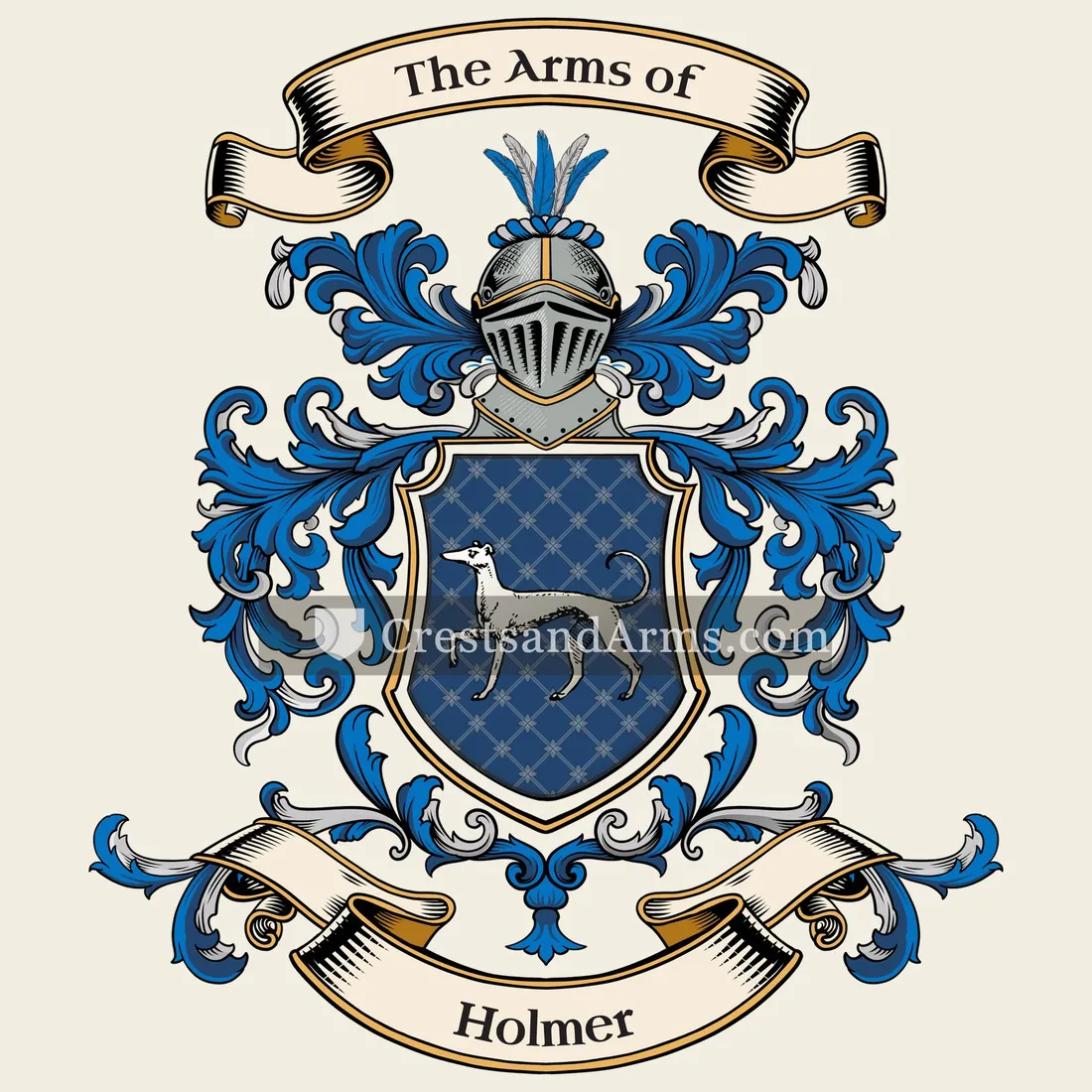
greyhoundCourage, vigilance and loyalty
Colours
Blue (Azure)Means: Loyalty and truth
Silver (Argent)Means: Peace and sincerity
Historical info
Source
J. B. Rietstap, Armorial Général, Gouda: G. B. van Goor Zonen, 1884–87
Blazon (the actual original written record)
“D'azur à un lévrier ramp. d'arg., coll. du même. Cq. cour. C.: le lévrier, iss.”
Austriac. 1772
Digital archive packCoat of arms PNG, gold border print PDF, vector SVG and the certificate of authenticity. Sent to your email in minutes.
Map of Austria showing where the Holmer arms are recorded
The Holmer arms were recorded in Austria, c. 1772.
Arms such as these were typically recorded in Tyrol.
Tyrol was mountain country in western Austria, where the valleys were held by families who had been there a very long time. Old tenure counted for more than money, and old families carried arms.
This is where the arms were entered in the register. Families often moved to other parts of the country, so the same name can turn up in more than one region.
Region
Tyrol
First recorded
1772
Granting Authority for the Holmer Arms
Imperial and Royal chancery
Sodacan · CC BY-SA 3.0
The body that granted and recorded arms in Austria in this period.
Joseph II, Holy Roman Emperor
Sovereign of the period
Joseph II, Holy Roman Emperor
1765–1790
Reigning in Germany when the Holmer arms are first recorded.
How Arms Worked in Austria
Austrian coats of arms were often linked directly to noble titles granted by the Emperor. These symbols belonged to the entire family line rather than just one individual. When a family grew, new branches kept the original design without needing to change it. This system allowed all members of a noble house to share the same identity across many generations.
Granting authority
The Imperial and Royal chancery managed all heraldic matters and controlled the official granting of arms throughout the Austrian lands.
How they got arms
Families typically received their arms through a formal imperial decree that often accompanied the elevation of a person to noble status.
Where arms were recorded
Official records of these grants were kept in the Imperial Register of Nobility which began its formal documentation process in 1453.
The family's standing
Recorded among the armigerous families of Austria.
Origin & History of the Holmer Family in Austria
The family name Holmer traces its roots in Austria to the rugged landscape of the Tyrol region. By 1772, records confirm that family members were already established in this mountainous area. The name itself is likely derived from the Middle High German word "Holm," which refers to a small island or a piece of elevated land near a river. This suggests that the earliest ancestors were likely farmers or settlers who lived near the valley floors or along the banks of the alpine streams common to the region. Life in eighteenth-century Tyrol was defined by strict social structures and the challenges of high-altitude agriculture. As members of the local community, the Holmer family would have been deeply connected to the seasonal rhythms of the Alps, contributing to the rural economy and the unique cultural identity of the Austrian frontier.
Holmer Meaning & Related Branches
Root word
Holm
A small island or a piece of flat land near a river.
This name
HolmerRefers to someone who lived on or near a small river island.
also spelled
Holm
Related arms
Moltke-Hvitfeldsimilar arms
Documented Sources
J. B. Rietstap, Armorial Général, Gouda: G. B. van Goor Zonen, 1884–87
Kaufmann, Henning. Untersuchungen zu altdeutschen Rufnamen. 1965
Bahlow, Hans. Deutsches Namenlexikon: Familien- und Vornamen nach Ursprung und Sinn erklärt. 1967
Landesarchiv Schleswig-Holstein, Kirchenbücher (Church Records) of the Duchy of Holstein, 1765
Digital archive packCoat of arms PNG, gold border print PDF, vector SVG and the certificate of authenticity. Sent to your email in minutes.


 fessThe military belt, and readiness to serve
 mulletThe third son, and a divine quality from above
 lionCourage, strength and royalty
 roseThe seventh son, and beauty with grace
 fessThe military belt, and readiness to serve
 mulletThe third son, and a divine quality from above
 lionCourage, strength and royalty
 roseThe seventh son, and beauty with grace


 greyhoundCourage, vigilance and loyalty