A record of documented arms, meaning and origin, researched for the Holstein family lines. Documented in 2 countries.
Reg. 6549 · Danish, G–I
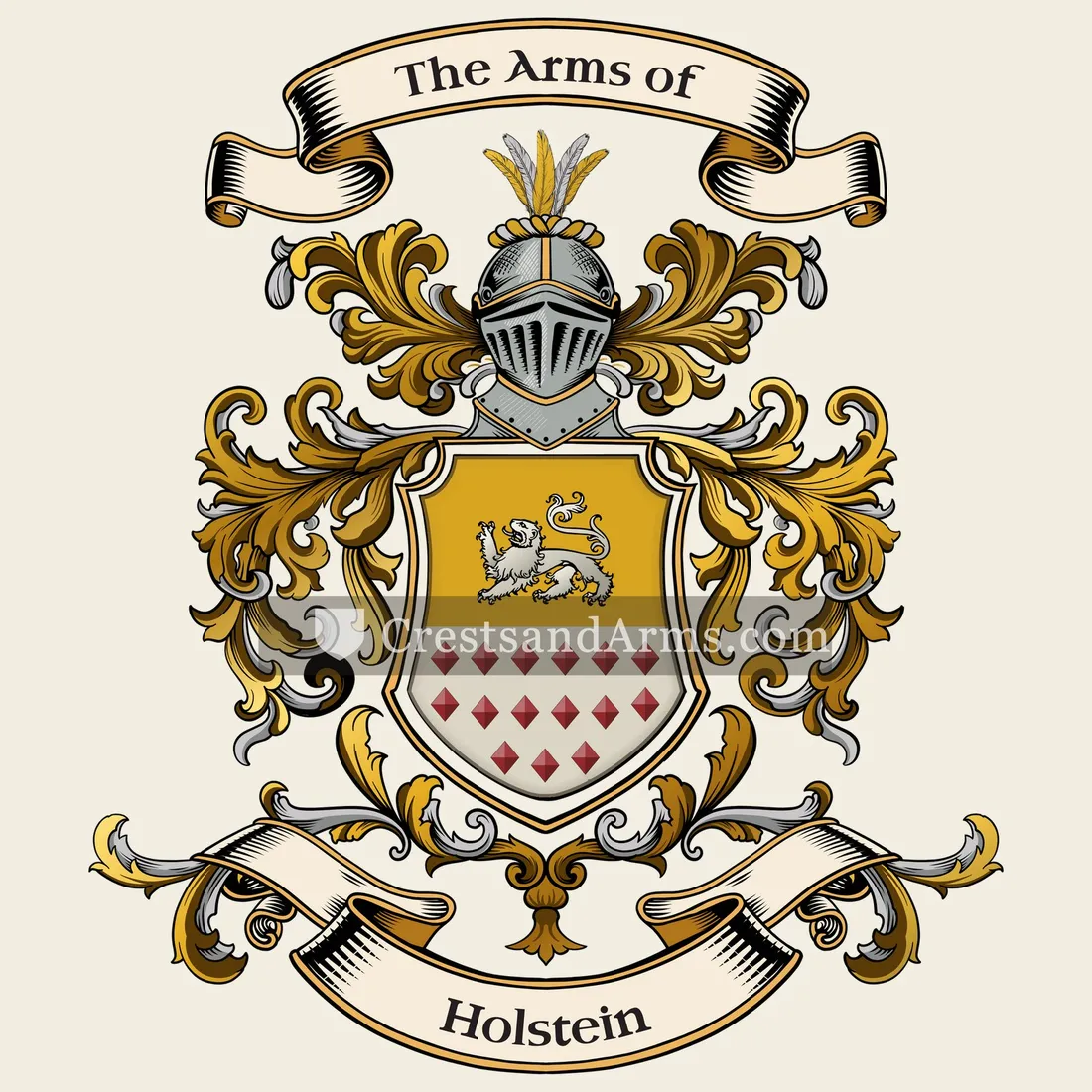
Meaning of the Holstein family crest colors & symbols
Symbols on this shield
lionCourage, strength and royalty
lozengeHonour and nobility, and the arms of a woman
Colours
Gold (Or)Means: Generosity
Silver (Argent)Means: Peace and sincerity
Red (Gules)Means: Military strength
Historical info
Source
J. B. Rietstap, Armorial Général, Gouda: G. B. van Goor Zonen, 1884–87
Blazon (the actual original written record)
“Coupé: au 1 d'or au lion léopardé d'arg.; au 2 d'arg. à quinze los. accolées et aboutées de gu., 6, 6 et 3. Cq. cour. C.: deux prob., de gu. et d'arg., ch. chacune de trois fasces de l'un à l'autre.”
Denmarkc. 1621
Digital archive packCoat of arms PNG, gold border print PDF, vector SVG and the certificate of authenticity. Sent to your email in minutes.
Map of Denmark showing where the Holstein arms are recorded
The Holstein arms were recorded in Denmark, c. 1621.
Arms such as these were typically recorded in Sjaælland.
Zealand held the Danish court, the crown's offices and Copenhagen itself. Families who served the king kept estates within reach of it, and royal service was the ordinary route to a coat of arms.
This is where the arms were entered in the register. Families often moved to other parts of the country, so the same name can turn up in more than one region.
The body that granted and recorded arms in Denmark in this period.
Christian IV of Denmark
Sovereign of the period
Christian IV of Denmark
1588–1648
Reigning in Denmark when the Holstein arms are first recorded.
How Arms Worked in Denmark
Danish heraldry during this period was closely tied to noble status and royal favor rather than being open to all citizens. Arms were typically granted by the monarch to individuals, and these symbols were then shared by all members of the noble house. If a family line died out, the right to use those specific arms ended with them.
Granting authority
The Danish royal chancery held the power to issue and regulate official coats of arms for the kingdom.
How they got arms
Families usually received their arms through a formal royal grant that confirmed their noble status and rights.
Where arms were recorded
These grants were officially recorded in the Danish Royal Chancery records starting in the sixteenth century.
The family's standing
Recorded among the armigerous families of Denmark.
Origin & History of the Holstein Family in Denmark
The family name Holstein has deep roots in Danish history, particularly within the island of Sjaælland where records confirm the family’s presence as early as 1621. During this period, the name was closely linked to the landed nobility and the complex political landscape of the Danish-German border regions. Many individuals bearing this name served as influential administrators and military officers who helped shape the governance of the Danish realm. As the family established itself in Sjaælland, they became integrated into the local social hierarchy through land ownership and service to the crown. Their history reflects the broader movement of families who navigated the shifting loyalties and cultural exchanges between Denmark and the neighboring duchies. By maintaining a steady presence in the Danish capital and its surrounding countryside, the Holstein family secured a lasting place in the administrative records of the seventeenth century.
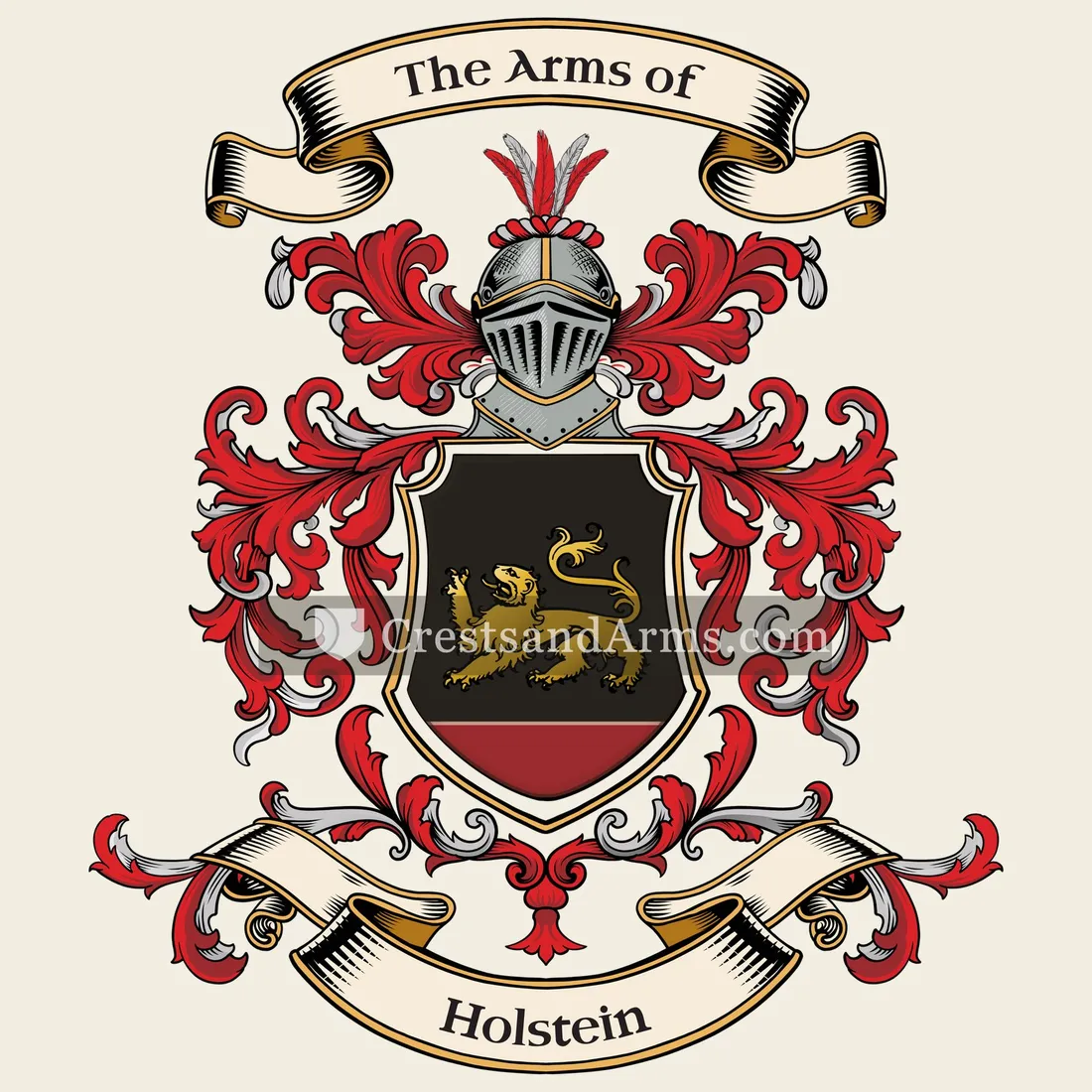
Meaning of the Holstein family crest colors & symbols
Symbols on this shield
lionCourage, strength and royalty
Colours
Black (Sable)Means: Constancy
Red (Gules)Means: Military strength
Gold (Or)Means: Generosity
Historical info
Source
J. B. Rietstap, Armorial Général, Gouda: G. B. van Goor Zonen, 1884–87
Blazon (the actual original written record)
“De sa. à un mur de gu., maçonné de sa., occupant la moitié inférieure de l'écu; et un lion naiss. d'or, mouv. dudit mur. Cq. cour. C.: un morion de sa., sommé de sept pl. d'aut., alt. de gu. et de sa. L.: à dextre de gu. et de sa., à sen. d'or et de sa.”
Germanyc. 1765
Digital archive packCoat of arms PNG, gold border print PDF, vector SVG and the certificate of authenticity. Sent to your email in minutes.
Map of Germany showing where the Holstein arms are recorded
The Holstein arms were recorded in Germany, c. 1765.
Arms such as these were typically recorded in Bavaria.
Bavaria was a country of old landed families and walled market towns. Estates passed down the same line for centuries, and both the landowners and the leading townsmen kept arms, which is why so many Bavarian names sit in the registers.
This is where the arms were entered in the register. Families often moved to other parts of the country, so the same name can turn up in more than one region.
The body that granted and recorded arms in Germany in this period.
Francis I, Holy Roman Emperor
Sovereign of the period
Francis I, Holy Roman Emperor
1745–1765
Reigning in Denmark when the Holstein arms are first recorded.
How Arms Worked in Germany
In the Holy Roman Empire, coats of arms were often granted to individuals by the Emperor or his representatives. These arms were then passed down through the generations to all legitimate descendants of the original holder. Younger branches of a family usually kept the same shield design without needing to change it, as the arms belonged to the entire lineage.
Granting authority
The Holy Roman Emperor held the sole power to grant new coats of arms throughout his vast imperial territories.
How they got arms
Families typically obtained their coats of arms through a formal imperial grant or by proving their noble status to the authorities.
Where arms were recorded
These grants were officially recorded in the Imperial Chancery registers, which began keeping formal records of such honors during the Middle Ages.
The family's standing
Recorded among the armigerous families of Germany.
Origin & History of the Holstein Family in Germany
The surname Holstein originates from the northern regions of Germany, where it was historically used as a geographic descriptor for people who hailed from the Duchy of Holstein. Over many centuries, families moved southward across the German landscape, eventually establishing roots in the southern state of Bavaria. By 1765, records confirm that members of the Holstein family were well-integrated into the local Bavarian community. During this period, the family likely lived as part of the agrarian or artisan classes that formed the backbone of the Holy Roman Empire. As they settled in the south, the name evolved from a simple regional identifier into a permanent family surname passed down through generations. This transition reflects the broader movement of people across German lands during the eighteenth century as families sought new opportunities in different provinces.
Holstein Meaning & Related Branches
Root word
Holt-stein
Derived from the Germanic words for wood or forest and stone.
This name
HolsteinRefers to a person living near a stony forest or a wooded rocky area.
also spelled
Holsteyn
Holstine
Related arms
Pemersimilar arms
Holsteynvariant spelling
Badenrecorded with Holstein, same area
Documented Sources
J. B. Rietstap, Armorial Général, Gouda: G. B. van Goor Zonen, 1884–87
Dansk Adelsforening, Danmarks Adels Aarbog, 1884
Hiort-Lorenzen, H. R. and Thiset, A., Danmarks Adels Aarbog, 1893
Rigsarkivet, Danske Kancelli: Skapsager
Rigsarkivet, Adelsarkiver: Holstein-familien
Digital archive packCoat of arms PNG, gold border print PDF, vector SVG and the certificate of authenticity. Sent to your email in minutes.


 lionCourage, strength and royalty
 lozengeHonour and nobility, and the arms of a woman
 lionCourage, strength and royalty
 lozengeHonour and nobility, and the arms of a woman