Map of Netherlands showing where the Homan arms are recorded
The Homan arms were recorded in Netherlands, c. 1815.
Arms such as these were typically recorded in Friesland.
Friesland was low, wet country on the northern coast of the Netherlands, farmed by families who had held the same land for centuries. Free landholders were unusually common there, and a free landholder could carry arms.
This is where the arms were entered in the register. Families often moved to other parts of the country, so the same name can turn up in more than one region.
Region
Friesland
First recorded
1815
Granting Authority for the Homan Arms
Hoge Raad van Adel
Photograph made by me · CC BY-SA 3.0
The body that granted and recorded arms in Netherlands in this period.
William I of the Netherlands
Sovereign of the period
William I of the Netherlands
1815–1840
Reigning in Netherlands when the Homan arms are first recorded.
How Arms Worked in Netherlands
In the Netherlands, coats of arms were often used by noble families and those who held specific public offices. These arms were passed down through the generations to legitimate descendants. Younger branches of a family usually kept the original design without needing to add special marks. This system ensured that the family identity remained clear and consistent over many years.
Granting authority
The Hoge Raad van Adel is the official body that regulates and manages noble titles and coats of arms in the Netherlands.
How they got arms
Families typically obtained their coats of arms through official royal grants or by proving their long-standing historical use of the symbols.
Where arms were recorded
Coats of arms are officially recorded in the registers held by the Hoge Raad van Adel, which began its work in 1814.
The family's standing
Recorded among the armigerous families of Netherlands.
Origin & History of the Homan Family in Netherlands
The Homan family name has deep roots in the northern provinces of the Netherlands, particularly within the region of Friesland. By the early 19th century, the name was well-established in this area, appearing in official records during the reorganization of the Dutch civil registry in 1815. The name likely originated as a descriptive term or a nickname, as the word "ho" or "hoo" often related to the concept of high ground or a hill in older Germanic dialects. Families carrying this name were typically part of the agrarian society that defined the Frisian landscape for centuries. Because Friesland maintained a unique cultural and linguistic identity separate from the rest of the country, the Homan family often lived in close-knit communities focused on farming and local trade. These early ancestors were part of a long tradition of independent landowners who helped shape the rural development of the northern Dutch provinces.
Coat of Arms & Family Crest Details
Symbols on this shield
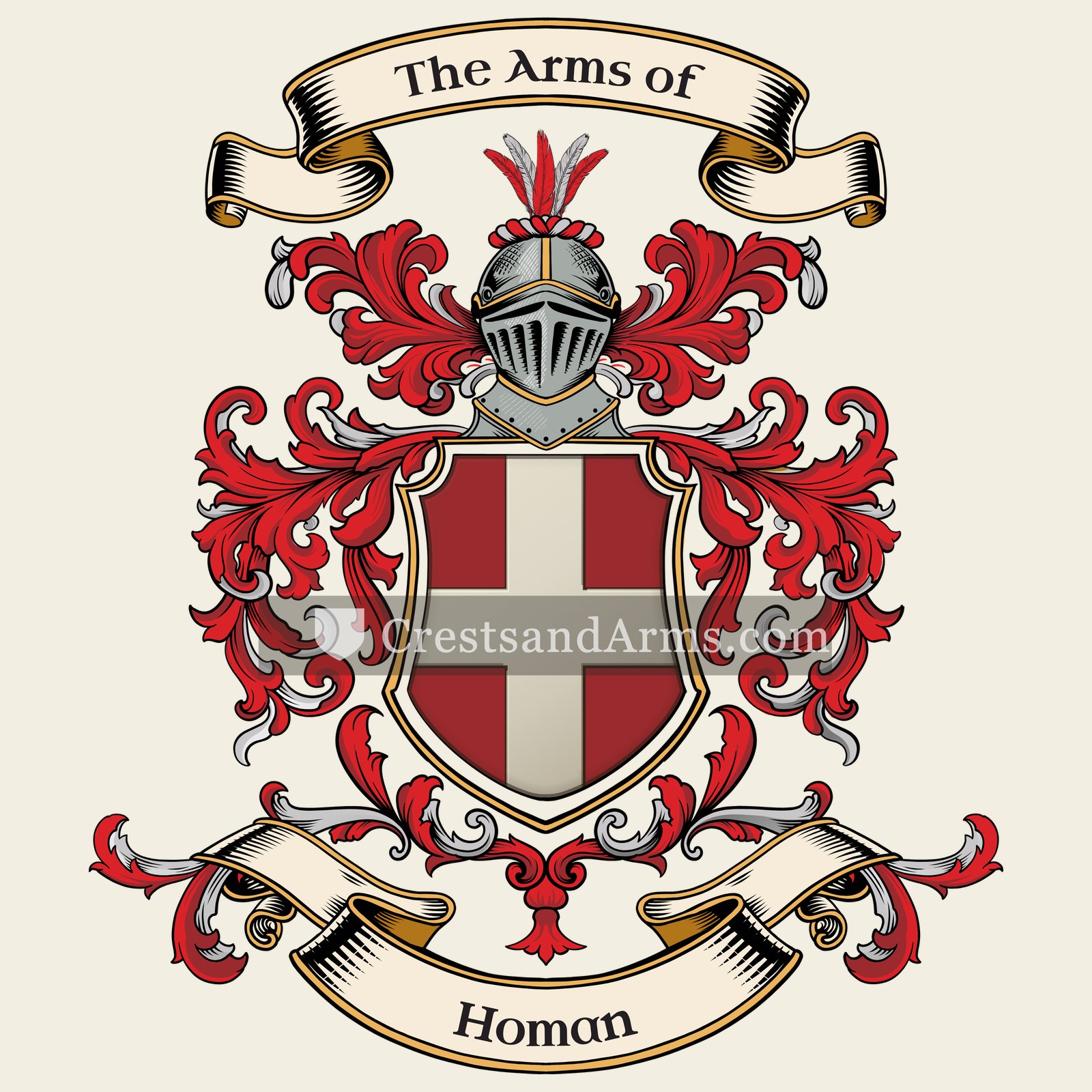
cross symbolChristian faith and service
Colours
Red (Gules)Means: Military strength
Historical info
Source
Sir Bernard Burke, The General Armory of England, Scotland, Ireland and Wales, London: Harrison & Sons, 1884
Blazon (the actual original written record)
“Gu. a cross fusily ar”
EnglandWestminster, c. 1585
Digital archive packCoat of arms PNG, gold border print PDF, vector SVG and the certificate of authenticity. Sent to your email in minutes.
Map of England showing where the Homan arms are recorded
The Homan arms were recorded in Westminster, c. 1585.
This is where the arms were entered in the register. Families often moved to other parts of the country, so the same name can turn up in more than one region.
The body that granted and recorded arms in England in this period.
Elizabeth I of England
Sovereign of the period
Elizabeth I of England
1558–1603
Reigning in Netherlands when the Homan arms are first recorded.
How Arms Worked in England
English heraldry allowed arms to be shared by all legitimate descendants of the original owner. These symbols were treated as personal property that moved through the generations to all children. While the eldest son kept the original design, other family members could use the same shield without needing to change it or register their own unique versions.
Granting authority
The College of Arms in London has regulated the use of coats of arms throughout England and Wales since 1484.
How they got arms
Families typically obtained their coats of arms through a formal grant from the Crown or by proving their ancient right to them.
Where arms were recorded
All official coats of arms are recorded in the registers kept at the College of Arms, which date back to the fifteenth century.
The family's standing
Recorded among the armigerous families of England.
Origin & History of the Homan Family in England
The surname Homan emerged in England as a descriptive name rooted in the social structure of the Middle Ages. It is widely believed to be a variation of the word "hoeman," which historically referred to a person who worked the land with a hoe or a farm laborer. By the late 16th century, the family had established a notable presence in the heart of London, specifically within the parish of Westminster. Records from 1585 confirm that members of the Homan family were living and participating in the daily life of this bustling administrative center during the reign of Queen Elizabeth I. As the name became more fixed in English society, it transitioned from a simple job title into a hereditary surname passed down through generations. This evolution reflects the broader shift in how common people were identified in official documents as the population of English cities began to grow and settle into permanent communities.
Coat of Arms & Family Crest Details
Symbols on this shield
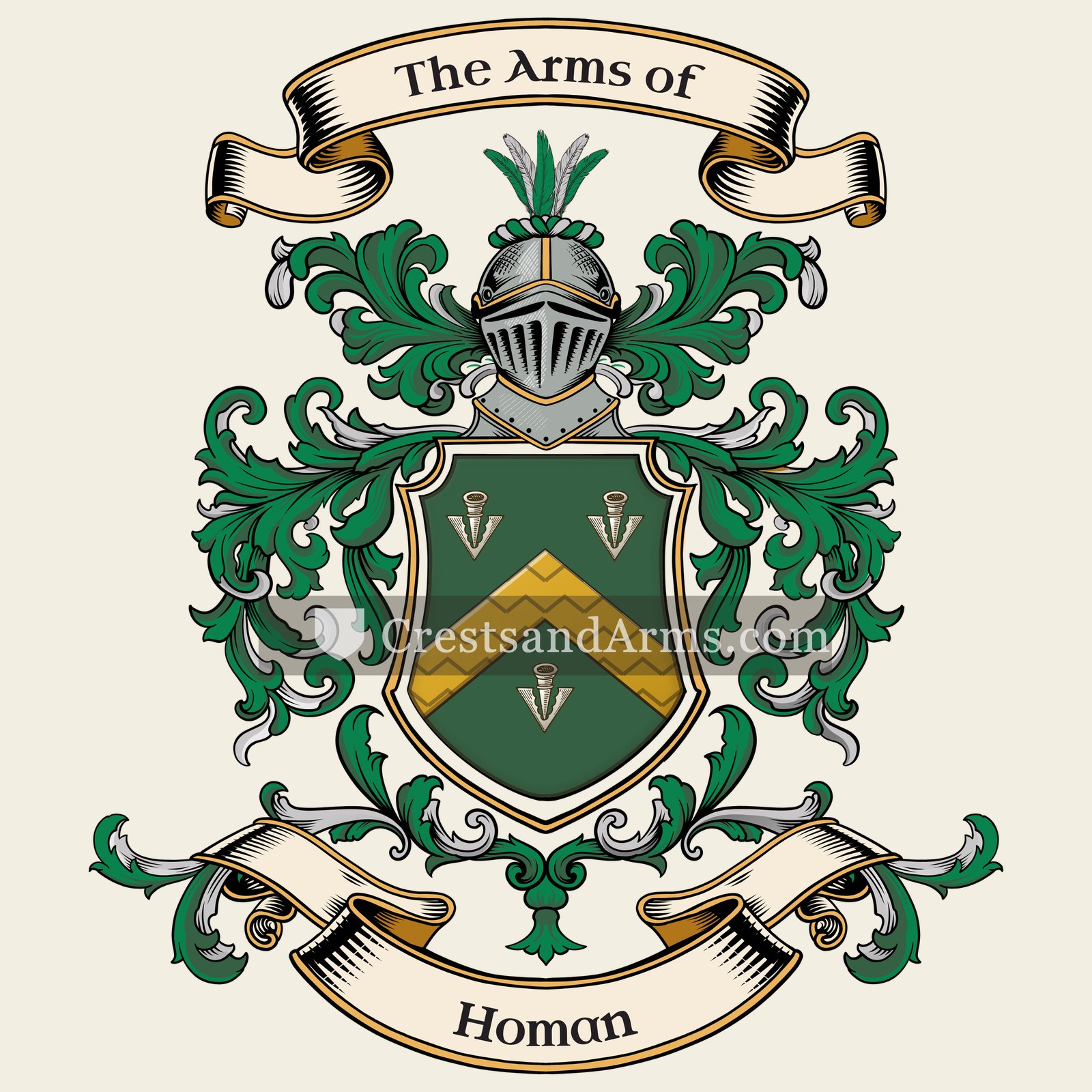
chevronProtection, and faithful service completed
arms pheon arrowheadReadiness for battle, and the broad arrow of the sovereign
Colours
Green (Vert)Means: Hope
Gold (Or)Means: Generosity
Silver (Argent)Means: Peace and sincerity
Historical info
Source
Sir Bernard Burke, The General Armory of England, Scotland, Ireland and Wales, London: Harrison & Sons, 1884
Blazon (the actual original written record)
“Vert a chev. or, betw. three pheons, points downwards ar”
WestmeathDunlum · Westmeath, c. 1645
Digital archive packCoat of arms PNG, gold border print PDF, vector SVG and the certificate of authenticity. Sent to your email in minutes.
Map of Ireland showing where the Homan arms are recorded
The Homan arms were recorded in Westmeath, c. 1645.
Westmeath was midland grazing country in Ireland, taken by Norman families and held for centuries. Its estates were large and passed down whole, and unbroken tenure brought arms with it.
This is where the arms were entered in the register. Families often moved to other parts of the country, so the same name can turn up in more than one region.
The body that granted and recorded arms in Ireland in this period.
Charles I of England
Sovereign of the period
Charles I of England
1625–1649
Reigning in Netherlands when the Homan arms are first recorded.
How Arms Worked in Ireland
The Ulster King of Arms granted coats of arms to individuals who proved their social standing and good character. These symbols were typically inherited by all legitimate descendants of the original holder. If a family branch wanted a unique look, they could apply for a specific change to their design through the office to ensure their identity remained distinct.
Granting authority
The Ulster King of Arms acted as the official body that regulated and issued all coats of arms throughout Ireland.
How they got arms
Families obtained their arms through formal grants issued by the office after proving their eligibility and paying the required fees.
Where arms were recorded
All official grants were recorded in the registers held by the Ulster King of Arms starting from the year 1552.
The family's standing
Recorded among the armigerous families of Westmeath.
Origin & History of the Homan Family in Ireland
The Homan family name has a distinct history in Ireland, particularly within the midlands of the country. By the year 1645, records confirm that members of the Homan family were well-established in County Westmeath. During this period, Ireland was undergoing significant political and social upheaval, which often influenced where families settled and how they held their land. The name is believed to have roots that connect to both local Gaelic traditions and the broader movements of people across the Irish Sea during the seventeenth century. As the family became rooted in Westmeath, they integrated into the local community, participating in the agricultural and social life of the region. Over time, the Homan name became a permanent fixture in the area, reflecting the complex patterns of migration and settlement that defined seventeenth-century Ireland.
Homan Meaning & Related Branches
Root word
Ho
A Germanic term referring to a high place or hill.
This name
HomanA topographic name for someone who lived on or near a hill or elevated land.
also spelled
Homann
Homane
Homon
Related arms
Ohmannvariant spelling
Documented Sources
J. B. Rietstap, Armorial Général, Gouda: G. B. van Goor Zonen, 1884–87
AlleFriezen, Burgerlijke Stand Geboorteakten (1811–1910)
Nationaal Archief, Registratie van de Burgerlijke Stand (1811–1825)
Dijkstra, F., Friese familienamen: Herkomst en verspreiding, 1998
Van der Meer, G., Nederlandse achternamen in historisch perspectief, 2005
Digital archive packCoat of arms PNG, gold border print PDF, vector SVG and the certificate of authenticity. Sent to your email in minutes.


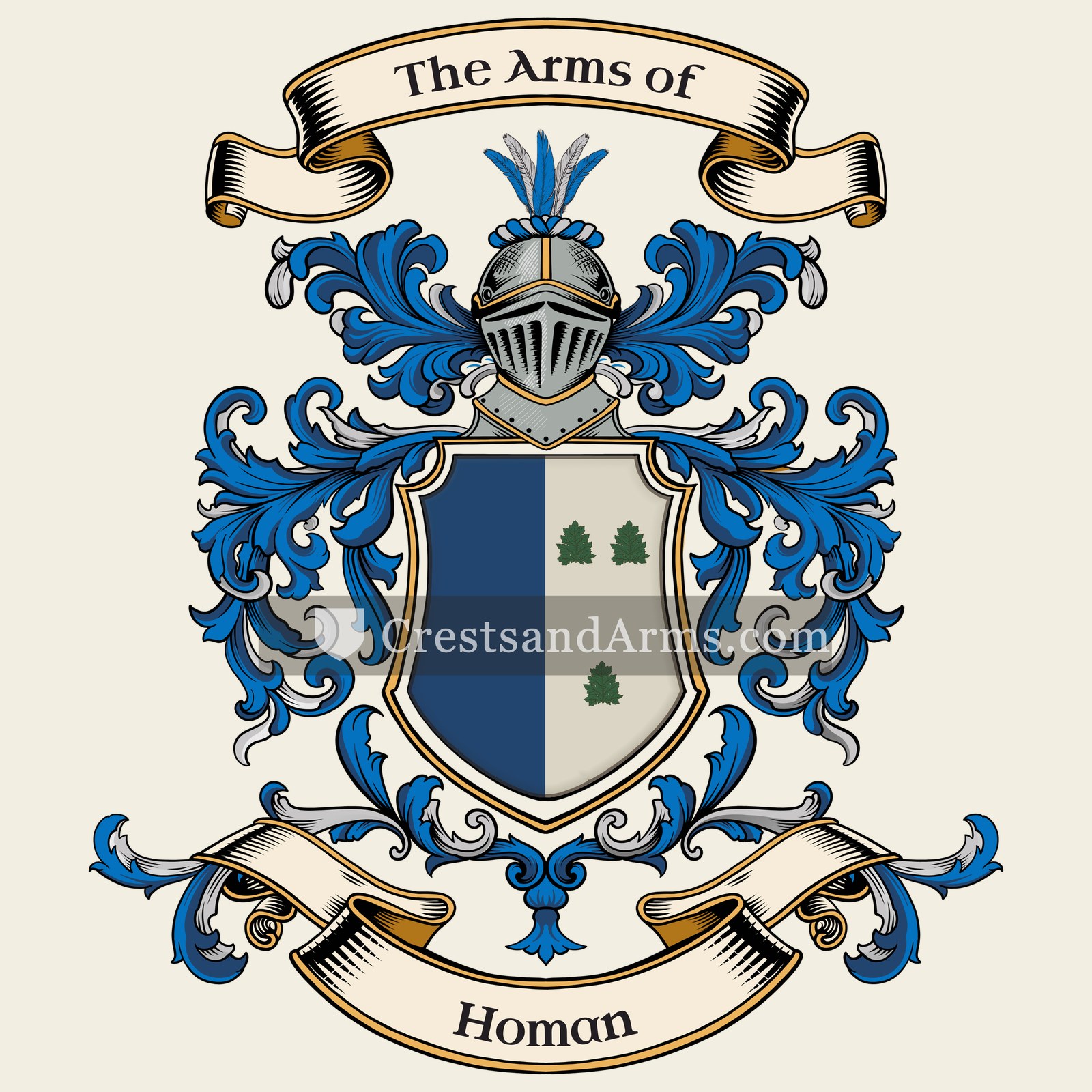
 leafHappiness and abundance
 leafHappiness and abundance


 cross symbolChristian faith and service


 chevronProtection, and faithful service completed
 arms pheon arrowheadReadiness for battle, and the broad arrow of the sovereign