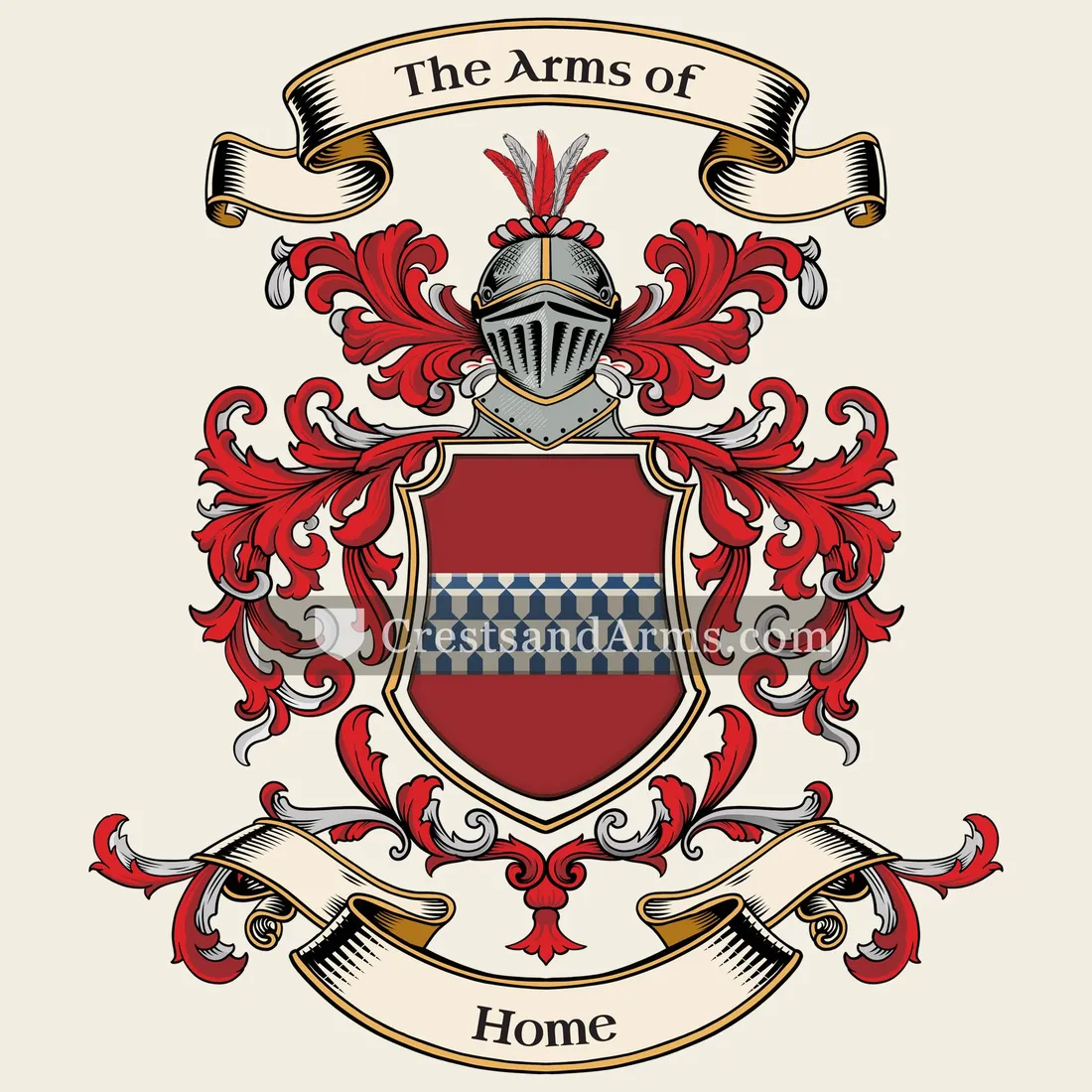
A record of documented arms, meaning and origin, researched for the Home family lines. Documented in 3 countries.
Reg. 1634 · Britain, G–I
Meaning of the Home family crest colors & symbols
Symbols on this shield
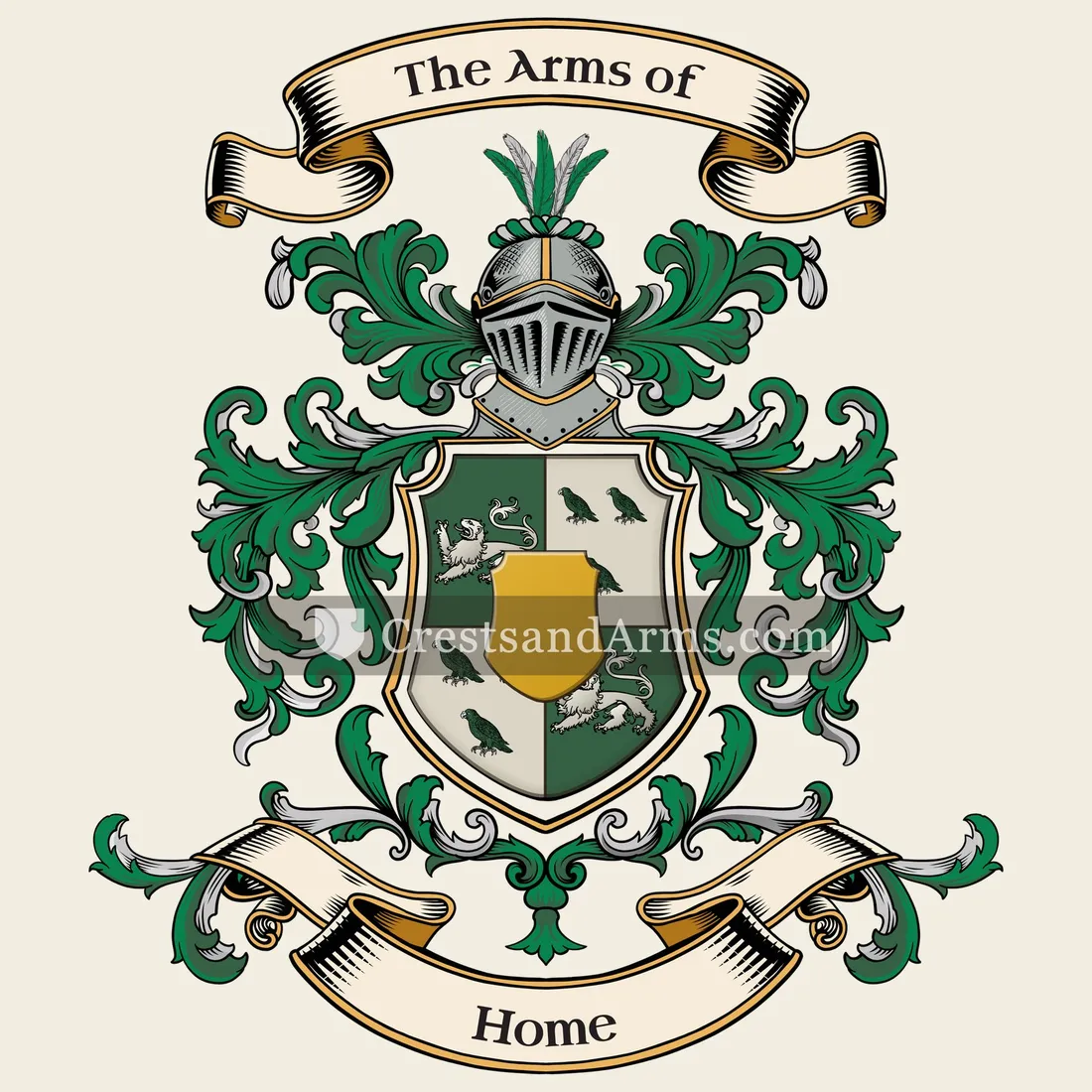
lionCourage, strength and royalty
parrotEloquence, and travel in distant lands
Colours
Green (Vert)Means: Hope
Silver (Argent)Means: Peace and sincerity
Gold (Or)Means: Generosity
Historical info
Source
J. B. Rietstap, Armorial Général, Gouda: G. B. van Goor Zonen, 1884–87
Blazon (the actual original written record)
“Ec.: aux 1 et 4 de sin. au lion d'arg., arm. et lamp. de gu. (Home); aux 2 et 3 d'arg. à trois perroquets de sin., bq. et m. de gu. (Pepdie de Dunglas). Sur le tout d'or à l'orle d'azur (Landell). C.: une tête de lion d'arg., soutenue d'un chapeau de tournoi de gu., retr. d'herm. S.: deux lions d'arg., arm. et lamp. de gu. Cri: A HOME! A HOME! A HOME! D.: TRUE TO THE END.”
Britainc. 1473
Digital archive packCoat of arms PNG, gold border print PDF, vector SVG and the certificate of authenticity. Sent to your email in minutes.
Map of Britain showing where the Home arms are recorded
The Home arms were recorded in Britain, c. 1473.
Arms such as these were typically recorded in Kent.
Kent sits between London and the short crossing to Europe, and the trade passing through made it wealthy. Merchant families bought land with that money, and it was landowners who took coats of arms.
This is where the arms were entered in the register. Families often moved to other parts of the country, so the same name can turn up in more than one region.
The body that granted and recorded arms in Britain in this period.
Edward IV of England
Sovereign of the period
Edward IV of England
1471–1483
Reigning in Britain when the Home arms are first recorded.
How Arms Worked in Britain
English heraldry allowed arms to be shared by all legitimate descendants of the original owner. These symbols were treated as personal property that moved through the generations to all children. While the eldest son kept the original design, other family members could use the same shield without needing to change it or register their own unique versions.
Granting authority
The College of Arms in London has regulated the use of coats of arms throughout England and Wales since 1484.
How they got arms
Families typically obtained their coats of arms through a formal grant from the Crown or by proving their ancient right to them.
Where arms were recorded
All official coats of arms are recorded in the registers kept at the College of Arms, which date back to the fifteenth century.
The family's standing
Recorded among the armigerous families of Britain.
Origin & History of the Home Family in Britain
The family name Home has deep roots in the British landscape, with historical records confirming the presence of family members in the county of Kent as early as 1473. During this period, the name was often associated with individuals living near a physical home or a specific piece of land, which was a common way for surnames to develop in medieval England. As the family established itself in the southeastern region, they became part of the local social fabric, likely participating in the agricultural and trade activities that defined life in Kent during the late fifteenth century. Over time, the name spread beyond these initial settlements, reflecting the broader movement of people across Britain. By studying these early records, we can see how the family name evolved from a simple description of a place into a lasting identifier for generations of people.
Meaning of the Home family crest colors & symbols
Symbols on this shield
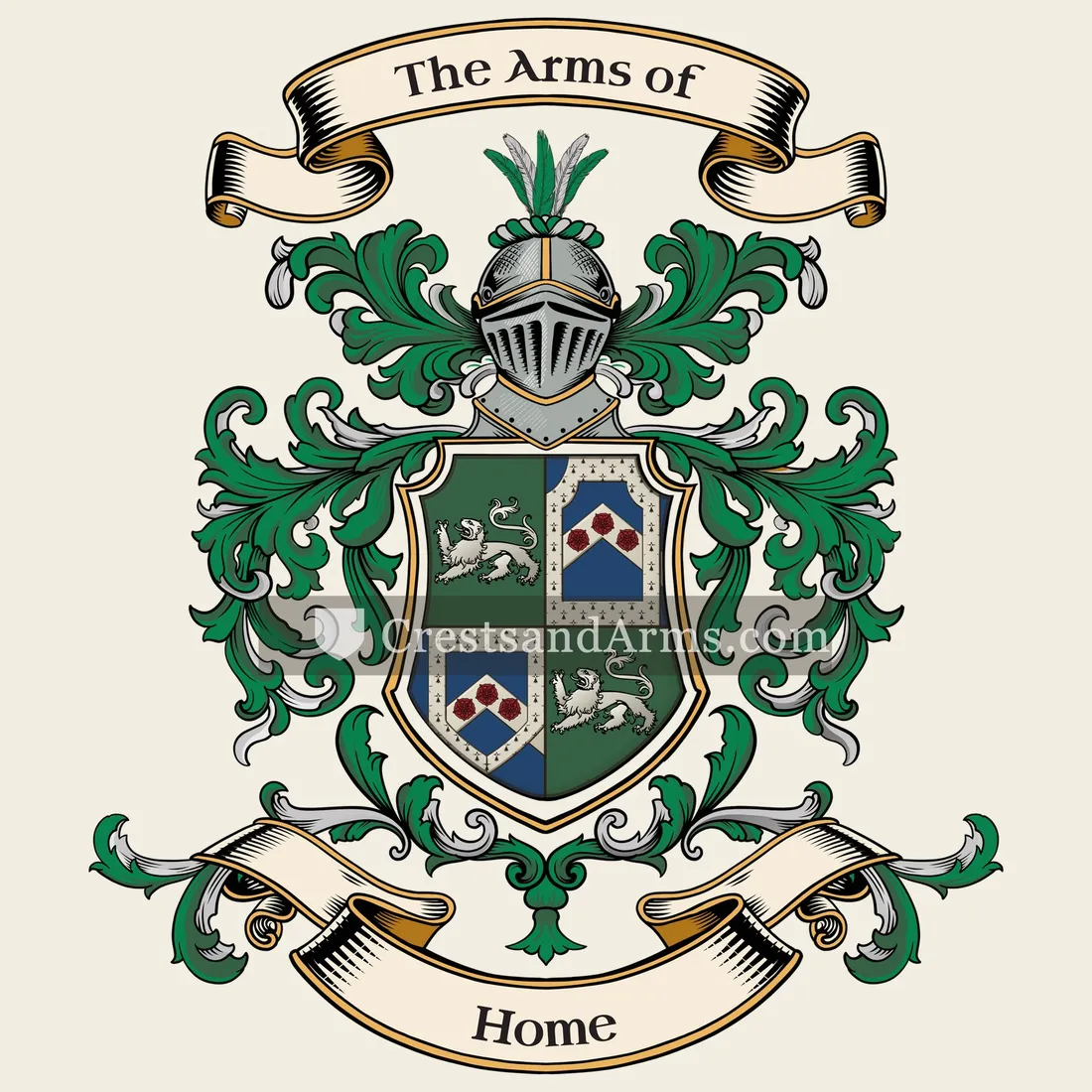
bordureA difference between branches of one family
chevronProtection, and faithful service completed
lionCourage, strength and royalty
roseThe seventh son, and beauty with grace
Colours
Green (Vert)Means: Hope
Blue (Azure)Means: Loyalty and truth
Silver (Argent)Means: Peace and sincerity
ErmineMeans: Dignity
Red (Gules)Means: Military strength
Historical info
Source
Sir Bernard Burke, The General Armory of England, Scotland, Ireland and Wales, London: Harrison & Sons, 1884
Blazon (the actual original written record)
“Quarterly, 1st and 4th, vert a lion ramp. ar. within a bordure erm.; 2nd and 3rd, az. on a chev. ar. three roses gu., for BLACKADDER”
BerwickBlackadder · Berwick, c. 1671
Digital archive packCoat of arms PNG, gold border print PDF, vector SVG and the certificate of authenticity. Sent to your email in minutes.
Map of Scotland showing where the Home arms are recorded
The Home arms were recorded in Berwick, c. 1671.
Berwickshire was Scottish border country, raided and fought over for three centuries. Families held their land in return for defending it, and a defending household carried a shield.
This is where the arms were entered in the register. Families often moved to other parts of the country, so the same name can turn up in more than one region.
The body that granted and recorded arms in Scotland in this period.
Charles II of England
Sovereign of the period
Charles II of England
1660–1685
Reigning in Britain when the Home arms are first recorded.
How Arms Worked in Scotland
Scottish heraldry is unique because it treats a coat of arms as a piece of personal property protected by law. Only one person can own a specific design at any given time. When a family grows, the head keeps the original shield while other relatives must apply for their own distinct version with slight changes to prove their specific identity.
Granting authority
The Court of the Lord Lyon acts as the official body that regulates and controls all heraldic matters throughout Scotland.
How they got arms
Individuals obtain a legal right to their arms through a formal petition process that confirms their identity and family connection.
Where arms were recorded
All valid coats of arms are officially entered into the Public Register of All Arms and Bearings starting from 1672.
The family's standing
Recorded among the armigerous families of Berwick.
Origin & History of the Home Family in Scotland
The family name Home has deep roots in the Scottish Borders, a region defined by its rugged landscape and a long history of border conflicts. While the name is famously linked to the powerful House of Home in Berwickshire, records from 1671 confirm that members of the family were well-established in the town of Berwick during this period. Historically, the name is a variation of the word "holm," which refers to a flat stretch of land near a river. This suggests that the earliest ancestors likely took their name from the specific geography of their ancestral home. As the family grew, they became deeply involved in the local governance and social life of the Scottish borders. By the late 17th century, families bearing this name were active participants in the trade and community life of Berwick, helping to shape the development of the region during a time of significant political change in Scotland.
Meaning of the Home family crest colors & symbols
Symbols on this shield
fessThe military belt, and readiness to serve
Colours
Red (Gules)Means: Military strength
Gold (Or)Means: Generosity
Historical info
Source
Sir Bernard Burke, The General Armory of England, Scotland, Ireland and Wales, London: Harrison & Sons, 1884
Blazon (the actual original written record)
“Gu. a fesse vairé or and az”
SuffolkEast Grinstead · Suffolk, c. 1620
Digital archive packCoat of arms PNG, gold border print PDF, vector SVG and the certificate of authenticity. Sent to your email in minutes.
Map of England showing where the Home arms are recorded
The Home arms were recorded in Suffolk, c. 1620.
Suffolk was wool country, and its cloth towns were among the wealthiest in England. Clothier families bought manors with their profits, and holding a manor was the ordinary route to a coat of arms.
This is where the arms were entered in the register. Families often moved to other parts of the country, so the same name can turn up in more than one region.
The body that granted and recorded arms in England in this period.
James VI and I
Sovereign of the period
James VI and I
1603–1625
Reigning in Britain when the Home arms are first recorded.
How Arms Worked in England
English heraldry allowed arms to be shared by all legitimate descendants of the original owner. These symbols were treated as personal property that moved through the generations to all children. While the eldest son kept the original design, other family members could use the same shield without needing to change it or register their own unique versions.
Granting authority
The College of Arms in London has regulated the use of coats of arms throughout England and Wales since 1484.
How they got arms
Families typically obtained their coats of arms through a formal grant from the Crown or by proving their ancient right to them.
Where arms were recorded
All official coats of arms are recorded in the registers kept at the College of Arms, which date back to the fifteenth century.
The family's standing
Recorded among the armigerous families of Suffolk.
Origin & History of the Home Family in England
The surname Home originates from the Old English word "ham," which translates to a home, village, or homestead. In the context of early English history, the name functioned as a locational descriptor for individuals who lived near a specific settlement or manor. By the early 17th century, the family had established a notable presence in the county of Suffolk. Records from 1620 indicate that members of the Home family were integrated into the local agricultural and social fabric of this region. During this era, families often moved within England to seek better land or trade opportunities, and the presence of the name in Suffolk suggests that these ancestors were likely part of the growing class of landowners or skilled tradespeople who helped shape the rural economy of East Anglia.
Home Meaning & Related Branches
Root word
Hume
Derived from the Old English word for a hill or mound.
This name
HomeA topographic name for someone who lived near a hill or a specific place in Berwickshire.
also spelled
Hoom
Hohm
Hume
Related arms
Humevariant spelling
Bannatynerecorded with Home, same area
Bonarrecorded with Home, same area
Boswellrecorded with Home, same area
Documented Sources
J. B. Rietstap, Armorial Général, Gouda: G. B. van Goor Zonen, 1884–87
Reaney, P.H., A Dictionary of British Surnames, 1958
Cottle, Basil, The Penguin Dictionary of Surnames, 1967
The National Archives, Early Chancery Proceedings, C 1/48/443 (1473)
Digital archive packCoat of arms PNG, gold border print PDF, vector SVG and the certificate of authenticity. Sent to your email in minutes.


 lionCourage, strength and royalty
 parrotEloquence, and travel in distant lands
 lionCourage, strength and royalty
 parrotEloquence, and travel in distant lands


 bordureA difference between branches of one family
 chevronProtection, and faithful service completed
 roseThe seventh son, and beauty with grace


 fessThe military belt, and readiness to serve