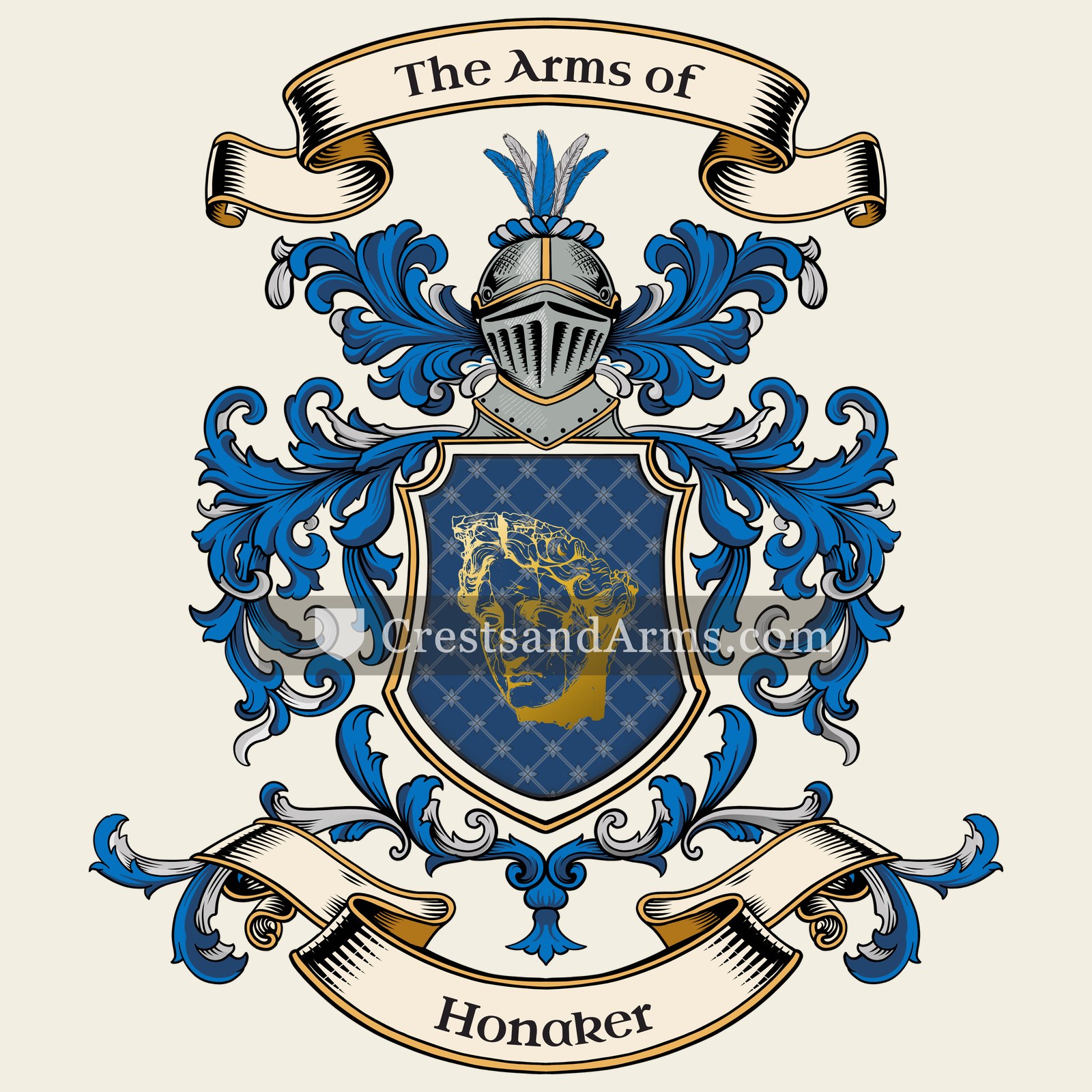
A record of documented arms, meaning and origin, researched for the Honaker family of Switzerland.
Reg. 5956 · Swiss, G–I
Coat of Arms & Family Crest Details
Symbols on this shield
womanGrace, and the founding of a house
Colours
Blue (Azure)Means: Loyalty and truth
Gold (Or)Means: Generosity
Historical info
Source
J. B. Rietstap, Armorial Général, Gouda: G. B. van Goor Zonen, 1884–87
Blazon (the actual original written record)
“D'azur à un buste de femme, hab. d'or, ayant tressé dans les cheveux de chaque côté une grappe de raisins d'arg., pamprée de sin. C.: un buste d'homme barbu, hab. d'or, au rabat d'arg., la tête ornée de grappes de raisins comme la femme dans l'écu. L. d'or et d'azur.”
SwitzerlandBâle, c. 1745
Digital archive packCoat of arms PNG, gold border print PDF, vector SVG and the certificate of authenticity. Sent to your email in minutes.
Map of Switzerland showing where the Honaker arms are recorded
The Honaker arms were recorded in Bâle, c. 1745.
This is where the arms were entered in the register. Families often moved to other parts of the country, so the same name can turn up in more than one region.
The body that granted and recorded arms in Switzerland in this period.
How Arms Worked in Switzerland
In Switzerland, coats of arms were not restricted to the nobility and were often adopted by common citizens and families. These symbols were passed down through generations to show family identity. When branches of a family grew, they often changed small details of the design to distinguish their own line from the original group.
Granting authority
Cantonal and civic authorities managed the use of coats of arms within their specific regions and local jurisdictions.
How they got arms
Families typically assumed their own coats of arms based on local custom rather than receiving them from a central monarch.
Where arms were recorded
Arms were recorded in various cantonal and civic registers starting from the fourteenth century throughout the Swiss region.
The family's standing
Recorded among the armigerous families of Switzerland.
Origin & History of the Honaker Family in Switzerland
The Honaker family name finds its historical roots in the German-speaking regions of Europe, with significant records placing the family in the city of Bâle, Switzerland, by the year 1745. During this period, the name was often spelled as Honacker or Honecker, reflecting the linguistic patterns of the Upper Rhine area. Families with this name were typically part of the industrious middle class, often working as skilled tradespeople or farmers in the rural cantons. As political and economic pressures grew in the mid-18th century, many individuals bearing the name began to look toward the American colonies for new opportunities. This migration pattern saw the Honakers travel down the Rhine River to major ports before crossing the Atlantic, eventually settling in the frontier regions of Pennsylvania and Virginia to establish new lives as pioneers.
Related Branches & Arms
Root word
Honegger
A person who works on a small farm or plot of land.
This name
HonakerDerived from a Swiss-German occupational term for a small-scale farmer or agricultural laborer.
also spelled
Honeker
Honeck
Documented Sources
J. B. Rietstap, Armorial Général, Gouda: G. B. van Goor Zonen, 1884–87
Strassburger, Ralph Beaver. Pennsylvania German Pioneers: A Publication of the Original Lists of Arrivals in the Port of Philadelphia from 1727 to 1808. 1934
Staatsarchiv Basel-Stadt. Bürgerverzeichnisse und Einwohnermelderegister. 1745
Digital archive packCoat of arms PNG, gold border print PDF, vector SVG and the certificate of authenticity. Sent to your email in minutes.


 womanGrace, and the founding of a house
 womanGrace, and the founding of a house