Map of Britain showing where the Hoot arms are recorded
The Hoot arms were recorded in Londres, c. 1700.
Arms such as these were typically recorded in Kent.
Kent sits between London and the short crossing to Europe, and the trade passing through made it wealthy. Merchant families bought land with that money, and it was landowners who took coats of arms.
This is where the arms were entered in the register. Families often moved to other parts of the country, so the same name can turn up in more than one region.
The body that granted and recorded arms in Britain in this period.
William III of England
Sovereign of the period
William III of England
1694–1702
Reigning in Britain when the Hoot arms are first recorded.
How Arms Worked in Britain
English heraldry allowed arms to be shared by all legitimate descendants of the original owner. These symbols were treated as personal property that moved through the generations to all children. While the eldest son kept the original design, other family members could use the same shield without needing to change it or register their own unique versions.
Granting authority
The College of Arms in London has regulated the use of coats of arms throughout England and Wales since 1484.
How they got arms
Families typically obtained their coats of arms through a formal grant from the Crown or by proving their ancient right to them.
Where arms were recorded
All official coats of arms are recorded in the registers kept at the College of Arms, which date back to the fifteenth century.
The family's standing
Recorded among the armigerous families of Britain.
Origin & History of the Hoot Family in Britain
The family name Hoot is rooted in the landscape of Kent, England, where records confirm the presence of the family by the early 18th century. The name likely originated as a topographic descriptor, referring to individuals who lived near a specific landmark or a wooded area known as a "hoot" or a similar dialect variation. During the 1700s, families with this name were often integrated into the local agricultural or trade communities that defined the county of Kent. As the region served as a vital gateway for trade and travel, the Hoot family likely participated in the steady economic life of the English countryside. Over generations, the name remained tied to this specific geographic region, reflecting the localized nature of surname development in pre-industrial England.
Related Branches & Arms
Root word
Hut
A small shelter or dwelling made of simple materials.
This name
HootA topographic name for someone who lived in a small hut or cottage.
also spelled
Hoett
Hoete
Hoot
Hoote
Documented Sources
J. B. Rietstap, Armorial Général, Gouda: G. B. van Goor Zonen, 1884–87
Reaney, P.H., A Dictionary of English Surnames, 1958
Cottle, Basil, The Penguin Dictionary of Surnames, 1967
The National Archives, Parish registers of Kent, 1700–1750
Kent History and Library Centre, Quarter Sessions records and local tax assessments, 1700–1720
Digital archive packCoat of arms PNG, gold border print PDF, vector SVG and the certificate of authenticity. Sent to your email in minutes.


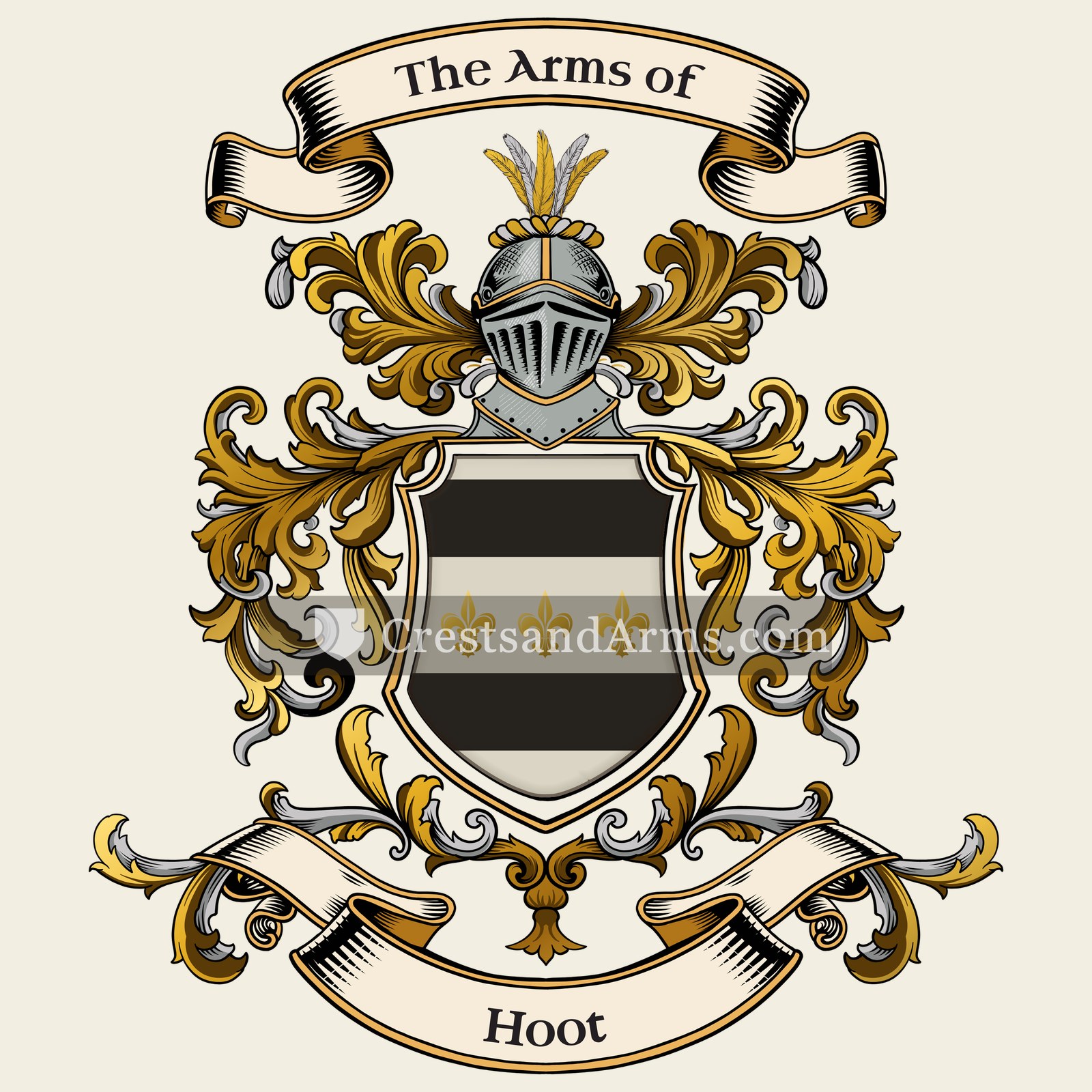
 fessThe military belt, and readiness to serve
 fleur de lisPurity, light, and the sixth son
 fessThe military belt, and readiness to serve
 fleur de lisPurity, light, and the sixth son