Map of Scotland showing where the Hope arms are recorded
The Hope arms were recorded in Edinburgh, c. 1628.
Edinburgh was the seat of Scotland's government, its courts and its heralds. Families with business there settled nearby, and being close to where arms were recorded is exactly why so many of them appear.
This is where the arms were entered in the register. Families often moved to other parts of the country, so the same name can turn up in more than one region.
The body that granted and recorded arms in Scotland in this period.
Charles I of England
Sovereign of the period
Charles I of England
1625–1649
Reigning in Scotland when the Hope arms are first recorded.
How Arms Worked in Scotland
Scottish heraldry is unique because it treats a coat of arms as a piece of personal property protected by law. Only one person can own a specific design at any given time. When a family grows, the head keeps the original shield while other relatives must apply for their own distinct version with slight changes to prove their specific identity.
Granting authority
The Court of the Lord Lyon acts as the official body that regulates and controls all heraldic matters throughout Scotland.
How they got arms
Individuals obtain a legal right to their arms through a formal petition process that confirms their identity and family connection.
Where arms were recorded
All valid coats of arms are officially entered into the Public Register of All Arms and Bearings starting from 1672.
The family's standing
Recorded among the armigerous families of Edinburgh.
Origin & History of the Hope Family in Scotland
The history of the Hope family in Scotland is deeply tied to the growth and influence of Edinburgh during the early seventeenth century. While the name likely originated as a descriptive term for a small enclosed valley or a place of refuge, the family established a prominent presence in the Scottish capital by 1628. During this era, members of the family became deeply involved in the legal and political life of the city. They rose to positions of power by serving as skilled advocates and advisors to the crown. Their success allowed them to acquire significant land holdings and integrate themselves into the upper levels of Scottish society. By focusing on education and public service, the family transitioned from local landowners to influential figures who helped shape the administrative landscape of Scotland during a time of great national change.
Meaning of the Hope family crest colors & symbols
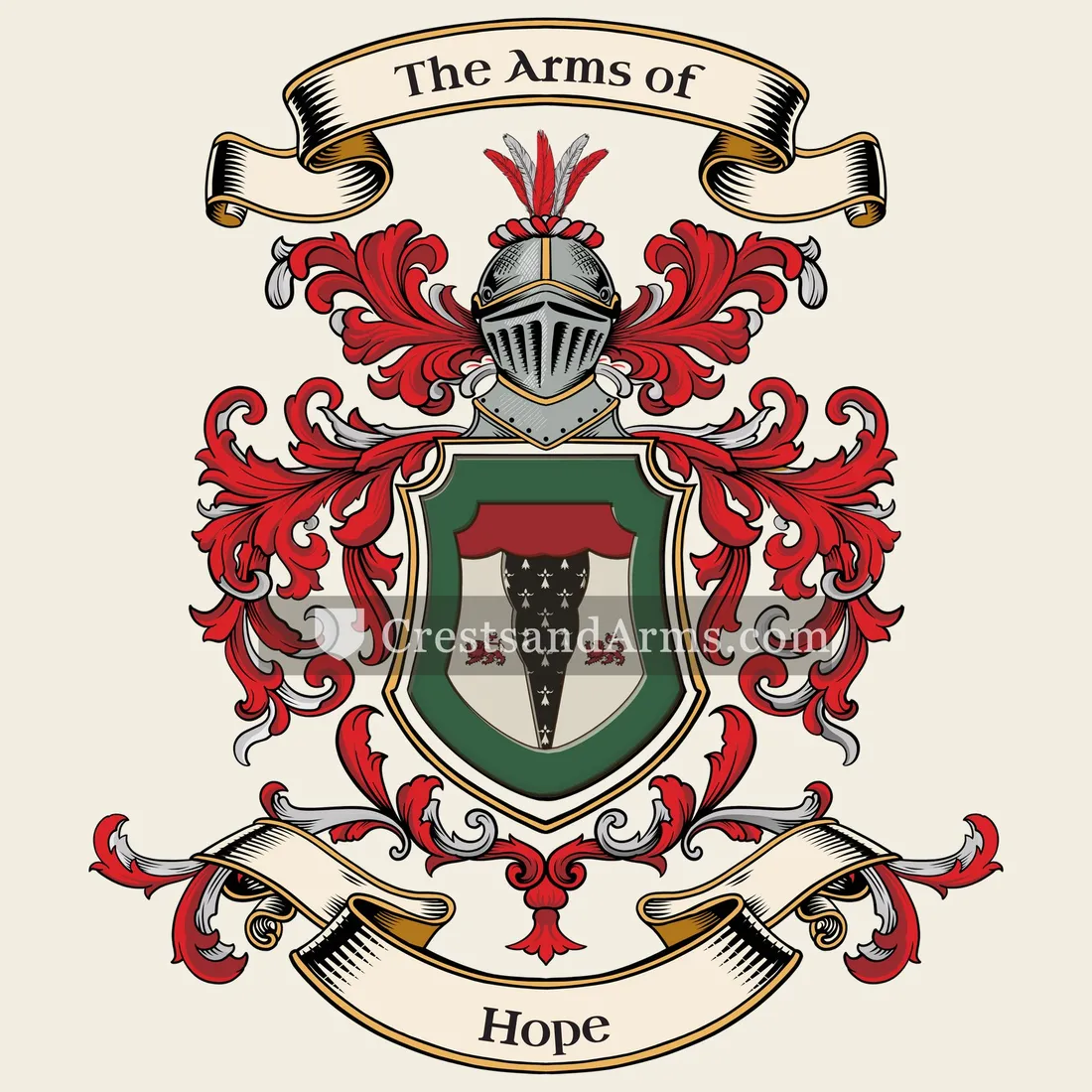
Symbols on this shield
chevronProtection, and faithful service completed
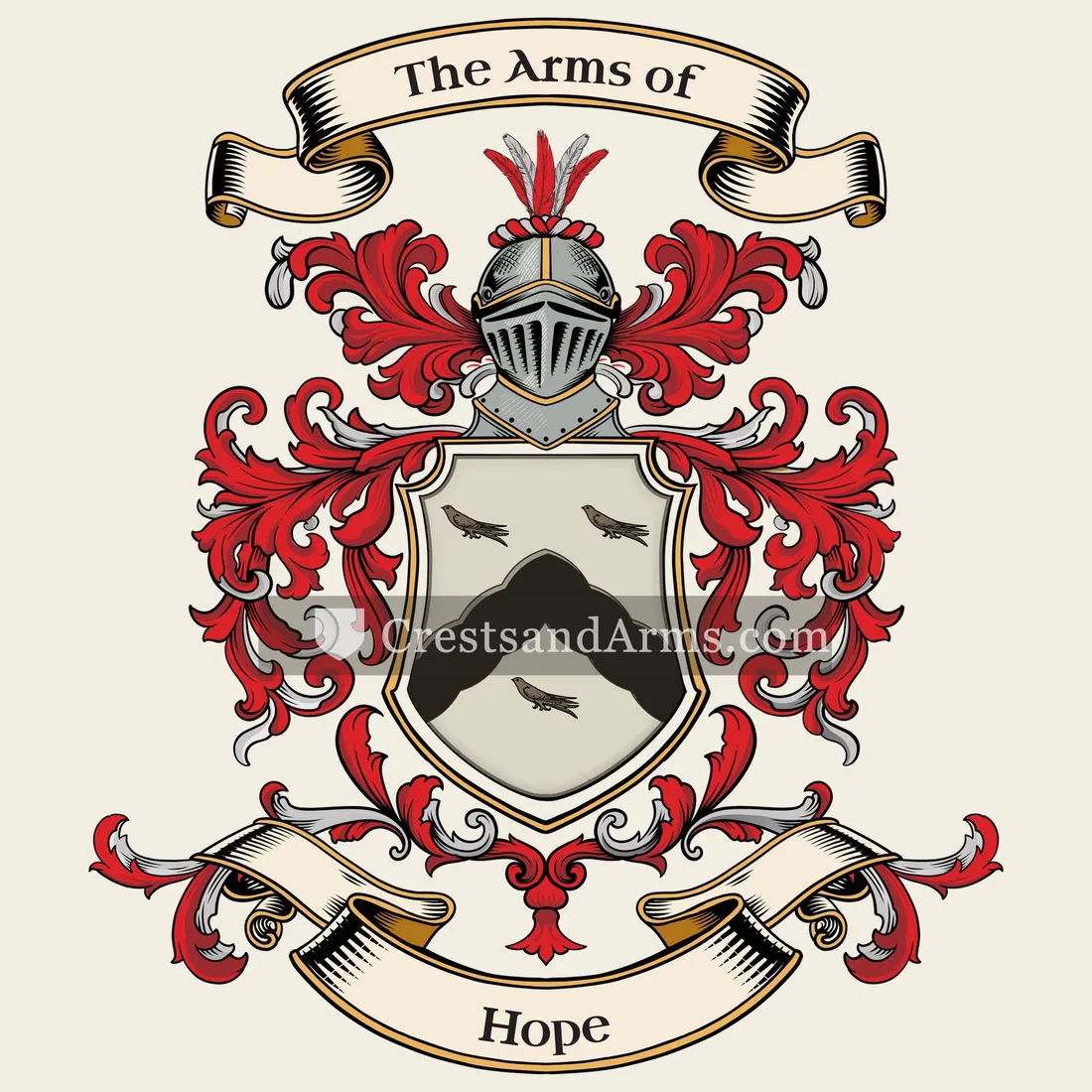
martletA younger son, who must win his own land
Colours
Silver (Argent)Means: Peace and sincerity
Black (Sable)Means: Constancy
Historical info
Source
Sir Bernard Burke, The General Armory of England, Scotland, Ireland and Wales, London: Harrison & Sons, 1884
Blazon (the actual original written record)
“Ar. a chev. engr. sa. betw. three Cornish choughs ppr”
DerbyGrangefield · Derby, c. 1620
Digital archive packCoat of arms PNG, gold border print PDF, vector SVG and the certificate of authenticity. Sent to your email in minutes.
Map of England showing where the Hope arms are recorded
The Hope arms were recorded in Derby, c. 1620.
Derbyshire had lead mines in its hills and good grazing in its valleys. Both made steady money, and families who made it bought manors, which is what put their names into the heraldic records.
This is where the arms were entered in the register. Families often moved to other parts of the country, so the same name can turn up in more than one region.
The body that granted and recorded arms in England in this period.
James VI and I
Sovereign of the period
James VI and I
1603–1625
Reigning in Scotland when the Hope arms are first recorded.
How Arms Worked in England
English heraldry allowed arms to be shared by all legitimate descendants of the original owner. These symbols were treated as personal property that moved through the generations to all children. While the eldest son kept the original design, other family members could use the same shield without needing to change it or register their own unique versions.
Granting authority
The College of Arms in London has regulated the use of coats of arms throughout England and Wales since 1484.
How they got arms
Families typically obtained their coats of arms through a formal grant from the Crown or by proving their ancient right to them.
Where arms were recorded
All official coats of arms are recorded in the registers kept at the College of Arms, which date back to the fifteenth century.
The family's standing
Recorded among the armigerous families of Derby.
Origin & History of the Hope Family in England
The surname Hope originated in England as a topographic name, which was a common way for people to identify themselves based on the landscape where they lived. In Old English, the word "hop" referred to a small, enclosed valley or a patch of marshy land. Early families who settled in these specific geographical features eventually adopted the name to distinguish themselves from others in their community. By the early 17th century, the family had established a notable presence in the town of Derby. Records from 1620 confirm that members of the Hope family were active participants in the social and economic life of this region. Over time, these early settlers helped shape the local history of the area through their involvement in trade and civic duties, cementing the name as a permanent fixture in the English Midlands.
Meaning of the Hope family crest colors & symbols
Symbols on this shield
pileWell-doing, and a mark of distinction
ermineDignity and rank
chiefAuthority, wisdom and dominion
bordureA difference between branches of one family
lionCourage, strength and royalty
Colours
Silver (Argent)Means: Peace and sincerity
Counter-ermine (Ermines)Means: Dignity
Red (Gules)Means: Military strength
Green (Vert)Means: Hope
Historical info
Source
Sir Bernard Burke, The General Armory of England, Scotland, Ireland and Wales, London: Harrison & Sons, 1884
Blazon (the actual original written record)
“Ar. a pile engr. ermines betw. two lions' heads erased gu. langued az. a chief vair, a border vert”
WestmeathMullingar · Westmeath, c. 1611
Digital archive packCoat of arms PNG, gold border print PDF, vector SVG and the certificate of authenticity. Sent to your email in minutes.
Map of Ireland showing where the Hope arms are recorded
The Hope arms were recorded in Westmeath, c. 1611.
Westmeath was midland grazing country in Ireland, taken by Norman families and held for centuries. Its estates were large and passed down whole, and unbroken tenure brought arms with it.
This is where the arms were entered in the register. Families often moved to other parts of the country, so the same name can turn up in more than one region.
The body that granted and recorded arms in Ireland in this period.
James VI and I
Sovereign of the period
James VI and I
1603–1625
Reigning in Scotland when the Hope arms are first recorded.
How Arms Worked in Ireland
The Ulster King of Arms granted coats of arms to individuals who proved their social standing and good character. These symbols were typically inherited by all legitimate descendants of the original holder. If a family branch wanted a unique look, they could apply for a specific change to their design through the office to ensure their identity remained distinct.
Granting authority
The Ulster King of Arms acted as the official body that regulated and issued all coats of arms throughout Ireland.
How they got arms
Families obtained their arms through formal grants issued by the office after proving their eligibility and paying the required fees.
Where arms were recorded
All official grants were recorded in the registers held by the Ulster King of Arms starting from the year 1552.
The family's standing
Recorded among the armigerous families of Westmeath.
Origin & History of the Hope Family in Ireland
The history of the Hope family in Ireland is deeply rooted in the plantation period of the early seventeenth century. By 1611, records confirm that members of the family had established themselves in County Westmeath. This region was a focal point for settlement during this era as the English administration sought to reorganize land ownership and encourage migration from Britain. The Hopes were part of a wave of settlers who moved into the Irish Midlands to take up land grants and participate in the developing colonial economy. Over the following decades, the family integrated into the local social structure, transitioning from newcomers to established landowners and community members. Their presence in Westmeath serves as a clear example of how families moved across the Irish Sea to reshape the landscape of the country during a time of significant political and social transition.
Hope Meaning & Related Branches
Root word
hop
A small enclosed valley or a secluded piece of land.
This name
HopeDerived from a topographical feature referring to someone who lived in a small valley.
also spelled
Hoope
Hoppe
Houp
Hoops
Related arms
Hoppevariant spelling
Hoopsvariant spelling
Creedrecorded with Hope, same area
Fullartonrecorded with Hope, same area
Documented Sources
Sir Bernard Burke, The General Armory of England, Scotland, Ireland and Wales, London: Harrison & Sons, 1884
Brunton, George and Haig, David. An Historical Account of the Senators of the College of Justice, from its Institution in MDXXXII. 1832
Grant, James. Old and New Edinburgh: Its History, its People, and its Places. 1880
National Records of Scotland, Register of the Privy Council of Scotland (PC1)
National Records of Scotland, Records of the Court of Session (CS)
Digital archive packCoat of arms PNG, gold border print PDF, vector SVG and the certificate of authenticity. Sent to your email in minutes.


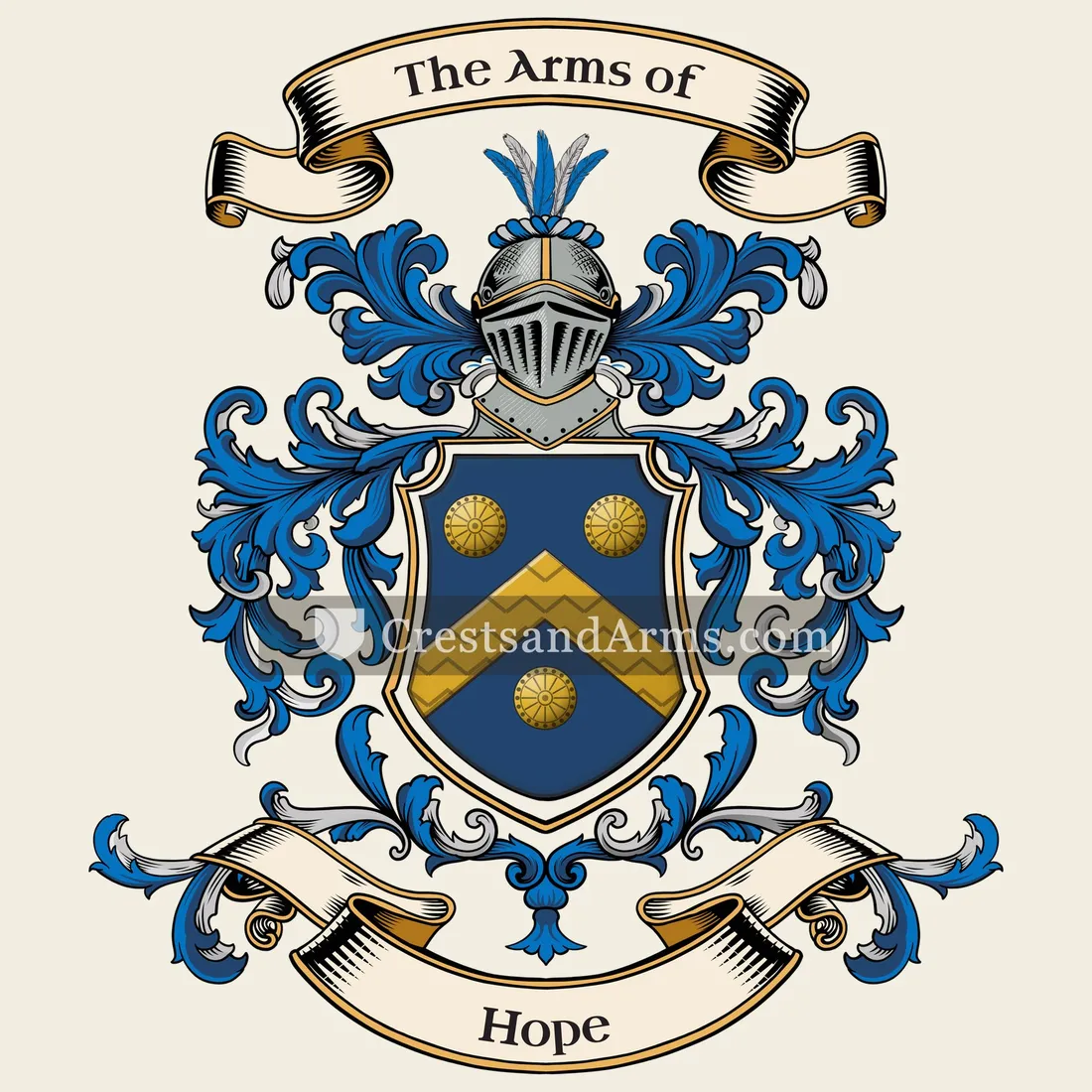
 chevronProtection, and faithful service completed
 roundelA coin, and one who has been to the crusades
 chevronProtection, and faithful service completed
 roundelA coin, and one who has been to the crusades


 martletA younger son, who must win his own land


 pileWell-doing, and a mark of distinction
 ermineDignity and rank
 chiefAuthority, wisdom and dominion
 bordureA difference between branches of one family
 lionCourage, strength and royalty