Map of Denmark showing where the Hoppe arms are recorded
The Hoppe arms were recorded in Denmark, c. 1722.
Arms such as these were typically recorded in Sjaælland.
Zealand held the Danish court, the crown's offices and Copenhagen itself. Families who served the king kept estates within reach of it, and royal service was the ordinary route to a coat of arms.
This is where the arms were entered in the register. Families often moved to other parts of the country, so the same name can turn up in more than one region.
The body that granted and recorded arms in Denmark in this period.
Frederik IV of Denmark
Sovereign of the period
Frederik IV of Denmark
1699–1730
Reigning in Denmark when the Hoppe arms are first recorded.
How Arms Worked in Denmark
Danish heraldry during this period was closely tied to noble status and royal favor rather than being open to all citizens. Arms were typically granted by the monarch to individuals, and these symbols were then shared by all members of the noble house. If a family line died out, the right to use those specific arms ended with them.
Granting authority
The Danish royal chancery held the power to issue and regulate official coats of arms for the kingdom.
How they got arms
Families usually received their arms through a formal royal grant that confirmed their noble status and rights.
Where arms were recorded
These grants were officially recorded in the Danish Royal Chancery records starting in the sixteenth century.
The family's standing
Recorded among the armigerous families of Denmark.
Origin & History of the Hoppe Family in Denmark
The family name Hoppe has deep roots in the Danish landscape, with documented evidence placing members of the family on the island of Sjælland as early as 1722. During this period, the name was often associated with individuals who served in professional or administrative roles within the growing Danish state. As the eighteenth century progressed, the family became more integrated into the social and economic fabric of Copenhagen and the surrounding rural districts. The name itself is thought to have originated from older Germanic linguistic roots, which were common among families living in northern Europe during the early modern era. By establishing themselves in Sjælland, the early Hoppe family members participated in the steady development of Danish society, moving from local community life into the broader historical narrative of the kingdom.
Meaning of the Hoppe family crest colors & symbols
Symbols on this shield
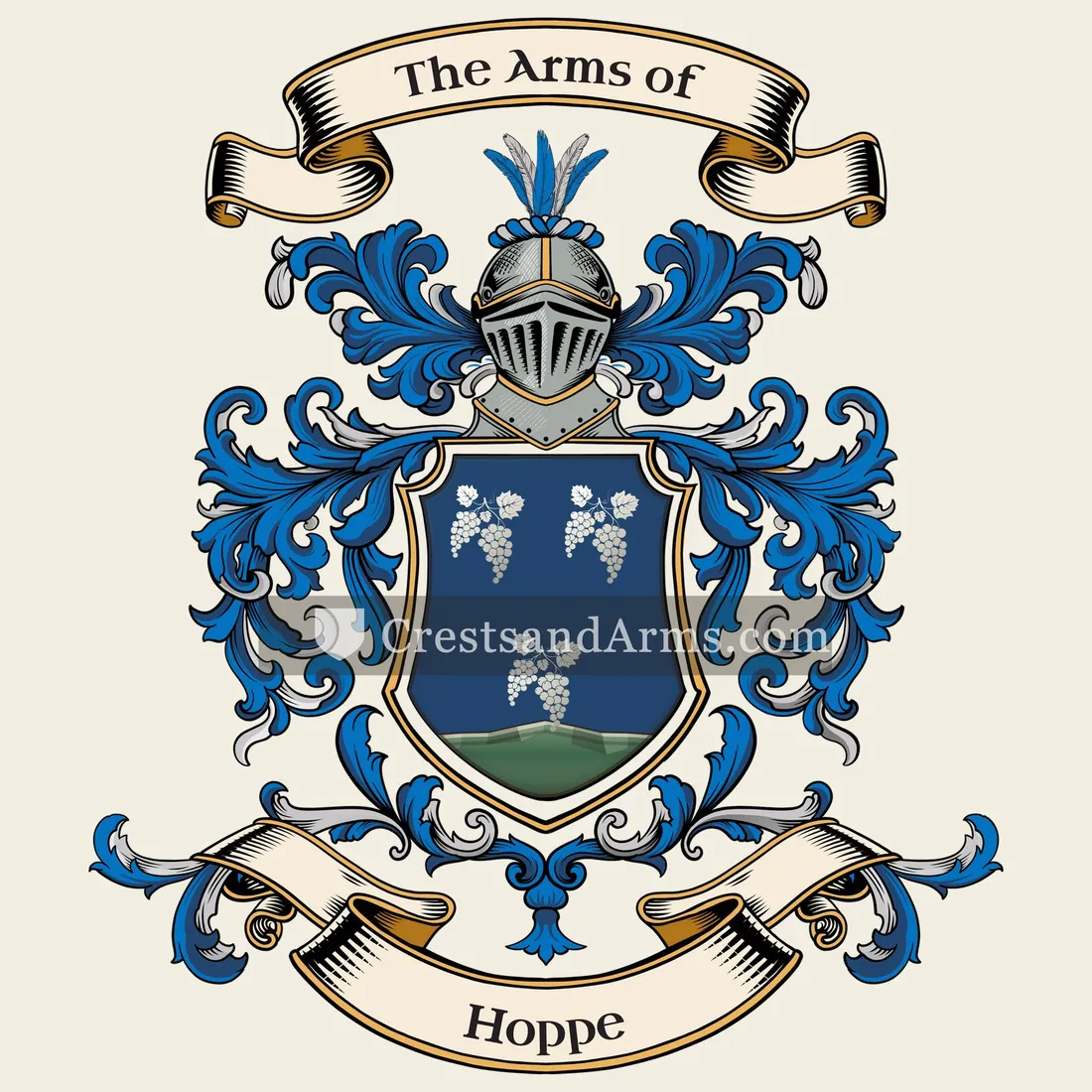
mountThe ground held, and steadfastness upon it
grapesPlenty, and the labour of the vine
Colours
Blue (Azure)Means: Loyalty and truth
Green (Vert)Means: Hope
Historical info
Source
J. B. Rietstap, Armorial Général, Gouda: G. B. van Goor Zonen, 1884–87
Blazon (the actual original written record)
“D'azur à trois ceps de houblon, accolés à leurs perches, posés sur un tertre de trois coupeaux de sin.; chacune des deux perches ext. sommée d'une huppe au nat.”
Germanyc. 1637
Digital archive packCoat of arms PNG, gold border print PDF, vector SVG and the certificate of authenticity. Sent to your email in minutes.
Map of Germany showing where the Hoppe arms are recorded
The Hoppe arms were recorded in Germany, c. 1637.
Arms such as these were typically recorded in Bavaria.
Bavaria was a country of old landed families and walled market towns. Estates passed down the same line for centuries, and both the landowners and the leading townsmen kept arms, which is why so many Bavarian names sit in the registers.
This is where the arms were entered in the register. Families often moved to other parts of the country, so the same name can turn up in more than one region.
The body that granted and recorded arms in Germany in this period.
Ferdinand II, Holy Roman Emperor
Sovereign of the period
Ferdinand II, Holy Roman Emperor
1619–1637
Reigning in Denmark when the Hoppe arms are first recorded.
How Arms Worked in Germany
In the Holy Roman Empire, coats of arms were often granted to individuals by the Emperor or his representatives. These arms were then passed down through the generations to all legitimate descendants of the original holder. Younger branches of a family usually kept the same shield design without needing to change it, as the arms belonged to the entire lineage.
Granting authority
The Holy Roman Emperor held the sole power to grant new coats of arms throughout his vast imperial territories.
How they got arms
Families typically obtained their coats of arms through a formal imperial grant or by proving their noble status to the authorities.
Where arms were recorded
These grants were officially recorded in the Imperial Chancery registers, which began keeping formal records of such honors during the Middle Ages.
The family's standing
Recorded among the armigerous families of Germany.
Origin & History of the Hoppe Family in Germany
The name Hoppe is deeply rooted in the linguistic history of Northern and Central Germany, originating as a nickname derived from the Middle Low German word *hoppe*, which refers to a hop plant. While the name is widely associated with the northern regions, the presence of the Hoppe family in Bavaria by 1637 highlights the movement of people across German lands during the seventeenth century. At that time, Bavaria was a central stage for the Thirty Years' War, a period that caused significant migration as families sought safety or new opportunities in different territories. The name likely traveled south through trade routes or the movement of laborers who carried their family identity with them into new regions. By settling in Bavaria, these early family members integrated into a society defined by its strong local traditions and agricultural roots, helping the name transition from a simple descriptive nickname into a permanent family surname that persisted through generations of social and political change.
Meaning of the Hoppe family crest colors & symbols
Symbols on this shield
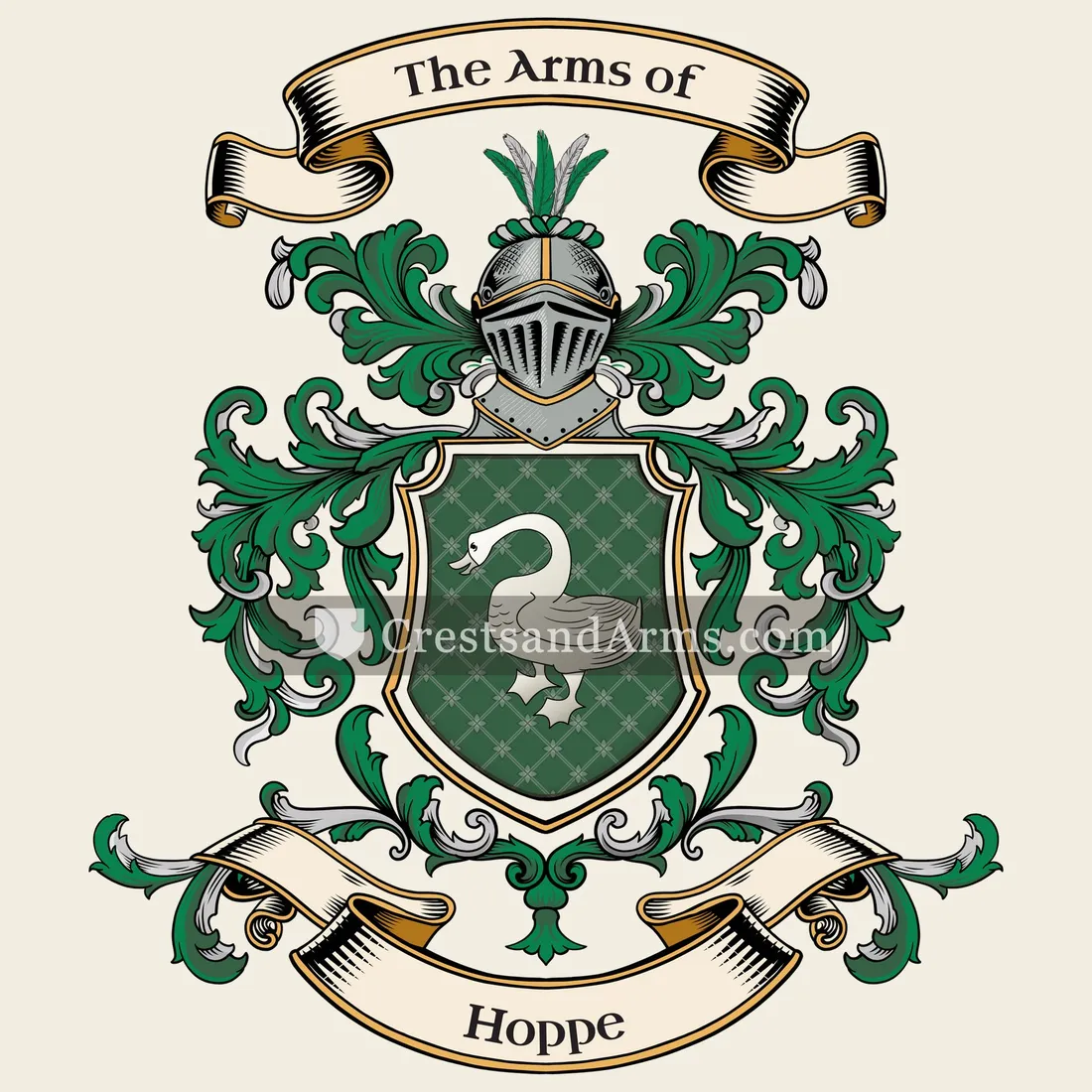
swanGrace, light and the poet's art
Colours
Green (Vert)Means: Hope
Silver (Argent)Means: Peace and sincerity
Historical info
Source
Sir Bernard Burke, The General Armory of England, Scotland, Ireland and Wales, London: Harrison & Sons, 1884
Blazon (the actual original written record)
“Vert a swan, wings endorsed ar”
Englandc. 1620
Digital archive packCoat of arms PNG, gold border print PDF, vector SVG and the certificate of authenticity. Sent to your email in minutes.
Map of England showing where the Hoppe arms are recorded
The Hoppe arms were recorded in England, c. 1620.
Arms such as these were typically recorded in York.
Yorkshire is the largest of the English counties, and it held more gentry families than any other. Land there was split among a great many households rather than a few, so a great many of them carried arms.
This is where the arms were entered in the register. Families often moved to other parts of the country, so the same name can turn up in more than one region.
The body that granted and recorded arms in England in this period.
James VI and I
Sovereign of the period
James VI and I
1603–1625
Reigning in Denmark when the Hoppe arms are first recorded.
How Arms Worked in England
English heraldry allowed arms to be shared by all legitimate descendants of the original owner. These symbols were treated as personal property that moved through the generations to all children. While the eldest son kept the original design, other family members could use the same shield without needing to change it or register their own unique versions.
Granting authority
The College of Arms in London has regulated the use of coats of arms throughout England and Wales since 1484.
How they got arms
Families typically obtained their coats of arms through a formal grant from the Crown or by proving their ancient right to them.
Where arms were recorded
All official coats of arms are recorded in the registers kept at the College of Arms, which date back to the fifteenth century.
The family's standing
Recorded among the armigerous families of England.
Origin & History of the Hoppe Family in England
The surname Hoppe carries a rich history that traces back to the medieval period, eventually establishing a notable presence in the northern English city of York by the early seventeenth century. While the name is often associated with Germanic roots, it became integrated into the English landscape as families migrated and settled into local communities. By 1620, records confirm that members of the Hoppe family were active residents of York, a city that served as a vital hub for trade and administration in the north. During this era, families with this name were likely involved in the local merchant guilds or the skilled trades that defined the city’s economy. Their presence in York suggests that they were part of the growing urban middle class that helped shape the social and economic fabric of England during the transition into the Stuart period. As these individuals navigated daily life in a bustling cathedral city, they contributed to the long-standing continuity of the name within the region.
Hoppe Meaning & Related Branches
Root word
Hoppe
Middle Low German term for a horse or a jumper.
This name
HoppeA nickname for someone who was lively, energetic, or a horse breeder.
also spelled
Hoppa
Hopp
Hoppey
Hop
Hoops
Related arms
Hopvariant spelling
Hopevariant spelling
Hoopsvariant spelling
Documented Sources
J. B. Rietstap, Armorial Général, Gouda: G. B. van Goor Zonen, 1884–87
Rigsarkivet (Danish National Archives), Kirkebøger for Sjællands Stift (Parish registers for the Diocese of Sjælland)
Rigsarkivet (Danish National Archives), Folketællinger (Census records)
Hiort-Lorenzen, H. R., and Thiset, A., Danmarks Adels Aarbog, 1884
Trap, J. P., Statistisk-topographisk Beskrivelse af Kongeriget Danmark, 1858
Digital archive packCoat of arms PNG, gold border print PDF, vector SVG and the certificate of authenticity. Sent to your email in minutes.


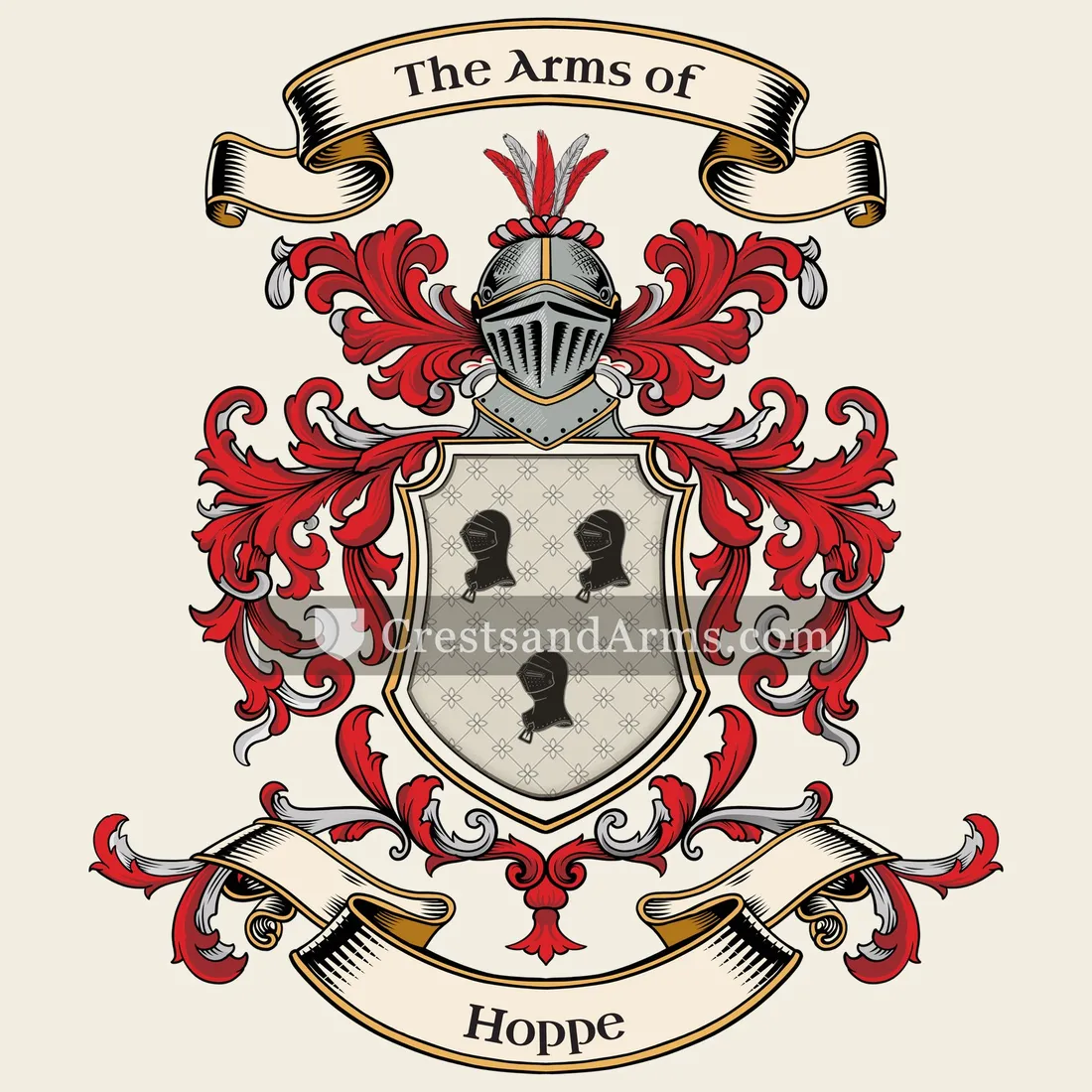
 helmetWisdom and security in defence
 helmetWisdom and security in defence


 mountThe ground held, and steadfastness upon it
 grapesPlenty, and the labour of the vine


 swanGrace, light and the poet's art