A record of documented arms, meaning and origin, researched for the Horn family lines. Documented in 3 countries.
Reg. 2995 · German, G–I
Coat of Arms & Family Crest Details
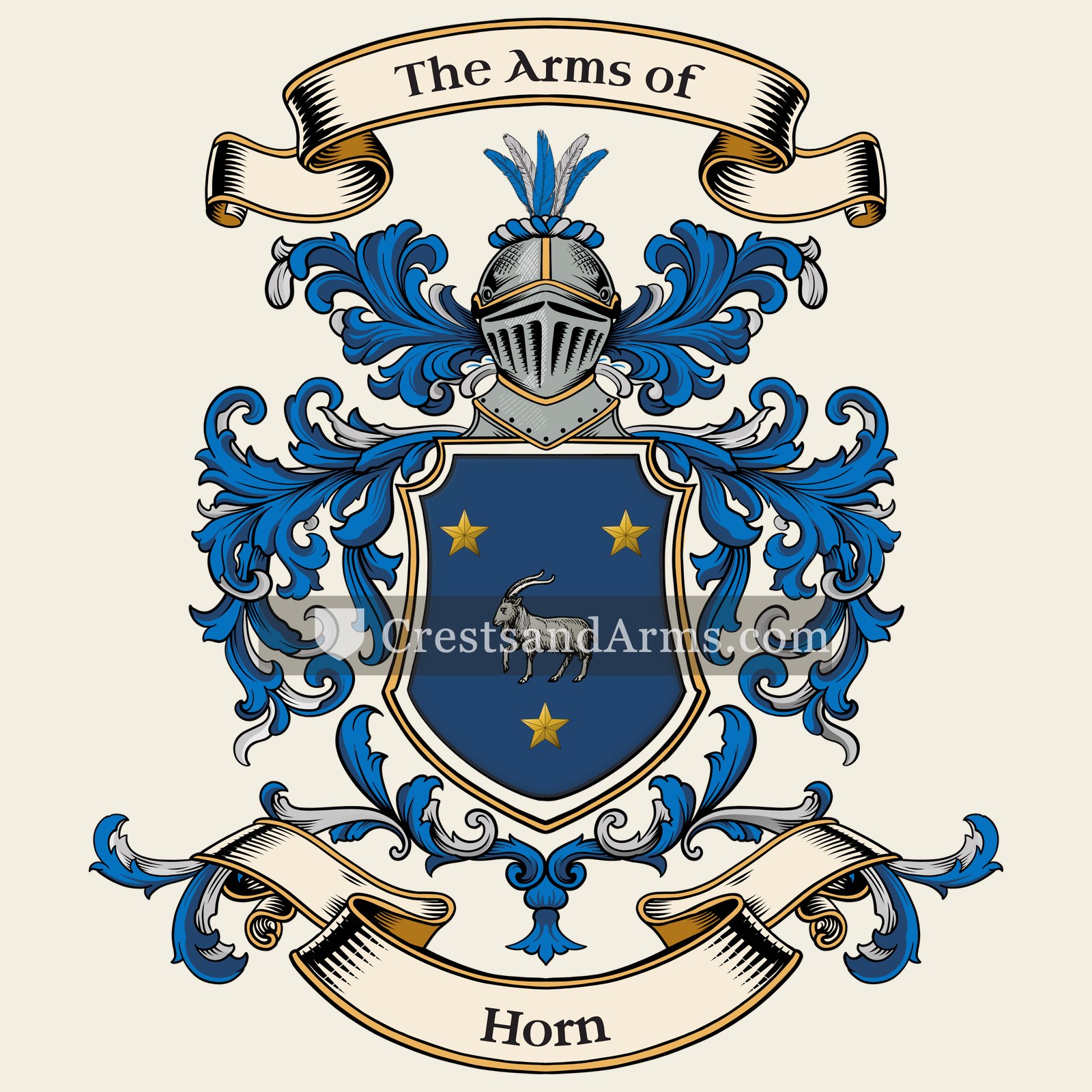
Symbols on this shield
goatOne who wins by diplomacy rather than force
mulletThe third son, and a divine quality from above
Colours
Blue (Azure)Means: Loyalty and truth
Silver (Argent)Means: Peace and sincerity
Gold (Or)Means: Generosity
Historical info
Source
J. B. Rietstap, Armorial Général, Gouda: G. B. van Goor Zonen, 1884–87
Blazon (the actual original written record)
“D'azur à un bouquetin naiss. d'arg., acc. de trois étoiles d'or, 1 en chef à dextre, 1 en flanc à sen. et 1 en p. Cq. cour. C.: le bouquetin, iss. L. d'arg. et d'azur.”
Germanyc. 1765
Digital archive packCoat of arms PNG, gold border print PDF, vector SVG and the certificate of authenticity. Sent to your email in minutes.
Map of Germany showing where the Horn arms are recorded
The Horn arms were recorded in Germany, c. 1765.
Arms such as these were typically recorded in Bavaria.
Bavaria was a country of old landed families and walled market towns. Estates passed down the same line for centuries, and both the landowners and the leading townsmen kept arms, which is why so many Bavarian names sit in the registers.
This is where the arms were entered in the register. Families often moved to other parts of the country, so the same name can turn up in more than one region.
The body that granted and recorded arms in Germany in this period.
Francis I, Holy Roman Emperor
Sovereign of the period
Francis I, Holy Roman Emperor
1745–1765
Reigning in Germany when the Horn arms are first recorded.
How Arms Worked in Germany
In the Holy Roman Empire, coats of arms were often granted to individuals by the Emperor or his representatives. These arms were then passed down through the generations to all legitimate descendants of the original holder. Younger branches of a family usually kept the same shield design without needing to change it, as the arms belonged to the entire lineage.
Granting authority
The Holy Roman Emperor held the sole power to grant new coats of arms throughout his vast imperial territories.
How they got arms
Families typically obtained their coats of arms through a formal imperial grant or by proving their noble status to the authorities.
Where arms were recorded
These grants were officially recorded in the Imperial Chancery registers, which began keeping formal records of such honors during the Middle Ages.
The family's standing
Recorded among the armigerous families of Germany.
Origin & History of the Horn Family in Germany
The surname Horn originated in Germany as a descriptive name, often given to people who lived near a prominent geographical feature like a sharp mountain peak or a curved bend in a river. In Middle High German, the word "horn" referred to these pointed landforms, and families living in such areas adopted the term to distinguish themselves within their local communities. By the time ancestors of the family were documented in Bavaria in 1765, the name was already well-established across various German-speaking regions. During this era, families with this name were typically involved in agriculture or skilled trades, reflecting the common social structures of rural Bavarian life. As the family grew, they became part of the local parish records that tracked births, marriages, and deaths, which helped solidify the name as a permanent fixture in the regional history of southern Germany.
Coat of Arms & Family Crest Details
Symbols on this shield
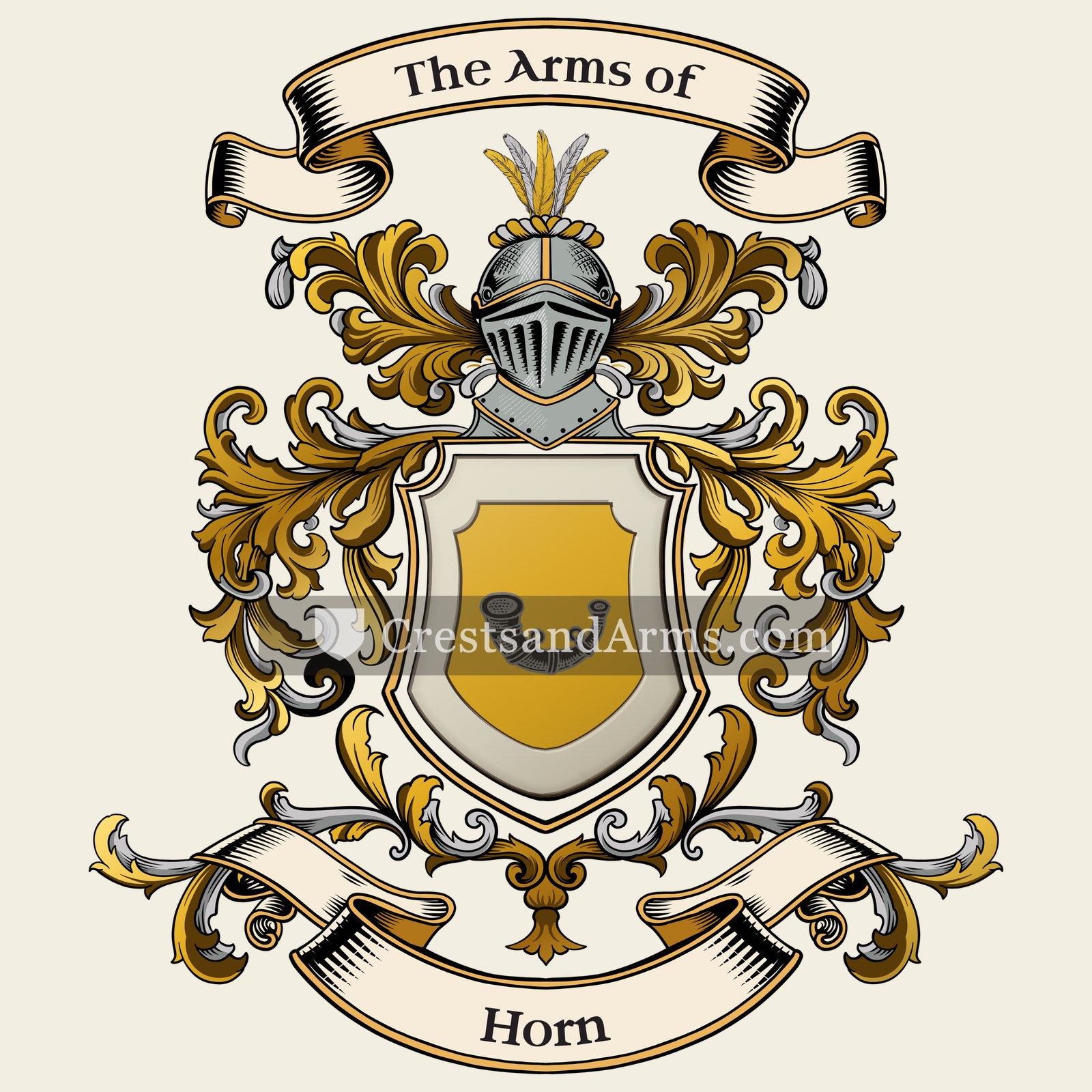
hunting horn stringedOne who delights in the chase
Colours
Gold (Or)Means: Generosity
Silver (Argent)Means: Peace and sincerity
Black (Sable)Means: Constancy
Historical info
Source
J. B. Rietstap, Armorial Général, Gouda: G. B. van Goor Zonen, 1884–87
Blazon (the actual original written record)
“D'or à un cor-de-chasse de sa., lié d'azur, l'embouchure à dextre; l'écu bordé d'arg. Deux cq. cour. C.: 1º une queue de paon au nat., ch. du cor-de-chasse; entre deux prob. de sa.; 2º deux bras, arm. au nat., les mains de carn. tenant ensemble un écusson d'azur, sommé d'une couronne royale d'or et ch. d'un G du même. S.: à dextre un lion reg. d'or, lamp. de gu.; à sen. un griffon reg. de gu.”
Swedenc. 1763
Digital archive packCoat of arms PNG, gold border print PDF, vector SVG and the certificate of authenticity. Sent to your email in minutes.
Map of Sweden showing where the Horn arms are recorded
The Horn arms were recorded in Sweden, c. 1763.
Arms such as these were typically recorded in Stockholm.
Stockholm held the Swedish court and the House of Nobility, where every noble family's arms were entered and kept. Families ennobled for service registered there, which is why so many are recorded around the city.
This is where the arms were entered in the register. Families often moved to other parts of the country, so the same name can turn up in more than one region.
The body that granted and recorded arms in Sweden in this period.
Adolf Fredrik of Sweden
Sovereign of the period
Adolf Fredrik of Sweden
1751–1771
Reigning in Germany when the Horn arms are first recorded.
How Arms Worked in Sweden
In Sweden, a coat of arms belonged to a noble family as a whole rather than just one individual. These arms were passed down through the generations to all legitimate descendants. Younger branches of the family used the same shield without needing to change it. This system ensured that the entire lineage shared the same identity and status under the law.
Granting authority
The Riddarhuset, or House of Nobility, regulated all noble coats of arms in Sweden under royal authority.
How they got arms
Families received their coats of arms through royal grants of nobility which were then officially registered with the House.
Where arms were recorded
Coats of arms were officially recorded in the Swedish House of Nobility register starting in the year 1626.
The family's standing
Recorded among the armigerous families of Sweden.
Origin & History of the Horn Family in Sweden
The name Horn has deep roots in Swedish history, often associated with families that rose to prominence through military service and government administration. While many families in Sweden adopted surnames based on their trade or geographic location, the name Horn is frequently linked to ancient noble lineages that held significant influence in the Swedish realm for centuries. By the time members of the family were documented in Stockholm in 1763, the name was already well-established within the urban elite. During this period, the family was likely involved in the bustling trade and political life of the capital city. Families with this name often maintained strong connections to the royal court and the Swedish military, which allowed them to leave a lasting mark on the nation's historical records. Their presence in Stockholm during the mid-eighteenth century reflects a time when the family was deeply integrated into the social and professional fabric of Swedish society.
Coat of Arms & Family Crest Details
Symbols on this shield
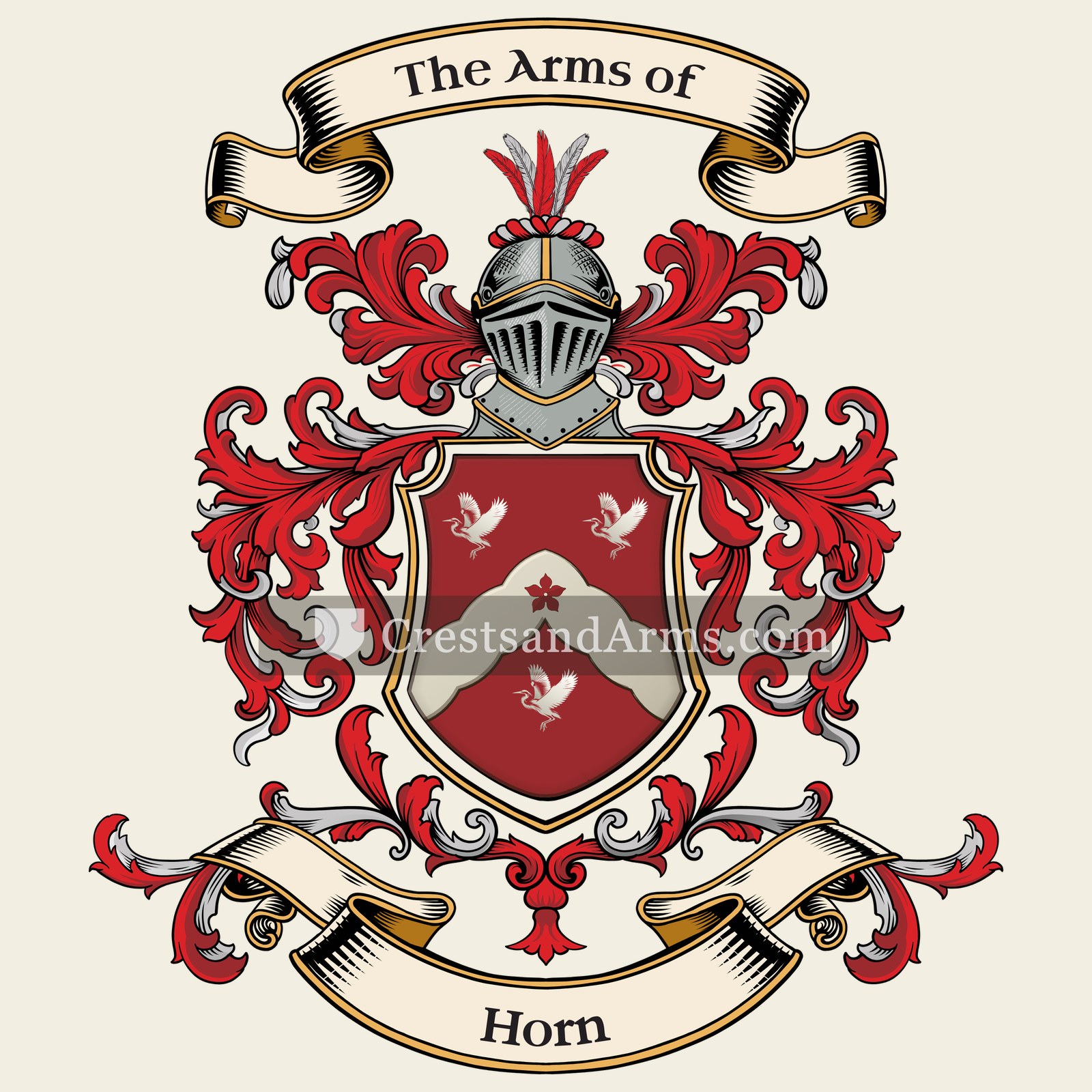
chevronProtection, and faithful service completed
heronPatience and quiet watchfulness
cinquefoilHope and joy
Colours
Red (Gules)Means: Military strength
Silver (Argent)Means: Peace and sincerity
Historical info
Source
Sir Bernard Burke, The General Armory of England, Scotland, Ireland and Wales, London: Harrison & Sons, 1884
Blazon (the actual original written record)
“Gu. on a chev. engr. betw. three herons ar. a cinquefoil of the first”
NorfolkNorfolk, c. 1620
Digital archive packCoat of arms PNG, gold border print PDF, vector SVG and the certificate of authenticity. Sent to your email in minutes.
Map of England showing where the Horn arms are recorded
The Horn arms were recorded in Norfolk, c. 1620.
Norfolk grew rich on wool and grain, and its wealth was spread among many middling families rather than a few great ones. Households of that kind bought land and took arms, and the county holds a large share of English names.
This is where the arms were entered in the register. Families often moved to other parts of the country, so the same name can turn up in more than one region.
The body that granted and recorded arms in England in this period.
James VI and I
Sovereign of the period
James VI and I
1603–1625
Reigning in Germany when the Horn arms are first recorded.
How Arms Worked in England
English heraldry allowed arms to be shared by all legitimate descendants of the original owner. These symbols were treated as personal property that moved through the generations to all children. While the eldest son kept the original design, other family members could use the same shield without needing to change it or register their own unique versions.
Granting authority
The College of Arms in London has regulated the use of coats of arms throughout England and Wales since 1484.
How they got arms
Families typically obtained their coats of arms through a formal grant from the Crown or by proving their ancient right to them.
Where arms were recorded
All official coats of arms are recorded in the registers kept at the College of Arms, which date back to the fifteenth century.
The family's standing
Recorded among the armigerous families of Norfolk.
Origin & History of the Horn Family in England
The surname Horn is an ancient occupational name that emerged in England during the Middle Ages. It was typically given to people who worked as horners, which meant they crafted useful household items like spoons, combs, and drinking vessels from animal horns. By the time the family was recorded in Norfolk in 1620, the name had been established for several centuries across various English counties. Families living in Norfolk during this period were often involved in the region’s thriving wool trade or local agriculture, which were the primary economic drivers of the area. As the name spread through different parishes, it became a common identifier for those whose ancestors had mastered the trade of shaping raw horn into durable goods. This history reflects the way many English surnames were formed by linking a person to the specific craft that supported their daily life.
Horn Meaning & Related Branches
Root word
horn
A hard, permanent outgrowth on the head of an animal.
This name
HornA topographic name for someone living on a spur of land or a mountain ridge.
also spelled
Horen
Horne
Hoorne
Hornne
Related arms
Davidsimilar arms
Hoornevariant spelling
Barkerollesrecorded with Horn, same area
Berkaerecorded with Horn, same area
Documented Sources
J. B. Rietstap, Armorial Général, Gouda: G. B. van Goor Zonen, 1884–87
Bahlow, Hans, Deutsches Namenlexikon: Familien- und Vornamen nach Ursprung und Sinn erklärt, 1967
Heintze, Albert, Die deutschen Familiennamen: geschichtlich, geographisch, sprachlich, 1903
Bayerisches Hauptstaatsarchiv, Kirchenbücher der katholischen Pfarreien in Bayern
Digital archive packCoat of arms PNG, gold border print PDF, vector SVG and the certificate of authenticity. Sent to your email in minutes.


 goatOne who wins by diplomacy rather than force
 mulletThe third son, and a divine quality from above
 goatOne who wins by diplomacy rather than force
 mulletThe third son, and a divine quality from above


 hunting horn stringedOne who delights in the chase


 chevronProtection, and faithful service completed
 heronPatience and quiet watchfulness
 cinquefoilHope and joy