Map of Wales showing where the Hoskinson arms are recorded
The Hoskinson arms were recorded in Monmouth, c. 1647.
Monmouthshire lay on the Welsh border, where land was held in return for military service. Families were expected to arm and to fight, and fighting households carried shields of their own.
This is where the arms were entered in the register. Families often moved to other parts of the country, so the same name can turn up in more than one region.
The body that granted and recorded arms in Wales in this period.
Charles I of England
Sovereign of the period
Charles I of England
1625–1649
Reigning in Wales when the Hoskinson arms are first recorded.
How Arms Worked in Wales
English heraldry allowed arms to be shared by all legitimate descendants of the original owner. These symbols were treated as personal property that moved through the generations to all children. While the eldest son kept the original design, other family members could use the same shield without needing to change it or register their own unique versions.
Granting authority
The College of Arms in London has regulated the use of coats of arms throughout England and Wales since 1484.
How they got arms
Families typically obtained their coats of arms through a formal grant from the Crown or by proving their ancient right to them.
Where arms were recorded
All official coats of arms are recorded in the registers kept at the College of Arms, which date back to the fifteenth century.
The family's standing
Recorded among the armigerous families of Monmouth.
Origin & History of the Hoskinson Family in Wales
The surname Hoskinson is a patronymic name, meaning it originated as a way to identify a person as the son of a man named Hodge, which was a common medieval nickname for Roger. While the name has roots in various parts of Britain, its presence in Wales is notably documented in the seventeenth century. By 1647, records confirm that members of the Hoskinson family were established in the border town of Monmouth. This location was a significant cultural crossroads where Welsh and English traditions frequently blended. Families in this region often navigated a shifting landscape of language and law during the mid-1600s, a period marked by the turbulence of the English Civil War. The survival of these early records in Monmouth suggests that the family was part of the local community during a time of great national transition, helping to anchor the name within the historical fabric of the Welsh borderlands.
Coat of Arms & Family Crest Details
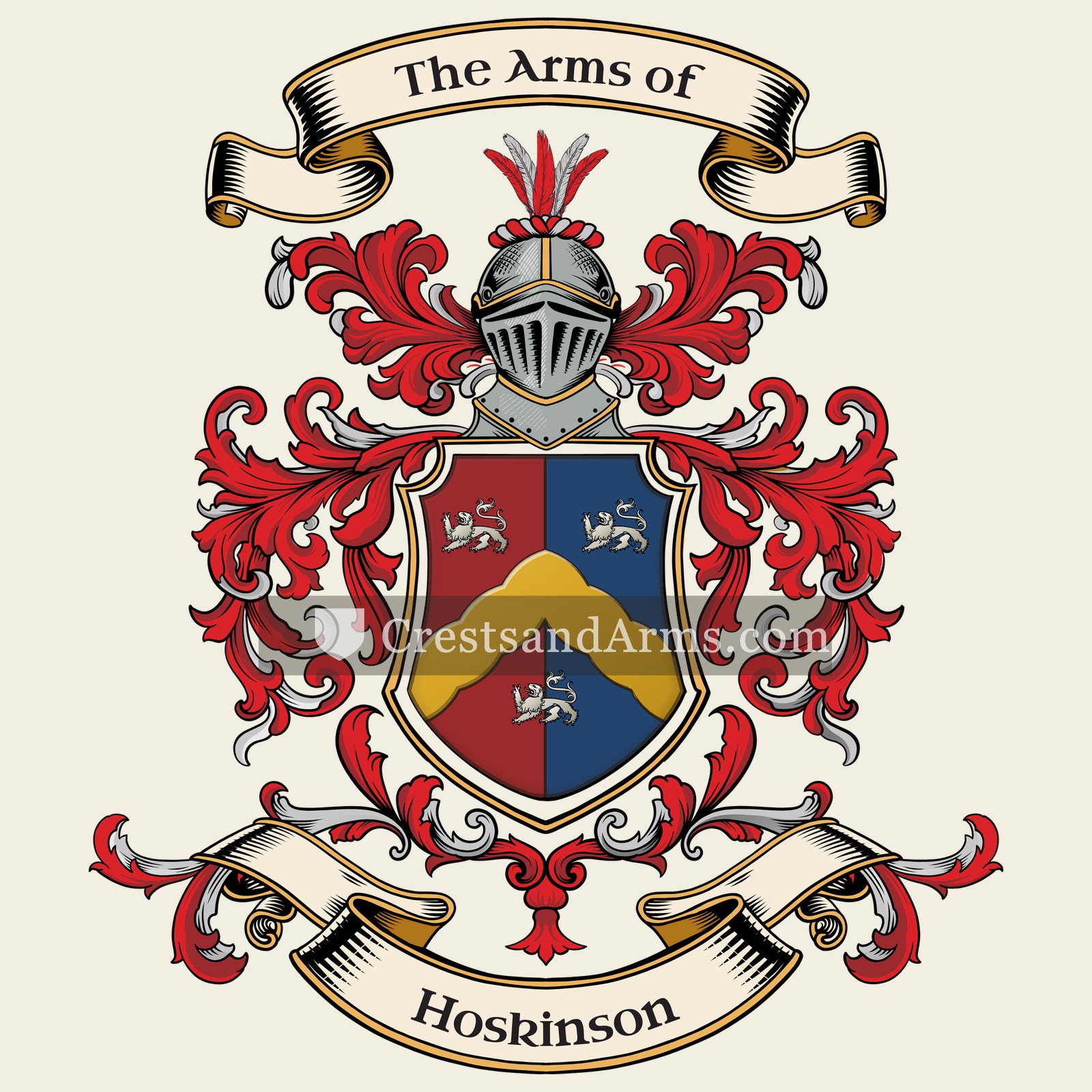
Symbols on this shield
chevronProtection, and faithful service completed
lionCourage, strength and royalty
Colours
Red (Gules)Means: Military strength
Blue (Azure)Means: Loyalty and truth
Gold (Or)Means: Generosity
Silver (Argent)Means: Peace and sincerity
Historical info
Source
Sir Bernard Burke, The General Armory of England, Scotland, Ireland and Wales, London: Harrison & Sons, 1884
Blazon (the actual original written record)
“Per pale gu. and az. a chev. engr. or, betw. three lions ramp. ar”
CumberlandHigham · Cumberland, c. 1620
Digital archive packCoat of arms PNG, gold border print PDF, vector SVG and the certificate of authenticity. Sent to your email in minutes.
Map of England showing where the Hoskinson arms are recorded
The Hoskinson arms were recorded in Cumberland, c. 1620.
Cumberland was rough border country in the north-west, facing Scotland across a disputed line. Its families held land in return for keeping it defended, and men who fought carried shields of their own.
This is where the arms were entered in the register. Families often moved to other parts of the country, so the same name can turn up in more than one region.
The body that granted and recorded arms in England in this period.
James VI and I
Sovereign of the period
James VI and I
1603–1625
Reigning in Wales when the Hoskinson arms are first recorded.
How Arms Worked in England
English heraldry allowed arms to be shared by all legitimate descendants of the original owner. These symbols were treated as personal property that moved through the generations to all children. While the eldest son kept the original design, other family members could use the same shield without needing to change it or register their own unique versions.
Granting authority
The College of Arms in London has regulated the use of coats of arms throughout England and Wales since 1484.
How they got arms
Families typically obtained their coats of arms through a formal grant from the Crown or by proving their ancient right to them.
Where arms were recorded
All official coats of arms are recorded in the registers kept at the College of Arms, which date back to the fifteenth century.
The family's standing
Recorded among the armigerous families of Cumberland.
Origin & History of the Hoskinson Family in England
The surname Hoskinson is a patronymic name, which means it originated as a way to identify a person as the son of someone named Hoskin. The name Hoskin itself began as a diminutive form of the name Roger, which was a very popular choice in medieval England. By the early 17th century, the family had established a notable presence in the northern county of Cumberland. This region was a rugged and challenging landscape where families often lived in small, tight-knit rural communities. Living in Cumberland during the 1620s meant that the early Wilkinsons and Hoskinsons were likely involved in farming or the wool trade, which were the primary ways people supported themselves in the north at that time. Because the name was tied to a specific father, it helped neighbors and local officials distinguish between different families living in the same parish. Over time, as the family grew and moved, the name became a permanent marker of their ancestry and their deep roots in the English countryside.
Hoskinson Meaning & Related Branches
Root word
Hodge
A medieval diminutive of the Germanic name Roger meaning famous spear.
This name
HoskinsonSon of the famous spear, denoting a patronymic lineage from a progenitor named Hodge.
also spelled
Hoskyns
Hoskings
Documented Sources
Sir Bernard Burke, The General Armory of England, Scotland, Ireland and Wales, London: Harrison & Sons, 1884
Bradney, Joseph Alfred, A History of Monmouthshire from the Coming of the Normans into Wales down to the Present Time, 1904
National Library of Wales, Great Sessions Records of Wales, 1647
Digital archive packCoat of arms PNG, gold border print PDF, vector SVG and the certificate of authenticity. Sent to your email in minutes.


 bordureA difference between branches of one family
 bordureA difference between branches of one family
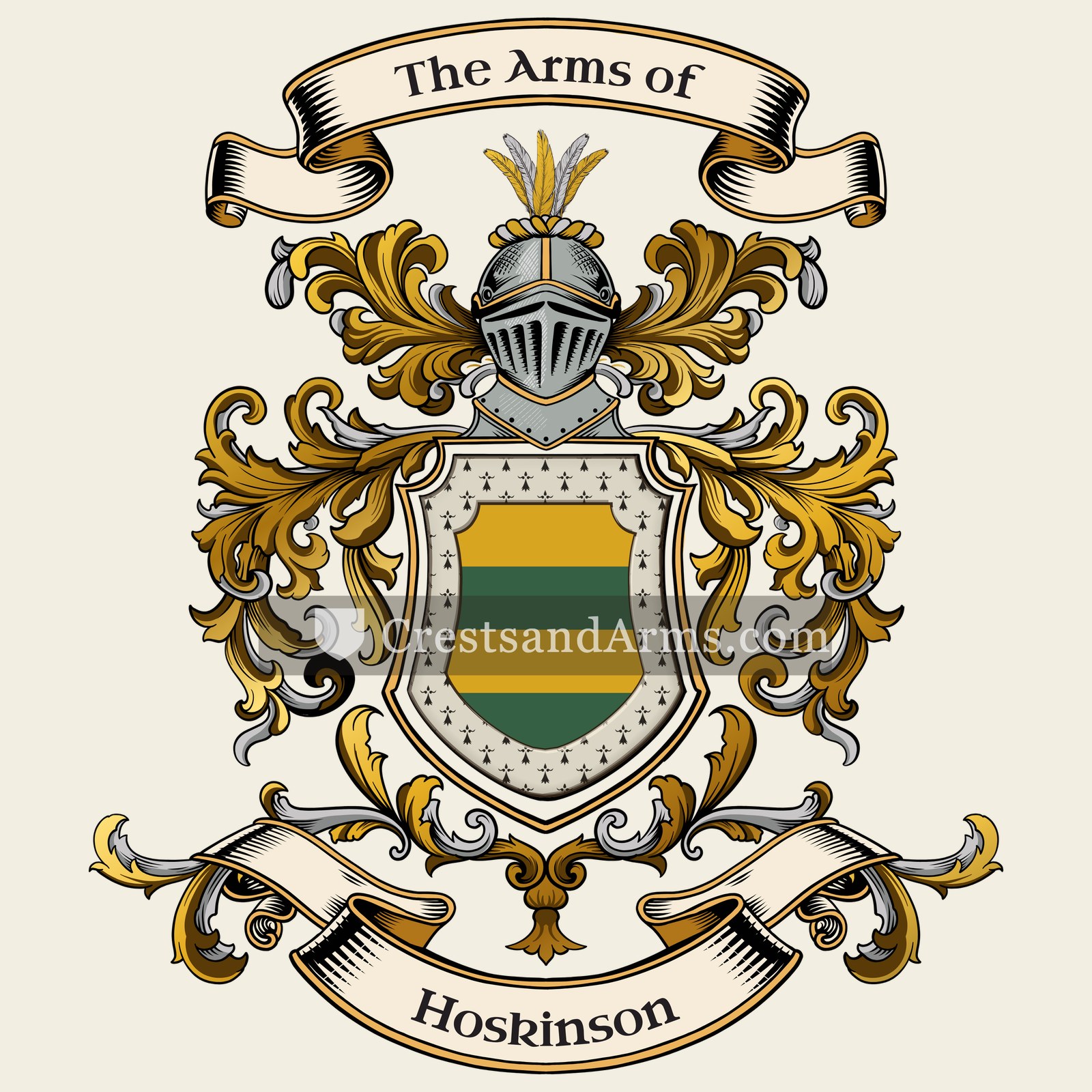


 chevronProtection, and faithful service completed
 lionCourage, strength and royalty