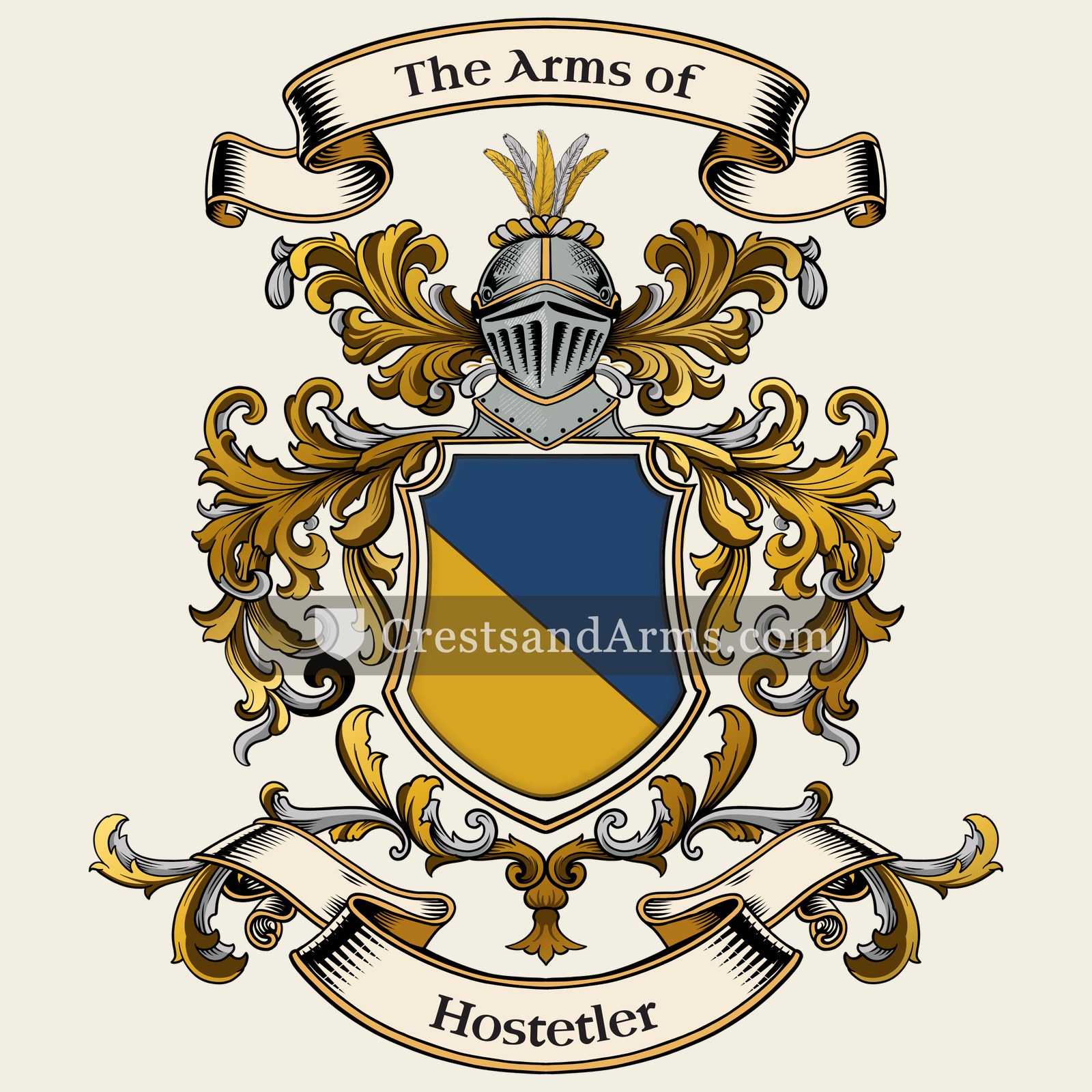
A record of documented arms, meaning and origin, researched for the Hostetler family of Germany.
Reg. 0215 · German, G–I
Coat of Arms & Family Crest Details
Colours
Gold (Or)Means: Generosity
Blue (Azure)Means: Loyalty and truth
Historical info
Source
J. B. Rietstap, Armorial Général, Gouda: G. B. van Goor Zonen, 1884–87
Blazon (the actual original written record)
“Taillé-cannelé d'or sur azur. Cq. cour. C.: deux cornes de buffle, d'or et d'azur, ornées de crêtes le long du dos de l'un à l'autre, les angles ornés de plumes de coq de sa.”
WurttembergWurttemberg, c. 1518
Digital archive packCoat of arms PNG, gold border print PDF, vector SVG and the certificate of authenticity. Sent to your email in minutes.
Map of Germany showing where the Hostetler arms are recorded
The Hostetler arms were recorded in Wurttemberg, c. 1518.
Wurttemberg was southern German country of small estates and well-off market towns. Both landowners and leading townsmen kept arms there, so the region carries far more names than its size suggests.
This is where the arms were entered in the register. Families often moved to other parts of the country, so the same name can turn up in more than one region.
The body that granted and recorded arms in Germany in this period.
Maximilian I
Sovereign of the period
Maximilian I
1486–1519
Reigning in Germany when the Hostetler arms are first recorded.
How Arms Worked in Germany
In the Holy Roman Empire, coats of arms were often granted to individuals by the Emperor or his representatives. These arms were then passed down through the generations to all legitimate descendants of the original holder. Younger branches of a family usually kept the same shield design without needing to change it, as the arms belonged to the entire lineage.
Granting authority
The Holy Roman Emperor held the sole power to grant new coats of arms throughout his vast imperial territories.
How they got arms
Families typically obtained their coats of arms through a formal imperial grant or by proving their noble status to the authorities.
Where arms were recorded
These grants were officially recorded in the Imperial Chancery registers, which began keeping formal records of such honors during the Middle Ages.
The family's standing
Recorded among the armigerous families of Wurttemberg.
Origin & History of the Hostetler Family in Germany
The Hostetler family name traces its roots to the German-speaking regions of Europe, with documented evidence placing early ancestors in the territory of Württemberg as early as 1518. The name itself is derived from the German words "Host," meaning a farm or a homestead, and "teler," which refers to someone who works or lives on that land. This suggests that the family were likely farmers or landholders who identified themselves by their specific place of residence. Over the following centuries, members of the family became deeply involved in the Anabaptist movement, a religious group that faced significant persecution for their beliefs. This religious commitment eventually led many family members to leave their ancestral homes in the German states and migrate to North America in search of religious freedom and new opportunities for their families.
Related Branches & Arms
Root word
Host
A guest or a host providing lodging
This name
HostetlerA person who lives on or manages a small farm or homestead
also spelled
Hockstetter
Hochsteter
Hochstetterer
Hoksteter
Documented Sources
J. B. Rietstap, Armorial Général, Gouda: G. B. van Goor Zonen, 1884–87
Gingerich, Hugh F. and Kreider, Rachel W., Amish and Amish Mennonite Genealogies, 1986
Hostetler, Harvey, Descendants of Jacob Hochstetler, the Immigrant of 1736, 1912
Mast, C. Z., A Brief History of Bishop Jacob Mast and Other Mast Pioneers, 1911
Staatsarchiv Ludwigsburg, Kirchenbücher der Evangelischen Landeskirche in Württemberg
Mennonite Historical Library, Hostetler Family Genealogical Records
Digital archive packCoat of arms PNG, gold border print PDF, vector SVG and the certificate of authenticity. Sent to your email in minutes.