Map of England showing where the Hotson arms are recorded
The Hotson arms were recorded in Cambridge, c. 1590.
Cambridgeshire was flat, rich farming country with the university at its centre. Fen drainage made new land and new fortunes, and families who gained by it bought manors and took arms to match.
This is where the arms were entered in the register. Families often moved to other parts of the country, so the same name can turn up in more than one region.
The body that granted and recorded arms in England in this period.
Elizabeth I of England
Sovereign of the period
Elizabeth I of England
1558–1603
Reigning in England when the Hotson arms are first recorded.
How Arms Worked in England
English heraldry allowed arms to be shared by all legitimate descendants of the original owner. These symbols were treated as personal property that moved through the generations to all children. While the eldest son kept the original design, other family members could use the same shield without needing to change it or register their own unique versions.
Granting authority
The College of Arms in London has regulated the use of coats of arms throughout England and Wales since 1484.
How they got arms
Families typically obtained their coats of arms through a formal grant from the Crown or by proving their ancient right to them.
Where arms were recorded
All official coats of arms are recorded in the registers kept at the College of Arms, which date back to the fifteenth century.
The family's standing
Recorded among the armigerous families of Cambridge.
Origin & History of the Hotson Family in England
The surname Hotson emerged in England as a patronymic name, which means it was originally used to identify a person as the son of someone named Hot or Hod. While the name likely existed in various regions, historical records confirm that the family was well-established in the university town of Cambridge by 1590. During this period, Cambridge was a bustling center of trade and intellectual growth, and families like the Hotsons often played active roles in the local parish life. Because the name is rooted in the common naming traditions of the Middle Ages, it reflects the way surnames evolved from simple nicknames or father-son relationships into permanent family identifiers. By settling in a prominent location like Cambridge, the early Hotsons became part of the long-standing social fabric of East Anglia, where they lived and worked for generations.
Meaning of the Hotson family crest colors & symbols
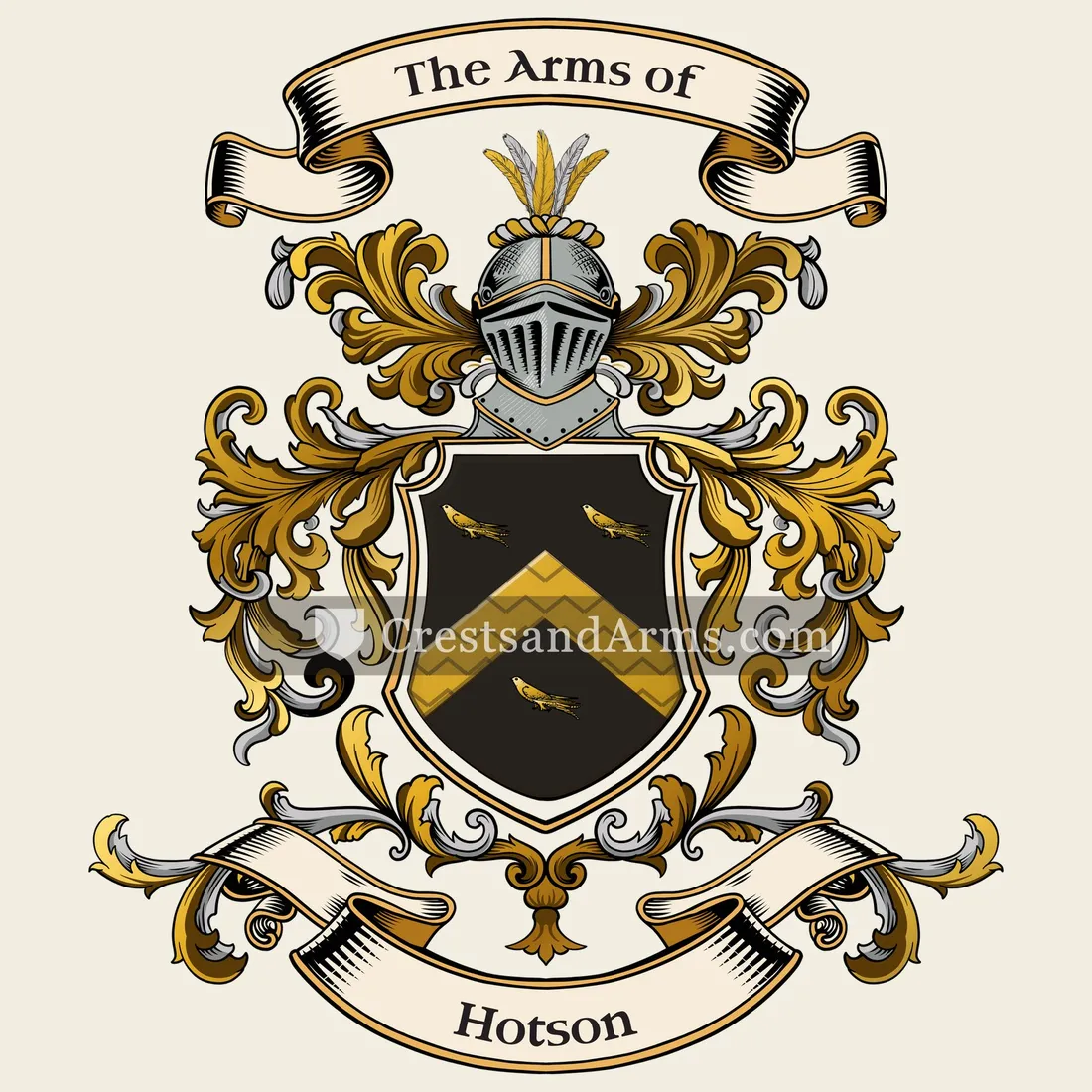
Symbols on this shield
chevronProtection, and faithful service completed
martletA younger son, who must win his own land
Colours
Black (Sable)Means: Constancy
Gold (Or)Means: Generosity
Historical info
Source
Sir Bernard Burke, The General Armory of England, Scotland, Ireland and Wales, London: Harrison & Sons, 1884
Blazon (the actual original written record)
“Sa. a chev. betw. three martlets or”
WicklowHollybrooke House · Wicklow, c. 1645
Digital archive packCoat of arms PNG, gold border print PDF, vector SVG and the certificate of authenticity. Sent to your email in minutes.
Map of Ireland showing where the Hotson arms are recorded
The Hotson arms were recorded in Wicklow, c. 1645.
Wicklow was mountain country immediately south of Dublin, the last part of the east coast brought under control. Families granted land there held it under arms, and those grants were recorded.
This is where the arms were entered in the register. Families often moved to other parts of the country, so the same name can turn up in more than one region.
The body that granted and recorded arms in Ireland in this period.
Charles I of England
Sovereign of the period
Charles I of England
1625–1649
Reigning in England when the Hotson arms are first recorded.
How Arms Worked in Ireland
The Ulster King of Arms granted coats of arms to individuals who proved their social standing and good character. These symbols were typically inherited by all legitimate descendants of the original holder. If a family branch wanted a unique look, they could apply for a specific change to their design through the office to ensure their identity remained distinct.
Granting authority
The Ulster King of Arms acted as the official body that regulated and issued all coats of arms throughout Ireland.
How they got arms
Families obtained their arms through formal grants issued by the office after proving their eligibility and paying the required fees.
Where arms were recorded
All official grants were recorded in the registers held by the Ulster King of Arms starting from the year 1552.
The family's standing
Recorded among the armigerous families of Wicklow.
Origin & History of the Hotson Family in Ireland
The Hotson family name has roots in Ireland that trace back to the mid-seventeenth century, with documented evidence placing members of the family in County Wicklow by 1645. During this period, Ireland was undergoing significant social and political upheaval, which often led to the movement of families across different regions. The name itself is thought to be of English or Anglo-Norman origin, likely arriving in Ireland during the waves of migration that occurred throughout the late medieval and early modern eras. Settling in the rugged landscape of Wicklow, early Hotsons would have been part of a changing rural society where families often established themselves as farmers or tradespeople. While the name remained relatively uncommon compared to native Irish surnames, its presence in the historical records of the 1640s highlights the family's integration into the local community during a time of great transition for the island.
Hotson Meaning & Related Branches
Root word
Hod
A medieval pet form of the Germanic name Roger.
This name
HotsonA patronymic surname meaning son of Hod or son of Roger.
also spelled
Hodsun
Hodsen
Documented Sources
Sir Bernard Burke, The General Armory of England, Scotland, Ireland and Wales, London: Harrison & Sons, 1884
Reaney, P.H., A Dictionary of English Surnames, 1958
Cambridgeshire Archives, Bishop's Transcripts for the Diocese of Ely, 1590
Digital archive packCoat of arms PNG, gold border print PDF, vector SVG and the certificate of authenticity. Sent to your email in minutes.


 chevronProtection, and faithful service completed
 falconOne eager and quick in pursuit
 chevronProtection, and faithful service completed
 falconOne eager and quick in pursuit
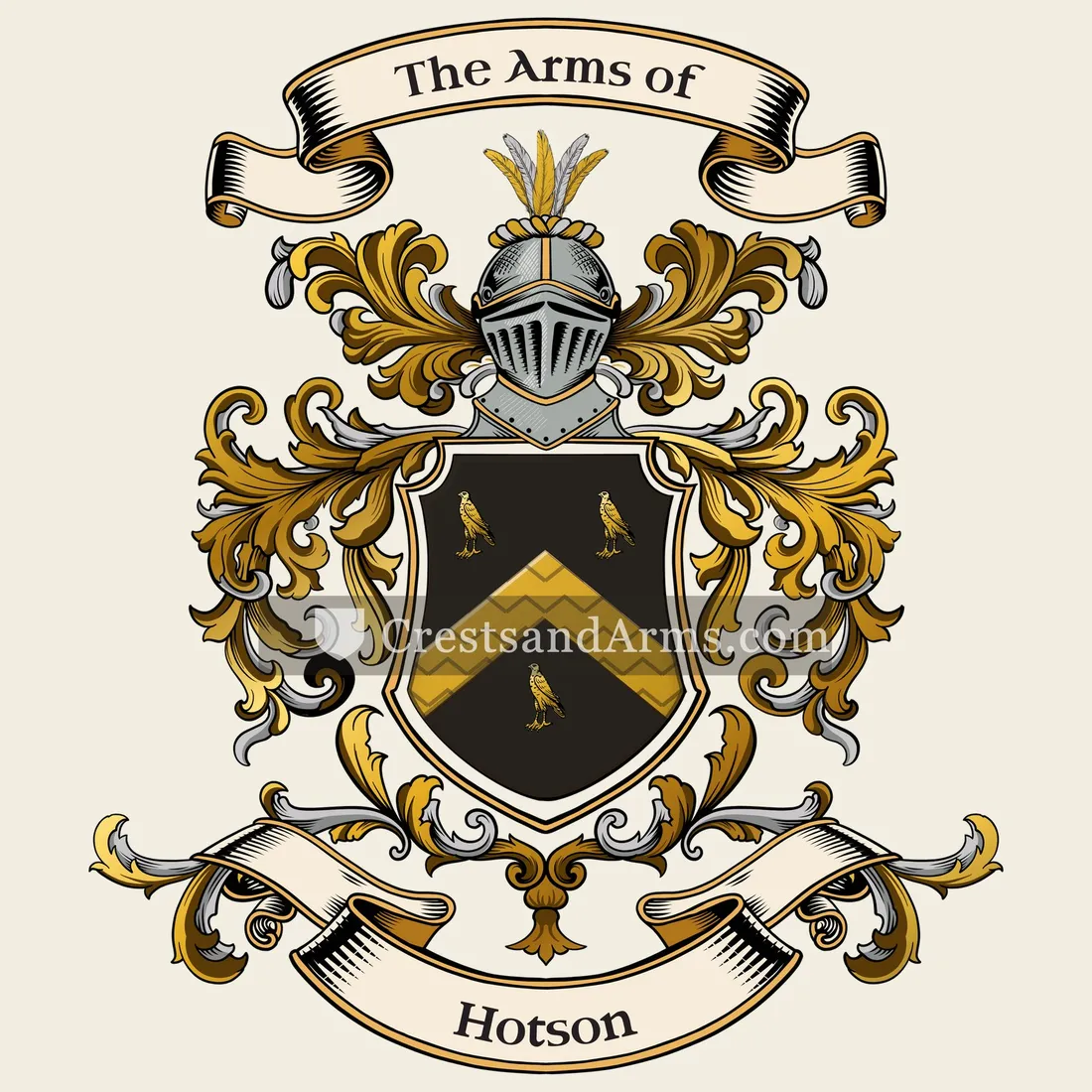


 martletA younger son, who must win his own land