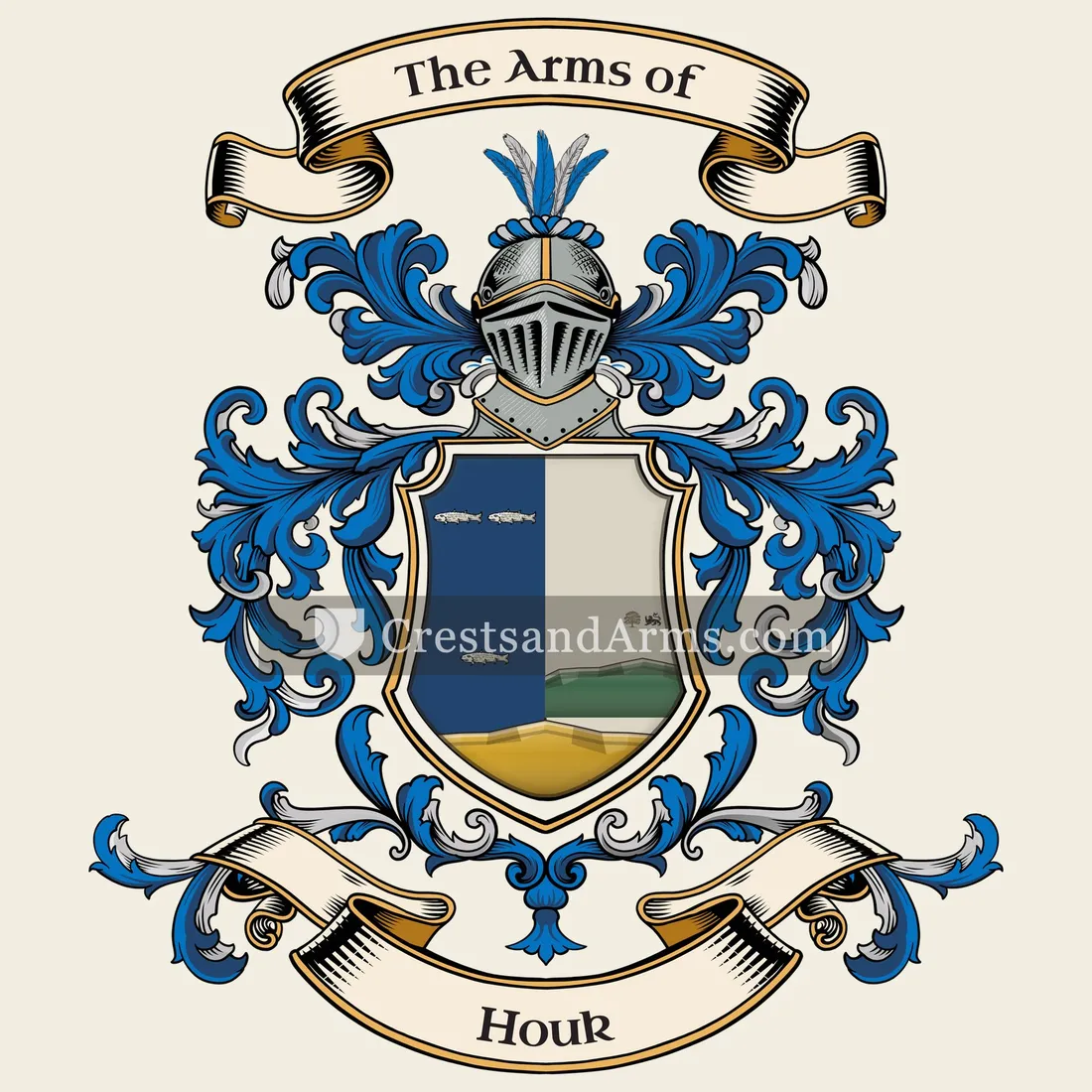
A record of documented arms, meaning and origin, researched for the Houk family of Netherlands.
Reg. 6793 · Dutch, G–I
Meaning of the Houk family crest colors & symbols
Symbols on this shield
mountThe ground held, and steadfastness upon it
fishA true and generous mind, and Christian faith
lionCourage, strength and royalty
treeLife, endurance and deep roots
Colours
Blue (Azure)Means: Loyalty and truth
Silver (Argent)Means: Peace and sincerity
Gold (Or)Means: Generosity
Green (Vert)Means: Hope
Black (Sable)Means: Constancy
Historical info
Source
J. B. Rietstap, Armorial Général, Gouda: G. B. van Goor Zonen, 1884–87
Blazon (the actual original written record)
“Parti: au 1 d'azur à trois harengs nageants d'arg., l'un sur l'autre, la tête de chaque hareng surm. d'une couronne d'or; au 2 d'arg. au lion de sa., ramp. contre un arbre au nat., mouv. du parti, le tout soutenu d'une terrasse d'or”
NetherlandsSchiedam, c. 1815
Digital archive packCoat of arms PNG, gold border print PDF, vector SVG and the certificate of authenticity. Sent to your email in minutes.
Map of Netherlands showing where the Houk arms are recorded
The Houk arms were recorded in Schiedam, c. 1815.
This is where the arms were entered in the register. Families often moved to other parts of the country, so the same name can turn up in more than one region.
Region
Schiedam
Town
Schiedam
First recorded
1815
Granting Authority for the Houk Arms
Hoge Raad van Adel
Photograph made by me · CC BY-SA 3.0
The body that granted and recorded arms in Netherlands in this period.
William I of the Netherlands
Sovereign of the period
William I of the Netherlands
1815–1840
Reigning in Netherlands when the Houk arms are first recorded.
How Arms Worked in Netherlands
In the Netherlands, coats of arms were often used by noble families and those who held specific public offices. These arms were passed down through the generations to legitimate descendants. Younger branches of a family usually kept the original design without needing to add special marks. This system ensured that the family identity remained clear and consistent over many years.
Granting authority
The Hoge Raad van Adel is the official body that regulates and manages noble titles and coats of arms in the Netherlands.
How they got arms
Families typically obtained their coats of arms through official royal grants or by proving their long-standing historical use of the symbols.
Where arms were recorded
Coats of arms are officially recorded in the registers held by the Hoge Raad van Adel, which began its work in 1814.
The family's standing
Recorded among the armigerous families of Netherlands.
Origin & History of the Houk Family in Netherlands
The family name Houk traces its roots back to the bustling maritime and industrial environment of the Netherlands. By 1815, records confirm that members of the family were established in the city of Schiedam, a location famous during that era for its thriving gin distilleries and busy shipping ports. The name itself likely evolved from regional dialects and occupational descriptions common to the Low Countries, reflecting the practical lives of ancestors who lived near the water. As the family navigated the social and economic changes of the early nineteenth century, they became part of the local fabric of Schiedam. This history highlights how families often settled in specific trade hubs to build their livelihoods during a time of significant growth in Dutch history.
Houk Meaning & Related Branches
Root word
Houc
A Middle Dutch term referring to a hook or a curved implement.
This name
HoukA topographic name for someone living near a curved piece of land or a bend in a river.
also spelled
Houcke
Houk
Documented Sources
J. B. Rietstap, Armorial Général, Gouda: G. B. van Goor Zonen, 1884–87


 mountThe ground held, and steadfastness upon it
 fishA true and generous mind, and Christian faith
 lionCourage, strength and royalty
 treeLife, endurance and deep roots
 mountThe ground held, and steadfastness upon it
 fishA true and generous mind, and Christian faith
 lionCourage, strength and royalty
 treeLife, endurance and deep roots