Map of Ireland showing where the Howden arms are recorded
The Howden arms were recorded in Ireland, c. 1645.
Arms such as these were typically recorded in Dublin.
Dublin was the seat of government in Ireland and the place where grants were sought and recorded. Families with business at the castle or the courts settled nearby, and settling there put their arms on record.
This is where the arms were entered in the register. Families often moved to other parts of the country, so the same name can turn up in more than one region.
The body that granted and recorded arms in Ireland in this period.
Charles I of England
Sovereign of the period
Charles I of England
1625–1649
Reigning in Ireland when the Howden arms are first recorded.
How Arms Worked in Ireland
The Ulster King of Arms granted coats of arms to individuals who proved their social standing and good character. These symbols were typically inherited by all legitimate descendants of the original holder. If a family branch wanted a unique look, they could apply for a specific change to their design through the office to ensure their identity remained distinct.
Granting authority
The Ulster King of Arms acted as the official body that regulated and issued all coats of arms throughout Ireland.
How they got arms
Families obtained their arms through formal grants issued by the office after proving their eligibility and paying the required fees.
Where arms were recorded
All official grants were recorded in the registers held by the Ulster King of Arms starting from the year 1552.
The family's standing
Recorded among the armigerous families of Ireland.
Origin & History of the Howden Family in Ireland
The surname Howden is a locational name that originated from a town in the East Riding of Yorkshire, England. The name itself comes from the Old English words for a hollow and a valley, describing the landscape where the first families lived. By the mid-seventeenth century, members of the Howden family had established a significant presence in Dublin, Ireland. Historical records confirm their residence in the city by 1645, a time when many families were moving across the Irish Sea due to shifting political and economic opportunities. These early settlers in Dublin likely integrated into the merchant and professional classes of the city, helping to anchor the family name in Irish history for generations to come.
Howden Meaning & Related Branches
Root word
Hough-den
A valley or hollow located near a hill or spur of land.
This name
HowdenDerived from a topographical location referring to a settlement situated in a hollow or valley.
also spelled
Howdon
Related arms
Howdon, or Houdonvariant spelling
Documented Sources
Sir Bernard Burke, The General Armory of England, Scotland, Ireland and Wales, London: Harrison & Sons, 1884
Black, George Fraser, The Surnames of Scotland: Their Origin, Meaning, and History, 1946
MacLysaght, Edward, The Surnames of Ireland, 1985
National Archives of Ireland, Civil Survey of the County of Dublin, 1654–1656
Digital archive packCoat of arms PNG, gold border print PDF, vector SVG and the certificate of authenticity. Sent to your email in minutes.


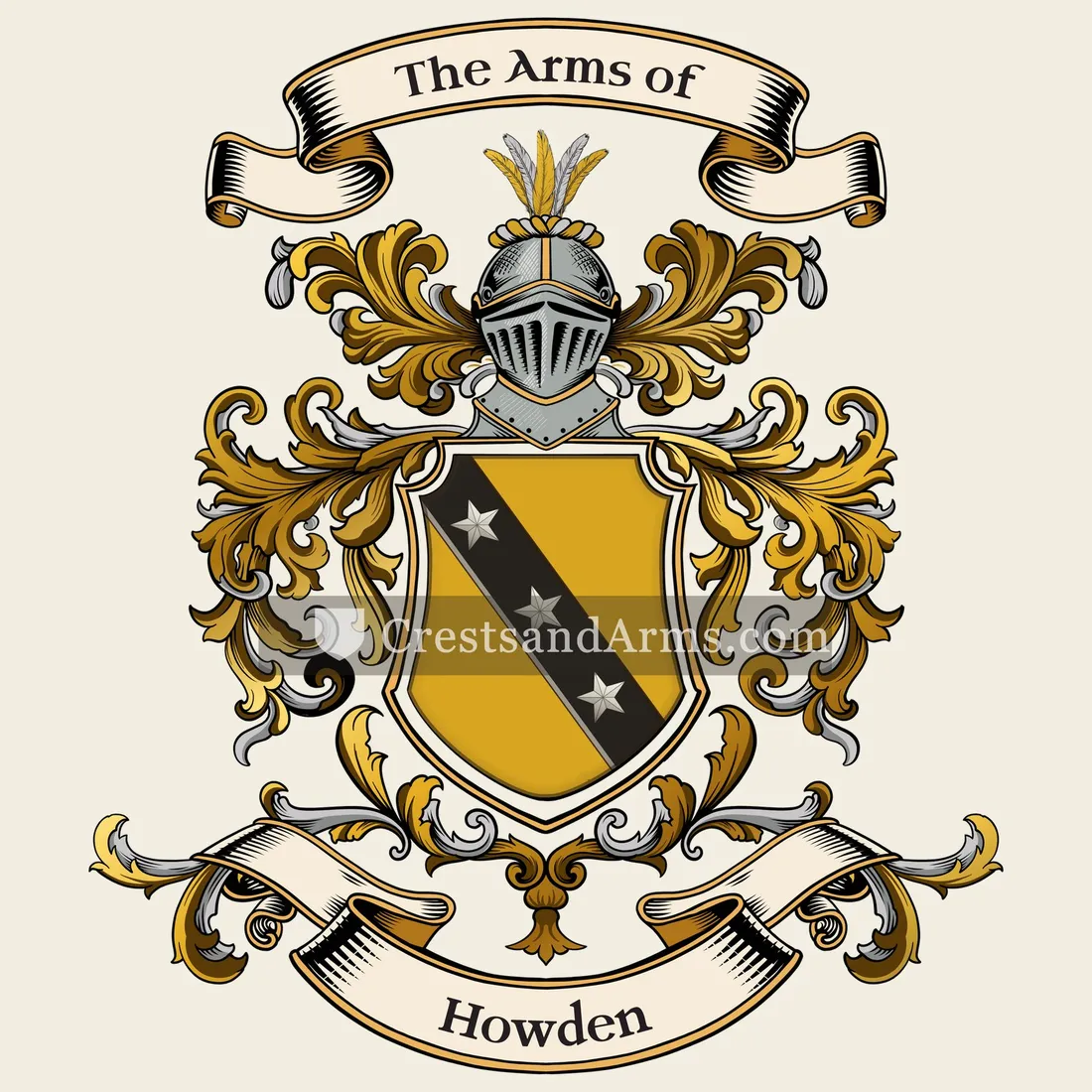
 bendDefence, and the scarf of a commander
 mulletThe third son, and a divine quality from above
 bendDefence, and the scarf of a commander
 mulletThe third son, and a divine quality from above