Map of Germany showing where the Hoy arms are recorded
The Hoy arms were recorded in Augsbourg, c. 1765.
This is where the arms were entered in the register. Families often moved to other parts of the country, so the same name can turn up in more than one region.
The body that granted and recorded arms in Germany in this period.
Francis I, Holy Roman Emperor
Sovereign of the period
Francis I, Holy Roman Emperor
1745–1765
Reigning in Germany when the Hoy arms are first recorded.
How Arms Worked in Germany
In the Holy Roman Empire, coats of arms were often granted to individuals by the Emperor or his representatives. These arms were then passed down through the generations to all legitimate descendants of the original holder. Younger branches of a family usually kept the same shield design without needing to change it, as the arms belonged to the entire lineage.
Granting authority
The Holy Roman Emperor held the sole power to grant new coats of arms throughout his vast imperial territories.
How they got arms
Families typically obtained their coats of arms through a formal imperial grant or by proving their noble status to the authorities.
Where arms were recorded
These grants were officially recorded in the Imperial Chancery registers, which began keeping formal records of such honors during the Middle Ages.
The family's standing
Recorded among the armigerous families of Germany.
Origin & History of the Hoy Family in Germany
The family name Hoy has deep roots in the German-speaking regions of Europe, where it likely originated as a descriptive nickname or a reference to a specific geographic location. By the mid-18th century, the family had established a notable presence in the historic city of Augsburg. In 1765, records confirm that members of the Hoy family were active participants in the social and economic life of this major Bavarian trade hub. During this era, Augsburg was a center for banking and craftsmanship, and families like the Hoys often integrated into the local merchant classes or skilled guilds. The name itself reflects the linguistic evolution of the region, potentially deriving from older Germanic terms related to high ground or specific agricultural markers. As the family moved through the generations in Augsburg, they contributed to the steady growth of the city’s urban population during a time of significant cultural change in the Holy Roman Empire.
Coat of Arms & Family Crest Details
Symbols on this shield
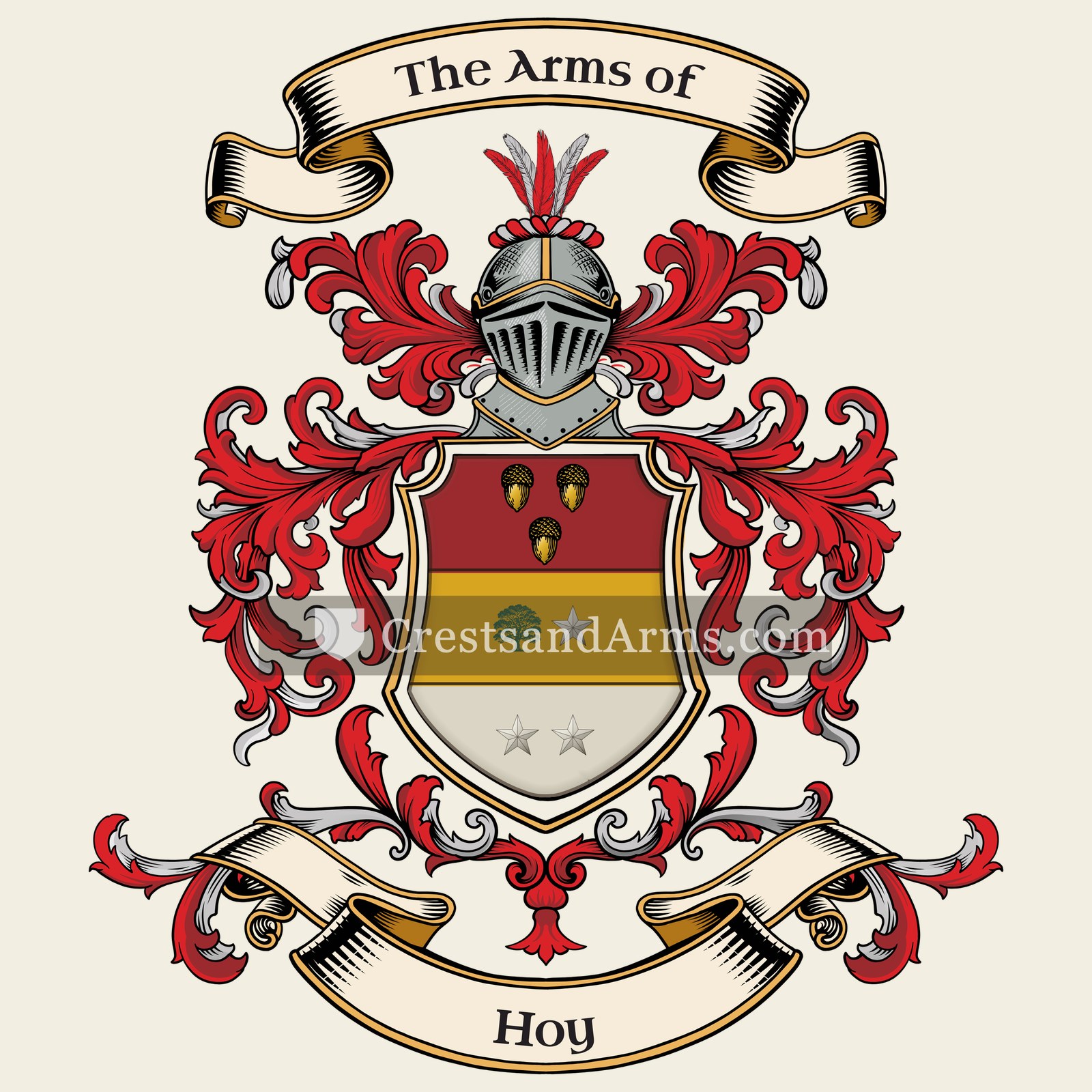
treeLife, endurance and deep roots
acornAntiquity and strength from small beginnings
mulletThe third son, and a divine quality from above
Colours
Red (Gules)Means: Military strength
Gold (Or)Means: Generosity
Silver (Argent)Means: Peace and sincerity
Green (Vert)Means: Hope
Historical info
Source
J. B. Rietstap, Armorial Général, Gouda: G. B. van Goor Zonen, 1884–87
Blazon (the actual original written record)
“De gu. à un chicot de sin., posé en bande, poussant vers le haut trois glands mal-ordonnés d'or aux coques de sin., les tiges du même; le tout acc. de trois étoiles d'arg., 2 dans les cantons de la p. et 1 la base de l'écu. Brl. de gu., d'or et d'arg. C.: un demi-vol, aux armes de l'écu. L.: à dextre d'arg. et de gu., à sen. d'or et de gu”
TyrolTyrol, c. 1577
Digital archive packCoat of arms PNG, gold border print PDF, vector SVG and the certificate of authenticity. Sent to your email in minutes.
Map of Austria showing where the Hoy arms are recorded
The Hoy arms were recorded in Tyrol, c. 1577.
Tyrol was mountain country in western Austria, where the valleys were held by families who had been there a very long time. Old tenure counted for more than money, and old families carried arms.
This is where the arms were entered in the register. Families often moved to other parts of the country, so the same name can turn up in more than one region.
Region
Tyrol
First recorded
1577
Granting Authority for the Hoy Arms
Imperial and Royal chancery
Sodacan · CC BY-SA 3.0
The body that granted and recorded arms in Austria in this period.
Emperor Rudolf II
Sovereign of the period
Emperor Rudolf II
1576–1612
Reigning in Germany when the Hoy arms are first recorded.
How Arms Worked in Austria
Austrian coats of arms were often linked directly to noble titles granted by the Emperor. These symbols belonged to the entire family line rather than just one individual. When a family grew, new branches kept the original design without needing to change it. This system allowed all members of a noble house to share the same identity across many generations.
Granting authority
The Imperial and Royal chancery managed all heraldic matters and controlled the official granting of arms throughout the Austrian lands.
How they got arms
Families typically received their arms through a formal imperial decree that often accompanied the elevation of a person to noble status.
Where arms were recorded
Official records of these grants were kept in the Imperial Register of Nobility which began its formal documentation process in 1453.
The family's standing
Recorded among the armigerous families of Tyrol.
Origin & History of the Hoy Family in Austria
The family name Hoy has deep roots in the rugged landscape of the Austrian Tyrol, where records confirm members of the family were established as early as 1577. During this period, the Tyrol region served as a vital crossroads for trade and cultural exchange between the Italian peninsula and the German-speaking lands. Families living in these high-altitude alpine valleys often identified themselves by their specific homesteads or the unique geographical features of their land. The name Hoy likely emerged as a localized identifier for people living near specific mountain clearings or small settlements within the Inn Valley. As the family grew, they integrated into the local social structure of the Tyrol, participating in the agricultural and civic life that defined the region during the late Renaissance. This early presence in such a historically significant area suggests that the family was well-connected to the shifting political and economic tides of the Austrian Empire.
Coat of Arms & Family Crest Details
Symbols on this shield
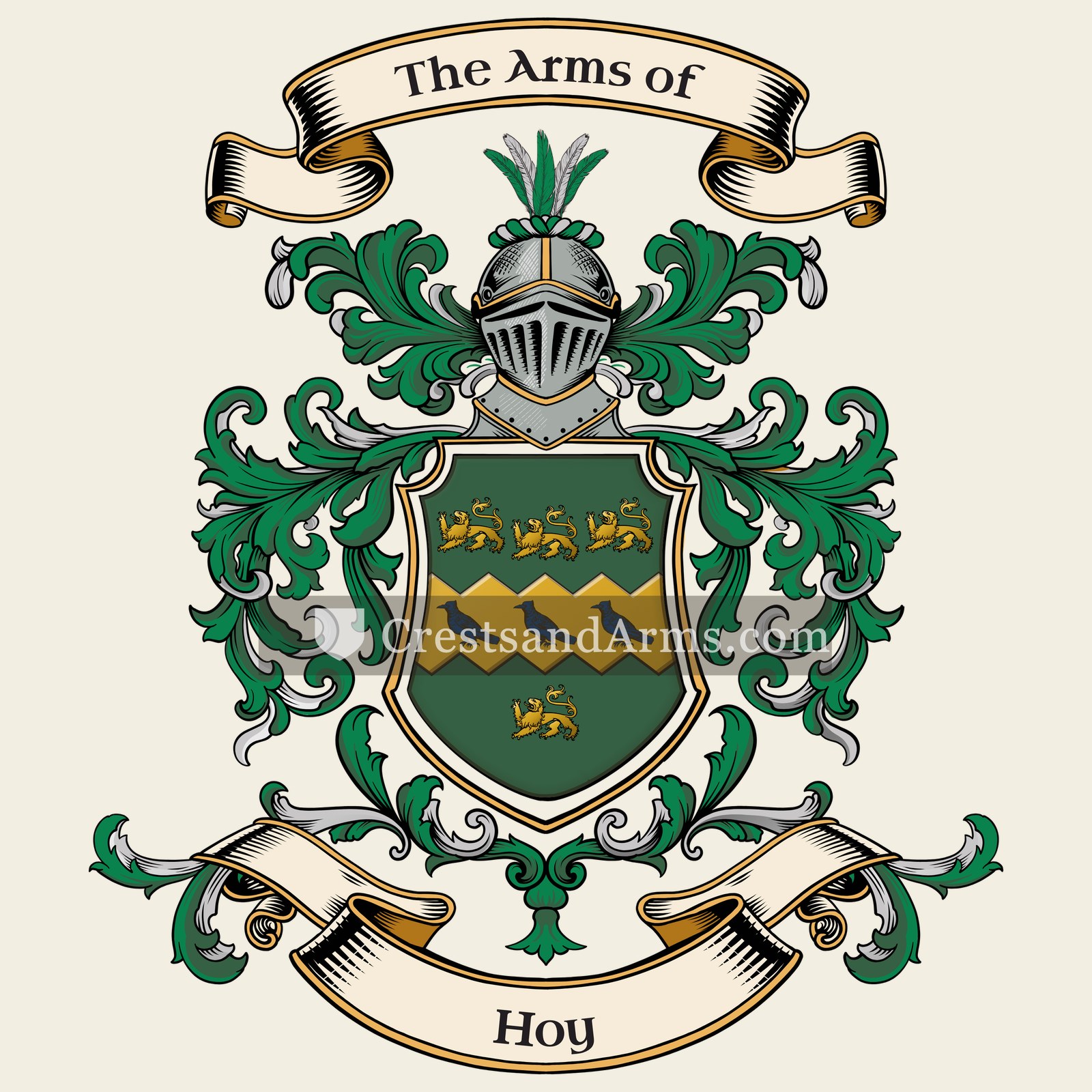
fessThe military belt, and readiness to serve
lionCourage, strength and royalty
dovePeace, love and the Holy Spirit
Colours
Green (Vert)Means: Hope
Gold (Or)Means: Generosity
Blue (Azure)Means: Loyalty and truth
Historical info
Source
Sir Bernard Burke, The General Armory of England, Scotland, Ireland and Wales, London: Harrison & Sons, 1884
Blazon (the actual original written record)
“Vert on a fesse dancettée betw. four lions' heads erased, three in chief and one in base or, three doves az”
SuffolkSuffolk, c. 1620
Digital archive packCoat of arms PNG, gold border print PDF, vector SVG and the certificate of authenticity. Sent to your email in minutes.
Map of England showing where the Hoy arms are recorded
The Hoy arms were recorded in Suffolk, c. 1620.
Suffolk was wool country, and its cloth towns were among the wealthiest in England. Clothier families bought manors with their profits, and holding a manor was the ordinary route to a coat of arms.
This is where the arms were entered in the register. Families often moved to other parts of the country, so the same name can turn up in more than one region.
The body that granted and recorded arms in England in this period.
James VI and I
Sovereign of the period
James VI and I
1603–1625
Reigning in Germany when the Hoy arms are first recorded.
How Arms Worked in England
English heraldry allowed arms to be shared by all legitimate descendants of the original owner. These symbols were treated as personal property that moved through the generations to all children. While the eldest son kept the original design, other family members could use the same shield without needing to change it or register their own unique versions.
Granting authority
The College of Arms in London has regulated the use of coats of arms throughout England and Wales since 1484.
How they got arms
Families typically obtained their coats of arms through a formal grant from the Crown or by proving their ancient right to them.
Where arms were recorded
All official coats of arms are recorded in the registers kept at the College of Arms, which date back to the fifteenth century.
The family's standing
Recorded among the armigerous families of Suffolk.
Origin & History of the Hoy Family in England
The family name Hoy has deep roots in the coastal regions of East Anglia, particularly within the county of Suffolk. By the early seventeenth century, members of the Hoy family were well-established in this area, living as part of the local agrarian and maritime communities. The name itself is thought to be topographical or occupational in origin, likely derived from the Middle English word "hoy," which referred to a small, sturdy type of coastal trading vessel. This suggests that the earliest ancestors to carry the name may have been sailors or merchants who navigated the North Sea. As these families settled into village life in Suffolk by 1620, they became part of the fabric of rural English society, contributing to the local economy and parish life during a period of significant social change. Their presence in these records highlights a history tied to the landscape and the traditional trades that defined the English coastline for generations.
Hoy Meaning & Related Branches
Root word
Hoge
A Middle Low German term referring to a high or elevated place.
This name
HoyA topographical surname for someone who lived on or near a hill or elevated ground.
also spelled
Hoye
Hoey
Hoyy
Hoyie
Related arms
Hoeyvariant spelling
Documented Sources
J. B. Rietstap, Armorial Général, Gouda: G. B. van Goor Zonen, 1884–87
Stadtarchiv Augsburg, Bürgeraufnahmen und Zunftregister der Stadt Augsburg, 1765


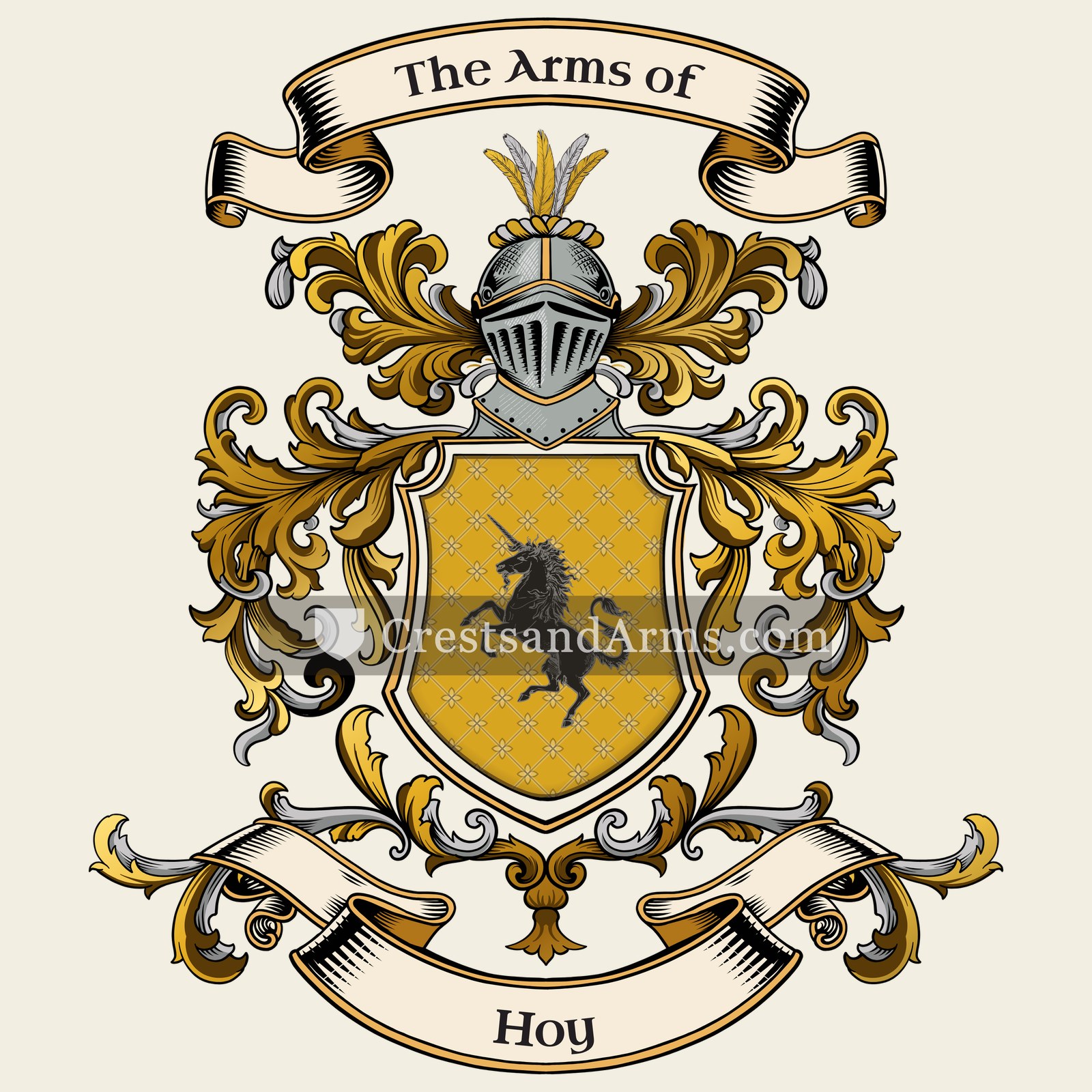
 unicornPurity, and extreme courage in defence of honour
 unicornPurity, and extreme courage in defence of honour


 treeLife, endurance and deep roots
 acornAntiquity and strength from small beginnings
 mulletThe third son, and a divine quality from above


 fessThe military belt, and readiness to serve
 lionCourage, strength and royalty
 dovePeace, love and the Holy Spirit