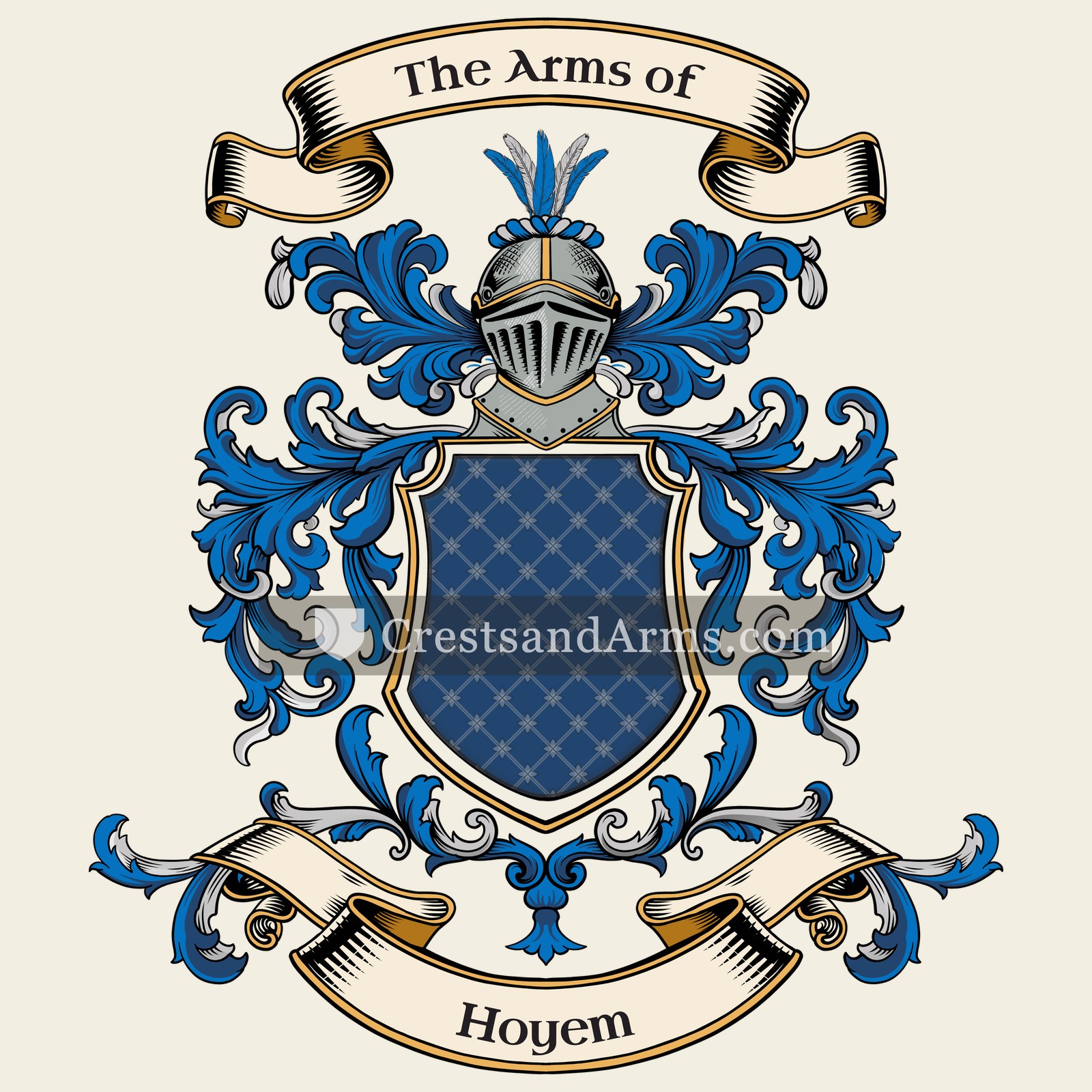
A record of documented arms, meaning and origin, researched for the Hoyem family of Germany.
Reg. 4927 · German, G–I
Coat of Arms & Family Crest Details
Colours
Blue (Azure)Means: Loyalty and truth
Historical info
Source
J. B. Rietstap, Armorial Général, Gouda: G. B. van Goor Zonen, 1884–87
Blazon (the actual original written record)
“D'azur à six burèles d'arg. Cq. cour. C.: un vol, d'arg. et d'azur. S.: deux aigles de Prusse, reg., la poitrine ch. du chiffre entrelacé F. W. R. d'or, surm. d'une couronne royale [Les gentilshommes du nom portent les mêmes armes, sans supports.]”
Germanyc. 1809
Digital archive packCoat of arms PNG, gold border print PDF, vector SVG and the certificate of authenticity. Sent to your email in minutes.
Map of Germany showing where the Hoyem arms are recorded
The Hoyem arms were recorded in Germany, c. 1809.
Arms such as these were typically recorded in Bavaria.
Bavaria was a country of old landed families and walled market towns. Estates passed down the same line for centuries, and both the landowners and the leading townsmen kept arms, which is why so many Bavarian names sit in the registers.
This is where the arms were entered in the register. Families often moved to other parts of the country, so the same name can turn up in more than one region.
The body that granted and recorded arms in Germany in this period.
Frederick William III of Prussia
Sovereign of the period
Frederick William III of Prussia
1797–1840
Reigning in Germany when the Hoyem arms are first recorded.
How Arms Worked in Germany
Prussian heraldry was strictly tied to social rank and noble status rather than being a free choice for every citizen. These symbols were treated as permanent family property that moved through the generations to all legitimate heirs. If a family branch wanted to change their design to stand out, they had to apply for official permission to alter their specific version of the shield.
Granting authority
The Prussian Heroldsamt acted as the central state office that managed and strictly controlled all noble titles and coats of arms.
How they got arms
Families usually obtained their arms through formal royal grants or by proving their long-standing noble status to the state authorities.
Where arms were recorded
All official coats of arms were kept in the rolls of the Prussian Heroldsamt, which functioned from 1706 until 1918.
The family's standing
Recorded among the armigerous families of Germany.
Origin & History of the Hoyem Family in Germany
The family name Hoyem is rooted in the linguistic traditions of Germanic regions, where surnames often evolved from specific geographic locations or local landmarks. By the year 1809, the family was firmly established in Bavaria, a period marked by significant political upheaval as the region transitioned into the Kingdom of Bavaria under the influence of the Napoleonic Wars. During this era, families like the Hoyems were often tied to the land through agricultural labor or localized trades within small village communities. As the administrative systems of the time began to standardize record-keeping, the name became a permanent identifier for families living in the rural districts near the Danube and the foothills of the Alps. This transition from informal naming customs to official census and parish registration helped solidify the Hoyem identity during a time of great change in Central Europe.
Related Branches & Arms
Root word
Hoge
A Middle Low German term for a high place or mound.
This name
HoyemA topographic name for someone who lived on or near a hill or elevated ground.
also spelled
Hoim
Hoyme
Hoymm
Documented Sources
J. B. Rietstap, Armorial Général, Gouda: G. B. van Goor Zonen, 1884–87