Map of Germany showing where the Hoyer arms are recorded
The Hoyer arms were recorded in Holstein, c. 1503.
Holstein was farming country between the North Sea and the Baltic, held in large estates. The same families kept the same land for generations, and generations of holding is what fills a register.
This is where the arms were entered in the register. Families often moved to other parts of the country, so the same name can turn up in more than one region.
The body that granted and recorded arms in Germany in this period.
Maximilian I
Sovereign of the period
Maximilian I
1486–1519
Reigning in Germany when the Hoyer arms are first recorded.
How Arms Worked in Germany
In the Holy Roman Empire, coats of arms were often granted to individuals by the Emperor or his representatives. These arms were then passed down through the generations to all legitimate descendants of the original holder. Younger branches of a family usually kept the same shield design without needing to change it, as the arms belonged to the entire lineage.
Granting authority
The Holy Roman Emperor held the sole power to grant new coats of arms throughout his vast imperial territories.
How they got arms
Families typically obtained their coats of arms through a formal imperial grant or by proving their noble status to the authorities.
Where arms were recorded
These grants were officially recorded in the Imperial Chancery registers, which began keeping formal records of such honors during the Middle Ages.
The family's standing
Recorded among the armigerous families of Holstein.
Origin & History of the Hoyer Family in Germany
The family name Hoyer has deep roots in the northern German region of Holstein, where records confirm members of the family were established as early as 1503. The name itself is derived from the Middle Low German word "hoyer," which historically referred to a person who was a hay merchant or a farmer who dealt in fodder. During the late Middle Ages, the people of Holstein lived in a landscape defined by marshlands and agriculture, making the trade of hay a vital part of the local economy. As the family grew, they became integrated into the social and economic fabric of the region, often serving as landowners or respected members of their local communities. By settling in this specific part of northern Germany, the early Hoyers were part of a long tradition of families who defined their identities through their connection to the land and the essential goods they provided to their neighbors.
Coat of Arms & Family Crest Details
Symbols on this shield
mountThe ground held, and steadfastness upon it
heronPatience and quiet watchfulness
billetThe sealed letter, and a message delivered
lionCourage, strength and royalty
Colours
Red (Gules)Means: Military strength
Black (Sable)Means: Constancy
Silver (Argent)Means: Peace and sincerity
Gold (Or)Means: Generosity
Historical info
Source
J. B. Rietstap, Armorial Général, Gouda: G. B. van Goor Zonen, 1884–87
Blazon (the actual original written record)
“De gu. à une grue d'arg., bq. et m. d'or, avec sa vigilance du sec., sur un tertre de trois coupeaux de sin.; le gu. chapé-ployé de sa., à deux lions affr. d'or, lamp. de gu. Cq. cour. C.: la grue sur le tertre; entre un vol coupé, à dextre d'arg. sur gu., à sen. d'or sur sa. L.: à dextre d'or et de sa., à sen. d'arg. et de gu.”
Austriac. 1633
Digital archive packCoat of arms PNG, gold border print PDF, vector SVG and the certificate of authenticity. Sent to your email in minutes.
Map of Austria showing where the Hoyer arms are recorded
The Hoyer arms were recorded in Austria, c. 1633.
Arms such as these were typically recorded in Tyrol.
Tyrol was mountain country in western Austria, where the valleys were held by families who had been there a very long time. Old tenure counted for more than money, and old families carried arms.
This is where the arms were entered in the register. Families often moved to other parts of the country, so the same name can turn up in more than one region.
Region
Tyrol
First recorded
1633
Granting Authority for the Hoyer Arms
Imperial and Royal chancery
Sodacan · CC BY-SA 3.0
The body that granted and recorded arms in Austria in this period.
Ferdinand II, Holy Roman Emperor
Sovereign of the period
Ferdinand II, Holy Roman Emperor
1619–1637
Reigning in Germany when the Hoyer arms are first recorded.
How Arms Worked in Austria
Austrian coats of arms were often linked directly to noble titles granted by the Emperor. These symbols belonged to the entire family line rather than just one individual. When a family grew, new branches kept the original design without needing to change it. This system allowed all members of a noble house to share the same identity across many generations.
Granting authority
The Imperial and Royal chancery managed all heraldic matters and controlled the official granting of arms throughout the Austrian lands.
How they got arms
Families typically received their arms through a formal imperial decree that often accompanied the elevation of a person to noble status.
Where arms were recorded
Official records of these grants were kept in the Imperial Register of Nobility which began its formal documentation process in 1453.
The family's standing
Recorded among the armigerous families of Austria.
Origin & History of the Hoyer Family in Austria
The surname Hoyer has deep roots in the alpine landscape of Austria, particularly within the rugged terrain of Tyrol. By the year 1633, records confirm that members of the family were already established in this region, likely living as mountain farmers or skilled tradespeople who adapted to the harsh climate of the high valleys. The name itself is thought to derive from the Middle High German word "heuer," which historically referred to a tenant or a person who hired out their labor. This suggests that early ancestors were often hardworking individuals who played a vital role in the local agricultural economy. As they settled into the tight-knit communities of the Tyrol, the family became part of the long-standing tradition of mountain life, where self-sufficiency and resilience were essential for survival. Over the generations, the Hoyer name became woven into the social fabric of the Austrian countryside, reflecting a history defined by steady labor and deep ties to the land.
Coat of Arms & Family Crest Details
Symbols on this shield
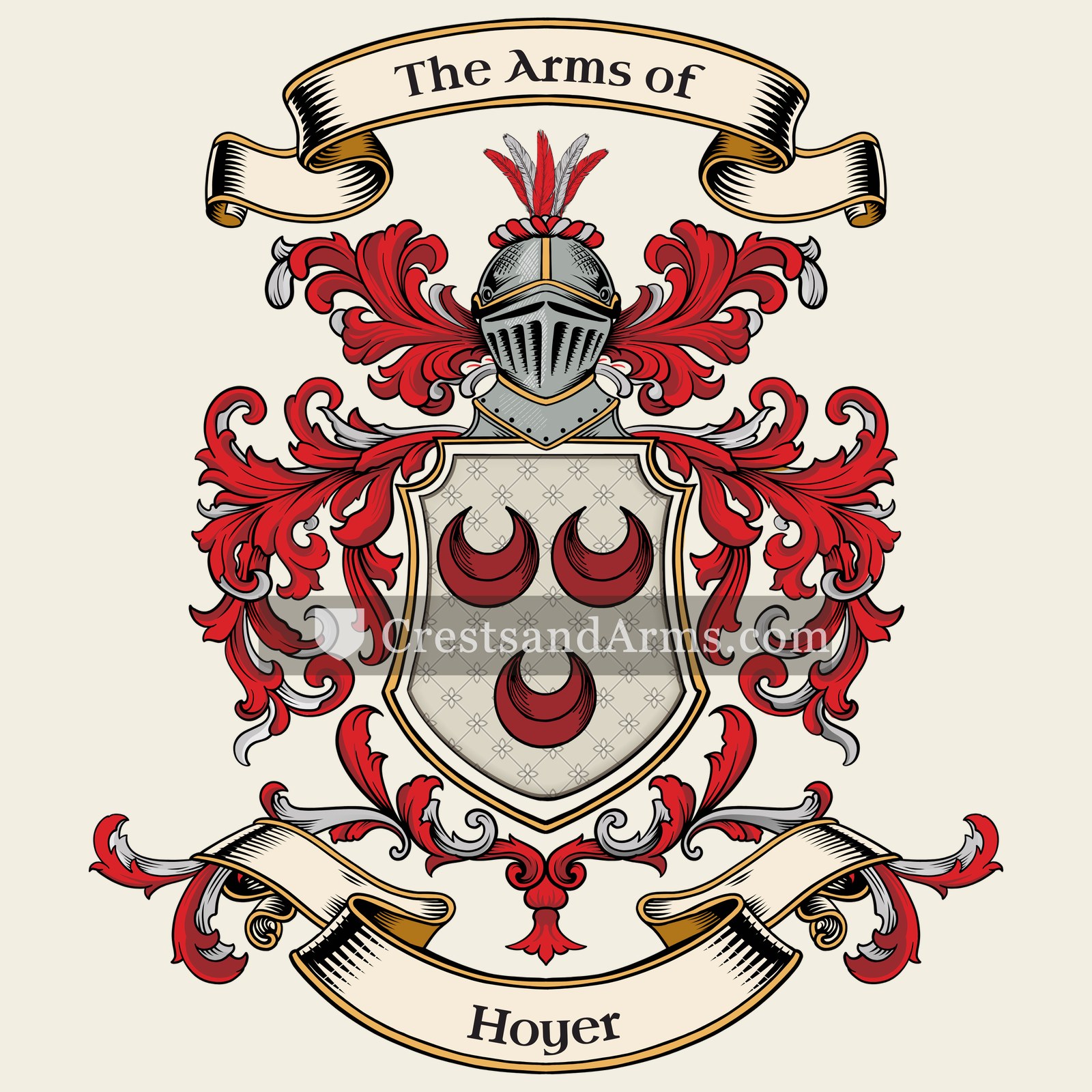
crescentHonour by the sovereign, and the second son
Colours
Silver (Argent)Means: Peace and sincerity
Red (Gules)Means: Military strength
Historical info
Source
J. B. Rietstap, Armorial Général, Gouda: G. B. van Goor Zonen, 1884–87
Blazon (the actual original written record)
“D'arg. à trois croiss. de gu.”
FranceBergzabern Alsace, c. 1663
Digital archive packCoat of arms PNG, gold border print PDF, vector SVG and the certificate of authenticity. Sent to your email in minutes.
Map of France showing where the Hoyer arms are recorded
The Hoyer arms were recorded in Bergzabern Alsace, c. 1663.
This is where the arms were entered in the register. Families often moved to other parts of the country, so the same name can turn up in more than one region.
The body that granted and recorded arms in France in this period.
Louis XIV of France
Sovereign of the period
Louis XIV of France
1643–1715
Reigning in Germany when the Hoyer arms are first recorded.
How Arms Worked in France
In France, a coat of arms was a mark of honor that passed down through the male line to all legitimate descendants. Families often used the same shield without changes to show their shared heritage. If a branch wanted to stand out, they could add a small mark to their shield to show their specific place in the family tree.
Granting authority
The Juge d'armes de France acted as the official authority that regulated and verified coats of arms across the country.
How they got arms
Families typically inherited their arms from ancestors, though they could also receive them through royal grants or by proving their noble status.
Where arms were recorded
Coats of arms were officially recorded in the Armorial Général de France, which began its main collection in the year 1696.
The family's standing
Recorded among the armigerous families of France.
Origin & History of the Hoyer Family in France
The history of the Hoyer family in the Alsace region is deeply connected to the complex political shifts of the seventeenth century. By 1663, records confirm that members of the family were established in the town of Bergzabern. At that time, this area was a crossroads of culture and language, situated within the Holy Roman Empire but heavily influenced by the expansionist policies of the French Kingdom. The name itself likely originated from Germanic roots, often associated with a guardian or a person of high standing in a local community. As the region transitioned through various territorial disputes between France and neighboring powers, families like the Hoyers had to adapt to changing administrative systems and legal requirements. Their presence in Bergzabern during this period highlights the resilience of families who maintained their identity while living in a borderland that frequently changed hands. These early ancestors were likely involved in the agricultural or trade activities that defined the economy of the Rhine valley, allowing them to anchor their family line in the region for generations.
Related Branches & Arms
Root word
Hoger
Derived from the Germanic elements for mind, spirit, or heart.
This name
HoyerAn occupational name for a guardian or a nickname for a thoughtful person.
also spelled
Hoier
Hoyere
Hoyerr
Related arms
Kienitzsimilar arms
Böldigkrecorded with Hoyer, same area
Heyerrecorded with Hoyer, same area
Documented Sources
J. B. Rietstap, Armorial Général, Gouda: G. B. van Goor Zonen, 1884–87
Bahlow, Hans, Deutsches Namenlexikon: Familien- und Vornamen nach Ursprung und Sinn erklärt, 1967
Heintze, Albert, Die deutschen Familiennamen: geschichtlich, geographisch, sprachlich, 1903
Landesarchiv Schleswig-Holstein, Schleswig-Holsteinische Regesten und Urkunden, 1503
Digital archive packCoat of arms PNG, gold border print PDF, vector SVG and the certificate of authenticity. Sent to your email in minutes.


 unicornPurity, and extreme courage in defence of honour
 unicornPurity, and extreme courage in defence of honour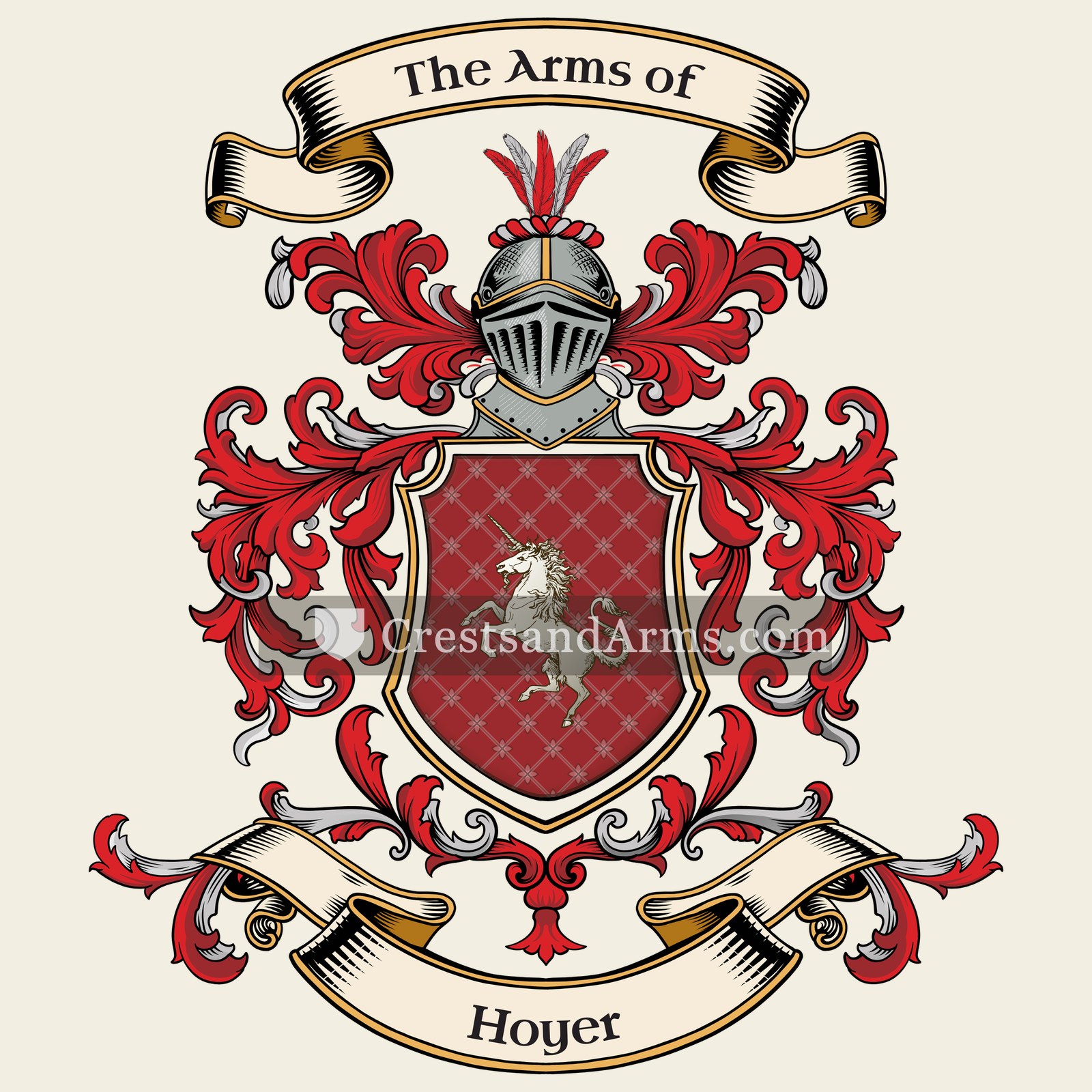


 mountThe ground held, and steadfastness upon it
 heronPatience and quiet watchfulness
 billetThe sealed letter, and a message delivered
 lionCourage, strength and royalty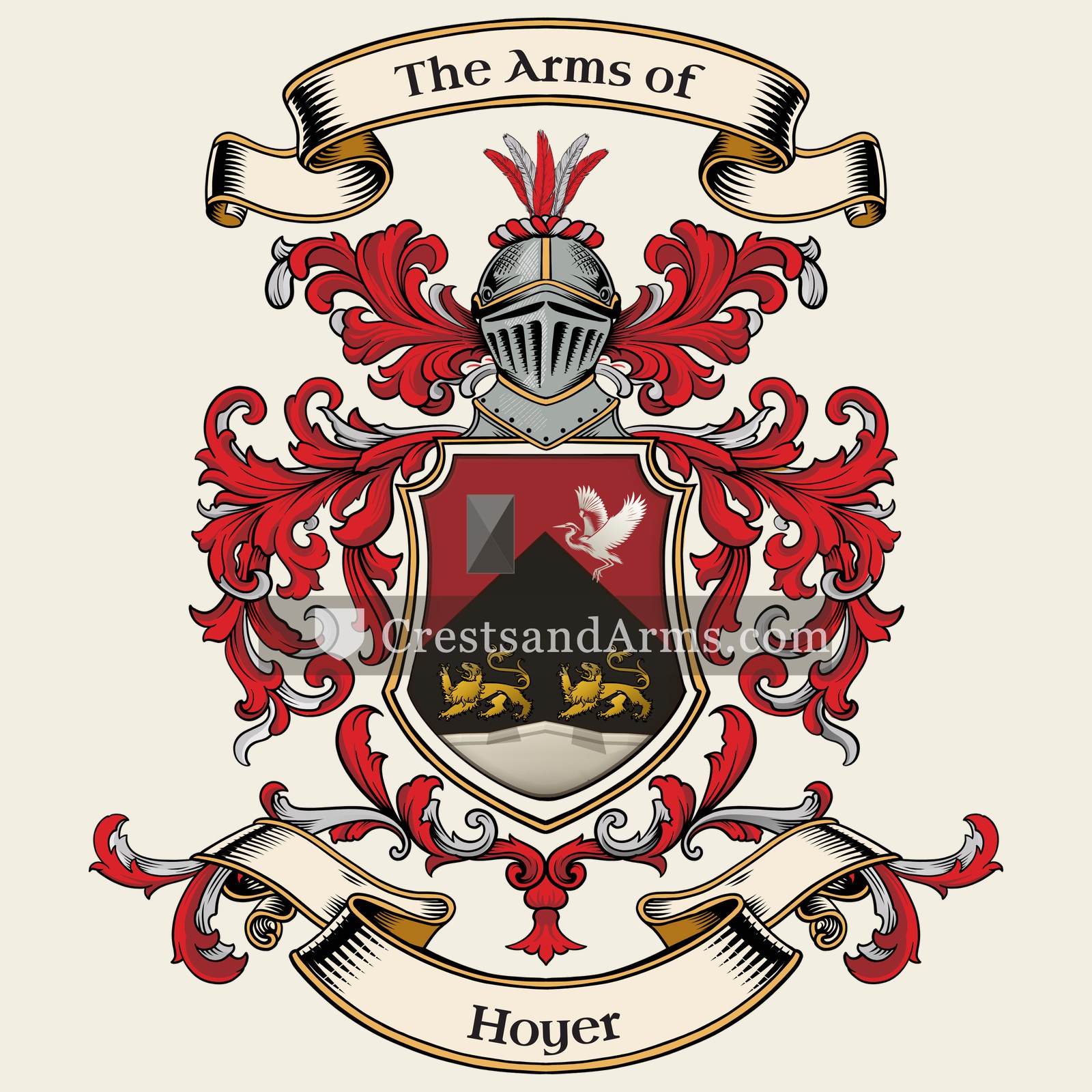


 crescentHonour by the sovereign, and the second son