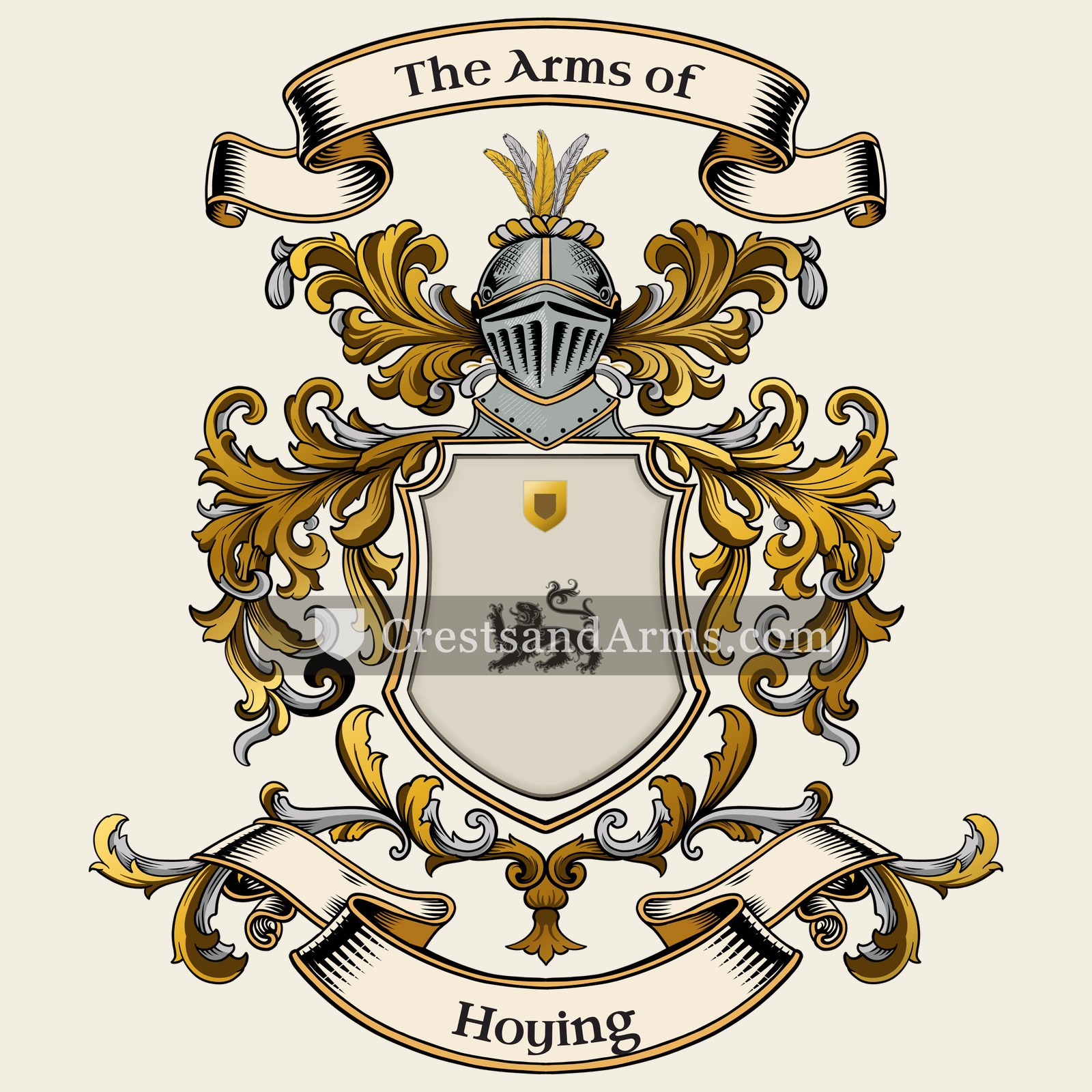
A record of documented arms, meaning and origin, researched for the Hoying family of Netherlands.
Reg. 8914 · Dutch, G–I
Coat of Arms & Family Crest Details
Symbols on this shield
lionCourage, strength and royalty
escutcheonA shield within a shield, and a claim inherited
Colours
Silver (Argent)Means: Peace and sincerity
Black (Sable)Means: Constancy
Gold (Or)Means: Generosity
Historical info
Source
J. B. Rietstap, Armorial Général, Gouda: G. B. van Goor Zonen, 1884–87
Blazon (the actual original written record)
“D'arg. au lion assis de sa., la patte dextre levée, la patte sen. appuyée sur un écusson penché d'or, ch. d'une flèche sans plumes de sa., en pal, le pied fendu.”
NetherlandsAmsterdam, c. 1815
Digital archive packCoat of arms PNG, gold border print PDF, vector SVG and the certificate of authenticity. Sent to your email in minutes.
Map of Netherlands showing where the Hoying arms are recorded
The Hoying arms were recorded in Amsterdam, c. 1815.
This is where the arms were entered in the register. Families often moved to other parts of the country, so the same name can turn up in more than one region.
Region
Amsterdam
Town
Amsterdam
First recorded
1815
Granting Authority for the Hoying Arms
Hoge Raad van Adel
Photograph made by me · CC BY-SA 3.0
The body that granted and recorded arms in Netherlands in this period.
William I of the Netherlands
Sovereign of the period
William I of the Netherlands
1815–1840
Reigning in Netherlands when the Hoying arms are first recorded.
How Arms Worked in Netherlands
In the Netherlands, coats of arms were often used by noble families and those who held specific public offices. These arms were passed down through the generations to legitimate descendants. Younger branches of a family usually kept the original design without needing to add special marks. This system ensured that the family identity remained clear and consistent over many years.
Granting authority
The Hoge Raad van Adel is the official body that regulates and manages noble titles and coats of arms in the Netherlands.
How they got arms
Families typically obtained their coats of arms through official royal grants or by proving their long-standing historical use of the symbols.
Where arms were recorded
Coats of arms are officially recorded in the registers held by the Hoge Raad van Adel, which began its work in 1814.
The family's standing
Recorded among the armigerous families of Netherlands.
Origin & History of the Hoying Family in Netherlands
The family name Hoying has deep roots tied to the urban landscape of the Netherlands during the early nineteenth century. By 1815, records confirm that members of the family were established in Amsterdam, a city that served as a major global hub for trade and migration following the end of the Napoleonic Wars. During this era, the surname likely functioned as a way to identify individuals within a rapidly growing population as the Dutch government began to standardize civil registration processes. Families like the Hoyings often lived in the dense, canal-lined districts of the city, where they participated in the local economy as laborers or craftsmen. This period of history was marked by significant social change, and the presence of the family in Amsterdam suggests they were part of the hardworking urban class that helped rebuild the nation during the transition into the modern Dutch state.
Related Branches & Arms
Root word
Hoge
Derived from the Middle Dutch word for high or tall.
This name
HoyingA topographic name for someone who lived on elevated ground or a high place.
also spelled
Hoyng
Hoying
Documented Sources
J. B. Rietstap, Armorial Général, Gouda: G. B. van Goor Zonen, 1884–87


 lionCourage, strength and royalty
 escutcheonA shield within a shield, and a claim inherited
 lionCourage, strength and royalty
 escutcheonA shield within a shield, and a claim inherited