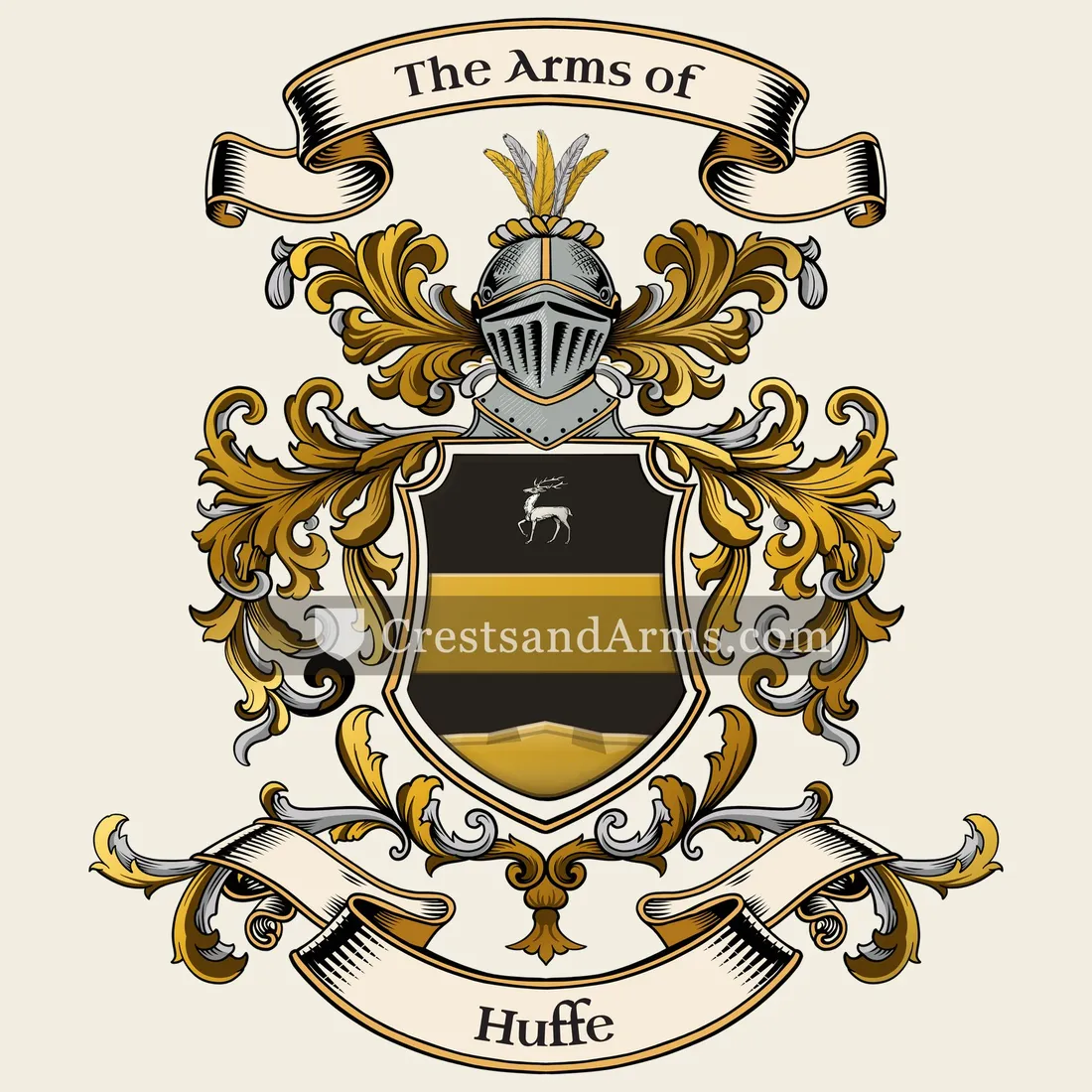
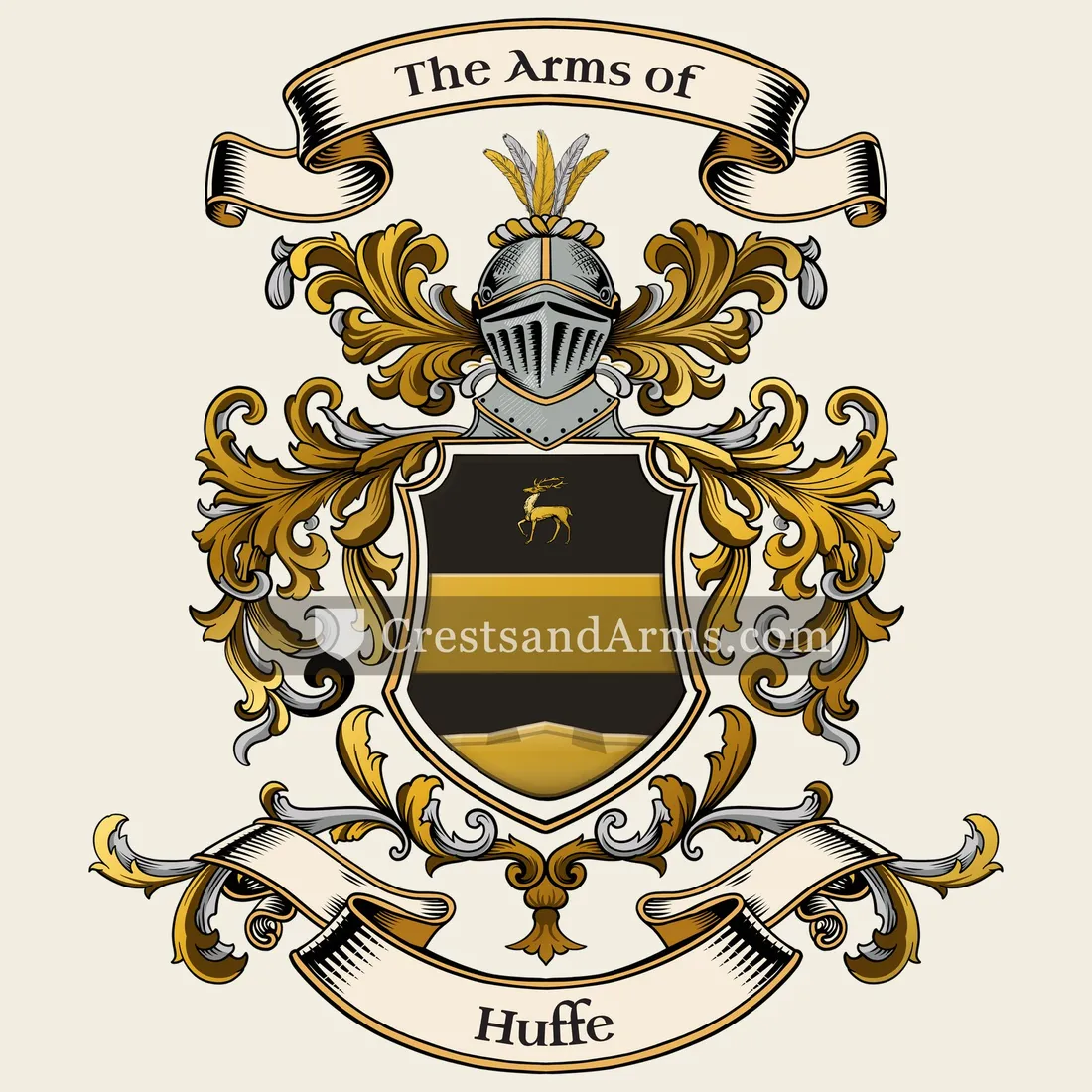
A record of documented arms, meaning and origin, researched for the Huffe family lines. Documented in 2 countries.
Reg. 2604 · Russian, G–I
Meaning of the Huffe family crest colors & symbols
Symbols on this shield
fessThe military belt, and readiness to serve
mountThe ground held, and steadfastness upon it
stagPeace and harmony, and one who will not fight unprovoked
Colours
Black (Sable)Means: Constancy
Gold (Or)Means: Generosity
Historical info
Source
J. B. Rietstap, Armorial Général, Gouda: G. B. van Goor Zonen, 1884–87
Blazon (the actual original written record)
“De sa. à la fasce d'or, acc. en chef d'un cerf naiss. au nat., mouv. de la fasce, et en p. d'un tertre de trois coupeaux d'or, mouv. de la p. Cq. cour. C.: un cerf élancé au nat. L. d'or et de sa. [D'après le diplôme de 1604, le tertre était de sin.]”
Russiac. 1604
Digital archive packCoat of arms PNG, gold border print PDF, vector SVG and the certificate of authenticity. Sent to your email in minutes.
Map of Russia showing where the Huffe arms are recorded
The Huffe arms were recorded in Russia, c. 1604.
Arms such as these were typically recorded in Moscow.
Moscow held the Russian court, and rank there came from service rather than land. Families who served the Tsar were entered in the registers of nobility, and that entry is where their arms are recorded.
This is where the arms were entered in the register. Families often moved to other parts of the country, so the same name can turn up in more than one region.
The body that granted and recorded arms in Russia in this period.
Boris Godunov
Sovereign of the period
Boris Godunov
1598–1605
Reigning in Russia when the Huffe arms are first recorded.
How Arms Worked in Russia
Russian heraldry was strictly tied to the nobility and the state service system. Families proved their ancient status or earned new rank to receive an official grant from the Tsar. These symbols were then inherited by all legitimate children of the noble line. If a family lacked proof of their status, they were often excluded from the official records entirely.
Granting authority
The Herald Master's Office acted as the central state body that strictly regulated and verified all noble heraldic symbols.
How they got arms
Families typically received their arms through a formal state grant or by proving their noble status to the government authorities.
Where arms were recorded
All approved coats of arms were officially recorded in the General Armorial of the Noble Families of the Russian Empire starting in 1797.
The family's standing
Recorded among the armigerous families of Russia.
Origin & History of the Huffe Family in Russia
The history of the Huffe family in Russia begins with their documented presence in Moscow by 1604, a time when the city was a bustling center of trade and political transition. During this era, many families with similar names arrived in Russia from Northern Europe to serve as specialists, merchants, or military advisors to the Tsar. The name likely evolved from Germanic roots, reflecting the movement of people across borders seeking new opportunities in the expanding Russian state. As these early family members settled into the social fabric of Moscow, they integrated into the local administrative and commercial systems. Their survival through the turbulent Time of Troubles suggests that they were adaptable and well-connected within the capital. By establishing themselves in the heart of the Russian Empire, the Huffe family became part of the diverse group of foreign residents who contributed to the development of early modern Moscow.
Meaning of the Huffe family crest colors & symbols
Symbols on this shield
fessThe military belt, and readiness to serve
mountThe ground held, and steadfastness upon it
stagPeace and harmony, and one who will not fight unprovoked
Colours
Black (Sable)Means: Constancy
Gold (Or)Means: Generosity
Historical info
Source
J. B. Rietstap, Armorial Général, Gouda: G. B. van Goor Zonen, 1884–87
Blazon (the actual original written record)
“De sa. à une fasce, acc. en chef d'un cerf naiss., mouv. de la fasce, et en p. d'un tertre de trois coupeaux, le tout d'or. Cq. cour. C.: un cerf élancé d'or [Armes du littérateur Wilhelm Hauff, né le 29 nov. 1802, décédé le 18 sept. 1827.]”
WurttembergWurttemberg, c. 1604
Digital archive packCoat of arms PNG, gold border print PDF, vector SVG and the certificate of authenticity. Sent to your email in minutes.
Map of Germany showing where the Huffe arms are recorded
The Huffe arms were recorded in Wurttemberg, c. 1604.
Wurttemberg was southern German country of small estates and well-off market towns. Both landowners and leading townsmen kept arms there, so the region carries far more names than its size suggests.
This is where the arms were entered in the register. Families often moved to other parts of the country, so the same name can turn up in more than one region.
The body that granted and recorded arms in Germany in this period.
Emperor Rudolf II
Sovereign of the period
Emperor Rudolf II
1576–1612
Reigning in Russia when the Huffe arms are first recorded.
How Arms Worked in Germany
In the Holy Roman Empire, coats of arms were often granted to individuals by the Emperor or his representatives. These arms were then passed down through the generations to all legitimate descendants of the original holder. Younger branches of a family usually kept the same shield design without needing to change it, as the arms belonged to the entire lineage.
Granting authority
The Holy Roman Emperor held the sole power to grant new coats of arms throughout his vast imperial territories.
How they got arms
Families typically obtained their coats of arms through a formal imperial grant or by proving their noble status to the authorities.
Where arms were recorded
These grants were officially recorded in the Imperial Chancery registers, which began keeping formal records of such honors during the Middle Ages.
The family's standing
Recorded among the armigerous families of Wurttemberg.
Origin & History of the Huffe Family in Germany
The family name Huffe finds its roots in the southwestern region of Germany, specifically within the historic territory of Württemberg. By the early 17th century, records confirm that members of the family were firmly established in this area by 1604. During this period, Württemberg was a landscape defined by small agricultural villages and a complex system of local governance. Families like the Huffes were typically tied to the land, often working as farmers or skilled tradespeople who contributed to the local economy of the duchy. Life in the region during the early 1600s was shaped by the transition from the Renaissance to the challenging years of the Thirty Years' War, which began shortly after the family was first documented. As residents of a German-speaking territory, the early Huffes lived through a time of significant social change, where community identity was closely linked to local parish records and the administration of the ruling House of Württemberg.
Huffe Meaning & Related Branches
Root word
Hof
A German term referring to a farmstead, courtyard, or manor.
This name
HuffeA topographic surname identifying someone who lived or worked on a farm or estate.
also spelled
Hauf
Howf
Documented Sources
J. B. Rietstap, Armorial Général, Gouda: G. B. van Goor Zonen, 1884–87
Bogoiavlenskii, S. K., Moskovskii prikaznyi apparat i deloproizvodstvo XVI-XVII vekov, 2006
Russian State Archive of Ancient Acts (RGADA), Fond 141: Prikaznye dela novykh let, 1604
Digital archive packCoat of arms PNG, gold border print PDF, vector SVG and the certificate of authenticity. Sent to your email in minutes.


 fessThe military belt, and readiness to serve
 mountThe ground held, and steadfastness upon it
 stagPeace and harmony, and one who will not fight unprovoked
 fessThe military belt, and readiness to serve
 mountThe ground held, and steadfastness upon it
 stagPeace and harmony, and one who will not fight unprovoked