Map of Netherlands showing where the Huffman arms are recorded
The Huffman arms were recorded in Amsterdam, c. 1815.
This is where the arms were entered in the register. Families often moved to other parts of the country, so the same name can turn up in more than one region.
Region
Amsterdam
Town
Amsterdam
First recorded
1815
Granting Authority for the Huffman Arms
Hoge Raad van Adel
Photograph made by me · CC BY-SA 3.0
The body that granted and recorded arms in Netherlands in this period.
William I of the Netherlands
Sovereign of the period
William I of the Netherlands
1815–1840
Reigning in Netherlands when the Huffman arms are first recorded.
How Arms Worked in Netherlands
In the Netherlands, coats of arms were often used by noble families and those who held specific public offices. These arms were passed down through the generations to legitimate descendants. Younger branches of a family usually kept the original design without needing to add special marks. This system ensured that the family identity remained clear and consistent over many years.
Granting authority
The Hoge Raad van Adel is the official body that regulates and manages noble titles and coats of arms in the Netherlands.
How they got arms
Families typically obtained their coats of arms through official royal grants or by proving their long-standing historical use of the symbols.
Where arms were recorded
Coats of arms are officially recorded in the registers held by the Hoge Raad van Adel, which began its work in 1814.
The family's standing
Recorded among the armigerous families of Netherlands.
Origin & History of the Huffman Family in Netherlands
The surname Huffman is a variation of the Germanic name Hoffmann, which originally served as a descriptive title for a steward or a manager of a farmstead. By the time the family was documented in Amsterdam in 1815, the name had evolved through regional dialects and migration patterns across Northern Europe. During the early 19th century, Amsterdam was a bustling center of trade and social transition following the end of the Napoleonic era. Families arriving or residing in the city during this period often integrated into the local merchant and artisan classes, contributing to the urban growth of the Netherlands. The presence of the Huffman name in these official city records highlights the movement of families across borders as they sought new economic opportunities in the growing Dutch capital. This period of history reflects a time when surnames became more firmly established in legal documents, allowing us to trace the family’s integration into the social fabric of the Netherlands.
Coat of Arms & Family Crest Details
Symbols on this shield
lozengeHonour and nobility, and the arms of a woman
Colours
ErmineMeans: Dignity
Red (Gules)Means: Military strength
Historical info
Source
J. B. Rietstap, Armorial Général, Gouda: G. B. van Goor Zonen, 1884–87
Blazon (the actual original written record)
“D'herm. à trois los. de gu. C.: une tour au nat., et un femme, iss. de la tour, hab. d'azur, tenant de sa main dextre une couronne de laurier de sin.”
Britainc. 1700
Digital archive packCoat of arms PNG, gold border print PDF, vector SVG and the certificate of authenticity. Sent to your email in minutes.
Map of Britain showing where the Huffman arms are recorded
The Huffman arms were recorded in Britain, c. 1700.
Arms such as these were typically recorded in Kent.
Kent sits between London and the short crossing to Europe, and the trade passing through made it wealthy. Merchant families bought land with that money, and it was landowners who took coats of arms.
This is where the arms were entered in the register. Families often moved to other parts of the country, so the same name can turn up in more than one region.
The body that granted and recorded arms in Britain in this period.
William III of England
Sovereign of the period
William III of England
1694–1702
Reigning in Netherlands when the Huffman arms are first recorded.
How Arms Worked in Britain
English heraldry allowed arms to be shared by all legitimate descendants of the original owner. These symbols were treated as personal property that moved through the generations to all children. While the eldest son kept the original design, other family members could use the same shield without needing to change it or register their own unique versions.
Granting authority
The College of Arms in London has regulated the use of coats of arms throughout England and Wales since 1484.
How they got arms
Families typically obtained their coats of arms through a formal grant from the Crown or by proving their ancient right to them.
Where arms were recorded
All official coats of arms are recorded in the registers kept at the College of Arms, which date back to the fifteenth century.
The family's standing
Recorded among the armigerous families of Britain.
Origin & History of the Huffman Family in Britain
The family name Huffman traces its roots to the Germanic linguistic tradition, where it likely originated as a descriptive name for someone who lived on a farm or managed a homestead. While the name is deeply connected to continental Europe, records confirm that members of the family were established in the county of Kent, England, by the year 1700. During this period, Kent served as a vital gateway for trade and migration between England and the European mainland. The presence of the family in this region suggests they were part of a wave of settlers who integrated into the local agricultural and merchant communities of southeastern England. As they settled in Kent, these early family members adapted to the local social structures, contributing to the diverse cultural landscape of the English countryside during the turn of the eighteenth century.
Coat of Arms & Family Crest Details
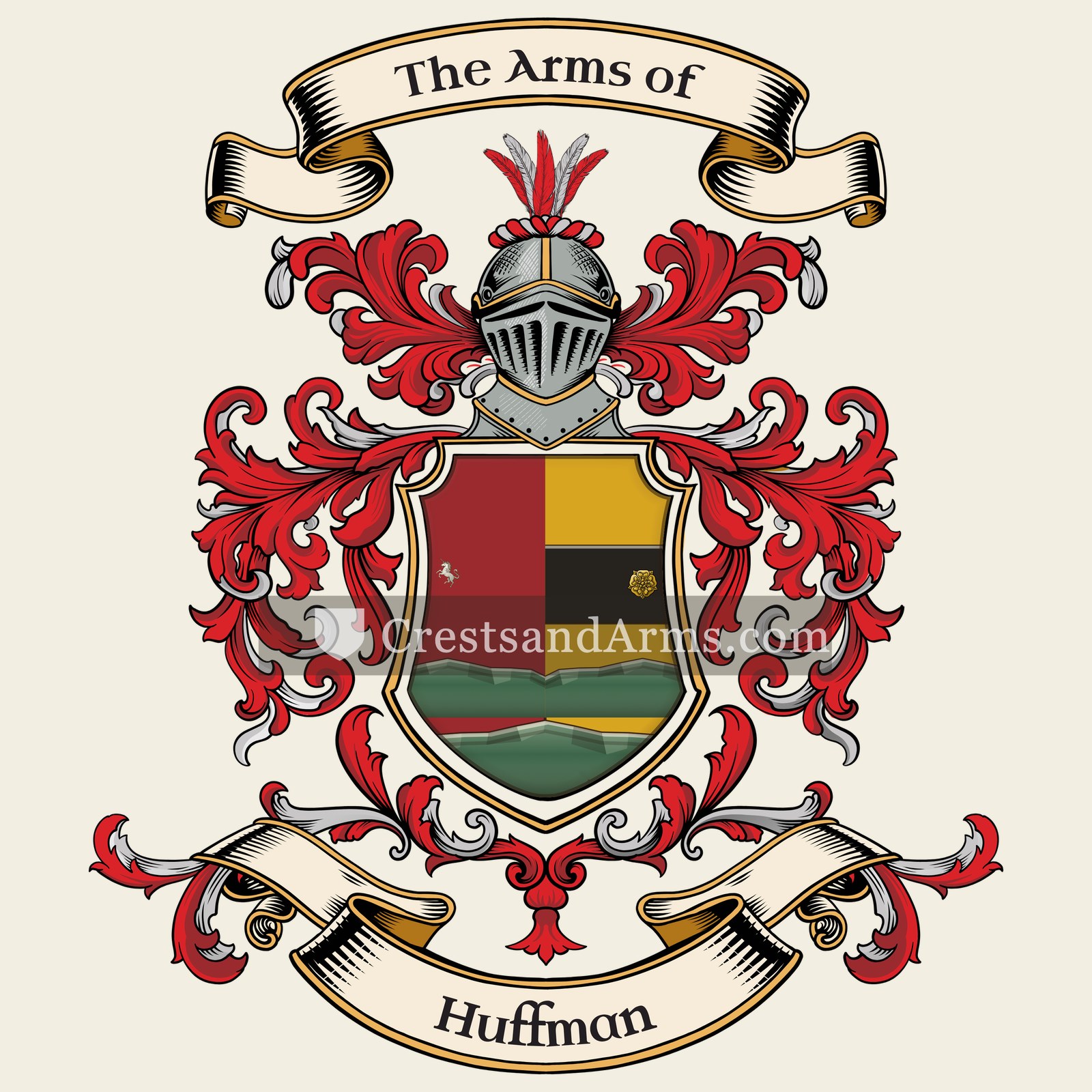
Symbols on this shield
mountThe ground held, and steadfastness upon it
fessThe military belt, and readiness to serve
unicornPurity, and extreme courage in defence of honour
roseThe seventh son, and beauty with grace
Colours
Red (Gules)Means: Military strength
Gold (Or)Means: Generosity
Green (Vert)Means: Hope
Black (Sable)Means: Constancy
Silver (Argent)Means: Peace and sincerity
Historical info
Source
J. B. Rietstap, Armorial Général, Gouda: G. B. van Goor Zonen, 1884–87
Blazon (the actual original written record)
“Parti: au 1 de gu. à une licorne ramp. d'arg., soutenue d'une terrasse de sin.; au 2 d'or à la fasce de sa., ch. d'une rose d'or. Cq. cour. C.: un chevalier iss., arm. d'arg., au baudrier de gu., le casque panaché, tenant une épée. L.: à dextre d'or et de sa., à sen. d'arg. et de gu.”
Germanyc. 1765
Digital archive packCoat of arms PNG, gold border print PDF, vector SVG and the certificate of authenticity. Sent to your email in minutes.
Map of Germany showing where the Huffman arms are recorded
The Huffman arms were recorded in Germany, c. 1765.
Arms such as these were typically recorded in Bavaria.
Bavaria was a country of old landed families and walled market towns. Estates passed down the same line for centuries, and both the landowners and the leading townsmen kept arms, which is why so many Bavarian names sit in the registers.
This is where the arms were entered in the register. Families often moved to other parts of the country, so the same name can turn up in more than one region.
The body that granted and recorded arms in Germany in this period.
Francis I, Holy Roman Emperor
Sovereign of the period
Francis I, Holy Roman Emperor
1745–1765
Reigning in Netherlands when the Huffman arms are first recorded.
How Arms Worked in Germany
In the Holy Roman Empire, coats of arms were often granted to individuals by the Emperor or his representatives. These arms were then passed down through the generations to all legitimate descendants of the original holder. Younger branches of a family usually kept the same shield design without needing to change it, as the arms belonged to the entire lineage.
Granting authority
The Holy Roman Emperor held the sole power to grant new coats of arms throughout his vast imperial territories.
How they got arms
Families typically obtained their coats of arms through a formal imperial grant or by proving their noble status to the authorities.
Where arms were recorded
These grants were officially recorded in the Imperial Chancery registers, which began keeping formal records of such honors during the Middle Ages.
The family's standing
Recorded among the armigerous families of Germany.
Origin & History of the Huffman Family in Germany
The name Huffman originates from the German language and serves as a descriptive surname that highlights the social status of early ancestors. It is derived from the Middle High German words "hof," meaning a farm or court, and "man," meaning a person. Historically, this name identified someone who owned or managed a farmstead, or perhaps a person who served at a noble estate. By the time records confirm the presence of the family in Bavaria in 1765, the name had become a well-established way to distinguish rural landowners from those living in urban centers. These early families were likely deeply rooted in the agricultural traditions of the Bavarian countryside, where they played a vital role in the local economy and community life. Over generations, the name evolved from a simple occupational description into a permanent family identifier that was passed down through the centuries.
Huffman Meaning & Related Branches
Root word
Hofman
A person who manages or works on a farm or estate.
This name
HuffmanAn occupational surname for a steward, farm manager, or court official.
also spelled
Hofman
Documented Sources
J. B. Rietstap, Armorial Général, Gouda: G. B. van Goor Zonen, 1884–87
Amsterdam City Archives (Stadsarchief Amsterdam), Burgerlijke Stand (Civil Registry), 1815
Debrabandere, Frans, Woordenboek van de familienamen in België en Noord-Frankrijk, 2003
Winkler, Johan, De Nederlandsche geslachtsnamen in oorsprong, geschiedenis en beteekenis, 1885
Digital archive packCoat of arms PNG, gold border print PDF, vector SVG and the certificate of authenticity. Sent to your email in minutes.


 bendDefence, and the scarf of a commander
 roseThe seventh son, and beauty with grace
 bendDefence, and the scarf of a commander
 roseThe seventh son, and beauty with grace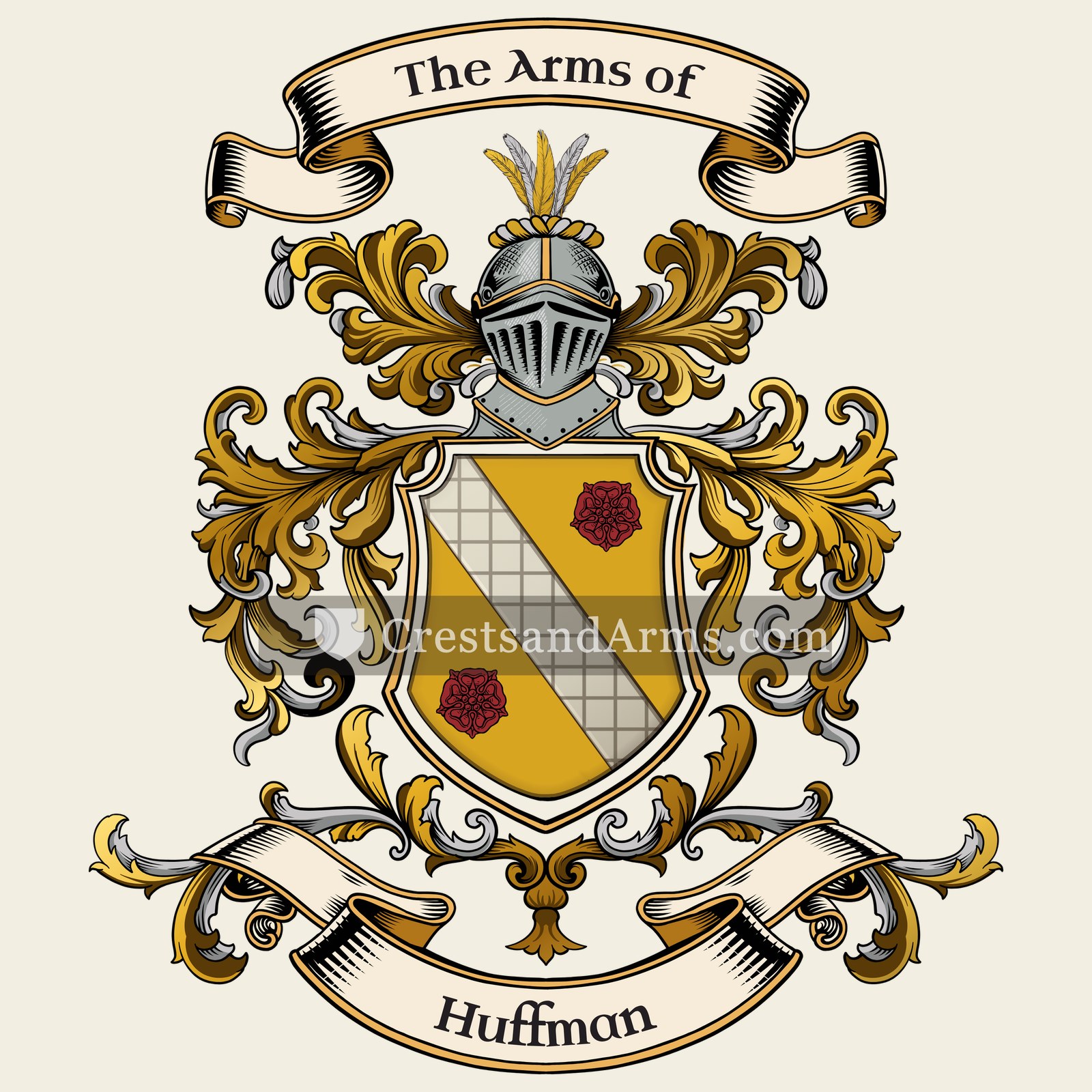


 lozengeHonour and nobility, and the arms of a woman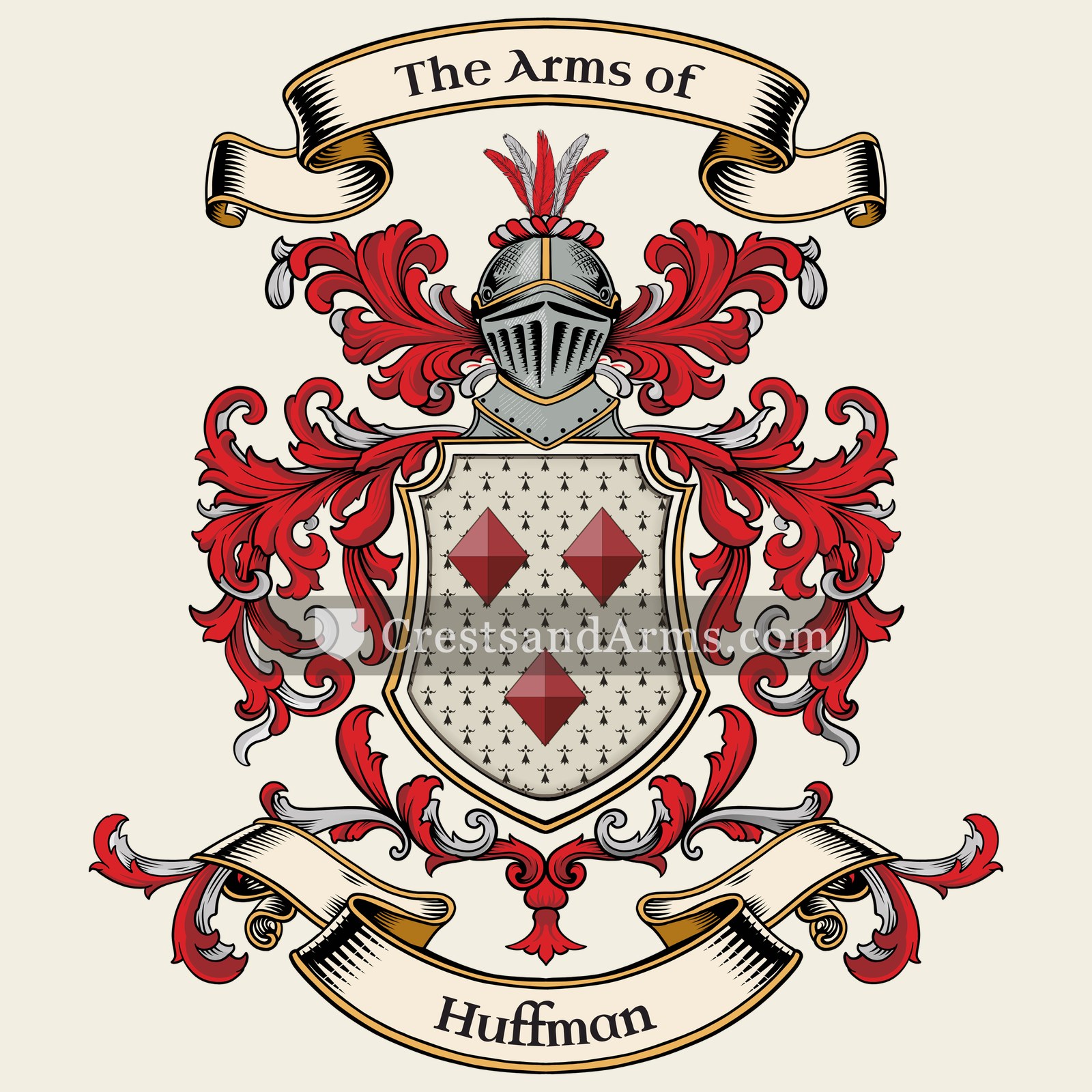


 mountThe ground held, and steadfastness upon it
 fessThe military belt, and readiness to serve
 unicornPurity, and extreme courage in defence of honour