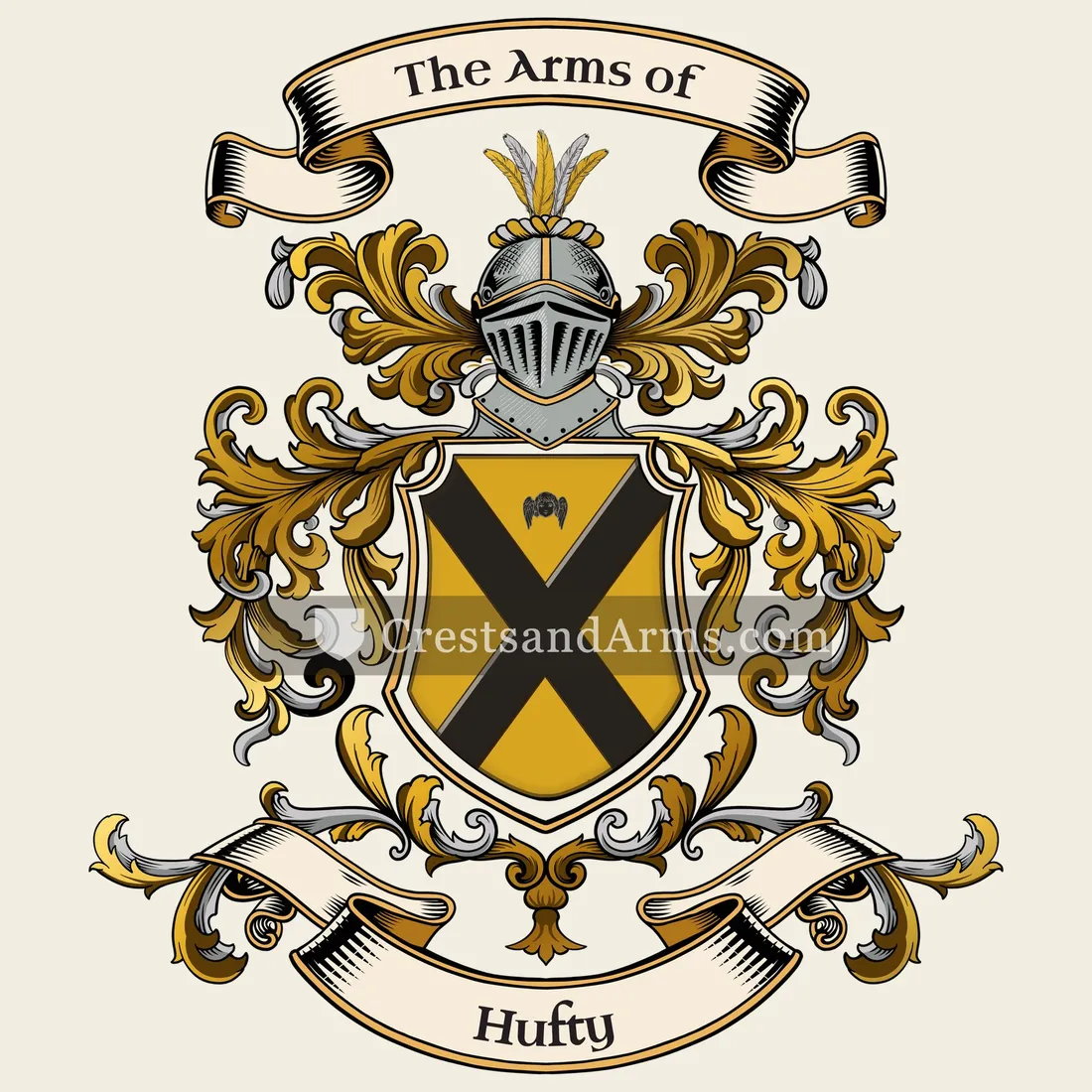
A record of documented arms, meaning and origin, researched for the Hufty family of Germany.
Reg. 5440 · German, G–I
Meaning of the Hufty family crest colors & symbols
Symbols on this shield
saltireResolution, and St Andrew's cross
cherubDivine protection over the innocent
Colours
Gold (Or)Means: Generosity
Black (Sable)Means: Constancy
Historical info
Source
J. B. Rietstap, Armorial Général, Gouda: G. B. van Goor Zonen, 1884–87
Blazon (the actual original written record)
“D'or au saut. de sa., acc. en chef d'une tête d'ange du même. C.: un écusson des armes, entre un vol, coupé alt. de sa. et d'or [Branche de la fam. Hoeufft.]”
GermanyCologne, c. 1765
Digital archive packCoat of arms PNG, gold border print PDF, vector SVG and the certificate of authenticity. Sent to your email in minutes.
Map of Germany showing where the Hufty arms are recorded
The Hufty arms were recorded in Cologne, c. 1765.
This is where the arms were entered in the register. Families often moved to other parts of the country, so the same name can turn up in more than one region.
The body that granted and recorded arms in Germany in this period.
Francis I, Holy Roman Emperor
Sovereign of the period
Francis I, Holy Roman Emperor
1745–1765
Reigning in Germany when the Hufty arms are first recorded.
How Arms Worked in Germany
In the Holy Roman Empire, coats of arms were often granted to individuals by the Emperor or his representatives. These arms were then passed down through the generations to all legitimate descendants of the original holder. Younger branches of a family usually kept the same shield design without needing to change it, as the arms belonged to the entire lineage.
Granting authority
The Holy Roman Emperor held the sole power to grant new coats of arms throughout his vast imperial territories.
How they got arms
Families typically obtained their coats of arms through a formal imperial grant or by proving their noble status to the authorities.
Where arms were recorded
These grants were officially recorded in the Imperial Chancery registers, which began keeping formal records of such honors during the Middle Ages.
The family's standing
Recorded among the armigerous families of Germany.
Origin & History of the Hufty Family in Germany
The family name Hufty is deeply rooted in the historical landscape of the Rhineland, with documented records confirming the presence of family members in Cologne by 1765. During this period, Cologne served as a vital center for trade and craftsmanship, and families like the Huftys were often integrated into the city’s bustling urban economy. The name itself likely evolved from regional dialects common in western Germany, where surnames were frequently derived from specific occupations, physical characteristics, or local geographic markers. As residents of a major hub along the Rhine River, early members of the family would have experienced the significant social and political shifts of the eighteenth century, including the transition toward industrialization and the changing administrative structures of the Holy Roman Empire. By maintaining a presence in such a prominent city, the family participated in the long-standing tradition of German urban life that defined the region for centuries.
Hufty Meaning & Related Branches
Root word
Huft
A German term referring to the hip or haunch of a body.
This name
HuftyA topographic or descriptive surname likely identifying someone with a prominent hip or gait.
also spelled
Heufft
Heufte
Heuff
Documented Sources
J. B. Rietstap, Armorial Général, Gouda: G. B. van Goor Zonen, 1884–87
Historisches Archiv der Stadt Köln, Bürgeraufnahmen und Zunftregister der Stadt Köln, 1760–1770
Stehkämper, Hugo, Geschichte der Stadt Köln: Von der Römerzeit bis zur Gegenwart, 2004
Digital archive packCoat of arms PNG, gold border print PDF, vector SVG and the certificate of authenticity. Sent to your email in minutes.


 saltireResolution, and St Andrew's cross
 cherubDivine protection over the innocent
 saltireResolution, and St Andrew's cross
 cherubDivine protection over the innocent