Map of Britain showing where the Hughes arms are recorded
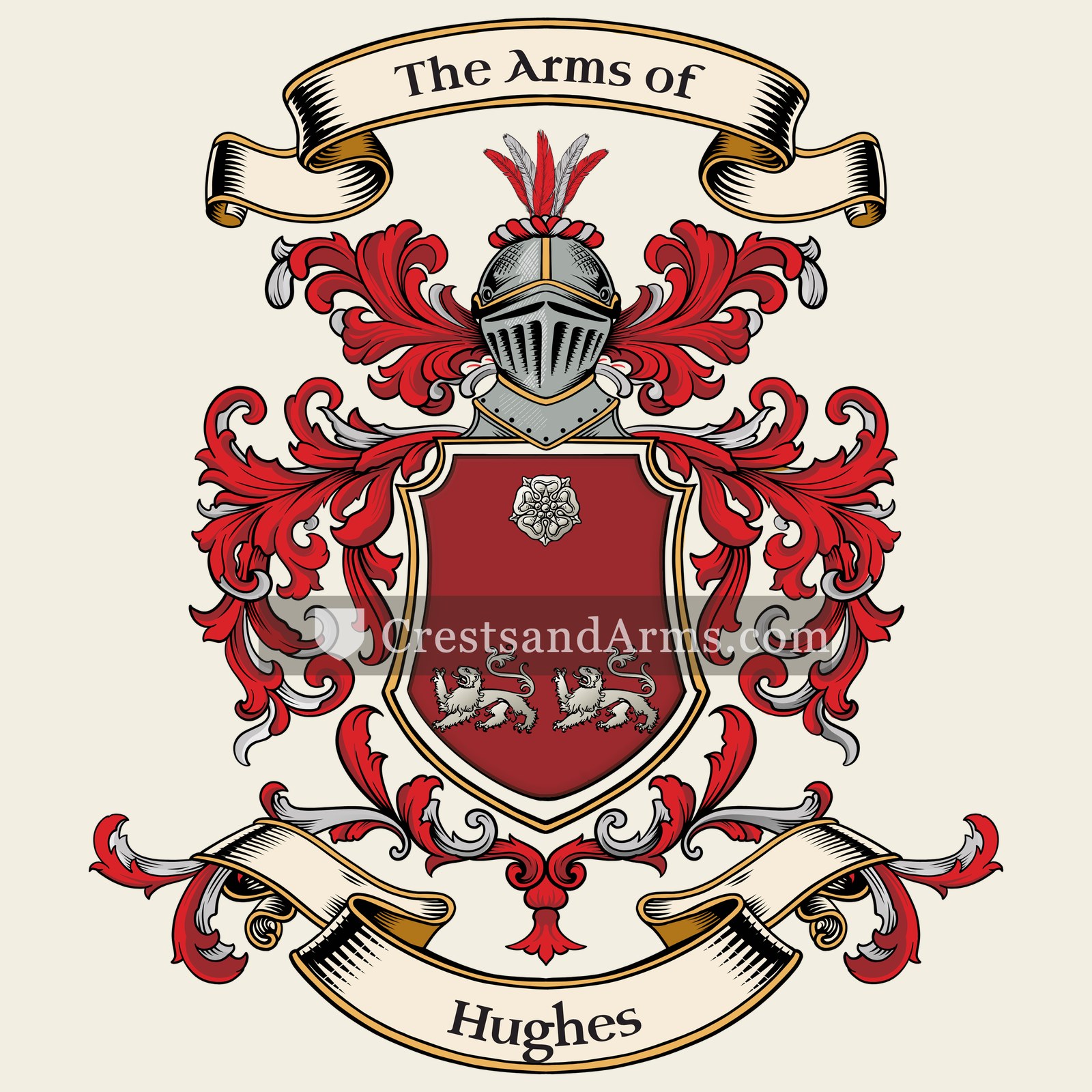
The Hughes arms were recorded in Suffolk, c. 1773.
Suffolk was wool country, and its cloth towns were among the wealthiest in England. Clothier families bought manors with their profits, and holding a manor was the ordinary route to a coat of arms.
This is where the arms were entered in the register. Families often moved to other parts of the country, so the same name can turn up in more than one region.
The body that granted and recorded arms in Britain in this period.
George III of Great Britain
Sovereign of the period
George III of Great Britain
1760–1801
Reigning in Britain when the Hughes arms are first recorded.
How Arms Worked in Britain
English heraldry allowed arms to be shared by all legitimate descendants of the original owner. These symbols were treated as personal property that moved through the generations to all children. While the eldest son kept the original design, other family members could use the same shield without needing to change it or register their own unique versions.
Granting authority
The College of Arms in London has regulated the use of coats of arms throughout England and Wales since 1484.
How they got arms
Families typically obtained their coats of arms through a formal grant from the Crown or by proving their ancient right to them.
Where arms were recorded
All official coats of arms are recorded in the registers kept at the College of Arms, which date back to the fifteenth century.
The family's standing
Recorded among the armigerous families of Suffolk.
Origin & History of the Hughes Family in Britain
The surname Hughes is a patronymic name, meaning it was originally derived from the first name of a father or ancestor. It comes from the ancient Germanic name Hugh, which translates to heart, mind, or spirit. After the Norman Conquest of 1066, the name became very popular across Britain because of its association with nobility and saints. Over several centuries, families bearing this name settled in various regions, including Suffolk, where records confirm their presence by 1773. During this era, families often lived in rural communities and worked in trades or agriculture. Because the name was based on a common first name, it emerged independently in many different locations rather than originating from a single household. This widespread use allowed the name to become firmly established in the social and historical landscape of the British Isles long before the eighteenth century.
Coat of Arms & Family Crest Details
Symbols on this shield
lionCourage, strength and royalty
roseThe seventh son, and beauty with grace
Colours
Red (Gules)Means: Military strength
Silver (Argent)Means: Peace and sincerity
Historical info
Source
Sir Bernard Burke, The General Armory of England, Scotland, Ireland and Wales, London: Harrison & Sons, 1884
Blazon (the actual original written record)
“Gu. two lions pass. and a rose in chief ar. Crest (granted by St. George, Norroy, 1620, to WILLIAM HUGHES, Esq., of Llewerllyd)—Out of a coronet or, a demi lion ar. holding a rose gu. stem and leaves vert”
FlintLlewerllyd · Flint, c. 1620
Digital archive packCoat of arms PNG, gold border print PDF, vector SVG and the certificate of authenticity. Sent to your email in minutes.
Map of Wales showing where the Hughes arms are recorded
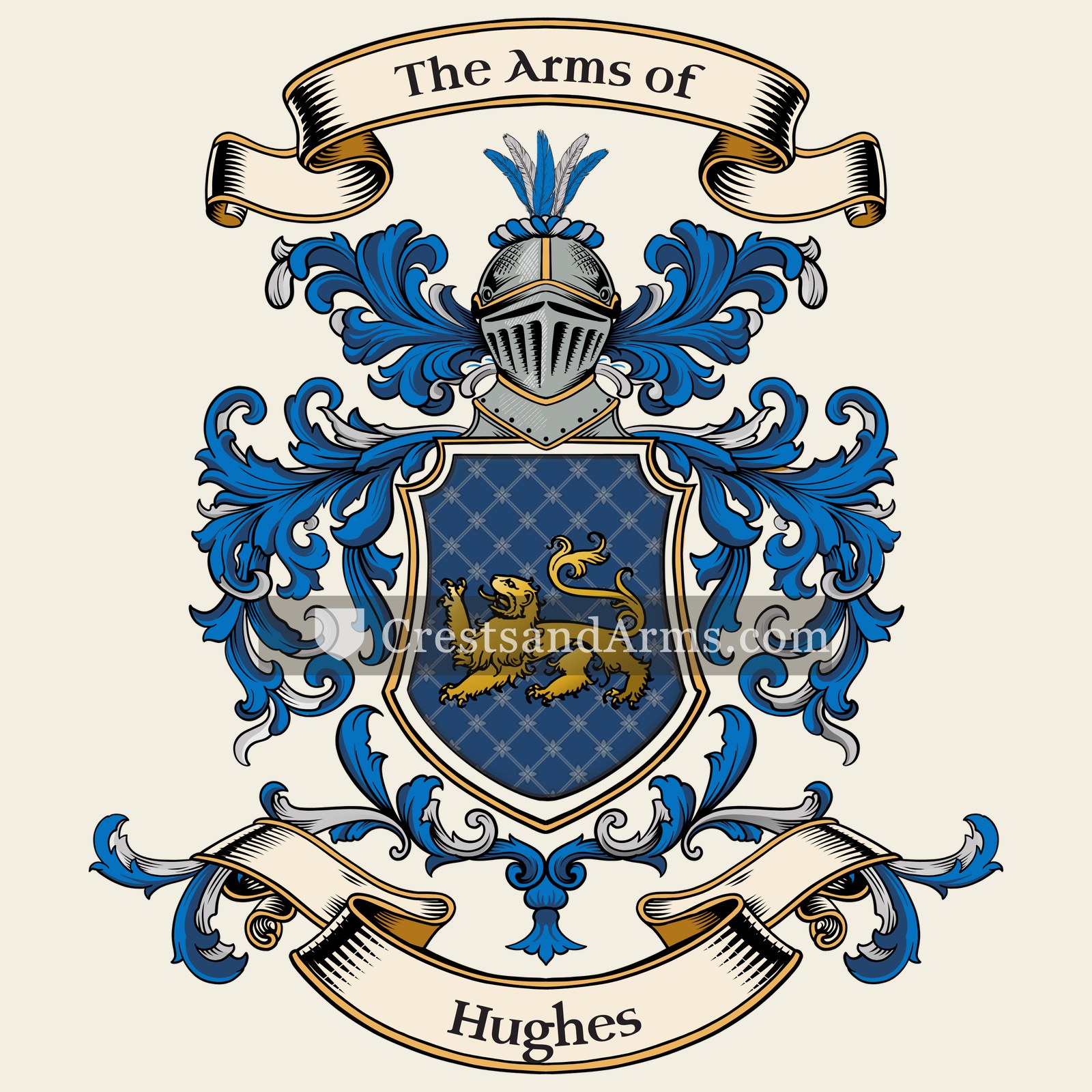
The Hughes arms were recorded in Flint, c. 1620.
Flintshire was small north Welsh country on the Dee estuary, close to Chester. English and Welsh families both held land there, and each holding brought its own claim to arms.
This is where the arms were entered in the register. Families often moved to other parts of the country, so the same name can turn up in more than one region.
The body that granted and recorded arms in Wales in this period.
James VI and I
Sovereign of the period
James VI and I
1603–1625
Reigning in Britain when the Hughes arms are first recorded.
How Arms Worked in Wales
English heraldry allowed arms to be shared by all legitimate descendants of the original owner. These symbols were treated as personal property that moved through the generations to all children. While the eldest son kept the original design, other family members could use the same shield without needing to change it or register their own unique versions.
Granting authority
The College of Arms in London has regulated the use of coats of arms throughout England and Wales since 1484.
How they got arms
Families typically obtained their coats of arms through a formal grant from the Crown or by proving their ancient right to them.
Where arms were recorded
All official coats of arms are recorded in the registers kept at the College of Arms, which date back to the fifteenth century.
The family's standing
Recorded among the armigerous families of Flint.
Origin & History of the Hughes Family in Wales
The surname Hughes is a patronymic name, meaning it originated from the first name Hugh. In the Welsh language, this name evolved from the personal name Huw, which was brought to the region during the medieval period. Because Welsh naming traditions often relied on the father’s name rather than a fixed family name, the transition to Hughes as a permanent surname occurred gradually as families began to adopt English naming customs. By the time records place the family in Flint in 1620, the name had become a stable identifier for households living in the borderlands between Wales and England. During this era, families in Flint were often involved in the local agricultural economy or the growing trade networks of the region. The presence of the name in 17th-century Flint reflects the broader movement of Welsh families who were integrating into a more formal administrative system while maintaining their deep cultural roots in the landscape of North Wales.
Coat of Arms & Family Crest Details
Symbols on this shield
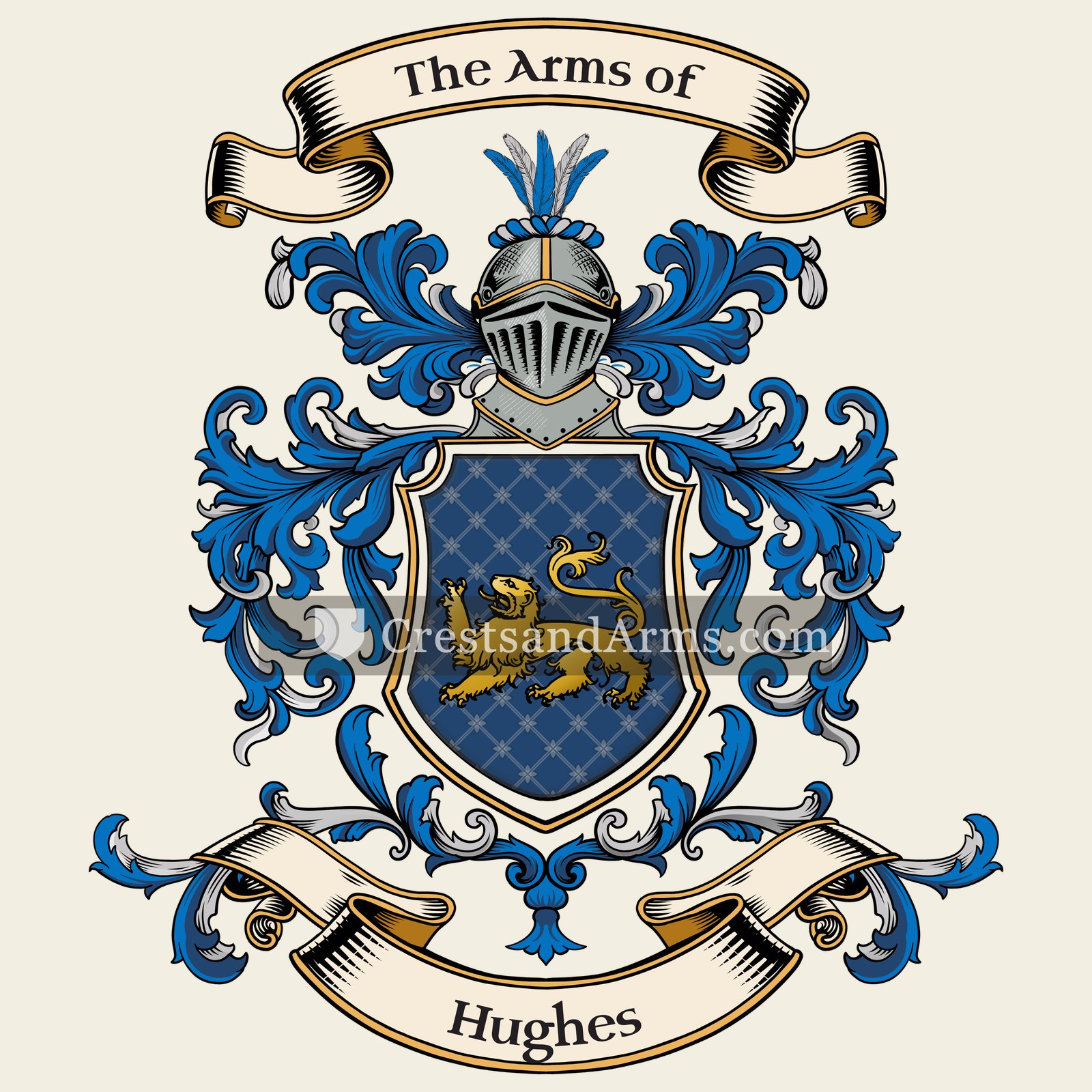
lionCourage, strength and royalty
Colours
Blue (Azure)Means: Loyalty and truth
Gold (Or)Means: Generosity
Historical info
Source
Sir Bernard Burke, The General Armory of England, Scotland, Ireland and Wales, London: Harrison & Sons, 1884
Blazon (the actual original written record)
“Az. a lion ramp. or”
SuffolkEast Bergholt · Suffolk, c. 1620
Digital archive packCoat of arms PNG, gold border print PDF, vector SVG and the certificate of authenticity. Sent to your email in minutes.
Map of England showing where the Hughes arms are recorded
The Hughes arms were recorded in Suffolk, c. 1620.
Suffolk was wool country, and its cloth towns were among the wealthiest in England. Clothier families bought manors with their profits, and holding a manor was the ordinary route to a coat of arms.
This is where the arms were entered in the register. Families often moved to other parts of the country, so the same name can turn up in more than one region.
The body that granted and recorded arms in England in this period.
James VI and I
Sovereign of the period
James VI and I
1603–1625
Reigning in Britain when the Hughes arms are first recorded.
How Arms Worked in England
English heraldry allowed arms to be shared by all legitimate descendants of the original owner. These symbols were treated as personal property that moved through the generations to all children. While the eldest son kept the original design, other family members could use the same shield without needing to change it or register their own unique versions.
Granting authority
The College of Arms in London has regulated the use of coats of arms throughout England and Wales since 1484.
How they got arms
Families typically obtained their coats of arms through a formal grant from the Crown or by proving their ancient right to them.
Where arms were recorded
All official coats of arms are recorded in the registers kept at the College of Arms, which date back to the fifteenth century.
The family's standing
Recorded among the armigerous families of Suffolk.
Origin & History of the Hughes Family in England
The surname Hughes is a patronymic name, which means it originated as a way to identify a person as the son of someone named Hugh. The name Hugh itself comes from the Germanic word "hug," which translates to heart, mind, or spirit. During the Middle Ages, this name became very popular across England after the Norman Conquest. By the time members of the family were documented in Suffolk in 1620, the name had already been established for several centuries as a common identifier in local communities. Families living in Suffolk during this period were often part of the agricultural or trade classes, and they frequently appeared in parish registers that tracked births, marriages, and deaths. These early records show that the Hughes name was deeply embedded in the social fabric of rural England, serving as a permanent link to the generations of ancestors who carried the name before them.
Hughes Meaning & Related Branches
Root word
Hug
A Germanic element meaning heart, mind, or spirit.
This name
HughesDerived from the Old French name Hugh, signifying a person of bright intellect or spirit.
also spelled
Hughs
Huez
Hughz
Hughson
Hues
Related arms
Birchsimilar arms
Stevensonsimilar arms
Hewesvariant spelling
Hewsevariant spelling
Documented Sources
J. B. Rietstap, Armorial Général, Gouda: G. B. van Goor Zonen, 1884–87
Reaney, P.H. and Wilson, R.M., A Dictionary of English Surnames, 1991
Cottle, Basil, The Penguin Dictionary of Surnames, 1967
Suffolk Archives, Parish registers for the county of Suffolk, 1773
Digital archive packCoat of arms PNG, gold border print PDF, vector SVG and the certificate of authenticity. Sent to your email in minutes.


 lionCourage, strength and royalty
 lionCourage, strength and royalty


 roseThe seventh son, and beauty with grace